
Last updated: 2 July 2026
Editorial Note:
This article explains Vinted’s UK marketplace business model using information published by Vinted, Vinted Group, the Financial Conduct Authority, HMRC and other marketplace operators.
Platform fees, eligibility requirements, verification prices and service availability can change. Buyers and sellers should check the current amount and terms displayed by Vinted before completing a transaction.
Vinted makes money by charging buyers a mandatory Buyer Protection fee when they purchase an item through the platform. It also generates income from optional seller promotions, product-verification services and commercial advertising.
The wider Vinted Group includes Vinted Marketplace, the logistics business Vinted Go and the payments business Vinted Pay. However, Vinted does not publish a complete breakdown showing exactly how much revenue comes from each service.
For UK purchases, the Vinted Buyer Protection fee normally consists of a fixed charge of between £0.30 and £0.80, plus 3% to 8% of the item or bundle price. The exact fee is displayed before the buyer completes the purchase.
Key Takeaways:
- Vinted primarily follows a buyer-funded marketplace model.
- Private sellers generally pay no standard listing or selling fee.
- Buyers pay a mandatory Buyer Protection fee on in-platform purchases.
- Sellers can pay for optional features such as Item Bumps and Showcase.
- Buyers can purchase verification for eligible designer and electronic items.
- Vinted also offers commercial advertising opportunities.
- Vinted Group generated €1.1 billion in revenue during 2025.
- Vinted Go and Vinted Pay support its logistics and payment infrastructure.
- Vinted does not disclose the exact contribution of each revenue stream.
How Does the Vinted Business Model Work?
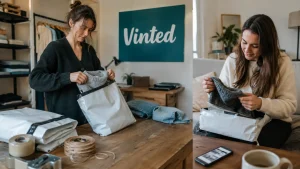
The Vinted business model connects people who want to sell second-hand goods with buyers looking for used clothing, accessories, electronics, collectables and other eligible products.
Vinted is therefore a consumer-to-consumer, or C2C, marketplace. It usually does not buy the products or hold the inventory listed on its platform. Instead, individual and professional sellers create the listings, set their prices and send sold items to buyers.
A typical transaction works as follows:
- A seller creates a listing and sets a price.
- A buyer finds the item and completes the purchase through Vinted.
- The buyer pays the item price, delivery cost and Buyer Protection fee.
- Vinted holds the payment while the seller sends the item.
- The buyer receives and checks the order.
- The money is released to the seller when the transaction is completed.
Vinted says there are no standard fees for uploading or selling ordinary items, meaning private sellers normally receive the full listed item price after a successful transaction.
What Services Does Vinted Provide?
Although Vinted does not own most of the items sold, it provides the technology and infrastructure needed to operate the marketplace.
These services include:
- Product listings and search tools
- Buyer and seller messaging
- Payment processing
- Prepaid shipping-label access
- Transaction monitoring
- Rating and feedback systems
- Refund and dispute procedures
- Buyer and seller support
- Optional product verification
- Paid listing-promotion tools
The platform’s value comes from making second-hand transactions easier to arrange, pay for and complete. Its revenue model depends on attracting enough buyers and sellers to create a large volume of transactions.
Why Does the Model Work Without Standard Seller Fees?
Removing the usual seller commission makes it easier for people to list unwanted possessions, including relatively inexpensive items.
More listings give buyers a wider selection. A larger buyer audience then makes the marketplace more attractive to existing and potential sellers.
This is known as a network effect.
The service becomes more useful as additional participants join it:
- More sellers create greater choice for buyers.
- More buyers improve the chances of sellers completing a sale.
- More completed sales create additional opportunities for Vinted to collect buyer fees.
- Greater activity can also increase demand for promotional and verification services.
This helps explain how Vinted makes money without taking a standard percentage from every private seller.
How Does Vinted Make Money from Buyer Protection?
Buyer Protection is one of Vinted’s clearest and most visible revenue streams.
The fee is added automatically when a buyer completes an eligible purchase through Vinted. It is separate from the listed item price and delivery charge.
Who Pays the Vinted Buyer Protection Fee?
The buyer pays the Buyer Protection fee. The seller does not normally have the fee deducted from the price they set for the item.
For example, when a seller lists an item for £20, the buyer’s final checkout total will be higher than £20 because delivery and Buyer Protection are added. Subject to the transaction being completed successfully, the seller normally receives the agreed £20 item price.
How is the Buyer Protection Fee Calculated?
Vinted’s published UK fee normally consists of:
- A fixed charge ranging from £0.30 to £0.80
- A variable charge ranging from 3% to 8% of the item or bundle price
Vinted says the precise amount depends on factors such as the item price and is shown during checkout. This means buyers should review the actual total rather than relying on one universal fee formula.
What does Vinted Buyer Protection cover?
Buyer Protection includes access to Vinted’s refund process when a qualifying problem occurs.
A buyer may be eligible for a refund when an item:
- Does not arrive
- Is damaged during delivery
- Is significantly different from its listing description
Vinted’s current UK safety guidance states that a buyer normally has two days to submit a claim when an item does not arrive, is damaged or is significantly different from its description. The buyer should select “I have an issue” within the relevant order and follow the instructions displayed by Vinted.
The deadline is important because payment may be released to the seller once the transaction is completed. Buyers should therefore inspect an order promptly and check the latest refund conditions rather than relying only on general guidance.
However, it would be inaccurate to describe the whole fee as profit. Vinted must also pay the technology, staffing, payment-processing, fraud-prevention and customer-service costs involved in running its marketplace.
Does Vinted Charge Sellers?
Private sellers generally do not pay Vinted a standard listing charge or sales commission.
Vinted states that sellers can upload items without a fee and receive the full item payment once the sale has been completed.
This is one of the main characteristics that helped distinguish the Vinted revenue model from traditional commission-based marketplaces.
Do Vinted Sellers Have to Pay Tax?
Selling unwanted personal possessions does not automatically mean that a Vinted user is operating a business or owes tax. For example, occasionally selling clothes that are no longer needed will normally be treated differently from buying or making products specifically to resell for profit.
A person may be considered to be trading when their activity is regular, organised and carried out with the intention of making a profit. HMRC currently advises that people whose total gross trading income exceeds the £1,000 trading allowance during a tax year may need to report that income.
Online platforms may also be required to collect and report certain seller information to HMRC. A platform reporting a seller’s information does not, by itself, determine whether that seller owes tax. Tax liability depends on the seller’s individual activity, income, expenses and circumstances.
Anyone uncertain about their position should check HMRC’s online-selling guidance or obtain advice from a qualified tax professional.
Are Buyer Rights Different with Private and Pro Sellers?
Private and professional sellers do not necessarily create the same legal relationship with a buyer.
When an item is purchased from a private seller, the buyer generally has fewer statutory consumer protections than when purchasing from a business.
The item must still match its description, and the seller must not misrepresent what is being sold. However, the buyer does not automatically receive all the protections that normally apply to purchases from a trader.
Vinted Pro sellers operate as business sellers. Purchases from a Pro seller may therefore include additional consumer rights, including a right to withdraw from many eligible purchases within 14 calendar days. Exceptions and return conditions can apply.
Vinted’s Buyer Protection process operates alongside these legal distinctions. Buyers should check whether the account is identified as a Pro seller and review the applicable refund terms before purchasing.
How Does Vinted Make Money from Promoted Listings?
Vinted generates additional revenue by selling optional visibility features to sellers.
The two main promotional tools are Item Bumps and Showcase.
What is a Vinted Item Bump?
An Item Bump is a paid feature applied to an individual listing.
A bumped item may be displayed more prominently in members’ feeds and search results, giving it more opportunities to be noticed. Vinted describes the feature as a way to increase an item’s chance of selling.
The price is shown to the seller before the Bump is purchased. It may vary according to the item and the chosen promotional option.
What is Vinted Showcase?
Showcase is a paid feature intended to increase the visibility of multiple listings from the same seller.
The service was formerly known as Wardrobe Spotlight. Vinted describes Showcase as a way to promote all of a seller’s listings and potentially improve their chances of making sales.
Do Vinted promotions guarantee a sale?
Neither an Item Bump nor Showcase guarantees that an item will sell.
Promotion can create more exposure, but the outcome will still depend on factors such as:
- The item’s price
- Its brand and condition
- The quality of the photographs
- The accuracy of the description
- The seller’s reviews
- Current buyer demand
- The number of similar listings
These services are attractive to sellers who value speed or visibility, while sellers who are not in a hurry can continue using the basic marketplace without paying for them.
This is a common freemium model: the essential service remains free, while some users pay for additional convenience or reach.
What Other Revenue Streams Does Vinted Have?
The Vinted revenue model extends beyond Buyer Protection and listing promotion.
Additional commercial services include product verification and advertising. The wider Vinted Group is also developing logistics and payment operations.
Designer Item Verification
Buyers can add Item Verification to certain eligible designer purchases.
In the UK, Vinted currently states that the designer verification service costs £10 per eligible item. This includes the verification service and shipping from the seller to the verification centre.
The item is assessed before being sent to the buyer. If it fails verification, Vinted cancels the transaction and returns the product to the seller.
Verification creates a direct service fee while also addressing a common concern in second-hand luxury shopping: whether an expensive branded item is authentic.
Greater buyer confidence may make people more willing to complete higher-value transactions, strengthening the marketplace even when the verification fee is not used on every sale.
Electronics Verification
Vinted also offers Electronics Verification for selected eligible products.
The service may be included at no additional cost on certain orders. Otherwise, Vinted’s UK guidance says it can be added at checkout for £5 per item. The fee includes verification and shipping from the seller to the verification centre.
Checks may cover factors such as functionality, condition and whether a device matches its description. Eligible mobile-phone transactions can also receive a test report following verification.
Advertising
Vinted offers advertising opportunities to businesses that want to reach its audience.
The UK advertising page describes Vinted as a large European C2C second-hand fashion marketplace with more than 80 million members and invites organisations to submit commercial advertising enquiries.
This confirms that advertising is part of Vinted’s commercial offering. However, the company does not publicly state what proportion of its annual revenue comes from advertising.
The service may appeal to businesses seeking an audience interested in fashion, lifestyle products, sustainability and online shopping.
How Do Vinted Go and Vinted Pay Support the Business?
Vinted Marketplace is part of a wider group that also includes Vinted Go and Vinted Pay.
These operations help Vinted control more of the infrastructure surrounding a marketplace transaction.
Vinted Go
Vinted Go is the group’s logistics business. It develops delivery infrastructure designed to make sending and receiving second-hand goods more convenient. Vinted Group says members have access to more than 500,000 pick-up and drop-off points across Europe through its network of delivery partners.
During 2025, Vinted Go expanded its carrier operations into Spain and Portugal and began testing delivery services for external clients. Its in-house carrier was operating across five markets by the time Vinted published its 2025 results.
Vinted Go can strengthen the overall Vinted business model by:
- Improving delivery convenience
- Supporting parcel tracking
- Increasing the use of collection and drop-off points
- Reducing friction in marketplace transactions
- Creating the potential to serve external commercial customers
- Giving the group greater influence over delivery quality and costs
It should not be assumed that Vinted automatically keeps a fixed margin from every UK postage label. Its public financial announcement does not provide enough information to calculate the profit made on individual shipping transactions.
Vinted Pay
Vinted Pay is Vinted Group’s dedicated payments business.
The company began rolling out its own wallet solution in selected European markets in January 2026. Vinted said the system was intended to address the specific requirements of its members, improve the customer experience and increase operational efficiency.
On 16 March 2026, Vinted announced that Vinted Pay had received an Electronic Money Institution licence from the UK Financial Conduct Authority.
The licence allows it to issue electronic money and provide payment services in the UK, although Vinted said UK members would receive more information before the wallet services launched.
Bringing more payment functions in-house may help Vinted:
- Improve control over the checkout and wallet experience
- Reduce dependence on external payment providers
- Respond more quickly to marketplace requirements
- Lower some payment-related costs
- Improve payment reliability
Cost savings can contribute to profit, but they are not the same as revenue. Revenue is money earned through commercial activity, whereas cost efficiency reduces the amount the business spends.
Who Pays Vinted? Buyer and Seller Costs Compared
| Participant or service | Typical charge | Mandatory or optional? | How it supports Vinted |
| Ordinary private seller | No standard selling commission | Not applicable | Encourages more listings |
| Buyer | 3%–8% plus £0.30–£0.80 | Normally mandatory | Buyer Protection and transaction income |
| Seller using Item Bump | Price displayed before purchase | Optional | Promotional revenue |
| Seller using Showcase | Price displayed before purchase | Optional | Promotional revenue |
| Designer-item buyer | £10 for an eligible item | Optional | Verification revenue |
| Electronics buyer | £5 where not included free | Optional | Verification revenue |
| Commercial advertiser | Commercially agreed | Optional | Advertising revenue |
Fees, features and eligibility rules can change. Users should check the price and terms displayed by Vinted before completing a purchase.
How Much Revenue Does Vinted Make?
Vinted Group reported €1.1 billion in revenue for 2025, an increase of 38% compared with 2024.
The company’s marketplace processed €10.8 billion in gross merchandise value, while Vinted Group recorded adjusted EBITDA of €151 million and a net profit of €62 million.
| Financial measurement | 2025 result | Change from 2024 |
| Marketplace gross merchandise value | €10.8 billion | Up 47% |
| Group revenue | €1.1 billion | Up 38% |
| Adjusted EBITDA | €151 million | Down 5% |
| Net profit | €62 million | Down 19% |
| Free cash flow | €137 million | Up 36% |
Vinted said profits were lower because it increased investment in areas including its German marketplace, new product categories, Vinted Go expansion and Vinted Pay’s wallet.
What is the difference between GMV, revenue and profit?
These measurements describe different parts of Vinted’s financial performance.
- Gross merchandise value, or GMV, is the total value of products traded through the marketplace. It is not the amount Vinted keeps.
- Revenue is the income recognised by Vinted Group from its commercial activities and services.
- Profit is what remains after the company accounts for its operating costs, staffing, technology, marketing, payment expenses and other relevant costs.
For example, Vinted’s €10.8 billion GMV does not mean that the company earned €10.8 billion. Its reported group revenue was €1.1 billion, and its net profit was €62 million.
Is Vinted profitable?
Yes. According to its latest complete annual results, Vinted Group was profitable in 2025.
Its €62 million net profit was lower than the €77 million reported for 2024, but revenue and marketplace activity continued to grow. The decline in profit illustrates why revenue growth does not always produce an immediate increase in net earnings.
A company may deliberately invest more of its income in technology, expansion, payments, logistics and customer support to support future growth.
How Is Vinted Different from Other Online Marketplaces?
Vinted’s buyer-funded approach is no longer completely unique in the UK. Other marketplaces have introduced similar models or reduced charges for private sellers.
| Marketplace | Current general UK approach | Main distinction |
| Vinted | Buyer Protection fee, optional promotions and paid services | Strong focus on second-hand C2C transactions |
| eBay | Buyer Protection fee on purchases from UK private sellers; most private sellers pay no transaction fee | Much broader product marketplace |
| Depop | Buyer Marketplace fee; no standard UK selling fee, although payment-processing charges apply | Fashion-led, social-commerce experience |
| Facebook Marketplace | Primarily local listings within Meta’s wider advertising ecosystem | Many transactions are arranged directly between users |
eBay currently says UK private sellers receive 300 free listings per month and pay no transaction fees in most categories, excluding vehicles. Buyers purchasing from UK private sellers pay an eBay Buyer Protection fee.
Depop also charges UK buyers a Marketplace fee of up to 5% plus a fixed amount of up to £1. UK sellers do not pay a standard Depop selling fee, although payment-processing and optional boosting fees may apply.
This shows that the buyer-funded marketplace model has become more common. Vinted’s competitive advantage therefore depends on more than its fee structure. Its inventory, ease of use, brand recognition, delivery options and active community also influence its position.
What Are the Main Risks in Vinted’s Business Model?
Vinted’s revenue model has supported rapid growth, but it also creates commercial and operational risks.
Buyer Resistance to Fees
- Buyer Protection can represent a noticeable proportion of the total cost when purchasing a low-priced item.
- A buyer may find a £3 item attractive initially but reconsider after Buyer Protection and delivery are added.
- Vinted must balance its need for revenue with the affordability that attracts people to second-hand shopping.
Fraud and Marketplace Trust
- Peer-to-peer marketplaces must manage risks involving counterfeit products, inaccurate descriptions, payment fraud, prohibited goods and dishonest users.
- Vinted must continue investing in monitoring, support and dispute processes.
- If users lose confidence in the marketplace, transaction volumes could decline.
Customer Service and Delivery Costs
- More purchases create more parcels, enquiries, refunds and disputes.
- Marketplace growth can therefore increase revenue and operational costs at the same time.
- Efficient systems are essential if Vinted wants to maintain profitability while transaction numbers rise.
Competition
- Sellers can list the same types of products on eBay,
- Depop, Facebook Marketplace and specialist resale services.
- Buyers can also compare prices across several apps.
- This makes switching relatively easy, so Vinted must continue giving both sides a reason to remain active.
Regulation
- Vinted operates across numerous countries and must comply with rules covering payments, consumer protection, data, digital platforms and professional sellers.
- Changes to these rules could create additional costs or require the company to modify its services.
Conclusion: How Vinted Makes Money Without Standard Seller Fees?
The answer to “how does Vinted make money?” lies mainly in its marketplace fee structure.
Instead of charging ordinary private sellers a standard commission, Vinted encourages them to create a large supply of second-hand listings. Buyers then pay a mandatory Buyer Protection fee when purchases are completed through the platform.
Vinted’s revenue streams also include paid Item Bumps, Showcase promotions, designer and electronics verification, and commercial advertising. Vinted Go and Vinted Pay strengthen the wider business by developing logistics and payment infrastructure, although the company does not disclose the precise revenue contribution of every service.
The Vinted marketplace business model depends on scale. Free ordinary listings attract sellers, a large selection attracts buyers, and completed transactions create opportunities for Vinted to earn fees.
With €1.1 billion in group revenue and €62 million in net profit reported for 2025, Vinted has demonstrated that a marketplace can remain profitable without relying on standard seller commissions.
Frequently Asked Questions
Is Vinted Buyer Protection Optional?
No. The fee is automatically added when a buyer uses Vinted’s “Buy now” button. As checked on 2 July 2026, the UK fee is 5% of the item price plus £0.70.
Does Vinted Make Money When an Item Does Not Sell?
An unsold listing does not generate a Buyer Protection fee. Vinted may still earn money if the seller purchases an optional Item Bump.
Does Vinted Make Money from Postage?
Vinted operates the Vinted Go logistics business. However, it does not disclose whether it earns a fixed amount from every UK shipping label.
Who Pays the Return Postage on Vinted?
The buyer normally pays return postage unless the buyer and seller agree otherwise. The applicable instructions are shown within the order.
Can Businesses Sell Items on Vinted?
Yes. Eligible sole traders, companies and non-profit organisations can use Vinted Pro and must follow relevant consumer, tax and business rules.
When Does a Vinted Seller Receive Their Money?
Vinted normally releases the payment after the buyer receives the item and confirms that everything is satisfactory. A reported problem can delay the payment.
Is Vinted Pay a Separate Source of Revenue?
Vinted Pay provides wallet and payment services for the group. However, Vinted does not disclose how much revenue or profit it generates separately.
How We Edited This Article?
This article was reviewed and updated on 2 July 2026 using current information from Vinted UK, Vinted Group, the Financial Conduct Authority, HMRC and the official fee pages of competing marketplaces.
The editing process included:
- Checking how Vinted charges buyers and confirming that ordinary private sellers do not pay standard selling fees.
- Reviewing Vinted’s Buyer Protection fee and its two-day deadline for reporting an item that is damaged, missing or significantly not as described.
- Confirming that Item Bumps and Showcase are optional paid promotional services and do not guarantee a sale.
- Checking the availability and pricing of Vinted’s designer-item and electronics verification services.
Company financial figures in this article are identified as figures reported by Vinted Group. No estimate has been made for the amount of revenue generated individually by Buyer Protection, shipping, advertising, verification, Vinted Go or Vinted Pay.
Official Sources Used: