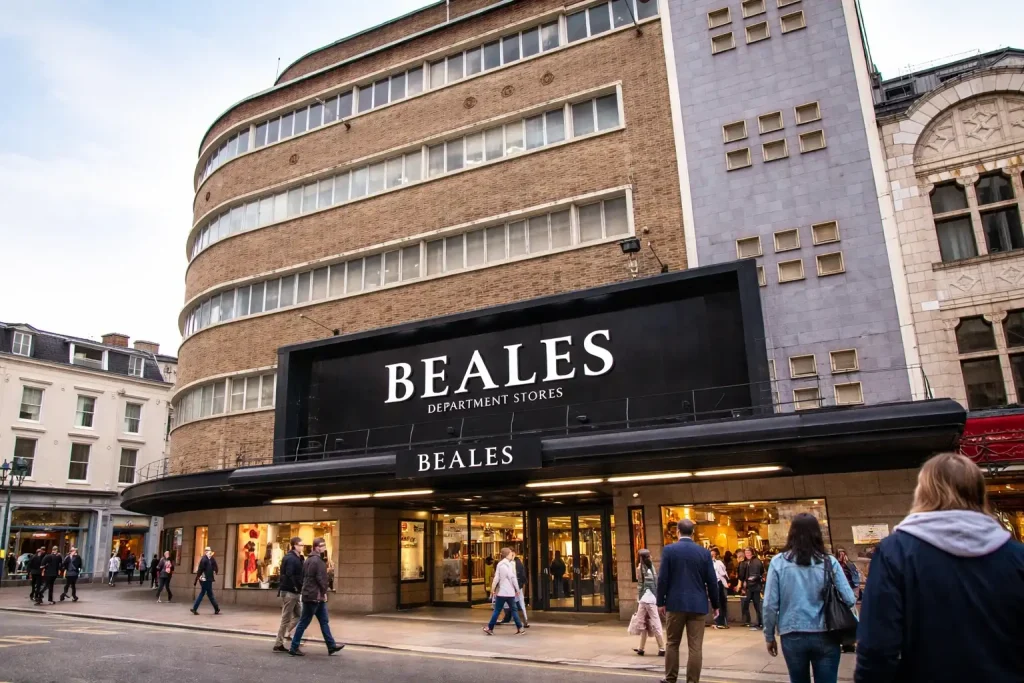
The closure of Beales, one of the UK’s most historic department stores, marks a significant moment in British retail history. After more than 140 years of serving communities across the country, Beales shut the doors of its final store in Poole on 31 May 2025.
But the question remains, how did a retail institution that once thrived across market towns vanish from the high street?
This article explores the multifaceted reasons behind the Beales department store closure in the UK. From shifting shopping habits and rising operational costs to government tax policies and missed opportunities, Beales’ story is a window into the broader challenges facing UK high street retailers.
Why Was Beales Once a Pillar of British High Street Culture?
Founded in 1881 in Bournemouth, Beales began as a family-run business rooted in community values and personal service. Over time, it grew into one of the UK’s most recognisable department store chains. By the late 20th century, Beales operated dozens of branches across the country, particularly in traditional market towns.
Customers flocked to Beales for its variety, which included fashion, furniture, beauty products and homeware. Each store became more than a place to shop; it was a social space, often acting as a local anchor in town centres.
Beales built a loyal customer base by focusing on high street presence rather than shifting early towards e-commerce. For many years, that approach worked well, but the rapid digital transformation of retail eventually left the brand vulnerable.
How Did the Pandemic Accelerate the Decline of Beales?
Though Beales had already faced mounting difficulties before 2020, the onset of the COVID-19 pandemic delivered a crippling blow. In January 2020, Beales entered administration, citing unsustainable losses. Within months, 22 out of its 23 stores had closed, leaving only one remaining.
The Poole branch, seen as a beacon of hope, reopened in August 2020 under new ownership. With support from the local community and fresh investment, it seemed the store could turn the tide. But the pandemic’s impact on consumer behaviour, a dramatic rise in online shopping and a sharp drop in high street footfall, proved irreversible.
While some retailers used the crisis as a springboard to digitise operations, Beales lacked the infrastructure and resources to pivot effectively. Its traditional business model, reliant on in-store sales and physical presence, could not withstand extended lockdowns and changing retail patterns.
What Were the Warning Signs Before the Final Closure?
The period between 2021 and 2025 was marked by caution and retrenchment. While the Poole store saw modest success post-reopening, other efforts to revive former locations failed. The Southport branch closed in 2023, and another attempt in Peterborough also ended prematurely. These closures pointed to deeper structural issues within Beales’ business model.
The company reduced staff numbers, streamlined its stock ranges and made logistical changes. Still, such measures only offered temporary relief. Without meaningful digital growth or financial relief from rising fixed costs, the business remained fragile.
Internally, Beales faced the difficult reality of choosing between maintaining quality or drastically cutting operations to save money. In the end, neither path proved sustainable under the pressure of compounding costs.
Why Did the Poole Branch Become Beales’ Last Stand?
The Poole branch became Beales’ final operating store as a result of careful strategic decisions aimed at preserving the brand while testing its long-term viability in a changing retail landscape.
A Strategic Reopening After Administration
The Poole branch was chosen for reopening in 2020 due to its location within the Dolphin Centre and its established customer base. At the time, it was seen as the strongest candidate for a scaled-down revival of the brand.
Strong Community Connection
Local shoppers maintained a deep emotional attachment to the store. For many residents, Beales was more than a retailer; it was part of Poole’s identity and a reliable anchor for surrounding businesses.
Financial Reality and Orderly Exit
Despite community support, the store could not absorb the rising costs introduced in subsequent years. In May 2025, management confirmed the closure would proceed as an orderly exit, ensuring that suppliers and employees were not left with financial losses.
What Role Did Inflation and Wage Reforms Play in Beales’ Demise?
In the final years of its operation, Beales faced severe financial pressures due to rising overheads. The burden was most sharply felt in 2025 following significant changes to employer obligations.
The minimum wage rose to £12.21 an hour, while employer National Insurance Contributions (NICs) increased to 15 percent. These reforms were part of the government’s broader fiscal policy but had unintended consequences for retailers operating on tight margins.
The table below outlines the cost increases Beales faced between 2020 and 2025:
Rising Business Costs at Beales (2020 vs. 2025)
| Cost Category | 2020 Cost Estimate (£) | 2025 Cost Estimate (£) | % Increase |
| Minimum Wage (Annual Staff) | £500,000 | £610,000 | +22% |
| Employer NICs | £100,000 | £150,000 | +50% |
| Business Rates Relief (Net) | -£50,000 | -£20,000 | -60% |
| Total Annual Operating Burden | £550,000 | £740,000 | +35% |
CEO Tony Brown claimed these changes added over £200,000 in costs for the Poole store alone, pushing the business model into unviability.
He openly criticised the government’s budget, labelling the final weeks as the “Rachel Reeves closing down sale”, a stark political statement reflecting the frustrations of many in the retail sector.
Could Beales Have Survived with a Different Business Model?
In hindsight, some observers suggest that Beales could have taken earlier action to adapt. Digital integration was limited, and although the company made modest efforts to modernise, it failed to establish a strong online presence.
A hybrid model, blending physical retail with robust online offerings, could have extended the company’s lifespan. However, adapting legacy operations and technology requires substantial investment, which Beales may not have been able to secure post-2020.
Some of the missed opportunities included:
- Click and collect integration
- E-commerce expansion beyond core regions
- In-store experiential marketing
- Retail partnerships with modern brands
Ultimately, the costs and speed of change required to transform the business were beyond what Bealescould execute in time.
What Does Beales’ Closure Reveal About Mid-Sized Retailers in the UK?
Beales’ closure underscores the fragile position of mid-sized retailers in the current retail ecosystem. Unlike national chains with deep capital reserves or niche independents with loyal customer bases, mid-sized stores often fall into a dangerous middle ground.
They face high rent, limited scalability and exposure to inflationary pressures. When faced with sudden cost surges, such as wage increases or tax changes, these retailers are often the first to suffer.
Risk Comparison Among UK Retail Segments:
| Retail Type | Capital Resilience | Tax Impact | Digital Flexibility | Physical Footprint Risk |
| Large Chains | High | Moderate | High | Medium |
| Mid-sized Stores | Low | High | Low | High |
| Niche Independents | Moderate | Low | Medium | Medium |
Without stronger support or greater flexibility, more retailers in this category could soon follow Beales.
How Did Beales Evolve from a Local Shop to a High Street Institution?
Beales’ rise mirrors the evolution of British retail itself. From its origins as a single store in Bournemouth, it expanded steadily throughout the twentieth century, becoming a familiar name in towns across England.
By 2010, Beales still operated 32 stores, many in communities underserved by major chains. However, the rapid growth of online shopping, combined with rising costs and changing lifestyles, gradually eroded its market position.
Key milestones in Beales’ history:
- 1881: Founded in Bournemouth
- 1920s to 1990s: Expansion across UK market towns
- 2010: Operated 32 stores
- 2020: Entered administration and closed 22 stores
- 2020: Poole store reopened
- 2025: Final store closed permanently
Despite attempts to modernise, the pace of change required to remain competitive ultimately proved too great.
Which Beales Store Locations Have Closed Since 2020?
Beales once maintained a nationwide footprint, but its presence rapidly diminished after administration. Of the 23 stores operating in early 2020, only Poole reopened later that year. Subsequent attempts to revive other locations were short-lived.
Timeline of Beales Store Closures (2020 to 2025):
| Year | Location | Status |
| 2020 | 22 branches nationwide | Closed after administration |
| 2020 | Poole | Reopened under new ownership |
| 2021 | Bournemouth | Reopened then closed in 2024 |
| 2022 | Peterborough | Reopened then closed in 2023 |
| 2023 | Southport | Closed permanently |
| 2025 | Poole | Closed on 31 May 2025 |
The closure of the Poole store marked the complete end of Beales as a high street retailer in the UK.
What Was the Public Reaction to Beales’ Final Days?
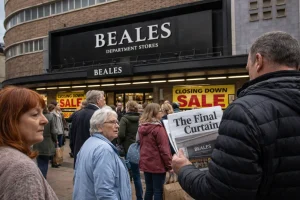
The final weeks of trading at Beales were emotional for many. Shoppers who had visited for decades shared memories and sentiments across social media, lamenting the loss of a store they considered a local staple.
Local residents expressed concern not just for the employees but also for the wider economic impact. In towns like Poole, anchor stores such as Beales play a critical role in attracting visitors to town centres, benefiting surrounding businesses and cafés.
In-person visits increased during the final sale period, with customers looking to say goodbye and pick up discounted items. Staff were praised for their professionalism and dedication through the closure process, reinforcing the store’s respected community standing.
What Will Fill the Void Left by Beales in Poole?
The Dolphin Centre is now assessing its options for the large space vacated by Beales. Redevelopment discussions are ongoing, with possibilities including mixed-use retail, health services or community facilities.
Despite the store’s closure, the NHS Outpatient Assessment Clinic on the top floor will continue to operate. Opened in 2021 to address waiting list backlogs, the clinic has become a vital local service and will remain active post-Beales.
Status of Beales Poole Site Post-Closure:
| Area | Status Post-Closure |
| Ground Floor Retail Space | Vacant (Redevelopment in planning) |
| NHS Clinic (Top Floor) | Continues Operation |
| Staff Employment | Exited with full notice |
| Supplier Accounts | Settled with no loss |
The centre’s future depends heavily on finding a replacement that supports footfall and offers sustainable use of the large retail footprint.
What Broader Lessons Can UK Retailers Learn from Beales’ Collapse?
The collapse of Beales highlights the challenges facing traditional UK retailers in an increasingly competitive and fast-changing market.
As consumer behaviour shifts and operating costs rise, long-established brands must reassess how they operate and engage with customers to remain viable.
Key Lessons for UK Retailers:
- Adaptability is essential, with investment in digital platforms and customer engagement now critical
- Operational flexibility matters, as large fixed premises can become a financial burden without strong footfall
- Policy impacts must be anticipated, especially sudden changes to tax or wage legislation
- Community connection remains powerful, with loyalty and local identity still influencing consumer support
Ultimately, Beales’ story shows that heritage alone is not enough to survive. Retailers that balance tradition with innovation, plan for economic uncertainty, and maintain strong local relationships are far better positioned to succeed in the evolving UK retail landscape.
Conclusion
Beales’ closure marks the end of an era on the British high street. Its legacy, spanning over 140 years, speaks to a time when department stores were at the heart of every community. Yet, the reasons behind its demise are not unique.
They reflect broader challenges, from economic policy and rising costs to digital disruption and shifting consumer preferences.
The lessons from Beales serve as both a cautionary tale and a roadmap. As UK retail continues to evolve, those who survive will be the ones who anticipate change, innovate bravely, and honour the traditions that customers still value.
FAQs
Why did Beales finally shut down its Poole store?
Beales closed its final store due to rising operational costs, especially from wage increases and higher National Insurance contributions, combined with declining footfall and minimal digital presence.
What was the significance of the Poole branch in Beales’ history?
The Poole store was the last remaining branch after the chain’s collapse in 2020 and represented its final effort to survive under new ownership.
Did Beales blame government policies for its closure?
Yes, Beales’ CEO cited recent tax and wage reforms as central to the store’s inability to remain viable, referring to the final sale as the “Rachel Reeves closing down sale.”
How did the staff react to the closure announcement?
Staff were deeply emotional but professional. Many had worked at Beales for years and were praised by leadership for their dedication through the closure process.
What made Beales different from stores like Debenhams or House of Fraser?
Beales had a smaller footprint and stronger ties to local communities, operating mostly in regional market towns rather than large cities.
Were there any attempts to modernise Beales before its closure?
Minimal digital upgrades were made. The business remained reliant on traditional retail methods and lacked a competitive online platform.
Could the NHS clinic inside Beales continue without the store?
Yes, the NHS Outpatient Clinic located on the top floor of the Poole branch will remain open and continue its services independently of the retail space.