

📊
UK GOVERNMENT BUDGET SURPLUS – KEY FINANCIAL UPDATE
Record January Surplus: £30.4bn – the highest monthly surplus since records began in 1993.
This figure exceeded forecasts by more than £6bn and reflects stronger-than-expected tax receipts combined with lower debt interest payments.
📈 What Drove the Surplus?
- Capital Gains Tax: ~£17bn (sharp rise ahead of tax changes)
- Income Tax: Boosted by fiscal drag and self-assessment payments
- National Insurance: Higher contributions from wage growth
- Debt Interest: £5bn lower than last January
Why It Matters: While the UK government budget surplus signals short-term fiscal strength, annual borrowing still exceeds £100bn. Long-term stability depends on sustained growth, controlled debt costs and stable tax receipts.
Fiscal Snapshot:
- January Surplus: £30.4bn
- Total Tax Receipts: £133.3bn
- Borrowing (Apr–Jan): £112.1bn
- National Debt: ~£2.9 trillion (92.9% of GDP)
- Next Major Update: Spring Statement & OBR Forecasts
“A record surplus provides breathing room – but lasting fiscal stability depends on sustained economic momentum.”
What is a UK Government Budget Surplus, and Why Does It Matter to You?

A UK government budget surplus occurs when the government collects more in revenue, mainly through taxes, than it spends in a given period. The opposite is a budget deficit, which requires borrowing to cover the shortfall.
In practical terms:
- If spending exceeds income → the government borrows.
- If income exceeds spending → the government runs a surplus.
- Borrowing adds to the national debt.
For you, this matters because persistent deficits can increase debt interest costs, reduce fiscal flexibility, and potentially lead to higher taxes or spending cuts in future.
As one Treasury official recently put it:
“When too much of what we raise goes on debt interest, there’s less left for schools, policing and the NHS.”
The UK’s national debt currently stands at around £2.9 trillion, roughly 92.9% of GDP, levels not seen since the early 1960s. So even a single strong month can influence financial markets and policy discussions.
However, a one-month surplus is not the same as balancing the books for the entire year. Context is critical.
What Happened in January That Created the Record UK Government Budget Surplus?
January delivered a £30.4bn surplus, nearly double the £15.4bn recorded in January the previous year and sharply reversing December’s £11.6bn deficit.
It was also significantly higher than forecasts. Analysts had expected roughly £23.8bn–£24bn, meaning the result exceeded expectations by more than £6bn.
The ONS described revenue as “strongly up” while spending was “little changed,” with lower debt interest payments helping offset higher public service costs.
To understand how exceptional this month was, the key figures are summarised below:
January 2026 Public Finance:
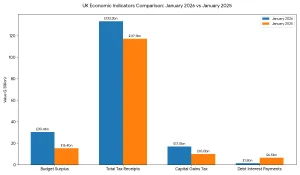
| Indicator | January 2026 | January 2025 | Change |
| Budget Surplus | £30.4bn | £15.4bn | +£15bn approx |
| Total Tax Receipts | £133.3bn | £117.1bn approx | +13.8% |
| Capital Gains Tax | ~£17bn | ~£10bn | +69% |
| Debt Interest Payments | £1.5bn | ~£6.5bn | -£5bn |
| Forecast Surplus (OBR est.) | ~£24bn | – | +£6.3bn above forecast |
The headline surplus reflects a powerful combination of strong tax receipts and lower interest payments on government debt.
But before concluding that the UK’s fiscal challenges are solved, it’s important to understand a crucial seasonal factor.
Why Is January Often a Surplus Month for the UK’s Public Finances?
January is traditionally the Treasury’s strongest month of the year.
The reason is simple: self-assessment tax payments are due.
Millions of individuals, including the self-employed, landlords and investors, settle large tax bills at the end of January. This creates a surge in revenue that does not repeat every month.
Grant Fitzner, chief economist at the ONS, explained it clearly:
“January – which is traditionally a strong month for self-assessed tax receipts – saw the highest surplus since monthly records began.”
In other words, January surpluses are not unusual. What made this year exceptional was the scale.
This is why economists caution against reading too much into a single month. As one analyst noted, “The public finances remain finely balanced.”
The real test is whether the broader fiscal year shows sustained improvement.
Which Taxes Actually Drove the £30.4bn UK Government Budget Surplus?
Three major tax categories explain most of the surge in revenue that produced January’s record UK government budget surplus.
While overall tax receipts were broadly higher, the scale of growth in capital gains tax, income tax and National Insurance contributions stands out as the decisive factor behind the £30.4bn figure.
Capital Gains Tax (CGT)
Capital Gains Tax receipts reached nearly £17bn, around 69% higher than January 2025.
The sharp rise appears linked to investors selling assets ahead of anticipated changes announced in the October 2024 Budget. When tax rises are expected, behaviour shifts. Investors accelerate disposals to lock in lower rates.
One wealth management executive observed that the spike likely reflects “investors disposing of assets ahead of expected increases.”
Self-Assessment Income Tax
Self-assessed income tax receipts totalled approximately £29.4bn. Overall income tax receipts were £3.6bn higher than last year.
A key driver is the continued freeze in income tax thresholds since 2022. As wages rise with inflation, more people are pulled into higher tax bands, a phenomenon known as fiscal drag.
This does not feel like a tax rise, but it increases revenue significantly.
National Insurance Contributions
National Insurance contributions rose by £2.9bn compared with the previous January. Both employers and employees contributed more, reflecting wage growth and labour market conditions earlier in the fiscal year.
Although employment has softened more recently, earlier earnings growth and contribution patterns fed through into January’s figures. National Insurance is closely linked to payroll levels, meaning even moderate wage growth can materially increase receipts.
Unlike capital gains tax, which can be volatile, National Insurance tends to provide a more stable and predictable revenue stream, though it still depends on labour market strength
Revenue Overview:
Major Drivers of January Revenue Growth
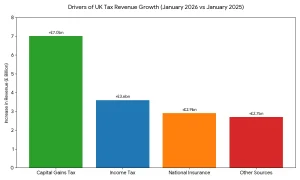
| Revenue Source | January 2026 | Year-on-Year Change | Main Driver |
| Capital Gains Tax | ~£17bn | +£7bn approx | Asset disposals ahead of tax changes |
| Income Tax | +£3.6bn increase | Up | Fiscal drag & earnings |
| National Insurance | +£2.9bn increase | Up | Wage growth |
| Total Tax Receipts | £133.3bn | +13.8% | Broad-based increase |
The message is clear: revenue growth was unusually strong and widespread.
How Did Lower Debt Interest Payments Help Boost the UK Budget Surplus?
While revenue rose sharply, spending remained broadly stable. Crucially, debt interest payments fell significantly.
In January, the government paid around £1.5bn in debt interest, roughly £5bn less than the same month last year.
Why?
Some government bonds are linked to inflation measures. As inflation has eased compared with last year, interest costs on those instruments have declined.
This reduction alone made a substantial difference to the monthly balance.
However, this benefit depends on inflation trends. If inflation or interest rates rise again, debt servicing costs could increase quickly.
As one rates strategist described it, the surplus was “a win for gilts” because it suggests lower borrowing needs, at least temporarily.
Does a Record UK Government Budget Surplus Mean the UK Is Back in the Black?
Not necessarily. While January showed a surplus, the broader fiscal year still reflects heavy borrowing.
In the first 10 months of the financial year (April to January), government borrowing totalled £112.1bn. That is 11.5% lower than the same period last year and below the Office for Budget Responsibility (OBR) forecast of £120.4bn.
However, borrowing for the full year is still projected to reach around £130bn.
One economist described that figure as:
“worrisome for an economy judged to be close to full capacity.”
So while the monthly UK government budget surplus is record-breaking, the UK is not running annual surpluses. Borrowing continues, just slightly below expectations.
What Could This UK Government Budget Surplus Mean for Your Taxes and Public Services?
A stronger fiscal position provides options, but those options are constrained by the government’s fiscal rules and broader economic conditions.
Chancellor Rachel Reeves has committed to:
- Funding day-to-day spending from tax receipts.
- Borrowing only for investment.
- Reducing debt as a share of GDP over time.
The January surplus may increase short-term fiscal headroom. However, weaker economic growth and rising unemployment could narrow that room quickly.
Economic growth was just 1.3% in 2025 and is expected to hover around 1% this year. Unemployment has reached 5.2%, a five-year high.
Retail sales rose 1.8% in January, the strongest monthly rise since May 2024, and PMI data suggests private sector activity improved. Yet some analysts warn that parts of the boost may be temporary.
As Paul Dales noted:
“The economy started the year looking a lot healthier,” but much depends on whether growth sustains momentum.
For you, this means:
- Immediate tax cuts are unlikely.
- Major spending expansions are improbable.
- The focus will remain on fiscal credibility.
How Will the Surplus Affect the Spring Statement and Fiscal Headroom?
The timing is politically significant. The Spring Statement on 3 March will include updated OBR forecasts.
The surplus provides the Chancellor with positive data to reference. However, the OBR will reassess growth projections and borrowing forecasts.
If economic growth underperforms, tax receipts may stall. If unemployment rises further, welfare spending may increase.
A Treasury minister recently stated:
“We have the right plan to build a stronger, more secure economy… borrowing this year is forecast to be the lowest since before the pandemic.”
Whether that projection holds depends on sustained economic momentum.
The markets reacted positively. Ten-year gilt yields dipped to around 4.36%, reflecting expectations of slightly lower borrowing. But fiscal credibility requires consistency, not just one exceptional month.
What Are the Biggest Risks That Could Wipe Out Future Surpluses?

Despite the record-breaking January figures, several underlying economic and structural risks could quickly erode future improvements in the public finances and reverse any sustained UK government budget surplus.
Three primary risks stand out:
- First, economic growth remains fragile. Output expanded just 0.1% in consecutive quarters late last year.
- Second, unemployment has climbed to 5.2%, with youth unemployment exceeding 16%. Slower wage growth could dampen income tax receipts.
- Third, capital gains tax revenue may fall back if January represented a behavioural spike rather than sustainable growth.
Debt interest is another variable. Inflation slowed to 3% in January, helping reduce costs. If inflation rebounds, servicing costs may rise again.
In short, while January’s UK government budget surplus is impressive, it may not signal a permanent shift.
What Should You Watch Next to Understand the UK’s Fiscal Direction?
To understand the UK’s fiscal direction in the months ahead, you should look beyond a single strong result and focus on consistent trends.
January’s surplus is encouraging, but sustainable improvement depends on broader economic momentum and disciplined borrowing.
Pay particular attention to:
- Monthly ONS public borrowing figures
- Updated OBR forecasts for growth and debt
- Bank of England decisions on inflation and interest rates
- Employment levels, wage growth and business activity
- Debt interest costs as a share of total government spending
If these indicators continue to improve, the recent UK government budget surplus could signal genuine stabilisation. If they weaken, January may be remembered as an exceptional but temporary spike within a still fragile fiscal environment.
Conclusion
The £30.4bn UK government budget surplus is undeniably significant. It reflects strong tax receipts, lower debt interest payments and a better-than-expected January performance.
However, it does not eliminate the UK’s broader borrowing challenge. The coming months, particularly the Spring Statement and updated OBR forecasts, will determine whether this was a one-off windfall or the beginning of sustained fiscal repair.
For now, the message is clear: progress has been made, but the public finances remain finely balanced.
Frequently Asked Questions (FAQs)
Is a budget surplus always good for the economy?
A surplus can reduce borrowing and improve fiscal stability, but excessive surpluses may also signal underinvestment in public services.
Why does January usually show a surplus?
January is when self-assessment tax payments are due, leading to a temporary surge in government revenue.
How does a surplus affect national debt?
A surplus reduces the need to borrow, potentially slowing the growth of national debt.
Could this lead to tax cuts?
Not immediately. Fiscal rules and economic uncertainty make tax cuts unlikely in the short term.
What role did capital gains tax play?
Capital gains tax receipts surged to nearly £17bn, likely reflecting asset disposals before expected tax increases.
How much is the UK currently borrowing this year?
Borrowing stands at £112.1bn for the first 10 months of the financial year.
Does this mean the UK economy is recovering strongly?
There are signs of improvement, but growth remains modest and risks persist.
{
“@context”: “https://schema.org”,
“@graph”: [
{
“@type”: “BlogPosting”,
“mainEntityOfPage”: {
“@type”: “WebPage”,
“@id”: “https://www.prestonblog.co.uk/uk-government-budget-surplus”
},
“headline”: “What Are the Biggest Risks That Could Wipe Out Future Surpluses”,
“image”: “https://www.prestonblog.co.uk/wp-content/uploads/2026/02/UK-Government-Budget-Surplus-Explained.webp”,
“datePublished”: “2026-02-21”,
“dateModified”: “2026-02-21”,
“author”: {
“@type”: “Person”,
“name”: “Hannah”
},
“publisher”: {
“@type”: “Organization”,
“name”: “Preston Blog”,
“logo”: {
“@type”: “ImageObject”,
“url”: “https://www.prestonblog.co.uk/wp-content/uploads/2025/12/Preston-Blog-Logo.png”
}
}
},
{
“@type”: “FAQPage”,
“mainEntity”: [
{
“@type”: “Question”,
“name”: “Is a budget surplus always good for the economy?”,
“acceptedAnswer”: {
“@type”: “Answer”,
“text”: “A surplus can reduce borrowing and improve fiscal stability, but excessive surpluses may also signal underinvestment in public services.”
}
},
{
“@type”: “Question”,
“name”: “Why does January usually show a surplus?”,
“acceptedAnswer”: {
“@type”: “Answer”,
“text”: “January is when self-assessment tax payments are due, leading to a temporary surge in government revenue.”
}
},
{
“@type”: “Question”,
“name”: “How does a surplus affect national debt?”,
“acceptedAnswer”: {
“@type”: “Answer”,
“text”: “A surplus reduces the need to borrow, potentially slowing the growth of national debt.”
}
},
{
“@type”: “Question”,
“name”: “Could this lead to tax cuts?”,
“acceptedAnswer”: {
“@type”: “Answer”,
“text”: “Not immediately. Fiscal rules and economic uncertainty make tax cuts unlikely in the short term.”
}
},
{
“@type”: “Question”,
“name”: “What role did capital gains tax play?”,
“acceptedAnswer”: {
“@type”: “Answer”,
“text”: “Capital gains tax receipts surged to nearly £17bn, likely reflecting asset disposals before expected tax increases.”
}
},
{
“@type”: “Question”,
“name”: “How much is the UK currently borrowing this year?”,
“acceptedAnswer”: {
“@type”: “Answer”,
“text”: “Borrowing stands at £112.1bn for the first 10 months of the financial year.”
}
},
{
“@type”: “Question”,
“name”: “Does this mean the UK economy is recovering strongly?”,
“acceptedAnswer”: {
“@type”: “Answer”,
“text”: “There are signs of improvement, but growth remains modest and risks persist.”
}
}
]
}
]
}