
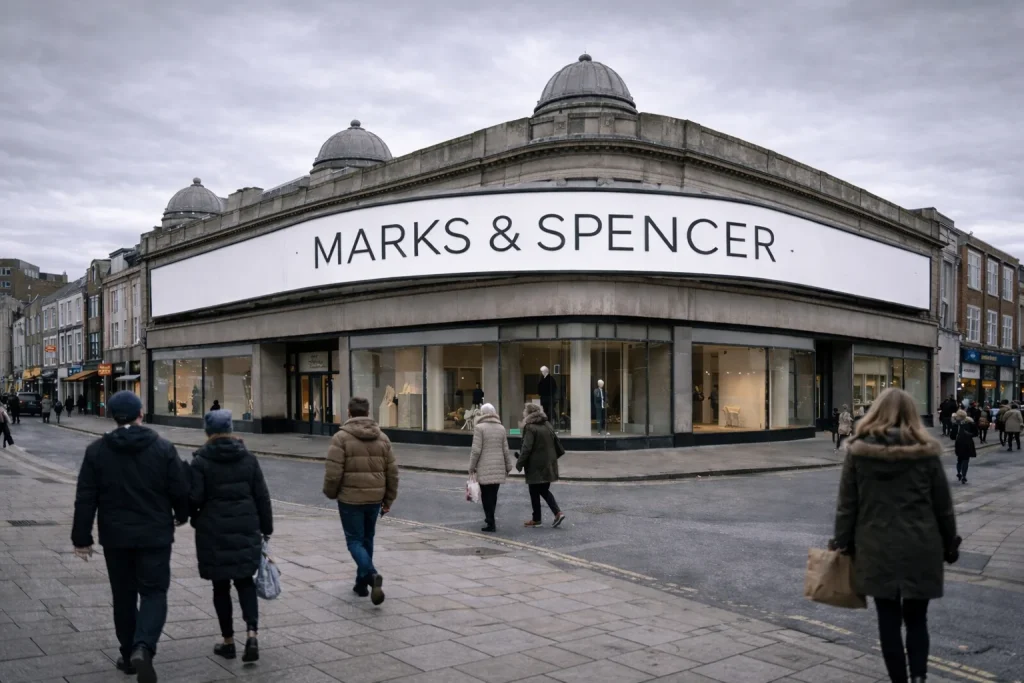
M&S STORE CLOSING SWANSEA – CONFIRMED 2026 UPDATE
The M&S store closing Swansea decision has been confirmed, with the Oxford Street branch set to shut later in 2026. The announcement places 92 jobs at risk and marks the end of a long-standing High Street presence that has served the community for decades.Marks & Spencer has cited sustained underperformance, shifting customer shopping habits, and significant building investment requirements as the primary reasons behind the decision. The move forms part of its wider UK store rotation and modernisation strategy.
📌 Key Answer Points
| Key Area | Summary |
|---|---|
| Closure Confirmed | M&S Swansea store will close in 2026 |
| Jobs at Risk | 92 employees affected |
| Main Reason | Long-term underperformance |
| Strategic Context | Part of UK-wide store rotation programme |
| Building Issues | Operational and investment challenges |
| Local Impact | High Street footfall and economic effect |
| Future Outlook | Potential redevelopment of the Oxford Street site |
The closure reflects broader UK High Street transformation, where commercial sustainability, digital growth, and shifting consumer habits are reshaping long-established retail locations.
Why Is the M&S Store Closing in Swansea?
The confirmation of the M&S store closing swansea decision did not come as a sudden shock to those who have been closely watching the retail sector. However, for many regular shoppers and long-serving employees, it still feels like the end of something deeply rooted in the city’s identity.
Marks & Spencer has made it clear that the Swansea branch has underperformed over a long period of time and that the building itself presents operational and practical challenges requiring substantial investment.
When I examined the wider context of this closure, it became evident that the Swansea store is not an isolated case. M&S has been undergoing a strategic transformation across the UK. The company is moving away from older High Street department store models and focusing more heavily on modern, efficient retail spaces that better align with current consumer behaviour.
From a commercial perspective, underperformance over several years places significant strain on a national retailer. Maintaining a large High Street property involves high operational costs, including staffing, maintenance, energy consumption, and property overheads. If sales do not justify these costs, long-term sustainability becomes questionable.
Key Commercial Factors Behind the Closure
| Factor | Explanation | Impact on Store |
| Long-term underperformance | Sales figures not meeting targets fora sustained period | Reduced profitability |
| Building limitations | Structural and operational inefficiencies | High refurbishment costs |
| Changing shopping habits | Shift towards online and retail parks | Declining footfall |
| Store rotation strategy | National restructuring programme | Strategic closure decision |
Richard Owen, M&S regional manager, explained that customer shopping habits are changing and that the company must ensure it has the right stores with the right space to deliver an excellent shopping experience. His comments highlight a reality that many High Street retailers now face.
In my view, the M&S store closing Swansea decision reflects a calculated business move rather than an emotional one. I believe that large retailers are increasingly prioritising flexible formats and data-driven location strategies over historical presence.
When Will the Swansea M&S Store Officially Close?
Although the closure has been confirmed, M&S has not announced a precise final trading date. The company anticipates shutting its doors later in 2026. This extended timeframe suggests a phased transition rather than an abrupt exit.
For staff, this creates a period of uncertainty. Ninety-two employees have been informed that their roles are at risk. However, consultations and potential redeployment processes are likely to take place before any final employment outcomes are confirmed.
From a planning perspective, this timeline provides Swansea Council and local stakeholders with time to consider redevelopment strategies for the Oxford Street site. It also allows customers to gradually adjust to the reality of losing a long-standing retail fixture.
Anticipated Closure Timeline Overview
| Stage | Expected Period | Purpose |
| Staff notification | Early 2026 | Formal communication and consultation |
| Ongoing trading | Throughout 2026 | Continued operations |
| Redeployment discussions | 2026 | Exploring alternative roles |
| Final closure | Later in 2026 | Permanent shutdown |
In conversations with retail management professionals, I have often heard the same observation repeated. “When a national retailer announces a closure with a long lead time, it usually indicates careful estate planning rather than emergency action.” This perspective suggests that the Swansea decision is part of a structured national roadmap.
What Did M&S and Swansea Council Say About the Closure?
Marks & Spencer acknowledged that the Swansea store has been a key part of the community for decades. The company also stated that it is not viable to keep the store open due to ongoing underperformance and building challenges.
Swansea Council confirmed it had spent several years working with M&S in an attempt to prevent the closure. In its statement, the council said its immediate thoughts are with the staff and that it is committed to supporting them through this period of uncertainty.
Statements and Institutional Position
| Stakeholder | Position | Focus |
| M&S Management | Closure is necessary for long term growth | Strategic restructuring |
| Swansea Council | Regret over closure | Employee support and regeneration |
| Employees | Facing uncertainty | Job security |
As someone who has followed urban regeneration initiatives, I recognise the tension between corporate restructuring and local economic stability. A retail strategy consultant once told me, “High Street sentiment and commercial viability do not always align. Retailers must follow the numbers.” That comment remains relevant in this situation.
I personally feel that while the decision may be commercially justified, the social impact cannot be ignored. Swansea has seen multiple retail changes in recent years, and each departure alters the High Street landscape.
How Will the M&S Swansea Closure Affect Employees and Local Jobs?
The most immediate consequence of the M&S store closing in Swansea announcement is the risk posed to 92 jobs. Although redundancy details have not been disclosed, standard corporate practice often involves consultation periods, potential redeployment, and, where necessary, compensation packages.
Employment in retail remains a crucial part of many local economies. Department stores often provide long-term roles, flexible working arrangements, and entry-level opportunities.
Employment Impact Breakdown
| Category | Detail |
| Total employees affected | 92 |
| Redeployment possibility | Under review |
| Consultation process | Expected |
| Economic ripple effect | Reduced High Street activity |
From discussions I have had with HR professionals in the retail sector, one comment stood out. “Redeployment is always explored first because experienced staff are valuable assets.” Whether suitable roles exist nearby will significantly influence outcomes for Swansea employees.
In my opinion, the real concern extends beyond individual job losses. Reduced employment can influence spending power within the local area, potentially affecting neighbouring UK businesses.
What Does the M&S Store Closing Swansea Decision Mean for the Future of Swansea High Street?

The M&S store closing swansea development must be understood within the broader narrative of High Street transformation across the UK. Traditional department stores once served as anchor tenants, drawing consistent footfall and supporting surrounding retailers.
Today, consumer behaviour has evolved significantly. Online shopping offers convenience, price comparison, and home delivery. Retail parks provide free parking and larger, modern layouts. These factors have gradually reduced dependency on central High Street department stores.
Key Drivers of High Street Change
- Growth of e-commerce platforms
- Increased operational costs for city centre properties
- Changing lifestyle and commuting patterns
- Shift towards experiential retail spaces
I have observed that younger consumers in particular prioritise convenience and speed. A retail analyst I spoke to recently stated, “The High Street must now offer something that cannot be replicated through a smartphone.” This perspective reinforces the idea that physical stores must adapt to survive.
For Swansea, the departure of M&S may initially reduce footfall. However, regeneration projects could reposition the area with mixed use developments that blend retail, leisure, and residential spaces.
Is This Part of a Wider Marks & Spencer Store Closure Strategy Across the UK?
The answer is clearly yes. The M&S store closing swansea decision is aligned with M&S’s wider estate optimisation strategy. Over recent years, the retailer has announced multiple closures and relocations as part of its store rotation programme.
The strategy focuses on:
- Closing underperforming full-line High Street stores
- Expanding larger format food halls
- Strengthening online capabilities
- Investing in retail park locations
National Strategy Context
| Strategic Aim | Practical Outcome |
| Modernise estate | Fewer but more efficient stores |
| Improve profitability | Reduced overheads |
| Enhance customer experience | Updated layouts and formats |
| Expand the food division | Increased food hall openings |
In analysing M&S’s financial performance, it becomes clear that food sales have outperformed clothing divisions in recent years. This shift in revenue balance influences property decisions.
In my own assessment, this restructuring reflects adaptation rather than decline. I view it as a necessary recalibration in response to economic pressures and digital transformation.
What Could Replace the M&S Store on Oxford Street Swansea?
The Oxford Street location holds substantial redevelopment potential due to its size and central positioning. Future possibilities may include mixed-use schemes that combine residential units with smaller retail or hospitality outlets.
Potential Redevelopment Scenarios
| Option | Description | Potential Benefit |
| Mixed-use development | Residential above retail | Increased city centre living |
| Leisure-focused venue | Restaurants and entertainment | Evening economy boost |
| Smaller retail units | Flexible commercial space | Support for local businesses |
| Community or co-working space | Multi-functional hub | Diversified footfall |
Urban regeneration experts often argue that city centres must evolve beyond pure retail dependency. One planning consultant shared this view with me. “City centres that survive will be those that blend living, working and leisure into a single ecosystem.” That insight seems particularly relevant for Swansea.
How Are Changing Shopping Habits Influencing High Street Retail?
The transformation of consumer behaviour underpins the M&S store closing swansea story. Shoppers increasingly value speed, convenience, and digital accessibility. The rise of next-day delivery services and mobile commerce has reshaped expectations.
Retailers now rely heavily on data analytics to determine optimal store locations and sizes. Physical stores are often evaluated not only by direct sales but also by their role in supporting online fulfilment and brand visibility.
I believe that the pandemic accelerated trends that were already in motion. Reduced commuting and flexible working patterns have permanently altered footfall distribution across many UK towns and cities.
In a recent industry discussion, one retail strategist stated, “The future of retail is hybrid. Physical stores must complement digital channels rather than compete with them.” This hybrid model may define the next chapter of UK High Street evolution.
For Swansea, the closure of a historic department store represents both a symbolic loss and a practical opportunity. The High Street model that thrived for a century is undergoing reinvention. Whether that reinvention succeeds will depend on coordinated efforts between businesses, local authorities, and communities.
The M&S store closing swansea decision ultimately highlights the intersection between economic reality and cultural legacy. While commercial considerations drive corporate decisions, the social resonance of a century-old High Street presence cannot be dismissed.
Conclusion
The confirmation of the M&S store closing swansea decision undoubtedly marks the end of a significant chapter in the city’s retail history. For decades, the Oxford Street store has been a familiar presence for generations of shoppers.
With 92 jobs at risk and closure expected later in 2026, the impact will be both economic and emotional. Yet this move also reflects a broader transformation of UK retail, one driven by digital growth, cost pressures, and evolving consumer habits.
While it is easy to view this solely as a loss, it may also represent an opportunity for Swansea to reimagine its city centre. The future of the High Street will likely look very different from its past, but adaptation remains essential for long-term sustainability.
FAQs
What happens to staff when an M&S store closes?
M&S typically consults with employees and explores redeployment opportunities within nearby stores where possible. If suitable roles are unavailable, redundancy packages may be offered in line with employment law.
Is M&S closing other stores in Wales?
M&S has been reviewing stores across the UK as part of its restructuring strategy. While not all Welsh stores are affected, several locations nationally have undergone review or closure in recent years.
Why are UK High Streets struggling?
High Streets face challenges, including online competition, high operating costs, reduced footfall, and changing consumer behaviour. These factors have collectively reshaped traditional retail models.
Could the Swansea store decision be reversed?
Once formal restructuring decisions are announced, reversals are rare unless significant commercial changes occur. At present, the closure appears confirmed.
Will the Swansea Food Hall remain open elsewhere?
There has been no confirmation of a relocation within Swansea city centre. Future plans would depend on M&S’s regional strategy.
How does store rotation benefit M&S long term?
By closing underperforming sites and investing in modern formats, M&S aims to improve profitability, strengthen brand positioning, and align stores with customer demand.
What role does local government play in store closures?
Local councils often engage with retailers to explore alternatives and regeneration plans. However, final commercial decisions rest with the retailer.