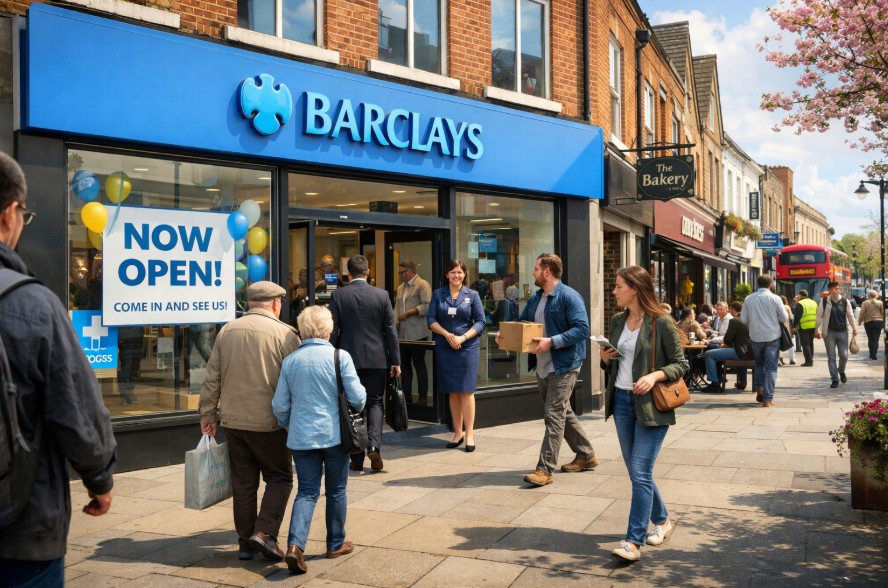
Barclays has paused further branch closures, plans to expand beyond its current 206 branches, and is bringing back the traditional “bank manager” role.
While the bank has not yet confirmed a full list of locations, it has made clear that more in-person banking services will appear in towns and cities across the UK.
Key highlights:
- Barclays closed more than 800 branches since 2018
- Around 206 Barclays branches currently remain
- New Barclays bank branches will be added beyond the current network
- Traditional branch managers are returning
- Barclays says the new branches will sit alongside digital banking and shared banking hubs
Why Is Barclays Opening New Bank Branches Again?

Barclays is changing direction because it believes customers still want face-to-face banking, even in an increasingly digital world. For years, the bank moved aggressively towards online services, reducing its branch network faster than many competitors.
However, growing frustration with automated systems and chatbots appears to have pushed Barclays into reconsidering its approach.
Vim Maru, Chief Executive of Barclays UK, said the bank wants to offer both strong digital services and physical support.
“Of course we’re going to be great in digital – but we’re going to be there for you when you need some help and support. You’re not going to be stuck in some chatbot trying to get out of the loop and trying to speak to someone.” – Vim Maru, Barclays UK
Barclays is also facing greater competition from digital-first banks such as Revolut, Monzo and Wise. Those firms have built strong mobile banking platforms, but they still lack the physical presence that many customers value.
Barclays appears to believe that offering both technology and human support could become a competitive advantage.
Why Customers Still Want Physical Branches?
Many banking tasks are easier in person, especially for:
- Mortgage applications
- Fraud and scam concerns
- Business banking queries
- Support for elderly or vulnerable customers
- Cash deposits and withdrawals
The Return of the Bank Manager
One of the clearest signs of Barclays’ change in strategy is the return of the “bank manager” title. The role had largely disappeared in favour of more modern corporate job titles, but Barclays believes customers still want a familiar point of contact.
“The branch manager or bank manager is back. Most customers come in and they want to talk to the bank manager from time to time.” – Vim Maru, Barclays UK
A Balance Between Digital and Human Service
Barclays is not abandoning digital banking. Instead, it is aiming for what it calls a blend of “great digital and great human touch”. T
he bank has improved its app, reduced mortgage application times, and is using AI to support staff. However, it now accepts that digital-only support is not enough for every customer.
How Many Barclays Branches Have Closed in Recent Years?
Barclays has closed more than 800 branches since 2018, leaving around 206 branches remaining as of early 2026. Overall, the bank has shut over 1,200 branches since 2015, making it one of the most aggressive in reducing its UK high street presence.
The closures happened in phases. Between 2015 and 2018, Barclays steadily reduced its network. From 2018 to 2023, closures accelerated significantly, with over 800 branches shutting during this period alone.
In 2023, 157 branches closed, followed by at least 99 more planned closures across 2024 and 2025.
Despite this trend, Barclays has recently paused large-scale closures and is now shifting strategy. The bank is focusing on returning to the high street, improving in-person services, and expanding through new-style branches and over 200 “Barclays Local” community locations.
Barclays Branch Closure Timeline
| Year | Estimated Barclays Branches | Key Development |
| 2015–2018 | Declining from 1,000+ | Gradual reduction in branch network |
| 2018–2023 | Sharp decline | Over 800 branches closed |
| 2023 | Further drop | 157 branches shut in one year |
| 2024–2025 | Around 206 | At least 99 more closures planned |
| 2026 onwards | 206+ expected | Strategy shift towards reopening and expansion |
The main reasons behind these closures include falling branch usage and the rapid shift to digital banking. However, with a renewed focus on customer experience, Barclays is now signalling a potential return to physical banking spaces.
Note: Branch numbers may continue to change as the network evolves.
Where Are Barclays’ New Bank Branches Expected to Open?
At present, Barclays has not published a full list of new branch locations. However, the bank has indicated that new branches will appear in towns and cities where there is still demand for in-person banking.
The likely focus areas include:
- Busy town centres and high streets
- Retail parks and shopping centres
- Areas where Barclays recently closed branches
- Places with strong local business activity
- Communities with limited access to banking hubs
Barclays has already said that it has relocated some branches to reflect where people now work, live and shop.
This suggests future branches may not always return to the same traditional high street locations that closed in the past.
Could New Barclays Branches Open in Shopping Centres?

Barclays has not yet confirmed exact locations for its new branches, but it is expected to focus on smaller, more flexible sites rather than large traditional high street buildings.
Instead of old-style branches, Barclays may open locations in:
- Shopping centres
- Retail parks
- Shared retail units
- Busy commuter hubs
- High-footfall town centres
This approach helps maintain a physical presence while reducing costs. New branches are likely to be smaller and focused on advice, appointments, and customer support, reflecting modern banking habits where customers combine banking with daily activities.
Why Smaller Branches Could Suit Barclays?
There are several reasons why Barclays may choose this approach:
- Lower rent and staffing costs
- Better access to footfall and passing customers
- Easier relocation if local demand changes
- More suitable for appointment-based services such as mortgages and business banking
As Barclays continues to balance digital banking with face-to-face support, smaller branches in busy retail locations may become a key part of its strategy.
Which UK Areas Could Be Priorities?
Although Barclays has not confirmed any specific towns or cities, several types of areas appear more likely to be prioritised based on the bank’s recent comments and wider industry trends.
| Likely Branch Priority Area | Why Barclays May Target It |
| Market towns | Many lost their only local Barclays branch |
| Large suburbs | Growing populations need nearby banking services |
| Retail centres | High footfall and lower running costs |
| Business districts | Small businesses still value face-to-face banking |
In particular, larger market towns could become a major focus. Many of these communities lost their only Barclays branch in recent years and now rely on banking hubs or travelling to nearby cities.
City suburbs may also be attractive because population growth has increased demand for local services.
Meanwhile, business districts remain important because small firms often need support with cash handling, lending and account management.
What Has Barclays Officially Confirmed?
So far, Barclays has only confirmed a limited number of details about its future branch plans.
Barclays has confirmed that:
- Closures have been paused
- The branch network will grow beyond 206
- New branches will be additional to banking hubs
- No final nationwide list has yet been announced
Because Barclays has not announced exact branch locations or opening dates, reports about specific towns should be treated with caution unless they come directly from Barclays.
For now, the bank’s strategy is clear: Barclays wants more physical branches on UK high streets again, but the final list of locations is still to come.
What Services Will the New Barclays Branches Offer Customers?
The new Barclays bank branches are expected to provide more than basic transactions. Barclays wants its branches to become centres for advice, support and more complex banking needs.
You will likely be able to use new branches for:
- Opening and managing accounts
- Mortgage and loan appointments
- Fraud and scam support
- Business banking services
- Help with online and mobile banking
- Cash and cheque services
| Service | Available in New Barclays Branches? |
| Cash withdrawals and deposits | Yes |
| Mortgage advice | Yes |
| Business banking support | Yes |
| Fraud and scam assistance | Yes |
| Help using the Barclays app | Yes |
| Face-to-face account reviews | Yes |
Barclays has also said it wants staff to spend more time helping customers directly. The bank has improved some of its systems so employees can focus on more complex queries rather than routine administration.
“I truly believe that the combination of great digital and great human touch is the future of banking.” – Vim Maru, Barclays UK
How Will Branches Work Alongside AI and Digital Banking?

Interestingly, Barclays is expanding branches at the same time as it increases its use of AI and automation. The bank has recently moved some internal jobs overseas and introduced AI tools in marketing and operations.
However, Barclays insists this technology is designed to support employees rather than replace customer-facing roles.
A Barclays spokesperson said:
“At Barclays, we are using AI as a tool to enhance human capability and people continue to play a crucial role in the development and delivery of our strategy.”
This suggests that while AI may help process paperwork or reduce waiting times, branches will still rely heavily on real staff.
Why Do Barclays’ New Branches Matter on UK High Streets?
The return of Barclays new bank branches matters because high streets across the UK have lost much of their traditional banking presence. In many towns, the closure of a bank branch has become symbolic of wider decline.
When a branch closes, the effects often go beyond simple inconvenience. Small businesses may struggle to deposit cash. Older residents may lose their preferred way of banking. Local shoppers may spend less time in the town centre.
The Impact on Communities
Many communities still depend on in-person banking for everyday financial tasks. This is particularly true in areas where internet access is poor or where residents are less confident using digital services.
Barclays’ move could help:
- Improve local access to cash
- Increase footfall on high streets
- Support small firms and traders
- Reduce travel times for customers
Real-Time Example: What One High Street Is Saying?
Let me share a real-world example to help you understand the bigger picture.
In towns like Chorley and Southport, where Barclays previously closed branches, I’ve seen local business groups highlight how much this impacts daily footfall.
It’s not just about banking, fewer people visiting the town can affect shops, cafés, and overall activity.
A local shop owner quoted by a Lancashire business forum recently said:
“When the bank left, people stopped coming into town as often. If Barclays comes back, it could help bring more people back to the high street.”
This clearly shows why the issue matters beyond banking and why many communities are hoping for a return.
Barclays Versus Other Banks
Barclays’ strategy now contrasts with many rivals, which are still reducing branch numbers.
| Bank | Current Branch Direction |
| Barclays | Planning to increase branch numbers |
| Lloyds | Continuing branch closures |
| Halifax | Reducing network in 2025 |
| NatWest | Limited branch reductions |
| Metro Bank | Continuing selective branch growth |
Are Barclays’ New Branches Different from Banking Hubs?
Yes. Barclays has made clear that its new branches will be different from the shared banking hubs now appearing around the UK.
A banking hub is a shared location operated by several banks, usually with support from the Post Office. Customers from different banks can access basic services in the same building.
A Barclays branch, by contrast, is operated directly by Barclays and provides a wider range of services, including specialist support and access to Barclays staff.
Barclays says the new branches will be in addition to banking hubs rather than replacing them. That means customers could eventually have access to both a local hub and a dedicated Barclays branch.
This distinction matters because many people feel banking hubs are useful for simple tasks but do not fully replace a proper branch.
Is This a Full Reversal of Barclays Branch Closures?
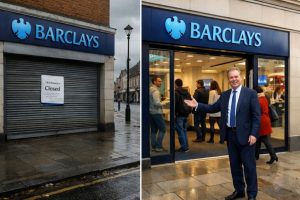
Not entirely. Barclays is not reopening all 800 branches it shut, nor has it admitted that its earlier closure strategy was a mistake. Instead, the bank appears to be making a limited but important shift.
The bank is:
- Pausing further closures
- Expanding beyond its current 206 branches
- Restoring in-person roles and services
- Continuing to invest heavily in digital banking
However, Barclays has not yet announced exactly how many new branches it will open or when they will arrive.
That means the move should be seen as a partial reversal rather than a complete return to the old banking model.
How Can You Check Whether Barclays Is Opening a Branch Near You?
If you want to know whether Barclays is planning a new branch in your area, the best approach is to monitor official updates directly from the bank.
You can check:
- The Barclays branch finder on its website
- Barclays’ official newsroom and press releases
- Local council and town centre announcements
- News about shared banking hubs in your area
Barclays has suggested more information will emerge as the rollout progresses. Until then, customers should be cautious about unofficial reports that claim a branch has definitely been confirmed.
Conclusion
Barclays new bank branches represent a major shift after years of closures. The bank now believes many customers still want face-to-face support, even as online banking continues to grow.
By pausing closures, bringing back branch managers and promising to expand beyond 206 branches, Barclays is signalling that physical banking still has a future on UK high streets.
However, important questions remain unanswered. Barclays has not yet published a full list of branch locations, opening dates or the total number of new sites. For now, the message is clear: Barclays is returning to the high street, but the details are still emerging.
FAQs About Barclays New Bank Branches
Is Barclays opening new branches in the UK?
Yes. Barclays has confirmed that it plans to increase its branch footprint beyond its current 206 branches.
How many Barclays branches are still open?
Around 206 Barclays branches remain open across the UK according to the bank’s latest reports.
Has Barclays published a full list of new branch locations?
No. Barclays has not yet released a complete list of where all new branches will open.
Why did Barclays close so many branches?
Barclays said closures were driven by more customers moving to digital banking and the need to reduce costs.
What is the difference between a Barclays branch and a banking hub?
A Barclays branch is run directly by Barclays, while a banking hub is shared by several banks and offers more limited services.
Will Barclays reopen branches in towns where it previously left?
It is possible, but Barclays has not confirmed which towns or cities will receive new branches.
Are Barclays branch managers returning?
Yes. Barclays has confirmed that the “bank manager” role is returning to its branch network.
Will Barclays continue investing in digital banking as well as branches?
Yes. Barclays says it wants to combine digital services with face-to-face support rather than choosing one over the other.