
Key Takeaways:
- One 77-year-old British man died in the crash
- The bus was carrying 27 British tourists and a driver
- Four people suffered serious injuries
- The crash happened on the dangerous GM-2 road in La Gomera
- Police are investigating whether brake failure caused the accident
What Happened in the Canary Islands Bus Crash in La Gomera?
The crash took place shortly after 1:15pm local time on the island of La Gomera. A tour bus carrying British holidaymakers reportedly veered off the road and plunged down a steep ravine near San Sebastián.
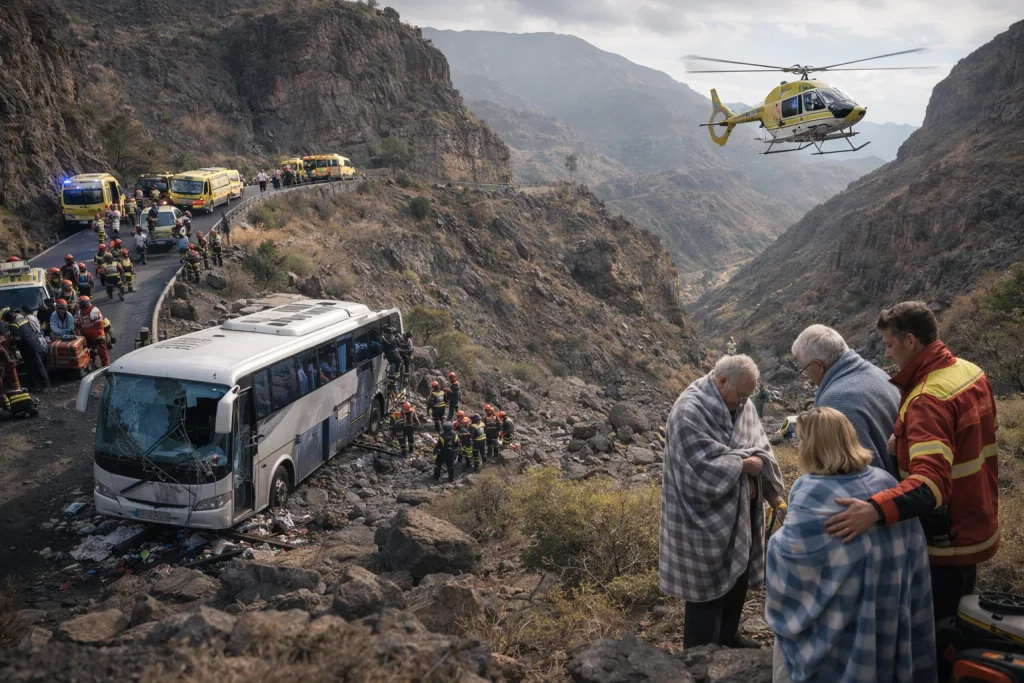
Witnesses said the coach lost control while travelling downhill on a winding section of the GM-2 road. The impact left the front of the vehicle badly damaged, with passengers trapped inside the wreckage until firefighters and rescue teams arrived.
At the time of the accident, there were 24 adults and three children travelling on the bus, along with the driver. Officials later confirmed that one British man died and every other passenger suffered some degree of injury.
| Crash Detail | Information |
| Location | GM-2 road near San Sebastián, La Gomera |
| Time of crash | Around 1:15pm local time |
| Number on board | 27 British tourists and 1 driver |
| Fatalities | 1 British man |
| Injured | 27 people |
Road Safety Profile: The GM-2 Mountain Pass
“The GM-2 road is a known logistical challenge for heavy vehicles. Local transport experts point to the steep gradients (often exceeding 10%) and the continuous wear on braking systems as significant risks for non-local drivers or aging coach fleets.”
Where Did the La Gomera Tourist Bus Crash Take Place?
The accident happened on the GM-2 road, one of La Gomera’s most difficult mountain routes. The road links the southern part of the island with San Sebastián, the island’s capital and main ferry port.
The crash site was close to a mountain tunnel and a tight hairpin bend high above rocky ground. Local residents have long warned that this route can be hazardous because of its steep descents, narrow lanes and limited barriers.
La Gomera is well known for its dramatic scenery, but the same mountain roads that attract tourists can also create serious risks. Drivers often face sharp turns, steep drops and sudden changes in visibility.
Many visitors use excursion buses to travel around the island because they are unfamiliar with the terrain. However, this crash has renewed concerns about whether larger coaches should be using some of the island’s more dangerous roads.
Who Was Killed and How Many People Were Injured in the Crash?
Spanish authorities confirmed that the victim was a 77-year-old British man. Reports suggest he was thrown from the vehicle during the crash.
In total, 27 people were injured. Most suffered moderate injuries such as cuts, bruises and broken bones, while four people were described as seriously hurt. Three children were also among the passengers, although officials have not released details about their conditions.
The injured passengers were treated at the scene before being taken to hospitals in La Gomera and Tenerife.
| Injury Level | Number of People |
| Fatality | 1 |
| Serious injuries | 4 |
| Moderate injuries | 23 |
| Children on board | 3 |
Why Did the Bus Leave the Road Near San Sebastián?
Investigators believe the bus may have suffered a mechanical problem while travelling downhill. The driver reportedly told police that the brakes stopped responding as the vehicle descended the mountain road.
According to local reports, the driver tried to prevent a more serious collision by steering towards a dirt track. However, the bus still left the road and rolled down the ravine.
Possible Brake Failure
Police are now examining the condition of the vehicle to establish whether brake failure was the main cause of the crash. Skid marks and tyre marks found near the road suggest the driver attempted to stop the coach before it plunged over the edge.
Mechanical failures can become especially dangerous on steep roads such as those in La Gomera. A coach descending a long mountain route depends heavily on its braking system, and even a brief failure can have catastrophic results.
Transport safety experts say buses operating in mountainous tourist areas should undergo more frequent inspections than ordinary vehicles. Brake systems can overheat on long downhill journeys, especially when carrying a full load of passengers.
James Thornton, a UK road safety consultant, said: “Mountain roads place enormous pressure on heavy vehicles. If there is even a minor problem with a braking system, the consequences can become serious within seconds.”
The police investigation is expected to focus on whether the vehicle had been properly maintained and whether the driver followed the correct safety procedures before the journey began.
How Did Emergency Services Respond to the La Gomera Bus Crash?
Emergency crews were sent to the scene immediately after the alarm was raised. Helicopters, ambulances, firefighters and police all took part in the rescue operation.
Firefighters worked to free trapped passengers from the damaged coach. Because the bus had come to rest on a steep slope, crews also had to secure the vehicle to stop it sliding further down the hillside.
The difficult location made the rescue effort far more complicated. Narrow roads and steep terrain meant that some emergency vehicles struggled to reach the scene quickly.
Despite these challenges, the first injured passengers were treated within minutes of the crash.
| Emergency Response | Action Taken |
| Fire brigade | Rescued trapped passengers |
| Ambulances | Transported injured to hospitals |
| Medical helicopters | Airlifted serious cases to Tenerife |
| Police | Secured area and began investigation |
Maria Delgado, an emergency response coordinator in the Canary Islands, explained: “The geography of La Gomera makes every rescue operation more difficult. Crews have to work in very dangerous conditions, especially when a crash happens near a ravine or mountain bend.”
Why Were Some British Tourists Airlifted to Tenerife Hospitals?
The most seriously injured passengers could not be fully treated on La Gomera because the island has limited hospital facilities. For that reason, four passengers and the bus driver were flown by helicopter to Tenerife.
Doctors in Tenerife are better equipped to deal with severe injuries such as head trauma, chest injuries and multiple fractures. Helicopter transfers are often used in the Canary Islands because the islands are separated by sea and specialist medical care is not available everywhere.
Two men aged 73 and 42 were among those transferred. Officials said both had suffered multiple serious injuries and needed urgent treatment.
The other injured passengers were taken to Nuestra Señora de Guadalupe Hospital in La Gomera, where they received treatment for less severe injuries.
The need to transfer patients has also highlighted the challenges faced by tourists visiting smaller islands. While destinations such as Tenerife and Gran Canaria have larger hospitals, islands like La Gomera often rely on emergency airlifts when major incidents occur.
What Do We Know About the British Holidaymakers on Board?
The passengers had reportedly been staying at a hotel in Playa de Santiago. They were travelling to San Sebastián to catch a ferry to Tenerife when the accident happened.
Hotel staff confirmed that all of the passengers on the bus were British. Many were believed to be older tourists taking part in a holiday excursion.
The bus belonged to a local company called Gomera Tours, which offers sightseeing trips and transport services around the island.
Several of the injured passengers are expected to remain in hospital for several days, while others may need to return to the UK for further treatment.
David Mercer, a travel insurance specialist, said: “Many people do not realise how important medical evacuation cover is until something goes wrong abroad. Smaller islands may not have the facilities needed after a major accident.”
His comments are likely to raise fresh concerns among British tourists about whether standard travel insurance provides enough protection when visiting remote holiday destinations.
Why Are Roads in La Gomera Considered Dangerous for Tourists?
La Gomera has some of the most difficult driving conditions in the Canary Islands. Many roads are narrow and winding, with steep drops and limited safety barriers.
Tourists often underestimate how challenging these routes can be because the island looks calm and scenic. In reality, roads on La Gomera can become dangerous very quickly, especially when larger vehicles are travelling downhill.
Narrow Mountain Roads and Hairpin Bends
The road where the crash happened includes several hairpin bends and sections where drivers have little room to manoeuvre. Large buses and coaches can struggle to navigate these turns safely, particularly if traffic is approaching from the opposite direction.
Steep descents also increase the risk of brake problems. Drivers may need to use their brakes constantly over long distances, which can make the system less effective.
Local residents have repeatedly called for better road safety measures, including stronger barriers, warning signs and stricter rules for tour buses using mountain routes.
Some visitors who have travelled around La Gomera describe the island’s roads as frightening, particularly when travelling by coach.
Travel writer Sarah Mitchell once described the experience by saying: “You can admire the scenery one moment and then suddenly realise the road beside you drops straight down the mountain. It can feel far more dangerous than people expect.”
What Has the Foreign Office Said About the Canary Islands Bus Crash?

The Foreign Office said it is supporting the British nationals affected by the crash and is in contact with Spanish authorities.
Government officials have also been working with hospitals and families to help them obtain information about injured passengers.
Senior ministers expressed sympathy for those involved. They described the crash as a tragedy and said support would remain available for the victims and their relatives.
The British Embassy in Madrid is expected to continue helping affected families with travel arrangements, hospital updates and emergency documentation if needed.
For many families in the UK, the next few days are likely to be extremely difficult as they wait for news from hospitals in Spain.
What Is the Latest Police Investigation Into the La Gomera Crash?
Police and Civil Guard officers are continuing to investigate exactly what happened. Officers have already spoken to witnesses and examined the road surface near the crash site.
Investigators are expected to inspect the bus in detail to determine whether there was a mechanical defect. They will also review the driver’s account, maintenance records and any previous problems involving the vehicle.
At the moment, brake failure remains the most likely explanation. However, police have not ruled out other factors such as road conditions, speed or driver error.
The investigation could take several weeks before officials publish their final findings.
Could This Bus Crash Affect Tourism in the Canary Islands?

The Canary Islands remain one of the most popular holiday destinations for British tourists. However, this accident is likely to raise questions about safety on smaller islands such as La Gomera.
Most tourist visits to the Canary Islands take place without any problems. Even so, high-profile incidents such as this can affect public confidence, particularly when they involve British visitors.
Travel companies may now face pressure to review the routes used by tour buses and carry out more safety checks before excursions begin.
Some tourists may also become more cautious about travelling on mountain roads or booking coach excursions during their holidays. While the island itself is still considered safe, the crash has highlighted the importance of road safety in remote tourist areas.
“For travelers booking mountain tours in the Canary Islands, it is recommended to verify that operators conduct ‘Pre-Departure Brake Checks’ (standard for GM-2 routes) and utilize coaches equipped with modern retarder braking systems.”
FAQS
What caused the Canary Islands bus crash?
Police believe the crash may have been caused by brake failure. Investigators are still examining the vehicle and have not yet reached a final conclusion.
How many British tourists were on the bus?
There were 27 British tourists on board, along with the driver. The group included 24 adults and three children.
Who died in the La Gomera bus crash?
A 77-year-old British man died in the accident. Spanish authorities confirmed his nationality but have not released his name.
Where did the bus crash happen?
The bus crashed on the GM-2 road near San Sebastián in La Gomera. The road is known for its steep bends and mountainous terrain.
How many people were seriously injured?
Four passengers suffered serious injuries. Several of them were transferred to hospitals in Tenerife for specialist treatment.
Were children involved in the bus crash?
Yes, three children were travelling on the bus. Officials have not provided detailed information about their injuries.
Is La Gomera safe for tourists?
La Gomera is generally considered safe for tourists. However, its mountain roads can be difficult and visitors should take extra care when travelling around the island.