
Last Updated: 23.10.2026
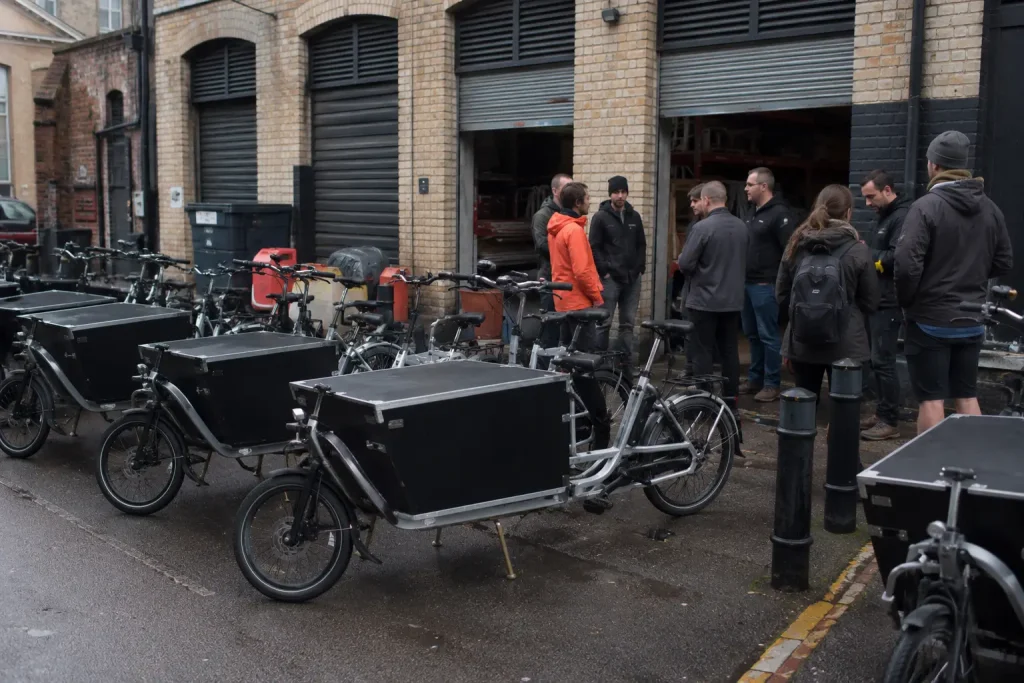
The Pedal & Post collapse has brought an end to one of Britain’s established environmentally friendly courier businesses, with approximately 60 workers affected and its Oxford and London operations permanently closed.
Founded in 2013 by Christopher Benton, Pedal & Post became known for replacing traditional delivery vans with bicycles and electric cargo bikes.
It transported parcels, medical supplies and commercial goods while helping businesses reduce emissions and congestion.
However, the loss of a major commercial contract in January 2026 triggered a financial crisis that the company could not overcome. The business subsequently entered creditors’ voluntary liquidation on 20 February 2026, according to Companies House.
Reports linked the lost contract to micromobility operator Voi. The agreement reportedly represented approximately 25% of revenue and 36% of profit, demonstrating how the departure of a single important customer can destabilise a business.
Our analysis of the closure, public company records and statements from those involved shows that Pedal & Post’s difficulties were not simply about whether cargo bikes could compete with vans.
The more significant issue was whether the company could maintain enough profitable contracts to support its workforce, infrastructure and operating expenses.
For businesses here in Preston and across Lancashire, the story is particularly relevant.
It illustrates how even an established company with an innovative business model can become vulnerable when a substantial proportion of its income depends on a small number of commercial relationships.
What Happened to Pedal & Post?
Pedal & Post was a specialist cycle logistics company headquartered in Oxford. It provided sustainable deliveries using conventional bicycles, electric cargo bikes and trailers rather than relying entirely on motor vehicles.
The company operated for more than a decade, serving local retailers, healthcare organisations, institutions and national parcel delivery companies.
In 2025, the business expanded into London, positioning itself for further growth in the UK’s urban logistics sector.
However, its expansion was followed by an unexpected setback.
In January 2026, the company lost a major client. Management subsequently concluded that the remaining revenue was insufficient to maintain operations.
Both the Oxford and London sites closed, affecting approximately 60 employed and self-employed workers.
The company publicly confirmed that it had explored alternatives to closure but could no longer sustain the business financially.
Although the shutdown occurred in January, the formal insolvency process began the following month.
Pedal & Post Collapse: Key Facts
| Particular | Confirmed or reported information |
| Company name | Pedal & Post Ltd |
| Company number | 08517098 |
| Founded | 2013 |
| Founder | Christopher Benton |
| Headquarters | Oxford, England |
| Other operating location | London |
| Trading ceased | January 2026 |
| Formal liquidation began | 20 February 2026 |
| Insolvency procedure | Creditors’ voluntary liquidation |
| Employees and contractors affected | Approximately 60 |
| Principal reported cause | Loss of a major commercial customer |
| Customer identified in reporting | Voi |
| Reported revenue exposure | Approximately 25% |
| Reported profit exposure | Approximately 36% |
| Companies House status | Liquidation |
The distinction between trading closure and formal liquidation is important. A business can stop accepting orders and dismiss its workforce before the legal winding-up procedure officially begins.
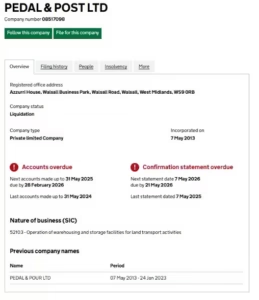
Pedal & Post Ltd’s official Companies House record confirms that the business is in liquidation.
Why Did Pedal & Post Collapse?
The immediate reason for the Pedal & Post collapse was the loss of a substantial commercial contract.
Although the business provided several types of delivery services, its financial position depended heavily on a relatively small number of major customers.
Founder Christopher Benton explained in comments reported by cycling industry journalists that companies relying on five or six significant clients can face serious difficulties when one relationship ends.
The fundamental problem was customer concentration.
A company might deliver thousands of parcels, serve multiple industries and operate in more than one city, yet still generate a disproportionate share of its profit from one agreement.
When that agreement disappears, replacing the lost contribution can be extremely difficult.
The Loss of the Voi Contract
Local Oxford reporting identified Voi, the electric scooter and micromobility operator, as the customer whose departure contributed to the closure.
Pedal & Post was involved in services supporting micromobility operations, including work associated with electric bikes and scooters.
The commercial agreement reportedly represented approximately 25% of the courier company’s revenue.
Separate reporting indicated that the contract accounted for around 36% of its profit contribution.
These figures are not interchangeable.
Revenue represents money earned from providing services, while profit reflects what remains after the relevant costs have been deducted.
A contract can contribute 25% of revenue while representing a greater share of profit if it generates better margins than other activities.
From a financial perspective, losing a disproportionately profitable contract can be especially damaging.
For example, if a business generates £1 million in annual revenue and loses a customer responsible for 25%, annual revenue could fall by £250,000, assuming no replacement work.
The actual cash-flow consequences depend on the costs saved, the contract’s profitability and the speed at which alternative business becomes available.
This is an illustrative calculation, not a statement of Pedal & Post’s final annual turnover.
Why Could the Business Not Replace the Lost Revenue?
Securing large commercial contracts requires negotiations, operational planning, staffing arrangements and agreement on pricing.
A courier business cannot necessarily replace a major customer’s work immediately, even when demand for deliveries remains strong.
There are also operating expenses that continue regardless of the number of parcels transported.
These include employee salaries, equipment maintenance, insurance, warehousing, premises and administration.
If revenue falls sharply, management may have insufficient time or financial reserves to reduce these commitments.
Pedal & Post said it examined available options before deciding that continuing to trade was no longer sustainable.
The precise financial alternatives considered by management have not all been publicly detailed.
When Did Pedal & Post Enter Liquidation?
Pedal & Post ceased trading in January 2026, but its formal creditors’ voluntary liquidation commenced on 20 February 2026.
Companies House records identify two insolvency practitioners appointed on that date:
- Margaret Carter
- Brett Barton
Both are recorded at Azzurri House, Walsall Business Park, Walsall Road, Walsall, West Midlands.
The company’s filing history subsequently recorded the appointment of liquidators, winding-up resolutions and a statement of affairs on 9 March 2026.
These filings provide a formal record of the insolvency proceedings.
Pedal & Post Collapse Timeline
| Date | Development |
| May 2013 | Pedal & Post Ltd incorporated |
| May 2023 | Company promotes an investment fundraising campaign |
| July 2025 | Business expands into London |
| January 2026 | Loss of a major client threatens financial viability |
| Late January 2026 | Oxford and London operations close |
| 18 February 2026 | Further public reporting confirms employment and operational consequences |
| 20 February 2026 | Creditors’ voluntary liquidation officially begins |
| 9 March 2026 | Liquidation documents filed with Companies House |
| 18 August 2026 | Additional notices of disclaimer recorded in filing history |
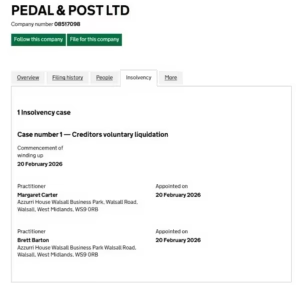
Official insolvency records show that Pedal & Post entered creditors’ voluntary liquidation on 20 February 2026.
What Does Creditors’ Voluntary Liquidation Mean?
Creditors’ voluntary liquidation is a formal process commonly used when a company cannot continue trading and its shareholders decide to wind it up.
Unlike administration, which may involve attempts to rescue or sell an operating business, liquidation primarily involves collecting and realising assets, dealing with creditor claims and closing the company.
Once liquidators are appointed, they assume responsibility for managing the winding-up process.
Their responsibilities generally include identifying company assets, reviewing liabilities, assessing creditor claims and distributing available funds according to insolvency law.
The appointment of liquidators does not mean that every creditor will receive repayment.
Recoveries depend on the value of assets, applicable security interests, liquidation expenses, preferential claims and other statutory priorities.
This distinction is important when examining other UK insolvency cases. For example, the Caldwell Construction insolvency involved administration, a different legal process with its own objectives and procedures.
Who Controls Pedal & Post’s Remaining Assets?
Following the liquidation appointment, the liquidators became responsible for the winding-up process.
Company assets may include equipment, vehicles, cargo bikes, business records, outstanding customer payments and other property legally owned by the business.
However, not every item used by a company necessarily belongs to it.
Some equipment may be leased, financed or owned by another party.
Consequently, the total value of equipment used during trading should not automatically be treated as the amount available to creditors.
The liquidators must establish which assets belong to the company and what amounts can realistically be recovered.
How Much Debt Did Pedal & Post Have When It Collapsed?
One of the most important financial questions concerns the company’s outstanding liabilities.
The existing reporting has referred to approximately £300,000 in debt, but a reliable assessment requires examination of the company’s formal statement of affairs rather than relying on a headline figure alone.
Companies House confirms that a statement of affairs was filed on 9 March 2026.
This document is important because it sets out information about the company’s financial position in connection with its liquidation.
It may identify categories of creditors, estimated assets and liabilities, and other relevant financial information.
However, figures in a statement of affairs may be estimates rather than final recoveries or agreed creditor balances.
The amount owed when liquidation begins can also differ from the ultimate amount admitted in creditor claims.
For these reasons, it would be premature to present a precise final creditor loss or repayment percentage without the relevant verified financial schedule.
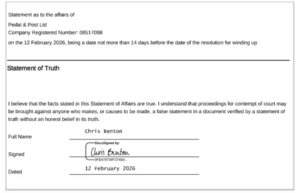
Pedal & Post’s statement of affairs was filed with Companies House on 9 March 2026, providing an official record for examining its financial position.
What Happened to the £500,000 Crowdfunding Campaign?
Pedal & Post attracted investment interest before its collapse.
In 2023, the company promoted a fundraising campaign through investment platform Ethex to support business development and expansion.
Its fundraising plans included ambitions to raise up to approximately £500,000.
The proposed investment was intended to support expansion into additional locations, increased delivery capacity and wider adoption of environmentally friendly urban logistics.
At one point during the campaign, promotional material indicated that more than £155,000 had been raised towards an initial target.
However, the £500,000 figure described a fundraising ambition and should not automatically be treated as the final amount successfully invested.
That distinction matters when considering the company’s financial history.
Were Investors Affected by the Closure?
Shareholders face substantial financial risk when a company enters insolvent liquidation.
Unlike ordinary creditors, shareholders generally have no right to recover their investment ahead of the company’s creditors.
They receive a distribution only if sufficient funds remain after the legally required payments.
In many insolvent liquidations, no money is available for shareholders.
Founder Christopher Benton acknowledged the difficult position facing shareholders when the closure was announced.
There is an important lesson here for investors evaluating businesses involved in environmental technology, sustainable transport and alternative logistics.
An attractive commercial concept, evidence of customer demand and ambitious expansion projections do not eliminate financial risk.
Investors must also consider cash reserves, profitability, contractual stability and the company’s ability to withstand unexpected losses.
How Many Jobs Were Lost in the Pedal & Post Collapse?
Approximately 60 people were affected across Pedal & Post’s Oxford and London operations.
Contemporary reporting described the workforce as including both employed and self-employed personnel.
This distinction affects the legal rights available following the closure.
Employees may qualify for statutory redundancy payments and certain outstanding employment-related sums.
Self-employed contractors generally have different rights and may instead need to pursue unpaid invoices as creditors, depending on their contractual and legal status.
The impact extends beyond the immediate loss of employment.
Workers may also lose regular income, employer-provided benefits and career opportunities associated with specialist transport services.
For those who developed expertise in electric cargo-bike logistics, the closure represents the loss of an employer operating within a relatively specialised sector.
What Support Is Available to Former Employees?
Employees affected by an insolvent employer may be able to claim certain payments through the government’s Redundancy Payments Service.
Depending on eligibility and circumstances, these can include statutory redundancy pay, unpaid wages, holiday pay and statutory notice pay.
The government advises that employees should generally apply for redundancy pay, unpaid wages and holiday pay within six months of dismissal.
Affected workers ordinarily need an insolvency case reference supplied through the insolvency practitioner.
Contractors should establish whether they qualify as employees for legal purposes or need to register a creditor claim.
The official government guidance on employee rights after insolvency explains the available options.
What Services Did Pedal & Post Provide?
Pedal & Post was not simply a bicycle-based parcel collection business.
Over its operating history, the company developed services across multiple areas of urban logistics.
Parcel and Last-Mile Deliveries
One of its principal activities involved collecting parcels from distribution points and completing the final part of a delivery journey.
This process is commonly known as last-mile delivery.
Pedal & Post worked with larger courier networks, including businesses associated with DPD, Yodel and Evri.
Its cargo-bike operations allowed parcels to be transported through densely populated areas where traditional vans could face congestion, parking restrictions or access difficulties.
Healthcare and Medical Logistics
The company also undertook specialist medical deliveries.
Its work included the transportation of important healthcare supplies, with reporting identifying services involving hospitals and NHS-related organisations.
Medical deliveries can require additional operational discipline because delays may affect time-sensitive processes.
The company’s experience in this area demonstrated how low-emission delivery systems could be used for more than ordinary retail parcels.
Local Business Deliveries
Small retailers, food suppliers and other organisations used the company’s services.
These activities included local commercial deliveries such as produce and coffee-related orders.
For independent businesses, cargo bikes can provide an alternative to operating a dedicated delivery van.
However, cost-effectiveness depends on journey distance, parcel size, delivery density and available courier capacity.
University and Institutional Deliveries
Oxford’s universities and colleges also formed part of the environment in which Pedal & Post operated.
Consolidating multiple deliveries into fewer journeys can reduce duplicated vehicle movements through busy streets.
Robin Tucker, Co-Chair of Oxford’s Coalition for Healthy Streets and Active Travel, highlighted the company’s role in consolidating freight for Oxford colleges.
This is particularly relevant to historic cities where road space and vehicle access are limited.
Did the Pedal & Post Collapse Disrupt Evri Deliveries?
Pedal & Post’s closure also attracted attention because of its relationship with major parcel operators.
Evri had used Pedal & Post as an e-cargo-bike delivery partner in parts of Oxford.
When Pedal & Post stopped operating, some customers experienced temporary delivery disruption.
However, this should not be confused with financial difficulties at Evri itself.
Evri did not enter liquidation as a result of the Pedal & Post collapse.
Evri explained publicly that the closure affected a small number of customers locally and that it reorganised delivery arrangements.
The disruption was therefore associated with the loss of a subcontracted delivery partner rather than the collapse of the national courier network.
The situation demonstrates how logistics businesses can be operationally interconnected.
When a local subcontractor ceases trading, a much larger company’s services may be temporarily affected in specific locations.
Nevertheless, the financial position of the subcontractor and the national carrier should be assessed separately.
How Did the Pedal & Post Collapse Affect Oxford’s Environmental Goals?
Pedal & Post became closely associated with efforts to reduce congestion and emissions in Oxford.
Its operating model centred on replacing suitable van journeys with cycle-based deliveries.
The company argued that cargo bikes could provide practical commercial advantages in dense urban environments.
In 2023, founder Christopher Benton promoted research indicating that cargo-bike deliveries could generate approximately 92% fewer greenhouse gas emissions per delivery than an average van delivery.
That figure should be understood as a historical, model-dependent comparison rather than a verified measurement of every Pedal & Post journey.
Environmental performance varies according to vehicle type, delivery distance, loading, electricity generation, maintenance and the number of parcels carried.
Nevertheless, the principle remains relevant: moving suitable short-distance freight journeys from combustion-engine vehicles to cargo bikes can reduce tailpipe emissions and local traffic impacts.
Will More Vans Return to Oxford’s Streets?
The closure removed an established operator that had consolidated deliveries and transported freight using bicycles.
Robin Tucker expressed concern that losing the business could increase van traffic, congestion and pollution in central Oxford.
However, the precise environmental impact depends on how former customers arrange replacement services.
Some deliveries may transfer to other cargo-bike operators, while others may be handled by electric or conventional vans.
Without reliable post-closure delivery data, the net change in emissions cannot be quantified.
Oxford City Council has continued to support low-emission delivery initiatives.
For example, a separate partnership with Velocity Cycle Couriers received council support for electric cargo-bike deliveries, including a 50% subsidy on eligible delivery charges during the announced programme.
This was a distinct scheme, not evidence that Pedal & Post itself received that particular subsidy.
Does the Collapse Mean Cargo-Bike Delivery Is Not Profitable?
The closure does not establish that cargo-bike logistics is commercially unviable.
It does, however, show that operational efficiency and profitability are different things.
Cargo bikes can reduce certain costs associated with conventional delivery vehicles.
They generally avoid fuel purchases for combustion engines, occupy less road space and may offer time advantages in congested city centres.
Yet a sustainable delivery business still needs sufficient revenue to cover labour, insurance, equipment, premises, administration and other commitments.
The financial challenge becomes more significant when operators seek to provide stable employment and competitive wages.
Christopher Benton discussed these pressures publicly after the closure, explaining that labour costs can be higher for businesses seeking to operate as more ethical employers within a sector that makes substantial use of self-employed workers.
This helps explain why reduced vehicle operating costs do not necessarily guarantee high overall profit margins.
The Importance of Delivery Density
An important commercial consideration is the number of deliveries a courier can complete during each paid working hour.
A cargo-bike operation with densely grouped addresses may achieve favourable productivity.
However, routes involving long distances, limited parcel volumes or repeated empty journeys can be less efficient.
The commercial outcome also depends on what customers are prepared to pay.
Businesses offering high-volume delivery services often face considerable price competition.
Consequently, operators must balance customer pricing, service quality, wages and delivery productivity.
How Does the Collapse Compare with Other UK Courier Failures?
Pedal & Post was not the only cargo-bike logistics business to experience severe financial difficulties.
In January 2025, Zedify’s parent company entered administration, with substantial job losses reported.
Zedify had also been involved in developing low-emission last-mile delivery services.
The two cases were not identical, and it would be inaccurate to assume they failed for precisely the same reasons.
However, both illustrate the commercial challenges associated with scaling specialist urban logistics networks.
These challenges may include securing sufficiently profitable customers, maintaining delivery volumes, financing expansion and controlling operating expenditure.
A similar distinction applies when examining failures across other industries.
The Glacier Energy Manufacturing administration demonstrates how weaker demand and financial pressures can undermine a business even when its wider industry continues to offer long-term opportunities.
The commercial viability of an individual company should therefore not be confused with the potential of the sector in which it operates.
What Can Businesses in Preston Learn from the Pedal & Post Collapse?
Although Pedal & Post operated primarily in Oxford and London, its closure offers important lessons for businesses across Preston, Lancashire and the wider North West.
Local companies frequently depend on relationships with larger customers, national retailers, manufacturers and logistics organisations.
These partnerships can provide reliable orders, predictable income and opportunities for expansion.
However, dependence on a small number of contracts can also create financial vulnerability.
Monitor Customer Concentration
One useful financial measure is the percentage of revenue generated by the company’s largest customers.
For example, a business generating 60% of its revenue from three customers faces greater concentration risk than one serving a broad and stable customer base, all else being equal.
The relevant assessment should consider both revenue and profitability.
Losing a relatively small but highly profitable contract can sometimes cause more damage than losing a larger agreement with limited margins.
Stress-Test Major Contract Losses
Business owners should model the financial consequences of losing their largest customer.
A basic stress test can examine the effect of losing 10%, 20% or 30% of revenue.
However, these percentages are scenario assumptions rather than universal risk thresholds.
The objective is to understand how quickly cash reserves would decline and what costs could realistically be reduced.
Management should also examine how much notice major customers must provide before terminating agreements.
Maintain Working Capital
A profitable business can still face difficulties if it does not have enough cash available when payments become due.
Working capital is therefore crucial.
Companies may have substantial equipment, stock or unpaid customer invoices but still struggle to meet immediate wage, tax and supplier commitments.
A regularly updated cash-flow forecast helps identify potential funding problems before they become critical.
Expand Without Overstretching
Pedal & Post’s London expansion came shortly before its closure.
That timing raises reasonable questions about the risks associated with expansion, but it does not prove that entering London caused the insolvency.
Expansion normally requires additional management attention, operational capacity and investment.
Businesses should ensure that existing operations remain resilient while pursuing growth.
For delivery companies, expansion may involve new premises, additional riders, equipment and commercial contracts.
If anticipated revenue fails to materialise, these commitments can place pressure on cash flow.
Consider the Employment Model
The company also highlights the relationship between employment practices and operating costs.
Logistics businesses using employees may face different cost structures from those relying extensively on self-employed contractors.
The classification of workers must reflect their actual legal status, not simply the company’s preferred arrangement.
Employment costs should therefore be included accurately when assessing delivery profitability.
For businesses evaluating logistics employment costs more broadly, comparing the economics of specialist cycle couriers with conventional delivery driver earnings can help illustrate how staffing requirements vary across transport models.
Could Pedal & Post Have Avoided Liquidation?
Determining whether the company could have survived requires more information than is available from public announcements alone.
Possible responses to a substantial contract loss can include seeking replacement work, negotiating additional finance, reducing costs or restructuring operations.
However, each option depends on the business’s financial position and the time available.
For example, replacing a contract responsible for a large share of profit may require securing several new customers.
That may not be achievable quickly if the company is already experiencing financial pressure.
Similarly, raising emergency investment can be difficult when financial forecasts show uncertainty about future income.
The company stated that management considered alternatives before closing.
There is insufficient publicly verified information to conclude that a particular restructuring strategy would definitely have prevented liquidation.
What Happens to Pedal & Post’s Customers, Suppliers and Creditors?
The liquidation affects different groups in different ways.
Customers with outstanding deliveries must establish whether their parcels were already transferred to another carrier or remained within the company’s custody.
Businesses with prepaid services may need to determine whether they are owed refunds.
Suppliers with unpaid invoices may need to submit claims to the liquidators.
Former employees may have access to separate statutory payment arrangements.
Shareholders generally face the highest risk of losing their investment because equity ranks behind creditor claims.
Can Creditors Recover Their Money?
There is no guarantee that unsecured creditors will recover the full amount owed.
The liquidators must assess available funds, asset ownership, secured claims, preferential debts and the expenses associated with the insolvency.
Creditors should retain invoices, contractual documents, statements and other evidence supporting their claims.
Those who have not received correspondence should contact the appointed liquidators through the official company records.
Government guidance explains how creditors can establish the relevant insolvency procedure and contact the practitioner handling the case.
What Is the Future of Sustainable Urban Delivery After Pedal & Post?
The end of Pedal & Post represents the closure of one established participant in the UK’s sustainable courier sector.
It does not mean that the underlying demand for lower-emission delivery systems has disappeared.
Urban areas continue to face practical challenges involving congestion, air quality, delivery volumes and vehicle access.
Cargo bikes remain one possible solution for journeys involving suitable distances, parcel sizes and delivery patterns.
However, their long-term commercial success depends on more than their environmental credentials.
Operators need viable pricing, reliable customers, effective route planning and sufficient financial resilience.
The challenge is particularly relevant to smaller companies competing with large delivery organisations that benefit from established infrastructure and substantial parcel volumes.
For cities such as Preston, where retailers, independent businesses and logistics providers must balance operating costs with changing transport expectations, the Pedal & Post collapse demonstrates the importance of evaluating both environmental and financial sustainability.
Conclusion
The Pedal & Post collapse brought an end to a business that had spent more than a decade demonstrating how bicycles and cargo bikes could play a meaningful role in modern urban delivery.
The company developed relationships with retailers, healthcare organisations, institutions and national courier networks while supporting efforts to reduce congestion and emissions.
However, the loss of a major commercial customer exposed weaknesses in its financial resilience.
With approximately 60 workers affected and the company entering creditors’ voluntary liquidation on 20 February 2026, the closure has had consequences for employees, investors, customers and suppliers.
Its wider significance is not simply that an environmentally focused company failed.
Rather, the case demonstrates that innovation, expansion and a strong environmental mission must be supported by sustainable profits, dependable cash flow and manageable commercial risks.
For the business community in Preston and across the North West, the central lesson is clear: long-term business stability depends not only on attracting customers, but also on ensuring that the loss of one important relationship does not threaten the survival of the entire company.
Frequently Asked Questions
Why did Pedal & Post collapse?
Pedal & Post stopped trading after losing a major commercial customer in January 2026. The loss significantly affected its financial viability, and management concluded that it could not sustainably continue operations.
When did Pedal & Post go into liquidation?
The company formally entered creditors’ voluntary liquidation on 20 February 2026, according to Companies House. Its Oxford and London operations had already closed in January.
Was Voi responsible for the Pedal & Post collapse?
Local reporting identified Voi as the lost customer. However, the broader cause of the closure was the company’s inability to continue financially following the loss of a substantial contract. Contract termination alone does not establish wrongdoing by Voi.
How many employees lost their jobs?
Approximately 60 employed and self-employed workers were affected across Oxford and London.
Did Evri go bust because of Pedal & Post?
No. Evri continued operating. Pedal & Post was a local delivery partner, and its closure caused temporary disruption affecting some Oxford parcels.
How much money did Pedal & Post raise through crowdfunding?
The company promoted a 2023 investment campaign with ambitions to raise up to approximately £500,000. Public promotional material recorded fundraising progress, but the maximum target should not be described as the final amount raised without confirmation.
Who founded Pedal & Post?
Christopher Benton founded the Oxford cycle delivery company in 2013.
Is Pedal & Post still operating in 2026?
No. The company’s Oxford and London operations closed in January 2026. Its official company status is liquidation.
Does the collapse prove that cargo-bike deliveries are unprofitable?
No. The closure illustrates the financial risks faced by one business, particularly its reliance on a major commercial contract. Other cargo-bike operations may have different customer bases, costs and profitability.
Why is the Pedal & Post collapse relevant to Preston businesses?
It highlights the importance of customer diversification, cash-flow planning and sustainable operating margins. These issues affect small and medium-sized businesses throughout Preston and Lancashire, regardless of industry.