
The most expensive Council Tax band depends on which part of the UK a property is in. In England, the highest current band is Band H.
Wales goes one step further with Band I, while Scotland currently has Band H as its highest band. Northern Ireland does not use Council Tax bands at all and operates a domestic rates system instead.
This means there is no single highest Council Tax band UK-wide under one common system. It is also important to separate the highest property band from the area with the highest annual Council Tax bill.
A home can sit in the highest band but still pay less than a similar-band property elsewhere because local authorities set different charges.
What Is the Most Expensive Council Tax Band in the UK?
The current highest bands can be summarised as follows:
| UK Nation | Highest Current Band or System | Property Value Basis | Key Point |
| England | Band H | More than £320,000 at 1 April 1991 values | Highest of eight bands |
| Wales | Band I | £424,001 and above at 1 April 2003 values | Highest of nine bands |
| Scotland | Band H | More than £212,000 at 1 April 1991 values | New high-value bands are planned |
| Northern Ireland | Domestic rates | Capital value | Council Tax bands are not used |
England and Scotland therefore currently finish at Band H, while Wales has a higher-labelled Band I. However, band letters alone do not show which household has the largest bill because the valuation systems, thresholds and local tax rates differ.
What Is the Highest Council Tax Band in England?
Band H is the highest Council Tax band in England. Properties are placed into one of eight bands, from A to H, using an estimate of what they would have been worth on 1 April 1991.
According to the official Council Tax band guidance on GOV.UK, the English thresholds are based on historic values rather than today’s market prices. Band H applies to homes valued at more than £320,000 on the 1991 valuation basis.
That historic valuation date matters. A house that is now worth £1 million is not automatically placed into Band H simply because of its current sale price. The relevant question is what the property would have been expected to sell for at the statutory valuation date.
How Much Is Band H Council Tax?
There is no single Band H Council Tax cost for England.
Band D acts as the standard benchmark. In England, Band H is charged at twice the Band D amount for the relevant area. The final bill can include amounts collected for different authorities, including county councils, police, fire services, combined authorities and parish councils where applicable.
For 2026/27, the average Band D Council Tax across England is £2,392, an increase of £111 or 4.9% from 2025/26. That figure includes adult social care and parish precepts.
It should not be converted into a supposed universal Band H bill, however, because individual council areas charge different amounts.
England Council Tax Rates for 2026/27
Official statistics show substantial geographical differences. In 2026/27, average area Band D Council Tax ranges from approximately £1,028 in Wandsworth to £2,765 in Dorset. Around 70% of English authorities fall between £2,300 and £2,600.
That difference demonstrates why the highest Council Tax band and the highest Council Tax rate should be treated as separate questions.
What Is the Highest Council Tax Band in Wales?
The highest Council Tax band in Wales is Band I.
Wales uses nine bands, from A to I, and its current system is based on property values at 1 April 2003 rather than England’s 1991 valuation date. Band I applies to properties valued at £424,001 or above on that basis.
The Welsh bands therefore cannot sensibly be compared with England simply by looking at the monetary thresholds.
For 2026/27, the average Band D Council Tax in Wales is £2,283. Billing-authority averages range from £2,013 in Cardiff to £2,594 in Merthyr Tydfil.
The figures include county council, police and community council elements. The Welsh Government’s 2026/27 Council Tax figures provide the current official comparison.
How Does Band I Compare With Band H?
The main differences are the number of bands and the valuation dates.
- England Has Eight Bands, ending with Band H.
- Wales Has Nine Bands, ending with Band I.
- England Uses 1 April 1991 Values, while Wales uses 1 April 2003 values.
- Band I In Wales Starts At £424,001, based on the Welsh valuation date.
- Actual Bills Still Depend On Location, not simply the band letter.
Wales also has a longer-term reform programme. The Local Government Finance (Wales) Act 2024 establishes a cycle of Council Tax revaluations beginning from 1 April 2028, with revaluations then planned every five years.
What Is the Highest Council Tax Band in Scotland?
Band H is currently the highest Council Tax band in Scotland, but this is one of the areas where readers need to distinguish today’s rules from confirmed government plans for the future.
Existing Scottish properties are assigned to Bands A to H based on 1 April 1991 values. Band H currently covers homes valued above £212,000 on that historic basis.
Scotland also uses different multipliers from England. The current Band H multiplier is 2.45 times Band D. For 2026/27, Scotland’s average Band D gross bill is approximately £1,653, while the average Band H gross bill is around £4,051.
New Council Tax Bands I And J For Expensive Scottish Homes
A significant official announcement was made in 2026.
On 6 July 2026, the Scottish Government opened a consultation on two new high-value Council Tax bands.
Under the plan:
- Band I Would Cover Homes Valued Between £1 Million And £2 Million.
- Band J Would Cover Homes Valued Above £2 Million.
- High-Value Properties Would Be Assessed Using Values At 1 April 2026.
- The New Bands Are Intended To Take Effect From 1 April 2028.
- Implementation Remains Subject To Scottish Parliament Approval.
The Scottish Government’s high-value Council Tax consultation remains open until 24 August 2026.
The government is consulting on illustrative multipliers of approximately 2.886 for Band I and 4.628 for Band J. Using average 2026/27 charges, those would equate to roughly £4,770 a year for Band I and £7,650 for Band J. These are illustrative figures, not final rates.
Compared with the current average Band H charge, the consultation estimates an additional annual amount of about £720 for Band I and £3,600 for Band J. Final multipliers will require legislation.
This is particularly important for anyone searching for the most expensive Council Tax band. Band J may become Scotland’s highest band from April 2028, but it is not the current highest band in August 2026.
Does Northern Ireland Have Council Tax Bands?
No. Northern Ireland does not operate the same Council Tax system used in England, Wales and Scotland.
Domestic properties are subject to domestic rates, with bills linked to property capital values and relevant regional and district rates. Land & Property Services provides property valuations and estimated annual rate calculations.
Northern Ireland should therefore not be placed into a table of Council Tax Bands A to I as though all four UK nations use identical systems.
How Do Council Tax Bands Work?
A Council Tax band is primarily a property valuation category. It is not a fixed national price.
The basic process involves:
- Assigning A Property To A Valuation Band.
- Setting A Local Band D Council Tax Rate.
- Applying The Relevant Band Multiplier.
- Adding Applicable Local Precepts.
- Applying Any Eligible Discounts, Reductions Or Exemptions.
Band D is widely used for comparisons because it provides a common benchmark. Official English statistics describe Band D as the standard measure used to compare Council Tax levels between authorities and across different years.
Council Tax also contributes towards local services. In Preston, this sits alongside everyday services residents encounter directly, including arrangements such as Preston bin collection days.
Is the Highest Council Tax Band the Same as the Most Expensive Council Tax Bill?
No. This distinction is central to understanding the most expensive Council Tax in the UK.
A Council Tax band describes the property’s valuation category. The bill is the amount actually charged in the local area.
Two Band H properties in different parts of England can therefore receive substantially different bills even though they occupy the same valuation band.
Three separate factors should be kept apart:
- Council Tax Band determines the property’s position in the valuation structure.
- Local Council Tax Rate determines how much the authority charges.
- Household Circumstances may affect the final amount through discounts, reductions, exemptions or premiums.
This is also why rankings of the most expensive Council Tax areas UK-wide normally use Band D rates. Band D allows more consistent comparison between councils than selecting properties at the top of each valuation structure.
Where Is Council Tax Most Expensive In The UK In 2026/27?
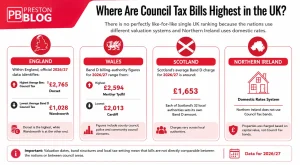
There is no perfectly like-for-like single UK ranking because the nations use different valuation systems and Northern Ireland uses domestic rates.
Within England, official 2026/27 data identifies Dorset at approximately £2,765 as the highest average area Band D Council Tax, while Wandsworth is at the other end at around £1,028.
In Wales, Band D billing-authority figures range from £2,013 in Cardiff to £2,594 in Merthyr Tydfil.
Scotland’s average Band D charge for 2026/27 is around £1,653, although each of Scotland’s 32 local authorities sets its own Band D amount.
| Comparison | 2026/27 Figure |
| England Average Band D | £2,392 |
| England Highest Area Average Band D | £2,765 in Dorset |
| England Lowest Area Average Band D | £1,028 in Wandsworth |
| Wales Average Band D | £2,283 |
| Wales Highest Billing-Authority Average Band D | £2,594 in Merthyr Tydfil |
| Scotland Average Band D | About £1,653 |
| Scotland Average Band H | About £4,051 |
The figures show why saying that one council has the “most expensive Council Tax band” can be misleading. The band structure and the amount charged are related but separate.
What Does The Most Expensive Council Tax Band Cost?
There is no universal price for the most expensive Council Tax band.
A household’s annual liability depends on several factors:
- The UK Nation Where The Property Is Located.
- The Property’s Council Tax Band.
- The Local Authority’s Band D Rate.
- Police, Fire, Parish Or Other Applicable Precepts.
- Any Council Tax Discounts Or Reductions.
- Whether Premiums Apply To The Property.
An English Band H property normally pays twice the relevant Band D rate. In Scotland, the current Band H multiplier is 2.45 times Band D. Wales uses its own band ratios extending through Band I.
That is why the postcode and local charging authority matter as much as the band letter.
How Does Council Tax In Preston Compare With Expensive UK Areas?
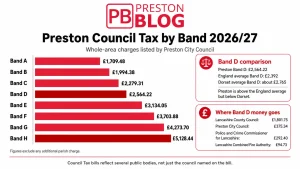
Preston provides a useful local example because its 2026/27 figures show clearly how Band D and Band H relate.
Preston City Council lists the following whole-area charges for 2026/27:
| Band | Preston 2026/27 Council Tax |
| Band A | £1,709.48 |
| Band B | £1,994.38 |
| Band C | £2,279.31 |
| Band D | £2,564.22 |
| Band E | £3,134.05 |
| Band F | £3,703.88 |
| Band G | £4,273.70 |
| Band H | £5,128.44 |
The figures exclude any additional amount payable in a parish area.
Preston’s Band D figure of £2,564.22 is above the England-wide average of £2,392, but below Dorset’s 2026/27 average area Band D figure of approximately £2,765.
For people less familiar with the local area, understanding where Preston is in the UK helps place the city within Lancashire and the wider North West.
The £2,564.22 Band D amount is not retained entirely by Preston City Council. The 2026/27 breakdown shows £1,801.75 going to Lancashire County Council, £375.34 to Preston City Council, £292.40 to the Police and Crime Commissioner for Lancashire and £94.73 to Lancashire Combined Fire Authority.
This illustrates why Council Tax bills reflect several public bodies rather than simply the district or city council named at the top of the bill.
Why Can An Expensive Home Have A Lower Council Tax Bill Than Expected?
Council Tax was not designed as a straightforward percentage of a home’s present-day market price.
In England and Scotland, existing bands still use 1991 values. Wales uses 2003 values. This creates situations where today’s house price can appear far removed from the property’s Council Tax category.
The top bands are also open-ended in some systems. England’s Band H includes any property that would have been worth more than £320,000 in 1991, regardless of how far above that figure it would have been.
Scotland’s existing Band H works similarly for properties above £212,000 at 1991 values. The Scottish Government has specifically identified the broad nature of Band H as one reason for introducing new high-value bands.
Location also matters. A high-value property in a lower-charging authority could receive a smaller Council Tax bill than a less expensive property in an area with significantly higher local rates.
Can Households In The Highest Council Tax Band Reduce Their Bill?
Being in Band H or Band I does not automatically prevent someone from qualifying for a discount or reduction. Eligibility depends on the relevant scheme and household circumstances.
Single-Person Discount
A household with only one resident counted as an adult for Council Tax purposes can normally receive a 25% discount in England. Different rules and disregarded-person provisions can affect who counts for this purpose.
Council Tax Reduction
Council Tax Reduction is separate from the property’s valuation band. Low-income households may be eligible for support depending on their circumstances and the scheme operating where they live.
Older households should check entitlement carefully. Research covered in PrestonBlog’s article on pensioners missing benefits highlights Council Tax Reduction as one of the forms of support that can be overlooked.
People reviewing their wider household finances may also want to distinguish Council Tax support from other benefits and payments. For example, PIP payment amounts in 2026 operate under separate eligibility rules and should not be treated as a Council Tax discount.
Other Household Support
Council Tax is only one part of household expenditure. Energy costs, housing expenses and other essential bills can materially affect affordability. Current information on whether gas and electric prices are going up can therefore be relevant when households are reviewing their overall monthly budget.
Similarly, information about cost-of-living support in 2026 should be considered separately from Council Tax Reduction because the eligibility rules and payment mechanisms differ.
The highest band and the highest bill are not the same thing
Pick a UK nation, then change the view. Explore where the Council Tax bands currently end and see why the amount households actually pay can depend heavily on location.
England
Can You Challenge The Highest Council Tax Band?
A Council Tax band can be checked and, in appropriate circumstances, challenged.
A household might investigate its band when comparable nearby properties appear to be in different bands, when information about the property’s characteristics appears incorrect or when a qualifying property change has occurred.
However, challenging a band does not guarantee that it will be reduced. A valuation review can confirm the existing band and, depending on the circumstances, changes to valuation lists can also affect other properties.
Households should therefore use the official valuation service applicable to their nation and review the evidence before making a formal proposal or appeal.
Latest Council Tax Announcements And Changes Affecting Expensive Homes
The most important recent development for high-value properties is currently in Scotland.
Scotland’s July 2026 High-Value Property Consultation
The Scottish Government’s consultation published on 6 July 2026 proposes two new bands above Band H.
Band I would cover residential properties valued between £1 million and £2 million, while Band J would cover homes worth more than £2 million. The relevant targeted valuation would use property values at 1 April 2026.
The consultation closes on 24 August 2026, and the proposed implementation date is 1 April 2028, subject to Scottish Parliament agreement. Final tax multipliers have not yet been determined.
That distinction is essential. Statements suggesting that Scotland already has Bands I and J would be premature as of 18 August 2026.
Wales Is Moving Towards Regular Revaluations?
Wales is also preparing for longer-term structural change. Its legislation establishes regular Council Tax revaluations beginning in 2028, with five-year cycles thereafter. Welsh Ministers have also been given greater flexibility over how the band structure may be organised in future.
For now, however, the existing A-to-I structure remains the relevant system for the 2026/27 financial year.
England’s 2026/27 Rates Have Increased
England has not introduced a new band above Band H for 2026/27. Instead, the main current change is in the amount charged.
The official average Band D figure has risen by 4.9% to £2,392. Of the 384 authorities subject to referendum principles, 274 used the maximum flexibility available to them when setting 2026/27 Council Tax.
Local authority costs are influenced by the resources required to provide public services. Staffing is one part of that wider picture, alongside other expenditure, and current developments such as the local government pay rise negotiations for 2026/27 show how council-service costs can continue to change during the financial year.
How To Check Your Council Tax Band And Current Bill?
A household checking whether it is in the highest Council Tax band should use current official information rather than estimating the band from today’s house price.
The practical process is:
- Check The Property’s Official Valuation Band.
- Confirm The Local Authority’s 2026/27 Council Tax Schedule.
- Check Any Police, Fire, Parish Or Other Precepts Included In The Bill.
- Review Eligibility For Discounts, Exemptions Or Council Tax Reduction.
- Investigate The Valuation Only If There Is Evidence The Band May Be Incorrect.
This approach avoids one of the most common sources of confusion: assuming that a current online property valuation automatically determines a Council Tax band.
What Is The Most Expensive Council Tax Band? Final Answer
The most expensive Council Tax band currently depends on where the property is located.
England’s highest Council Tax band is Band H, covering properties valued above £320,000 at 1 April 1991 values. Wales’s highest band is Band I, covering properties valued at £424,001 or more at 1 April 2003 values.
Scotland’s current highest band is Band H, covering properties above £212,000 at 1991 values. Northern Ireland uses domestic rates instead of Council Tax bands.
Scotland is the nation to watch for the biggest upcoming change. Its government intends to introduce Bands I and J for homes valued above £1 million and £2 million respectively from April 2028, subject to legislation.
For households, the most important point is that the highest Council Tax band UK residents can occupy is not automatically the same as the highest Council Tax bill. The amount ultimately paid depends heavily on local rates, the relevant national system and individual household circumstances.
Frequently Asked Questions
What Is The Most Expensive Council Tax Band In The UK?
There is no single UK-wide answer because Council Tax systems differ. England currently ends at Band H, Wales at Band I and Scotland at Band H. Northern Ireland uses domestic rates rather than Council Tax bands.
Is Band H The Highest Council Tax Band In England?
Yes. Band H is England’s highest Council Tax band. It covers properties valued above £320,000 using estimated 1 April 1991 values.
What Is The Highest Council Tax Band In Wales?
Band I is the highest Council Tax band in Wales. It applies to properties valued at £424,001 or above on the 1 April 2003 valuation basis.
What Is The Highest Council Tax Band In Scotland?
Band H is currently Scotland’s highest band. The Scottish Government intends to add Bands I and J for high-value homes from April 2028, subject to parliamentary approval.
How Much Does Band H Council Tax Cost Per Year?
There is no single Band H price. The amount depends on the local authority. In Preston, for example, the whole-area Band H charge for 2026/27 is £5,128.44, before any additional parish amount.
Which Area Has The Most Expensive Council Tax In The UK?
Comparisons need to specify the nation and band because the systems differ. In England, official 2026/27 statistics show Dorset with the highest average area Band D charge at about £2,765. In Wales, Merthyr Tydfil has the highest billing-authority Band D average at £2,594.
Can A Property In The Highest Council Tax Band Have Its Band Reduced?
Potentially, but only where the valuation is found to be incorrect or another valid basis for changing the band applies. A challenge does not guarantee a reduction, so households should check official valuation information and comparable properties before starting the process.