
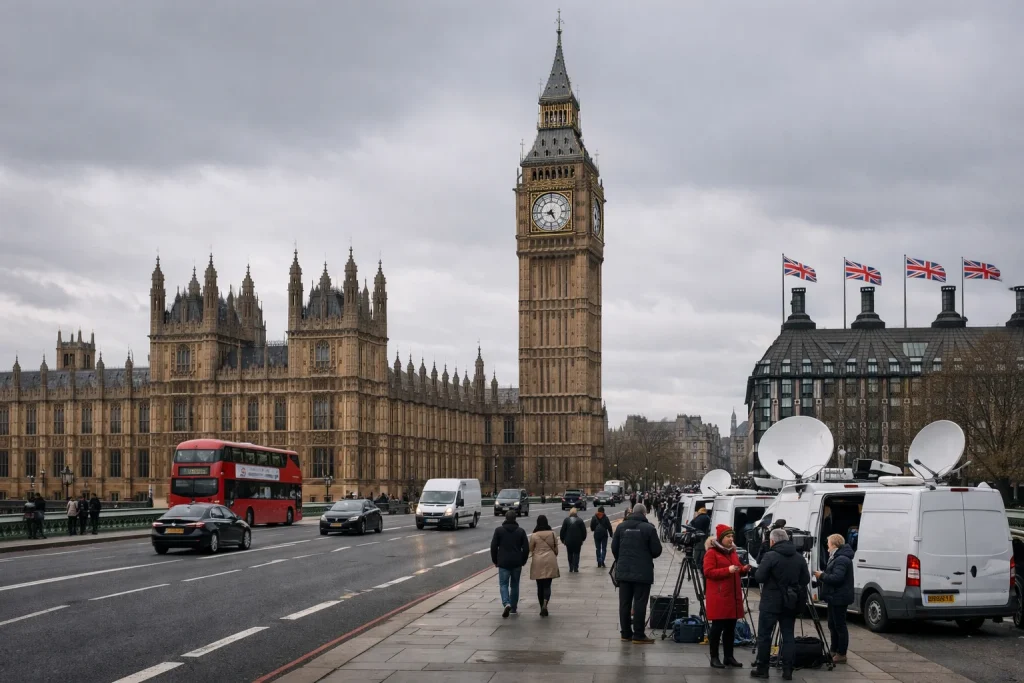
The UK is not confirmed to be going to war in 2026, but it is preparing more seriously for conflict risks, especially around NATO deterrence, Middle East escalation, and ongoing “hybrid” threats.
When people search “are the UK going to war 2026?”, they’re usually reacting to sharp political language (“be ready for war”), alarming headlines, and real-world crises that can pull allies closer to confrontation.
Key takeaways:
- The UK can become involved in conflict without a formal declaration of war.
- The most plausible pathways are NATO escalation, Middle East spillover, and hybrid disruption at home.
- Readiness debates centre on stockpiles, industrial capacity, recruitment, and national resilience.
- The smartest approach is scenario planning, not panic, watch for practical signals, not viral certainty.
What Does “Are the UK Going to War 2026” Actually Mean in Practical Terms?
When people search for the UK going to war in 2026, they often imagine a formal declaration of war and mass troop deployments. In reality, modern conflict is far more complex.
“War” in 2026 could mean several different things:
- A NATO Article 5 response if a member state is attacked
- Direct UK military strikes or combat deployments
- Limited involvement through air defence, naval escorts, or intelligence
- Hybrid warfare, including cyber attacks and infrastructure disruption
Armed Forces Minister Al Carns recently stated:
“A lot of people say that the UK doesn’t have a frontline but the reality is that we do. It sits in the North Atlantic. It sits in cyberspace and it sits in influence.”
This highlights a critical shift. Conflict is no longer confined to tanks and trenches. It includes digital networks, undersea cables, satellites, and economic systems.
So the question is not simply whether Britain will “declare war”, but whether it could be drawn into escalating security crises.
Why Are UK Leaders Warning That Britain Must Be “Ready for War”?
Over the past two years, senior ministers and defence officials have repeatedly warned that the UK must prepare for a more hostile world.
At the Munich Security Conference, the Prime Minister said:
“We must build our hard power, because that is the currency of the age.”
These warnings are tied to three major developments:
- Russia’s full-scale invasion of Ukraine and ongoing aggression in Europe
- Growing tensions in the Middle East involving Iran and allied forces
- Increasing cyber and hybrid threats targeting UK infrastructure
Military leaders argue that preparing for war makes war less likely. As one former Royal Navy commander noted, strengthening defence is about deterrence, not aggression.
However, critics point out that despite strong rhetoric, Britain has yet to fully mobilise government-wide resilience planning similar to Cold War structures.
Is There Real Evidence That the UK is Planning to Enter a War in 2026?

Based on the reference material you provided, the strongest evidence points to preparation and contingency planning, not a declared intention to enter a new war on a specific date. The distinction matters.
What does appear in the competitor material is:
- A push to talk more openly about national warfighting readiness.
- Concern about a lack of a coherent, whole-of-government blueprint for moving from peace to war.
- Political pressure from some figures to be more directly involved in Middle East operations.
- Ongoing commitments to allies, especially through NATO, could create escalation pathways.
This is where readers often get misled: a country can be concerned about war, planning for war, and trying to deter war, all at the same time. None of that automatically equals “the UK will go to war in 2026.”
A useful way to think about it is this: governments plan for worst-case scenarios because failing to plan is more dangerous. Planning is a sign of responsibility; it is not, by itself, evidence of intent.
Could NATO Obligations Pull Britain Into a Wider European Conflict?
This is the pathway most analysts treat as the highest-impact scenario: not because it is inevitable, but because NATO is the UK’s central security framework.
If a NATO member is attacked and Article 5 is invoked, the UK could be expected to contribute in a meaningful way, politically, militarily, and logistically.
The NATO “tripwire” Problem
- NATO deterrence relies on the belief that an attack on one ally triggers a collective response.
- That belief is designed to prevent escalation, but if deterrence fails, escalation can happen quickly.
- UK deployments and leadership roles in northern Europe are part of that deterrent “signal.”
Why the North Atlantic, “high North,” and Infrastructure Keep Coming Up?
Competitor narratives stress that conflict wouldn’t begin only with tanks rolling. It might begin with sabotage, cyberattacks, maritime harassment, or pressure on undersea cables and pipelines.
The practical point is that the UK’s security and economy are tied to networks, digital, energy, and maritime, which are difficult to fully protect.
What UK Involvement Could Look Like (Without Sensationalism)?
- Reinforcing NATO air policing or air defence.
- Increasing naval presence in the North Atlantic.
- Supporting logistics, intelligence, surveillance, and reconnaissance.
- Strengthening the UK’s own homeland air defence and resilience posture.
This is also where political messaging is often aimed: to reduce the chances that an adversary decides to probe NATO unity.
How Could Tensions in the Middle East Involve the UK Militarily?
The Middle East pathway is less about formal alliance obligations and more about bases, regional security, and escalation control.
Your reference material describes a situation where the UK was informed of strikes, confirmed it did not participate, and faced political pressure from opposition figures to do more.
In this environment, UK involvement can occur on a spectrum:
- Non-combat roles: evacuations, consular support, maritime security, air defence.
- Defensive posture: reinforcing bases and protecting UK personnel and interests.
- Operational support: intelligence sharing, enabling allies through basing decisions.
- Direct action: strikes or combat support, typically the most politically sensitive step.
The most direct route into escalation would be through joint facilities such as Diego Garcia, which require UK approval for certain operational uses.
Political divisions also exist. Some opposition figures urged stronger support for allied strikes, while others warned involvement would be “ill-advised and illegal”.
This debate illustrates that Middle East escalation is a potential pathway, but not an inevitability.
What Role Do British Military Bases Play in Potential Conflict Scenarios?
Bases matter because they shape what allies can do quickly, where assets can be positioned, and what protective responsibilities the host government inherits. That’s why basing questions can become political flashpoints during crises.
In the Middle East context, the reference information highlights that a key route into deeper involvement could be through a joint facility used by allies, raising questions about permission, oversight, and consequences.
The big public misunderstanding is thinking “bases equal participation.” In reality, basing decisions can range from routine support to highly consequential enabling.
How Base-related Decisions Can Escalate Involvement?
| Decision type | What it means in practice | Why it matters politically | Potential risk |
| Routine access and logistics | Transit, refuelling, routine support | Often low-profile | Usually limited |
| Defensive reinforcement | Air defence, force protection, extra patrols | Signals heightened risk | Retaliation risk increases |
| Permission for launch/enabling | Allies use a base for strikes | Can look like de facto participation | Escalation and targeting risk |
| Direct UK operational use | UK assets operate from bases in-theatre | Clear involvement | Highest exposure |
Bases also connect to the bigger “are the UK going to war 2026” anxiety: if crises intensify, basing and access debates become more visible, and visibility can look like inevitability. It isn’t.
Is the UK Already Involved in a Form of War Through Cyber and Hybrid Threats?

Competitor coverage repeatedly returns to the idea that the UK faces “sub-threshold” attacks, harmful actions that stop short of missiles but still degrade national life.
These can include cyberattacks, disinformation, probing of critical infrastructure, and interference with undersea cables or space-enabled services.
This matters because the “first day” of a modern conflict may not look like a battlefield. It may look like:
- patchy communications,
- disrupted payments,
- supply chain delays,
- transport confusion,
- online panic amplified by misinformation.
One of the most relatable (and worrying) illustrations in your competitor material is the everyday scenario:
“Well that’s odd. I’ve got no signal on my phone… I’m offline. What’s going on?”
It’s a reminder that the UK’s vulnerability is not only military, but it’s also societal, infrastructural, and informational.
Hybrid conflict also blurs the emotional meaning of the word “war.” If people feel attacked, financially, digitally, psychologically, then “going to war” starts to sound less like a single event and more like a condition.
How Prepared Are the British Armed Forces for a Prolonged Conflict?
This is where commentary becomes bluntest: the UK can field highly capable forces, but the big question is sustainment, how long the country can maintain high-intensity operations, replenish stockpiles, replace losses, and keep systems running.
The “depth” Problem: Stockpiles, Logistics, Regeneration
- Modern conflict consumes ammunition and spares at scale.
- Sustainment depends on industrial output, repair capacity, and supply chain resilience.
- Prolonged conflict requires “depth”, the ability to absorb losses and keep fighting.
People, Training Pipelines, and Medical Capacity
- Recruitment and retention shape readiness over years, not weeks.
- Reserves and mobilisation depend on training pipelines that cannot be improvised overnight.
- Medical surge capacity matters in worst-case scenarios, even if planners hope never to use it.
What Capability Gaps Usually Mean in Plain English?
- If stockpiles are tight, commanders must ration or depend on allies.
- If industrial output is slow, losses take longer to replace.
- If training pipelines are slow, force generation lags behind events.
To ground this in the language from your references, one analysis warns:
“There remains little evidence that the UK has a plan to fight a war lasting more than a few weeks.”
Another source flags shortages across ammunition, vehicles, air defence, and personnel. Readers don’t need to accept every alarming sentence as gospel to grasp the underlying point: readiness isn’t just bravery and kit, it’s logistics, industry, and national organisation.
What “readiness” Actually Consists of (and Why It’s Hard)?
| Readiness area | What it covers | Why is it difficult to fix quickly |
| Stockpiles and munitions | Ammunition, missiles, spare parts | Production lead times and budgets |
| Personnel and retention | Numbers, skills, experience | Multi-year recruiting and training |
| Industrial capacity | Manufacturing, maintenance, repair | Requires contracts, workforce, supply chains |
| Command, intelligence, planning | Decision speed and situational awareness | Depends on systems and coordination |
| National resilience | Energy, comms, transport, health surge | Cross-government, cross-industry challenge |
This is exactly why “ready for war” messaging can feel out of step with what the public sees: readiness upgrades are often invisible until they’re complete.
What Warning Signs Would Indicate That Britain is Moving Closer to War?
A practical rule: ignore vague “it’s happening” posts and watch for policy and posture changes that are harder to fake. Many of the strongest signals are boring on purpose.
Examples of credible warning signs include:
- Accelerated procurement and production announcements tied to stockpiles and air defence.
- Visible force posture changes, such as sustained deployments, not one-off exercises.
- Whole-of-government resilience planning, including clearer public guidance and critical infrastructure measures.
- Increased protective posture at bases and around national infrastructure.
- Sharp travel advisories and evacuation preparation for specific regions.
In the Middle East scenario described in your references, the existence of emergency meetings and rapid government coordination is itself a sign of seriousness, but it still doesn’t prove an intention to fight. It proves the government anticipates consequences and wants options.
The same is true for European tension: deterrence requires activity. The question is whether activity is routine deterrence or exceptional mobilisation.
So, Are the UK Going to War in 2026 or Simply Preparing for Uncertainty?
For most readers, this is the real answer: the UK is preparing for a more dangerous decade, and 2026 is a year in that timeline, not necessarily “the year war begins.” The keyword are the UK going to war 2026 is understandable, because the tone of public discussion has shifted. But the best evidence in your reference set points to risk management, not a pre-set war plan.
You can summarise the UK’s posture as three simultaneous tracks:
- Deterrence in Europe: supporting NATO credibility so that escalation becomes less likely.
- Crisis management in the Middle East: trying to prevent a regional conflict from expanding, while protecting UK nationals and assets.
- Resilience against hybrid disruption: treating cyber, infrastructure, and influence threats as ongoing security realities.
A useful way to frame 2026 is not “war or peace,” but “how prepared and resilient will the UK be if a crisis worsens?” That framing aligns with much of the expert commentary you provided.
And it helps avoid two extremes:
- Pretending war is impossible (which breeds complacency), and
- Pretending war is inevitable (which breeds panic and misinformation).
To capture the mood behind current messaging, one senior military voice in your reference set is quoted as saying, “the situation is more dangerous than I have known… and the price of peace is rising.” That’s a warning, yet it’s also a reminder of what preparation is trying to achieve: keeping the peace by raising the cost of aggression.
Key Risk Pathways for UK Involvement in 2026
| Risk pathway | Likelihood (relative) | What it might look like | Potential UK impact |
| Hybrid disruption (ongoing) | High | Cyber incidents, infrastructure interference, and disinformation spikes | Disruption at home, economic impact |
| Middle East escalation | Moderate | Base protection, maritime escorts, evacuation operations, enabling decisions | Security alerts, energy/shipping effects |
| NATO escalation in Europe | Moderate | Reinforcement of NATO posture, air/naval deployments, alliance response planning | Major defence focus, mobilisation pressure |
| Direct attack on UK territory | Low | Kinetic strike or sustained sabotage | National emergency, high disruption |
Conclusion
On the evidence provided, there is no confirmed plan that Britain will enter a new war in 2026.
What is clear is that the UK is treating the security environment as more dangerous than it has been in decades, and that means louder warnings, more contingency planning, and sharper political debate about alliances and bases.
If you want a clear takeaway, the UK is preparing for risk, not announcing inevitability. Europe’s security, the Middle East escalation, and hybrid disruption can all create pathways to deeper involvement.
But preparation is intended to reduce the chances of conflict, strengthen resilience, and keep decision-makers from being forced into rushed choices if a crisis accelerates.
Frequently Asked Questions
Could the UK introduce conscription if a major war erupted?
There is no active conscription policy, and the UK would likely expand reserves and retention before considering such a major political and legal step.
Would everyday life change quickly if the UK faced a serious security crisis?
Yes, impacts could appear first through cyber issues, fuel supply disruption, or tighter security rather than visible military action.
Why do headlines mention “weeks” of fighting capacity?
This usually refers to stockpiles and logistics sustainability, not the capability or professionalism of UK forces.
Can the UK be involved in conflict without declaring war?
Yes, the UK can participate in coalitions, defensive missions, or limited operations without a formal war declaration.
Are UK overseas bases likely to become targets in a wider crisis?
Overseas bases can become strategic pressure points during heightened regional tensions.
How should people interpret political calls to “join” a conflict?
Such statements reflect political opinion, not confirmed government action or policy.
What is the most responsible way to follow the 2026 war updates?
Rely on official statements and credible defence reporting rather than viral or unverified claims.