DWP SP on a bank statement usually identifies a State Pension payment made by the Department for Work and Pensions. The payment is normally deposited every four weeks, although the first payment, a backdated amount or a pension adjustment may be different from the amount you usually receive.
If you do not recognise the payment, check the amount and payment date against your State Pension records and recent DWP letters. Avoid spending an unexpected payment until the Pension Service confirms that it belongs to you.
Key Points:
- DWP SP usually refers to a State Pension payment.
- State Pension is normally paid every four weeks.
- A larger payment may be a first payment, backdated entitlement or adjustment.
- The bank reference alone may not explain why the amount has changed.
- Contact the Pension Service if the payment is unexpected or cannot be verified.
Last Updated: 30.07.2026
What Does DWP SP Mean on a Bank Statement?
DWP SP usually refers to a State Pension payment made by the Department for Work and Pensions. DWP is the government department responsible for administering the State Pension and several welfare benefits across Great Britain.
Banks often use shortened transaction references because only limited information can be displayed on a statement. In this reference, DWP identifies the paying department and SP commonly indicates State Pension.
A regular DWP SP transaction will normally be the recipient’s scheduled State Pension payment. However, the same or a similar reference may also appear when the DWP pays a pension adjustment, arrears or a corrected amount.
The transaction description can help identify the sender, but it may not explain why a particular amount was paid. For a complete explanation, compare the deposit with your pension award notice, previous payments and recent DWP correspondence.
Why Is My DWP SP Payment Different From the Usual Amount?
Most DWP SP transactions are regular State Pension payments. However, the amount may sometimes be higher or lower than expected.
Possible explanations include:
- First pension payment: The first deposit may cover a different period from later payments.
- Backdated entitlement: Money may be owed from an earlier date after a claim or review was completed.
- Pension adjustment: The DWP may correct a previous underpayment or update the recipient’s entitlement.
- Annual pension increase: State Pension rates are normally reviewed each tax year.
- Early bank-holiday payment: The money may arrive before the normal date when the scheduled payment falls on a bank holiday.
- Change to bank details or payment arrangements: A recent account update can make the transaction appear unfamiliar.
Do not rely solely on the bank reference to identify the reason for an unusual amount. Review your latest pension notice or contact the Pension Service for an explanation.
Why Have I Received DWP SP Unexpectedly?
An unexpected DWP SP payment does not necessarily mean that fraud has occurred, but it should be checked before the money is used.
Possible explanations include:
- The payment belongs to another holder of a joint bank account.
- It is the first payment following a recently completed State Pension claim.
- The DWP has issued a backdated or corrected pension payment.
- A deferred State Pension claim has recently started.
- The payment relates to the pension record of a deceased spouse or civil partner.
- Incorrect bank information has caused a payment to reach the wrong account.
Reaching State Pension age does not automatically start payments. State Pension normally has to be claimed, and choosing not to claim it immediately generally results in deferral.
If nobody connected with the account is expecting the money, leave it untouched and ask the Pension Service to confirm who the payment belongs to.
How Can I Check a DWP SP Payment?
Use the following steps to check whether the payment is correct:
Record the transaction details
Note the exact bank reference, payment date and amount. Do not rely on a notification preview because it may display an abbreviated reference.
Compare it with previous payments
Check whether the amount and four-week payment pattern match earlier State Pension deposits.
Review recent DWP correspondence
Look for a State Pension award notice, annual rate notification, reassessment letter or explanation of a backdated payment.
Check the expected payment day
Your normal State Pension payment day is based on the final two digits of your National Insurance number.
Ask other account holders
On a joint account, the payment may belong to a spouse, civil partner or another named account holder.
Contact the Pension Service
Contact the Pension Service using the details published on GOV.UK if the payment remains unexplained. Use official contact information rather than a telephone number received in an unexpected text message or email.
Do not spend, transfer or return an unexplained payment until its source has been confirmed. If the money was paid in error, the DWP may ask for it to be repaid.
What Does the Payment Pattern Suggest?
| What appears on the statement | Possible explanation | Recommended action |
| The usual amount every four weeks | Regular State Pension payment | Compare it with previous deposits |
| A larger one-off payment | Backdated entitlement or pension adjustment | Check recent DWP correspondence |
| A smaller first payment | Payment covering a partial initial period | Compare it with the pension start date |
| Payment before the normal day | Weekend or bank-holiday adjustment | Check the official payment schedule |
| Payment in a joint account | Another account holder’s State Pension | Ask the other account holders |
| A completely unexplained payment | Administrative error or incorrect bank details | Do not spend it and contact the Pension Service |
The table provides general explanations rather than confirming why a particular payment was made. Only the DWP can confirm the reason for an individual transaction.
What Other DWP References Can Appear on a Bank Statement?

Bank references can vary according to the benefit, banking provider and payment system. Commonly reported references include:
| Possible reference | Payment it may relate to |
| DWP SP | State Pension |
| DWP PC | Pension Credit |
| DWP PIP | Personal Independence Payment |
| DWP AA | Attendance Allowance |
| DWP UC | Universal Credit |
| DWP CA | Carer’s Allowance |
| DWP XB | Christmas Bonus |
These references should be treated as a general guide rather than a complete official list. Banks may shorten or display payment descriptions differently.
Check your award letter and payment history if a code is unclear. Contact the relevant DWP office when the reference and amount do not match a benefit you receive.
When Is DWP SP Normally Paid?
State Pension is usually paid every four weeks into the recipient’s nominated bank, building society or credit union account.
The normal payment day depends on the final two digits of the recipient’s National Insurance number:
| Final two NI number digits | Normal payment day |
| 00 to 19 | Monday |
| 20 to 39 | Tuesday |
| 40 to 59 | Wednesday |
| 60 to 79 | Thursday |
| 80 to 99 | Friday |
A payment may arrive earlier when the usual date falls on a weekend or bank holiday. The first State Pension payment may also differ from later payments because it can cover a different payment period.
Because State Pension is usually paid every four weeks rather than once per calendar month, most recipients receive 13 payments during a 52-week year.
Can You Work While Receiving DWP SP?
You can normally continue working while receiving State Pension. State Pension is not means-tested, so employment income does not directly reduce the pension payment.
However, State Pension is taxable income. The amount of tax owed depends on the recipient’s total taxable income, which may include earnings, workplace pensions and private pensions.
Does Deferring State Pension Increase the Payment?
People who delay claiming the new State Pension may receive a higher weekly amount when they eventually claim.
For people who reached State Pension age on or after 6 April 2016, the new State Pension generally increases by 1% for every nine weeks of deferral. This is equivalent to just under 5.8% for a full year.
Deferral is not automatically suitable for everyone. It can affect certain benefits, and it may take many years of higher payments to recover the pension income that was not received during the deferral period.
Why Can State Pension Amounts Differ?
The amount shown as DWP SP is not the same for every recipient. An individual’s State Pension entitlement depends primarily on their National Insurance record and the pension rules that apply to them.
Factors that can affect the amount include:
- The number of National Insurance qualifying years.
- Whether the person’s record began before or after April 2016.
- Periods when the person was contracted out of the Additional State Pension.
- Additional State Pension built up under the previous system.
- A protected payment under the transitional rules.
- Time spent deferring the State Pension claim.
- Credits received during periods of caring, unemployment or illness.
People whose National Insurance record started after April 2016 normally need at least ten qualifying years to receive any new State Pension and 35 qualifying years to receive the full rate.
However, the calculation can be more complicated for people with a National Insurance history before April 2016. Those who were contracted out may need more than 35 qualifying years to reach the full new State Pension rate.
The most reliable way to check an individual amount is to use the official State Pension forecast rather than estimating it from the number of qualifying years alone.
How Do You Claim or Manage State Pension Payments?
State Pension is not normally paid automatically. Eligible people usually receive an invitation explaining how to claim before reaching State Pension age.
A claim can normally be made:
- Online through GOV.UK.
- By contacting the State Pension claim line.
- By requesting the appropriate postal claim form from the Pension Service.
Information commonly needed for a claim includes:
- National Insurance number.
- Bank or building society account details.
- Details of a spouse or civil partner, where relevant.
- Dates of marriages, civil partnerships or divorces.
- Details of time spent living or working outside the UK.
People living overseas may need to deal with the International Pension Centre. Payment arrangements and annual increases can depend on the country in which the recipient lives.
Use the latest GOV.UK claim instructions rather than downloading an old form from an unofficial website.
What Should You Do About an Incorrect or Suspicious DWP SP Payment?
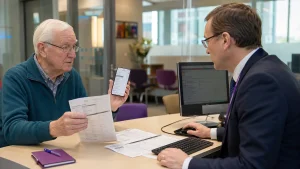
Treat an unexpected payment carefully, but do not assume that the transaction itself is fraudulent. A genuine DWP payment may be unfamiliar because it is a first payment, adjustment or backdated amount.
Take the following precautions:
- Do not spend or transfer the unexplained money.
- Check whether another holder of the account receives State Pension.
- Review recent DWP letters and previous bank transactions.
- Contact the Pension Service using contact details obtained directly from GOV.UK.
- Do not call a number contained in an unexpected message claiming to be from the DWP.
- Do not disclose your full bank password, card PIN or one-time security code.
- Contact your bank separately if the transaction is connected with other suspicious account activity.
If the DWP confirms that the payment was made incorrectly, ask for written repayment instructions. Do not return the money to bank details supplied through an unsolicited telephone call, email or text message.
Conclusion
DWP SP on a bank statement usually relates to a State Pension payment from the Department for Work and Pensions. In most cases, it will be a normal four-weekly deposit, but the amount can differ when the payment includes arrears, an adjustment or an initial partial period.
Check the amount against previous deposits, your State Pension notice and recent DWP correspondence. When the payment remains unexplained, leave the money untouched and contact the Pension Service through GOV.UK.
Recognising the reference is useful, but the bank code alone cannot confirm the reason for an individual payment.
Frequently Asked Questions
Is DWP SP a genuine payment?
DWP SP usually identifies a genuine State Pension payment from the Department for Work and Pensions. Check the amount against previous pension deposits and DWP correspondence if you do not recognise it.
Is DWP SP paid every month?
State Pension is normally paid every four weeks rather than on the same date each calendar month. This generally results in 13 payments over a 52-week year.
Why is my DWP SP payment larger than usual?
A larger payment may include State Pension arrears, a corrected underpayment, an annual increase or money covering a different payment period. Contact the Pension Service when the reason is not explained in your correspondence.
Can DWP SP appear in a joint account?
Yes. A person can have State Pension paid into an account in their own name, a joint account or another suitable nominated account. Ask the other account holders whether the payment belongs to them.
Is DWP SP taxable?
State Pension counts as taxable income, although tax is not normally deducted directly from the State Pension payment. Whether tax is owed depends on the recipient’s total taxable income.
What should I do if I received DWP SP by mistake?
Do not spend or transfer the money. Contact the Pension Service through the official GOV.UK contact details and ask them to confirm whether the payment belongs to you.
Can the DWP recover an incorrect payment?
The DWP may seek repayment when money has been overpaid, including in some cases where the payment resulted from an administrative error. Ask for written confirmation and official repayment instructions.
Note
This article provides general information about DWP SP payments and State Pension transactions shown on UK bank statements. It has been checked against current guidance published by GOV.UK, including information about State Pension payment schedules, claims and pension deferral.
Bank references may differ between banks, and the transaction code alone may not explain why a particular amount was paid. Readers should check their DWP correspondence or contact the Pension Service through the official GOV.UK contact details for information about an individual payment.
Last reviewed: 10.08.2026