

A new road safety strategy could change how elderly drivers stay on the road in Britain. Among the most discussed proposals is the introduction of mandatory eye tests for drivers over the age of 70, to be completed every three years. This would replace the long-standing system of self-declaration, which relies on individuals reporting their own health and vision changes.
The proposed changes follow serious concerns over road safety, particularly among elderly motorists, and aim to bring the UK in line with best practices already in place in other European countries.
Why Is the Government Planning Mandatory Eye Tests for Over-70s?
The planned changes are part of the government’s first full road safety strategy in over a decade. As the UK’s population ages, more drivers are continuing to drive well into their seventies and beyond. In 2024 alone, government figures showed that nearly one in four car drivers who died in accidents were aged 70 or older.
These statistics have raised questions about the adequacy of current driving fitness assessments. Currently, drivers are not required to undergo routine medical or vision checks once they’ve passed their initial test, regardless of age. At 70, a driver is simply asked to renew their licence every three years and self-certify that they are medically fit to drive, including meeting eyesight standards.
Ministers argue that while many older drivers are responsible and proactive, relying on self-assessment alone is no longer sufficient to ensure road safety.
How Do the Current Eyesight Rules for Driving Work?
The UK’s Driver and Vehicle Licensing Agency (DVLA) sets basic eyesight standards for all drivers. To drive legally, a person must be able to read a standard number plate from 20 metres away. In addition, drivers should have a visual acuity of at least 6/12 on the Snellen scale, either with or without glasses or contact lenses.
Currently, however, there is no legal requirement for drivers to take a vision test at licence renewal, even at 70 or older. Instead, the system depends on self-reporting, with drivers expected to tell the DVLA if their health or eyesight deteriorates to a point where it might affect their driving.
This approach has drawn widespread criticism, particularly after a number of fatal accidents were linked to drivers with known but undeclared vision issues.
What Are the Risks of Relying on Self-Reporting?
In 2025, an inquest in Lancashire drew national attention when four people were killed in collisions involving elderly drivers with unfit vision. The senior coroner, Dr James Adeley, described the self-reporting system as “ineffective and unsafe”, noting that it permits drivers to ignore medical advice or conceal vision issues from healthcare professionals.
One serious issue is that vision often deteriorates gradually. A person may not realise that their eyesight has fallen below the legal standard until it’s too late. There is also evidence that some individuals may knowingly ignore medical warnings and continue driving, either due to denial or fear of losing independence.
By introducing compulsory eye tests every three years for over-70s, the government hopes to catch these issues before they result in serious accidents.
What Would Driving Look Like for a 72-Year-Old in the Future?
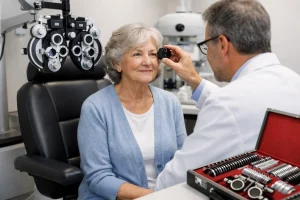
To understand how the proposed changes might work in practice, let’s consider a likely future scenario.
Margaret, a 72-year-old retired teacher from Preston, renews her licence as required every three years. Under the new law, as part of her renewal in 2027, she receives a letter from the DVLA reminding her to book an eyesight test at her local optician. She attends the appointment, where her vision is tested using a Snellen chart and a field-of-vision assessment.
Margaret has worn glasses for reading for years but has never considered whether her distance vision was affected. During the test, her optician finds that her distance vision has dropped below the legal requirement, something she hadn’t noticed. The optician updates her prescription, and within days she has a new pair of glasses that ensure she can drive safely.
Because the eye test was linked to her licence renewal, Margaret now has documented proof that her vision meets DVLA standards. She feels reassured, her family is more comfortable with her driving, and road safety is improved, all without any need for a full medical or driving test.
How Will NHS Eye Tests Support the New Requirements?

Many people over 70 are unaware that NHS eye tests are already free for those aged 60 and over. This means that cost should not be a barrier to complying with the proposed vision check requirements.
In England, Wales, and Northern Ireland, specific groups are entitled to NHS-funded eye tests based on age, income, or health conditions. In Scotland, the NHS offers free eye tests to everyone, regardless of age.
This infrastructure already exists, meaning that implementing a more formal testing requirement could be done without major changes to the healthcare system.
According to Edmund King, President of the AA, this change simply formalises what health professionals have long recommended: that everyone over 60 should have an eye test every two years, not just for driving but for early detection of other health conditions.
What Do Experts and Charities Say About the Eye Test Proposal?
Many in the medical and road safety communities welcome the proposed changes.
Dr Peter Hampson, from the Association of Optometrists, has warned that undetected vision deterioration can lead to slower reaction times and increased crash risk. He supports the move to regular testing and notes it will bring the UK closer to European standards.
The Royal Society for the Prevention of Accidents (RoSPA) has also supported the idea, stressing that the key is not to penalise drivers but to help them remain safe and independent for as long as possible.
However, not all believe this change alone is enough. Age UK has expressed cautious support, noting that while most older drivers are responsible, eyesight checks need to be part of a broader package of safety reforms. Charity director Caroline Abrahams also stressed that the loss of a driving licence could lead to social isolation, especially for those living in rural areas with limited public transport.
Will Eye Tests Be Extended to All Age Groups in the Future?
While the current focus is on drivers aged 70 and above, some experts argue that regular health or vision checks should apply to all drivers, not just older ones.
Robert Owens, 71, from Wrexham, is one such voice. He believes driving is a privilege that should come with ongoing responsibility, regardless of age. Describing cars as “lethal weapons,” he told reporters that he asks his optician every year whether he remains optically fit to drive and would stop immediately if advised otherwise.
This view is gaining traction, with some safety groups suggesting that more frequent vision and health checks could become part of UK driving regulations in the longer term.
Could These Changes Lead to Loss of Independence for Older Drivers?
One of the most delicate aspects of the reform is how it affects personal freedom. Driving is more than a convenience; for many older adults, it represents independence, autonomy, and connection to family and community.
Professor Andrew Steptoe of University College London warns that if more older people are required to give up driving, the government must ensure that they do not become socially isolated. This could include investment in community transport services, subsidised travel options, or support for volunteer driver schemes.
The new rules, he argues, must be balanced with support systems that help people transition away from driving when it is no longer safe without cutting them off from society.
Could Eye Tests Over 70 Truly Make the Roads Safer?
Ultimately, the proposed rule change aims to prevent accidents before they happen. While no measure can eliminate road risk entirely, regular, independent vision checks could help reduce collisions involving elderly drivers who are unaware of their declining eyesight.
As with any public policy, success will depend on clear communication, easy access to services, and a supportive approach that helps rather than punishes drivers.
If implemented, this reform could provide peace of mind for older drivers and their families, strengthen public confidence in road safety, and help the UK catch up with global best practices in elderly driver management.
Frequently Asked Questions
Will the new rules require a specific type of eye test?
Yes, the proposed reform would involve a standard vision check conducted by an optician, measuring visual acuity and field of vision. This may be linked directly to DVLA licence renewal.
Can a person still drive if they fail the eye test?
Only if the vision issue can be corrected, usually with updated glasses or lenses. If the problem cannot be resolved, the person may be deemed unfit to drive.
Are NHS eye tests really free for those over 70?
Yes. All UK residents aged 60 and over are eligible for free NHS eye tests, and in Scotland, everyone is entitled to free eye examinations regardless of age.
Do older drivers have to take a driving test again?
Not unless the DVLA requests it due to a medical condition or concern raised by a healthcare professional.
Will drivers be notified when it’s time to get their eyes tested?
If implemented, drivers over 70 would likely receive a reminder during their licence renewal process.
Could these rules apply to younger drivers in the future?
Some experts advocate expanding health checks to all drivers, but current proposals focus on those aged 70 and above.
What happens if a driver lies about their eyesight to the DVLA?
Falsifying medical information is a legal offence. If caught, it could result in fines, licence revocation, or legal prosecution.