
📌 Local Government Pay 2026/27: Quick Snapshot
Union Pay Claim
£3,000 or 10% (Greater of)
Minimum Hourly Rate
£15.00/hr
Additional Benefits
+1 Day Leave &
-2 Hr Work Week
Effective Date
1 April 2026
The proposed 2026/27 local government pay deal from UNISON, GMB, and Unite outlines a landmark claim aiming to reverse years of stagnation. If agreed, many full-time council employees could see a substantial rise in their base income, improved work-life balance, and enhanced recognition for their contribution to essential public services.
What Is the 2026/27 Local Government Pay Claim?
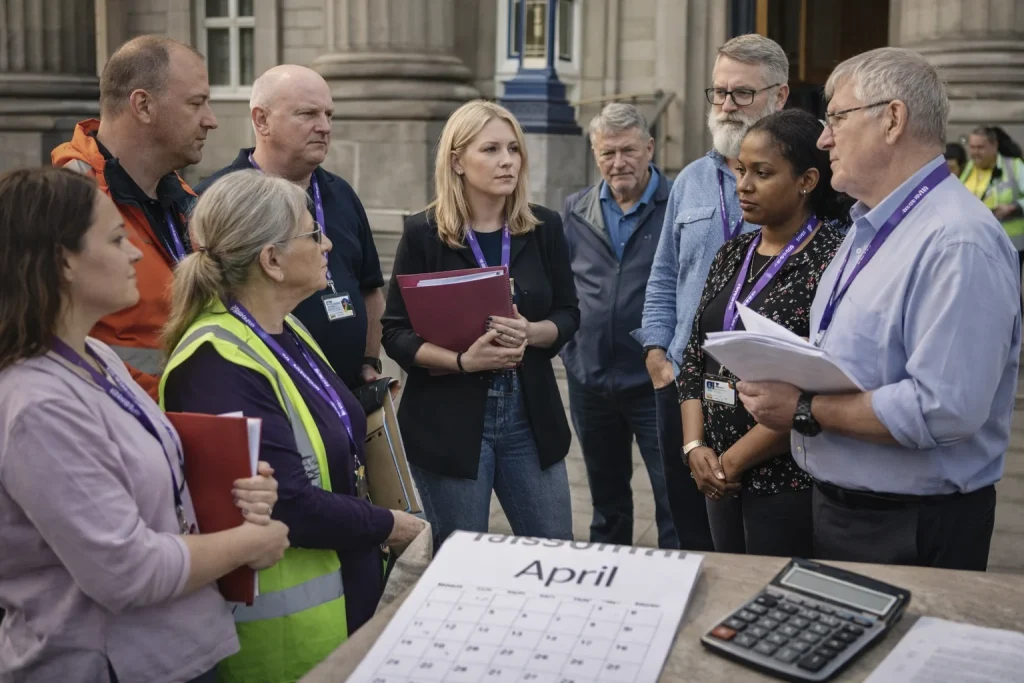
The 2026/27 local government pay claim is a formal request submitted by the three recognised National Joint Council (NJC) unions, UNISON, GMB and Unite, to local government employers. It applies to council staff and school support staff employed under NJC Green Book terms and conditions, covering more than one million workers across England, Wales and Northern Ireland.
At its core, the claim reflects a shared view among unions that previous pay settlements have failed to keep pace with inflation, workload pressures, and recruitment challenges. Over more than a decade, many local government roles have seen their real value decline, particularly at the lower end of the pay spine.
Rather than proposing a modest percentage increase, the unions have put forward a claim that they argue would begin to reverse long-term pay erosion. Importantly, this is a claim, not an agreed deal. Employers, represented nationally through the Local Government Association (LGA), are still consulting and have not yet made a counter-offer.
As one union representative put it during the submission period:
“This claim is about restoring fairness, not creating windfalls. Local government staff have absorbed years of cuts and rising expectations.”
When Was the Pay Claim Submitted and What’s the Expected Timeline?
The joint pay claim for the local government pay rise 2026/27 was formally submitted in late 2025, with most sources pointing to November and early December. This follows the standard National Joint Council (NJC) cycle, where claims are lodged months ahead of the new pay year.
The official pay year starts on 1 April 2026. Even if talks run beyond this date, any agreed pay award is normally backdated, which strongly shapes staff expectations.
Negotiations typically move through winter and early spring, as councils assess affordability and unions maintain pressure. A formal offer often appears between February and April, though delays are common.
| Stage | Expected Timing |
| Pay claim submitted | Nov–Dec 2025 |
| Negotiations ongoing | Winter–Spring 2026 |
| Pay year begins | 1 April 2026 |
| Likely offer window | Feb–Apr 2026 |
While the timetable is clear in theory, the final outcome for the 2026/27 pay rise will depend on how negotiations unfold in the months ahead.
What Are the Unions Demanding in Detail?
The unions’ demands for the local government pay rise 2026/27 are wide-ranging and deliberately structured to benefit both lower- and middle-paid staff. This is one of the three main sections where bullet points are used, to clearly set out the elements of the claim.
Pay Increase and Minimum Wage Proposal
- A pay increase of at least £3,000 or 10%, whichever is greater, applied across all NJC spinal column points
- Introduction of a £15 per hour minimum rate, ensuring the lowest-paid staff receive a significant uplift
- Application of the increase from 1 April 2026, with backdating once agreed
This flat-rate-or-percentage approach is designed to prevent lower-paid workers from falling further behind, while still delivering meaningful increases across the pay spine.
Working Time, Leave, and Staff Conditions
- A two-hour reduction in the standard working week, with no loss of pay
- One additional day of annual leave for all NJC staff
- Specific improvements for school support staff, including a day of paid leave during term time
Taken together, these proposals go beyond pay alone. They reflect a broader argument that recruitment, retention and wellbeing are inseparable from pay negotiations.
The table below summarises the core elements of the union claim:
| Claim Component | Union Proposal |
| Pay increase | £3,000 or 10% (whichever is greater) |
| Minimum hourly rate | £15 per hour |
| Working week | Two-hour reduction |
| Annual leave | One extra day |
| School staff | Paid term-time leave |
For many staff, the outcome of these demands will be a key test of whether pay negotiations can deliver meaningful improvements beyond headline figures.
Why Are the Unions Pushing for This Pay Rise?
The pressure behind the local government pay rise 2026/27 did not emerge overnight. Union arguments are rooted in long-term trends rather than short-term economic spikes. Many local government roles have seen pay increases that failed to match inflation over multiple years, resulting in significant real-terms losses.
Workloads have also intensified. Councils deliver increasingly complex services with fewer staff, particularly in areas such as adult social care, housing, environmental services and education support. At the same time, competition from the private sector has made recruitment and retention more difficult, especially for technical and specialist roles.
One UNISON negotiator involved in the submission described the mood bluntly:
“This isn’t just about inflation anymore. It’s about dignity at work. Staff are expected to do more with less, year after year.”
From the union perspective, a substantial claim is not a negotiating tactic but a reflection of accumulated pressures. They argue that anything less risks further hollowing out local government services.
Has the Employer Made an Official Pay Offer Yet?

As of early February 2026, no formal national pay offer has been made by employers for the local government pay rise 2026/27. This is not unusual at this stage of the process, but it does contribute to uncertainty among staff.
Employers, coordinated through the LGA, are still in the consultation phase. This involves gathering feedback from councils on affordability, assessing the impact of potential settlements, and considering the wider funding environment. Councils vary significantly in their financial positions, which makes forming a unified response challenging.
While unions have increased public messaging around the claim, employers have remained cautious. Behind the scenes, discussions are ongoing, but there is no confirmed timetable for an offer. This gap between claim and response is often where tension builds, particularly as April approaches.
How Do Council Budget Constraints Impact the Pay Talks?
Council finances are a central factor shaping the local government pay rise 2026/27. This is the second main section where bullet points are used, reflecting the complexity of the issue.
Local Authority Financial Challenges
Across the UK, councils are navigating an increasingly difficult fiscal environment. Key challenges include:
- Widening budget deficits, with many councils forecasting shortfalls exceeding several million pounds for the 2026/27 financial year
- Section 114 notices in some authorities, legally restricting new expenditure due to insolvency risk
- Soaring costs in core services such as adult social care, energy provision, and infrastructure maintenance, placing additional strain on budgets
These factors severely limit the flexibility councils have when considering higher pay awards, even if they support the principle of fairer wages.
Role of Central Government Funding
The ability of councils to meet union demands also hinges on the level of support, or lack thereof, from central government.
In particular:
- Uncertainty around government grants makes long-term financial planning extremely difficult
- Council tax increases, while being explored in many areas, are unlikely to generate the funding necessary for large-scale pay increases
- A pay deal approaching £3,000 per staff member or 10% may require emergency funding or national intervention to be viable across all councils
As one senior pay policy adviser at a metropolitan borough council explained:
“We want to reward staff, but we’re trying to plug a £15 million budget hole. Without help, choices become painfully stark.”
To illustrate how these financial challenges interact with the pay settlement process, the following table breaks down key pressures and their likely impact:
| Financial Pressure | Impact on Pay Settlement |
| Budget deficits | Limits scope for large increases |
| Funding uncertainty | Delays or prevents employer commitments |
| Rising service delivery costs | Competes with staff pay for limited funds |
| Inflation in supplies | Reduces real-term spending capacity |
In this context, the demand for a meaningful pay rise exists alongside growing concerns about affordability. While unions argue that now is the time for investment in the workforce, employers caution that without structural support, delivering such a settlement may be impossible for many councils.
Will the Pay Rise Be Backdated to April 2026?
Backdating is one of the most consistent features of NJC pay agreements, and the local government pay rise 2026/27 is expected to follow the same pattern. The official pay year begins on 1 April 2026, and any agreement reached later is normally applied from that date.
This means that once a settlement is agreed, councils typically issue a lump-sum payment covering the period from April to the implementation date. While this does not eliminate the frustration of delays, it does ensure staff eventually receive the full value of the award.
Based on previous years, agreements reached in late spring often result in back pay being processed between May and June, depending on payroll systems and local timetables.
What Happens If No Agreement Is Reached Soon?
If no agreement is reached in the early months of the pay year, pressure on all parties is likely to increase. Extended negotiations can test patience among staff and place unions under growing pressure to demonstrate progress.
This does not automatically lead to industrial action, but it can result in:
- Consultative or indicative ballots to gauge member support
- Increased campaigning to maintain visibility and momentum
- Stronger public messaging around recruitment and retention risks
For employers, prolonged uncertainty may:
- Affect staff morale and engagement
- Increase retention and vacancy pressures
- Complicated workforce and budget planning
Historically, spring is a pivotal phase. Agreements reached before summer are easier to absorb into council budgets, while extended delays tend to escalate tensions and reduce room for compromise on both sides.
What Should Local Government Workers Expect Next?
For most staff, the immediate future of the local government pay rise 2026/27 will involve waiting. Employer consultations are expected to conclude in early 2026, after which a formal response to the union claim may emerge.
Negotiations are likely to intensify as April approaches. Even if no deal is reached by the start of the pay year, backdating provides some reassurance. However, the scale of the union claim means that discussions will be complex and politically sensitive.
The key point is that nothing is final yet. The claim sets out what unions are demanding, not what staff will necessarily receive. The eventual outcome will depend on negotiation, funding decisions, and the balance of pressure applied by both sides.
Conclusion: Where the 2026/27 Pay Deal Stands?
The local government pay rise 2026/27 remains unresolved, but the direction of travel is clear. Unions are pushing for a settlement that addresses years of pay restraint, while employers face genuine financial constraints. Between these positions lies a complex negotiation shaped by budgets, politics and workforce pressures.
With the 1 April 2026 start date approaching, the coming months will be decisive. Whether the final agreement reflects the full scale of the union claim or a more modest compromise, it will set the tone for local government pay well beyond 2026.
Frequently Asked Questions
Will the local government pay rise 2026/27 be backdated to April?
Yes. NJC pay awards are normally backdated to 1 April, even if agreed later in the year.
Has an employer pay offer been made yet?
No formal national offer has been confirmed as of early February 2026.
How much are UNISON, GMB and Unite demanding?
They are seeking at least £3,000 or 10%, whichever is greater, plus a £15 minimum hourly rate and improved conditions.
Are school support staff included in the claim?
Yes. School support staff employed under NJC Green Book terms are covered, with specific proposals for term-time leave.
What happens if talks break down?
Negotiations may continue, or unions may consult members on next steps, including possible escalation.
Does Scotland follow the same pay deal?
No. Scotland has a separate agreement, with a confirmed 3.5% increase from April 2026 for certain staff.
When will staff see any increase in their payslip?
If a deal is agreed in spring, increases and back pay are typically processed in late spring or early summer.