
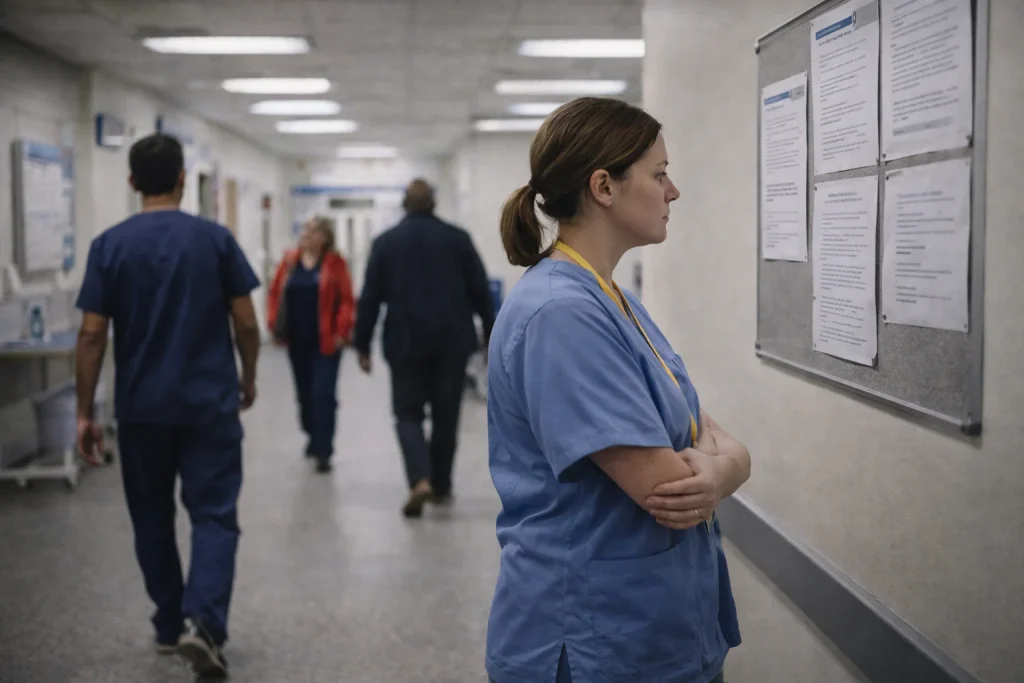
NHS Pay Rise 2026/27 – Current Position
Government Proposal
2.5% (Not Final)
Decision Timeline
Late Summer – Autumn 2026
Likely Payment
Late 2026 / Early 2027
Backdating
Expected from April 2026
Key Points Covered:
- Government proposes 2.5% pay rise (not final)
- Unions have rejected the figure as insufficient
- NHS Pay Review Body and DDRB reviewing evidence
- Pay award likely announced by late summer 2026
- Implementation expected late 2026 or early 2027
- Possible backdating to April 2026
- Speculative predictions suggest 3%+ may be possible
- Strong focus on inflation, affordability, and retention
What Is the Current Status of the NHS Pay Rise for 2026/27?

The NHS pay round for the 2026/27 financial year is actively progressing through the formal process involving independent review bodies.
In July 2025, the health secretary issued remit letters to both the NHS Pay Review Body (NHSPRB) and the Review Body on Doctors’ and Dentists’ Remuneration (DDRB), formally launching the pay round earlier than in previous years.By moving the timeline forward, the government intends to achieve pay awards and announcements in a more timely fashion than we have seen in recent cycles.
Both bodies are now compiling evidence from the Department of Health and Social Care (DHSC), NHS Employers, NHS Providers, unions, and other stakeholders.
The written evidence submitted by the government and NHS England is extensive and covers pay levels, workforce pressures, recruitment and retention challenges, as well as the broader financial context within which pay awards must be delivered.
A central feature of the 2026/27 review is the emphasis on affordability. Successive pay rounds had suffered delays and disputes due to late submissions and protracted negotiations. The government’s remit letter reflects a desire to reverse that trend by engaging review bodies earlier and prioritising faster recommendations.
Running parallel to this, unions have mounted criticisms of the existing system and, in several cases, chosen not to participate directly in the formal evidence submission process, opting instead to press for direct talks with ministers.
Overview of the NHS Pay Review Process 2026/27
| Stage | Description | Expected Timing |
| Government Submission | DHSC and NHS England submit written evidence to NHSPRB and DDRB | October 2025 |
| Evidence Gathering | Review bodies collect evidence from unions, employers, and stakeholders | Late 2025 – Spring 2026 |
| Review Body Reports | Independent recommendation reports published | Spring – Summer 2026 |
| Government Decision | Ministers consider recommendations and announce awards | Late Summer – Autumn 2026 |
| Implementation | New pay rates applied (likely backdated) | Late 2026 – Early 2027 |
This table sets out the principal stages that define the pay round timeline. It is important to appreciate that these timetable points reflect expectations based on historic patterns and the government’s stated intention to accelerate the overall process.
What Has the UK Government Proposed for the NHS Pay Rise 2026/27?
The government’s written evidence to the review bodies makes clear that it proposes a pay award of up to 2.5 per cent for NHS staff in the 2026/27 pay round. This figure applies to Agenda for Change staff (the majority of NHS employees, including nurses, allied health professionals, and support staff) as well as to doctors and dentists reviewed by the DDRB.
The proposal is framed primarily around departmental budget limits set out in the 2025 Spending Review, which restricts the funds available for pay settlements.
In its remit letter, the health secretary wrote that all pay must be funded from within existing departmental resources, and that there would be no additional funding made available specifically for pay uplifts.
The government’s cost pressures include not only pay awards but also the broader financial challenges facing the NHS, such as rising demand, service backlogs, industrial action costs, and the need to support digital transformation and recruitment initiatives.
The written evidence submitted to the NHSPRB runs to hundreds of pages and details these pressures alongside earnings data and workforce planning considerations.
A clear implication of this approach is that any recommendation above the proposed 2.5 per cent would require a reassessment by ministers of how additional funding could be accommodated.
This has major significance for the negotiating landscape because unions are arguing that the proposed level is insufficient given inflation, cost‑of‑living increases, and the need to make pay awards meaningful for staff on the lowest pay bands.
Government Pay Submission – Key Points
| Component | Content |
| Proposed Pay Increase | Up to 2.5% |
| Funding Source | Within existing departmental budgets (no additional funding) |
| Pay Bodies Involved | NHSPRB (Agenda for Change) & DDRB (Doctors/Dentists) |
| Government Emphasis | Timeliness and affordability |
| Workforce Pressures | Recruitment, retention, backlogs, industrial action costs |
This table highlights the government’s core parameters for the 2026/27 NHS pay round. By placing affordability at the centre, ministers have set a clear boundary around what they consider deliverable within current funding assumptions.
How Have NHS Unions Responded to the Proposed Pay Increase?

Unions representing NHS workers have been forthright in their criticism of the government’s proposed 2.5 per cent pay increase. Organisations such as UNISON, the Royal College of Nursing (RCN), and other health worker unions argue that this figure would equate to a real‑terms pay cut for many staff because it is insufficient to keep pace with inflation and rising living costs.
In several cases, unions have refused to participate directly in the formal evidence submission to the NHSPRB or DDRB, instead calling for formal negotiation talks with ministers.
UNISON’s position is that the Pay Review Body process is outdated and does not serve the interests of frontline staff effectively. The union has stated that bypassing direct talks with the government increases the risk of further disputes and industrial action, as well as contributing to low morale across the workforce.
The Royal College of Nursing, which joined forces with other unions in a joint letter to the government, has emphasised the need for formal pay reform discussions. The RCN has noted that ongoing pay erosion and stagnation have undermined staff confidence and that the current system does not provide a reliable way to secure fair awards.
From a professional standpoint:
“the central concern expressed by unions is that pay awards below inflation effectively reduce real incomes for NHS workers who are already facing significant cost pressures in their personal lives.”
Analysis of union positions suggests that any award that does not at least match inflation will be seen by many staff as inadequate, particularly for those in lower pay bands whose earnings are closer to the National Minimum Wage.
Union Concerns
- Pay below inflation erodes real income and morale
- Agenda for Change bands at risk of falling below statutory wage thresholds
- Call for direct negotiation with the government, bypassing review bodies
- Frustration with the pay review timeline and perceived delays
These points summarise the central arguments unions are making against the government’s proposed level of pay uplift.
What Are the Predicted NHS Pay Rise Figures for 2026/27?

At the time of writing, there is no official pay award confirmed for NHS staff in 2026/27 because the independent review bodies have not yet published their recommendations. Their reports are a key part of the process, and historically, these recommendations have carried weight in shaping the government’s final decision.
The government’s submission sets out a framework for a 2.5 per cent increase, but neither review body has yet made a formal recommendation.
Analysts and commentators have suggested that a figure somewhat higher than 2.5 per cent might eventually emerge from the independent bodies, especially in light of inflationary pressures and workforce shortages. However, such predictions remain speculative.
What is clear, based on past pay rounds, is that the independent review bodies consider a wide range of evidence, including earnings data, recruitment and retention statistics, and the financial context, before making their recommendations.
Their reports will likely include:
- Detailed analysis of current NHS pay structures
- Comparisons with public sector and private sector earnings
- Assessment of recruitment and retention pressures
- Consideration of inflation and cost‑of‑living impacts
Until these reports are published, any specific numbers should be treated as predictions rather than confirmed figures.
When Will the NHS Pay Rise for 2026/27 Be Paid?
The implementation and payment schedule for the 2026/27 pay award will follow a pattern similar to previous years, but with an emphasis on achieving more timely outcomes. Table 3 below outlines the likely stages from announcement to payment.
Expected Schedule for 2026/27 Pay Award Payment
| Milestone | Expected Timing | Activity |
| Review Body Reports | Spring – Summer 2026 | Independent recommendations published |
| Government Decision | Late Summer – Autumn 2026 | Final pay award announced |
| Payroll Implementation | Late 2026 – Early 2027 | Pay rates applied in payroll systems |
| Backdating Effective | 1 April 2026 | Award usually backdated to start of financial year |
In previous cycles, the final awards have been backdated to the beginning of the financial year, which is 1 April. Payroll systems then reflect those awards in the months following the government announcement.
The intention to bring forward the timeline for pay review reporting and final decisions suggests that staff could see their pay packets updated earlier than in some recent years.
From my perspective, ensuring that pay increases are paid quickly after being agreed is crucial for staff confidence. Delayed payments can undermine trust in the process and create practical difficulties for employees who plan household budgets around expected income changes.
This timetable closely mirrors the historic framework but reflects a renewed priority on speed and clarity in applying pay awards.
What Happens Next in the NHS Pay Negotiation Process?

Once all evidence has been submitted and reviewed by the independent bodies, the next steps are as follows:
- The NHSPRB and DDRB complete their assessment of all submissions and publish recommendation reports.
- These reports go to the UK government, which considers them alongside affordability and other fiscal constraints.
- Ministers then announce the final pay award and outline any accompanying guidance on implementation.
- Employers across the NHS begin the process of rolling out new pay rates through payroll systems and communicating changes to staff.
A key difference this year is the concerted effort to move the timeline forward. By issuing remit letters earlier and seeking cooperation from review bodies on scheduling, the government hopes to make the whole cycle more predictable and timely. That said, the influence of ongoing union dissatisfaction and calls for direct negotiation may complicate how smoothly future rounds proceed.
Conclusion
The NHS pay rise for 2026/27 is still being negotiated through the formal review bodies. While the government’s initial submission points to a 2.5% rise, this is not final and may change once independent recommendations and union negotiations are complete.
The implementation is likely later in 2026, potentially backdated to April of that year, but exact details are yet to be confirmed.
From my perspective, the priority should be a pay award that recognises both the inflationary climate and the long‑term challenges NHS staff face, not merely a headline figure that fails to reverse years of real‑terms pay decline.
Frequently Asked Questions About the NHS Pay Rise 2026/27
When will the NHS pay rise for 2026/27 be announced?
The government and independent review bodies are expected to complete their review and make recommendations by summer 2026, with a final announcement likely in late summer or autumn 2026.
Is the government’s 2.5% suggestion the final amount?
No. The 2.5% figure is a government submission to review bodies, not a final award. Independent recommendations and the final government decision may differ.
Will the pay rise be backdated?
If a pay award is agreed, it is typically backdated to 1 April of the financial year it relates to, with implementation following in pay runs a few months later.
Are doctors’ pay awards handled differently?
Doctors and dentists have their pay reviewed by the Review Body on Doctors’ and Dentists’ Remuneration (DDRB), a separate independent body that makes recommendations to the government.
Why are unions unhappy with the proposal?
Unions argue that a 2.5% increase would be below inflation and insufficient to ensure many NHS roles remain above the National Minimum Wage and competitive with other sectors.
What jobs are covered by Agenda for Change?
Agenda for Change covers most NHS staff outside doctors, dentists, and senior managers, including nurses, therapists, allied health professionals and support workers and sets pay bands and progression structures.
Could there be strikes if the pay rise is too low?
While industrial action is unpredictable, historically, dissatisfaction with pay awards that lag inflation and the cost of living has contributed to NHS strikes and disputes.
{
“@context”: “https://schema.org”,
“@type”: “FAQPage”,
“mainEntity”: [
{
“@type”: “Question”,
“name”: “When will the NHS pay rise for 2026/27 be announced?”,
“acceptedAnswer”: {
“@type”: “Answer”,
“text”: “The government and independent review bodies are expected to complete their reviews by summer 2026, with a final NHS pay announcement likely in late summer or autumn 2026.”
}
},
{
“@type”: “Question”,
“name”: “Is the government’s 2.5% suggestion the final amount?”,
“acceptedAnswer”: {
“@type”: “Answer”,
“text”: “No, the 2.5% figure is a government submission to independent review bodies and not a final decision. The eventual pay award may be higher or lower.”
}
},
{
“@type”: “Question”,
“name”: “Will the pay rise be backdated?”,
“acceptedAnswer”: {
“@type”: “Answer”,
“text”: “If agreed, NHS pay rises are usually backdated to 1 April of the relevant financial year, with payments made once new rates are implemented.”
}
},
{
“@type”: “Question”,
“name”: “Are doctors’ pay awards handled differently?”,
“acceptedAnswer”: {
“@type”: “Answer”,
“text”: “Yes, doctors’ and dentists’ pay is reviewed separately by the Review Body on Doctors’ and Dentists’ Remuneration, which makes independent recommendations to the government.”
}
},
{
“@type”: “Question”,
“name”: “Why are unions unhappy with the proposal?”,
“acceptedAnswer”: {
“@type”: “Answer”,
“text”: “Unions argue that a 2.5% increase would be below inflation and may not keep some NHS roles above the National Minimum Wage or competitive with other sectors.”
}
},
{
“@type”: “Question”,
“name”: “What jobs are covered by Agenda for Change?”,
“acceptedAnswer”: {
“@type”: “Answer”,
“text”: “Agenda for Change covers most NHS staff apart from doctors, dentists and senior managers, including nurses, allied health professionals, therapists and support staff.”
}
},
{
“@type”: “Question”,
“name”: “Could there be strikes if the pay rise is too low?”,
“acceptedAnswer”: {
“@type”: “Answer”,
“text”: “Industrial action cannot be predicted, but historically, NHS disputes and strikes have been linked to pay awards that fall behind inflation and living costs.”
}
}
]
}
{
“@context”: “http://schema.org/”,
“@type”: “Article”,
“mainEntityOfPage”: {
“@type”: “WebPage”,
“@id”: “https://www.prestonblog.co.uk/nhs-pay-rise-2026-27/”
},
“author”: {
“@type”: “Person”,
“name”: “Jasmine”
},
“publisher”: {
“@type”: “Organization”,
“name”: “Preston Blog”,
“logo”: {
“@type”: “ImageObject”,
“url”: “https://www.prestonblog.co.uk/wp-content/uploads/2025/12/Preston-Blog-Logo.png”
}
},
“headline”: “NHS Pay Rise 2026/27: Expected Increase, Timeline, and Key Details”,
“image”: “https://www.prestonblog.co.uk/wp-content/uploads/2026/01/NHS-Pay-Rise-202627-Expected-Increase-Timeline-and-Key-Details.webp”,
“datePublished”: “2026-01-24”,
“dateModified”: “2026-01-24”
}