
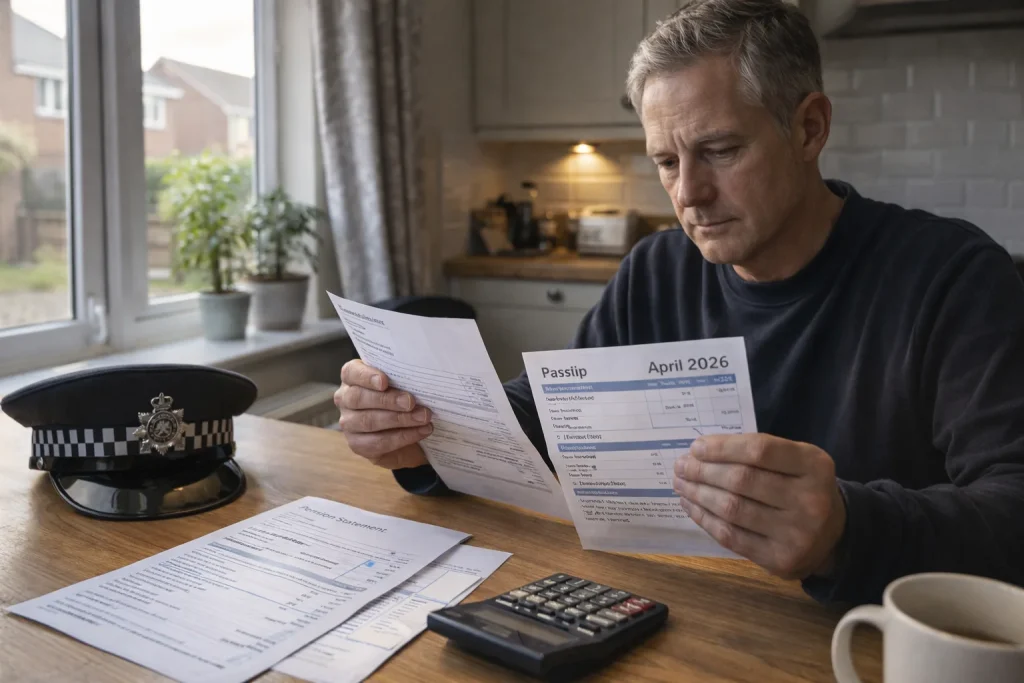
📊 POLICE PENSION INCREASE 2026 – CPI UPDATE CONFIRMED
The 2026 uplift ensures police pensions in payment continue to rise in line with inflation under the statutory CPI-linked review process. Formal confirmation is expected via the Pensions Increase (Review) Order in March 2026.
Quick Overview:
💷 Who Qualifies: Police pensions currently in payment (including ill-health and survivor pensions)
📅 Application Date: Automatically applied to the April 2026 pension payroll
⚖️ Pro-Rata Rule: If your pension has been in payment for less than 12 months, a partial increase may apply
📑 Confirmation Timeline: Draft Order expected early 2026, final approval typically in March
At-A-Glance Summary:
- Increase Rate: 3.8%
- CPI Reference Period: 12 months to September 2025
- Payment Effective Date: 6 April 2026
- Eligibility: Pensions in payment (generally from age 55+)
- Action Required: None – applied automatically
The CPI figure determines the uplift – the March Order simply formalises it.
This 2026 police pension update outlines who qualifies for the 3.8% uplift, how pro-rata rules may affect recent retirees, and what to check in your April payslip.
What is the Police Pension Increase For 2026 Expected to Be?
The expected police pension increase for 2026 is 3.8%, based on the Consumer Prices Index (CPI) for the year ending September 2025.
Under long-standing legislation, including the Pensions (Increase) Act 1971 and related social security provisions, public sector pensions in payment are increased each April in line with the CPI figure from the previous September. In October 2025, the Office for National Statistics confirmed CPI stood at 3.8% for the relevant 12-month period.
This means that, unless there is an unexpected change during the formal approval process, police pensions in payment are set to rise by 3.8% from 6 April 2026.
A senior pensions official recently summarised the position clearly:
“The CPI figure published in October provides the basis for next April’s pension increase. Once confirmed through the Pensions Increase Order, schemes apply the uplift automatically.”
For many retired officers, this is a welcome improvement on the previous year’s more modest increase. While inflation remains below the peaks seen in earlier cost-of-living pressures, a 3.8% uplift still provides meaningful protection against rising household bills.
When will the Police Pension Increase be Applied in 2026?

The increase is expected to take effect from 6 April 2026, which aligns with the start of the new tax year.
Public sector pension increases are normally applied from the first Monday after 5 April. In 2026, that date falls on 6 April. Your April pension payment should therefore reflect the uplift.
Although the CPI figure is known in October 2025, the increase is formally confirmed through the Pensions Increase (Review) Order, usually approved by Parliament around March 2026. After that, pension administrators implement the adjustment.
You do not need to apply for the increase. It is applied automatically to eligible pensions in payment. You should see the updated amount in your April 2026 payslip or pension notification.
If you use an online member portal, such as your scheme’s Member Self Service platform, you may also be able to view the revised annual figure there once the April payroll has been processed.
Who Will Get The 2026 Police Pension Increase?
Not every member of a police pension scheme receives the full uplift immediately. Eligibility depends on your age, retirement status and the type of pension you receive.
Pensions In Payment
If you are already receiving your police pension, you will normally qualify for the 3.8% increase from April 2026.
This includes:
- Standard service retirement pensions
- Ill-health retirement pensions
- Injury benefit pensions
- Survivor pensions in payment
The key condition is that your pension must be “in payment”. Deferred pensions that have not yet come into payment are treated differently until they are drawn.
Ill-Health And Survivor Pensions
If you retired on ill-health grounds, the increase generally applies regardless of age. Similarly, widow, widower, civil partner and eligible dependant pensions typically receive the same CPI-based uplift.
Recent parliamentary engagement on police survivors’ pensions has reinforced the importance of maintaining inflation protection. One campaign representative commented:
“For widows and widowers, index-linking is not a technical detail, it is essential financial stability.”
Age 55 Rule And Deferred Members
For many officers, police pensions become index-linked from age 55. If you are under 55 and drawing a pension (other than ill-health or survivor benefits), the increase may not be applied until your 55th birthday.
If you are due to turn 55 during the 2026–27 financial year, your administrator will normally calculate a part-month or part-period adjustment.
If your pension has been in payment for less than 12 months by April 2026, you will usually receive a pro-rata increase, meaning only part of the full 3.8% uplift.
Does the Increase Apply to the 1987, 2006 and 2015 Police Pension Schemes?
The police pension increase 2026 applies across the main police pension schemes in the UK, but the way it affects your benefits may differ slightly depending on which scheme you belong to.
The three principal schemes are:
- Police Pension Scheme 1987 (PPS 1987)
- Police Pension Scheme 2006 (PPS 2006)
- Police Pension Scheme 2015 (CARE scheme)
If you are receiving a pension under any of these schemes and it is in payment, the CPI-based uplift generally applies.
The 2015 scheme operates on a Career Average Revalued Earnings (CARE) basis. While you are an active member, your accrued pension is revalued annually under scheme rules. Once your pension comes into payment, it is increased in line with CPI like other public service pensions.
This distinction between “revaluation” (while active or deferred) and “index-linking” (once in payment) is often misunderstood. However, once you are drawing your pension, the annual April increase is aligned with CPI across schemes.
How is the 3.8% Figure Calculated and Can It Still Change?
Understanding how the 3.8% figure is determined helps clarify why it is widely considered reliable – but not formally final until early 2026.
September CPI And the Inflation Measure
The Consumer Prices Index measures the average change in prices for goods and services across the UK. Each September, the Office for National Statistics publishes the 12-month inflation rate.
For September 2025, CPI stood at 3.8%. Under statutory arrangements, this is the figure used to determine April 2026 pension increases.
In practical terms, this means the 2026 uplift reflects inflation experienced between October 2024 and September 2025.
Pensions Increase (Review) Order Process
Although CPI provides the calculation basis, the increase must be confirmed through the Pensions Increase (Review) Order, laid before Parliament and approved early in the new year.
The usual process is:
- October: CPI announced
- January/February: Draft Pensions Increase Order prepared
- March: Parliamentary approval
- April: Increase applied to pensions
It is extremely rare for the government to deviate from the published CPI figure for public sector pensions.
As one pensions policy adviser explained:
“Once CPI is confirmed in October, the direction of travel is clear. The legal mechanism in March formalises what has already been established.”
How Much More Money will You Receive After the 2026 Increase?
A 3.8% increase may sound modest, but the actual monetary difference depends on your annual pension amount.
Below is an illustration of how the expected police pension increase 2026 could affect different pension levels.
Pension Increase Table At 3.8%:
| Current Annual Pension | 3.8% Annual Increase | New Annual Pension | Approx. Monthly Increase |
| £10,000 | £380 | £10,380 | £31.67 |
| £15,000 | £570 | £15,570 | £47.50 |
| £20,000 | £760 | £20,760 | £63.33 |
| £25,000 | £950 | £25,950 | £79.17 |
| £30,000 | £1,140 | £31,140 | £95.00 |
These figures are gross amounts before tax. Your net increase will depend on your personal tax position.
Real-Life Example:
Consider David, a retired sergeant receiving a £22,000 annual pension. With a 3.8% uplift, his annual pension would increase by £836, taking it to £22,836. That equates to roughly £69.67 extra per month before tax.
For David, that additional income helps offset higher energy bills and council tax costs. While it may not fully match rising expenses, it preserves the real value of his pension.
What Happens If Your Pension Has Been In Payment For Less Than A Year?

If your pension began less than 12 months before 6 April 2026, you will likely receive a pro-rata increase.
This means the uplift is applied proportionally based on how long your pension has been in payment during the relevant period.
For example, if your pension started in October 2025, you would typically receive around half of the full 3.8% increase in April 2026. By April 2027, you would receive the full CPI-based uplift.
Your pension administrator calculates this automatically. You do not need to request it.
How Does The 2026 Police Pension Increase Compare With The State Pension And Other Changes?
It is important not to confuse the police pension increase with other financial changes occurring in 2026.
State Pension Increase 2026
The State Pension is expected to rise by 4.8% from April 2026 under the triple lock mechanism. This figure is higher than 3.8% because it reflects earnings growth rather than CPI.
The State Pension and police pension are separate systems. You may receive both, but each is calculated differently.
Police Federation Subscription Changes
From 1 January 2026, Police Federation member subscriptions are increasing by £2 per month. This change affects serving officers and membership fees, not pension payments.
The Federation explained:
“These changes are about securing long-term support and representation for members, not altering pension entitlements.”
It is understandable that some online discussions blend these announcements together, but they relate to entirely different financial arrangements.
What Should You Do If Your 2026 Pension Increase Looks Incorrect?

If your April 2026 pension payment does not reflect the expected uplift, remain calm and review the details carefully.
Common reasons for apparent discrepancies include:
- You are under 55 and not yet eligible for index-linking
- Your pension started within the previous 12 months (pro-rata applies)
- Tax code adjustments have altered your net payment
- Survivor or ill-health provisions are calculated differently
First, check your April payslip or pension statement. Compare your new annual amount to your previous figure.
If you believe there is an error, contact your pension administrator directly. Keep copies of relevant correspondence and previous statements.
Underpayment cases do occur occasionally. As seen in previous police pension administration updates, members are entitled to repayment with interest if an underpayment is confirmed.
Could Future Inflation Affect the Police Pension Increase Beyond 2026?
Yes. The police pension increase is reviewed annually, meaning your pension will continue to rise in line with CPI each April.
To illustrate how CPI has influenced pension increases in recent years, consider the following overview:
Recent CPI-Based Pension Increases:
| Year Applied | CPI (Previous September) | Pension Increase |
| 2022 | 3.1% | 3.1% |
| 2023 | 10.1% | 10.1% |
| 2024 | 6.7% | 6.7% |
| 2025 | 1.7% | 1.7% |
| 2026 (Expected) | 3.8% | 3.8% |
Inflation can fluctuate significantly from year to year. The key advantage of CPI index-linking is that it maintains the purchasing power of your pension over the long term.
While no system perfectly offsets all cost pressures, the statutory framework underpinning public sector pensions ensures regular review and adjustment.
Conclusion
The police pension increase 2026 is expected to be 3.8% from 6 April 2026, based on the September 2025 CPI figure.
If your pension is already in payment and you meet the age or eligibility requirements, the uplift should be applied automatically in your April 2026 payment. If your pension began less than a year earlier, you will likely receive a pro-rata adjustment.
Formal confirmation will typically come through the Pensions Increase (Review) Order in March 2026. However, based on established practice and the published CPI data, the 3.8% increase is widely anticipated.
Ultimately, this annual adjustment helps ensure your police pension continues to reflect inflation and retain its real-world value, providing financial stability throughout retirement.
Frequently Asked Questions
How do you know the police pension increase rate before April 2026?
The rate is based on the CPI figure for the 12 months to September 2025, published in October 2025. Although formal confirmation comes later, the CPI figure determines the increase.
Will the 2026 increase be backdated if confirmed in March?
No backdating is usually required. The increase is applied from 6 April 2026 once formally approved.
Does the 3.8% uplift apply to survivor pensions?
Yes, survivor pensions in payment are generally increased in line with CPI each April.
If you retire in early 2026, will you get the full increase?
If your pension has been in payment for less than 12 months by April 2026, you will normally receive a pro-rata increase rather than the full 3.8%.
Are police pensions increased in the same way across the UK?
Police pensions across England, Wales, Scotland and Northern Ireland follow similar CPI-based uprating principles, though administration may differ slightly.
Does the increase apply to lump sum payments?
Annual CPI increases apply to pensions in payment, not to lump sums already taken at retirement.
What should you do if you do not receive a payslip or notification?
Check your pension administrator’s online portal. If necessary, contact the administrator directly to request documentation or clarification.
{
“@context”: “https://schema.org”,
“@graph”: [
{
“@type”: “BlogPosting”,
“@id”: “https://www.prestonblog.co.uk/police-pension-increase-2026#blogposting”,
“mainEntityOfPage”: {
“@type”: “WebPage”,
“@id”: “https://www.prestonblog.co.uk/police-pension-increase-2026”
},
“headline”: “Police Pension Increase 2026 – How Much Will Rates Rise And When?”,
“image”: “https://www.prestonblog.co.uk/wp-content/uploads/2026/02/Police-Pension-Increase-2026.webp”,
“datePublished”: “2026-02-20”,
“dateModified”: “2026-02-20”,
“author”: {
“@type”: “Person”,
“name”: “Jennifer”
},
“publisher”: {
“@type”: “Organization”,
“name”: “Preston Blog”,
“logo”: {
“@type”: “ImageObject”,
“url”: “https://www.prestonblog.co.uk/wp-content/uploads/2025/12/Preston-Blog-Logo.png”
}
}
},
{
“@type”: “FAQPage”,
“@id”: “https://www.prestonblog.co.uk/police-pension-increase-2026#faq”,
“mainEntity”: [
{
“@type”: “Question”,
“name”: “How do you know the police pension increase rate before April 2026?”,
“acceptedAnswer”: {
“@type”: “Answer”,
“text”: “The rate is based on the CPI figure for the 12 months to September 2025, published in October 2025. Although formal confirmation comes later, the CPI figure determines the increase.”
}
},
{
“@type”: “Question”,
“name”: “Will the 2026 increase be backdated if confirmed in March?”,
“acceptedAnswer”: {
“@type”: “Answer”,
“text”: “No backdating is usually required. The increase is applied from 6 April 2026 once formally approved.”
}
},
{
“@type”: “Question”,
“name”: “Does the 3.8% uplift apply to survivor pensions?”,
“acceptedAnswer”: {
“@type”: “Answer”,
“text”: “Yes, survivor pensions in payment are generally increased in line with CPI each April.”
}
},
{
“@type”: “Question”,
“name”: “If you retire in early 2026, will you get the full increase?”,
“acceptedAnswer”: {
“@type”: “Answer”,
“text”: “If your pension has been in payment for less than 12 months by April 2026, you will normally receive a pro-rata increase rather than the full 3.8%.”
}
},
{
“@type”: “Question”,
“name”: “Are police pensions increased in the same way across the UK?”,
“acceptedAnswer”: {
“@type”: “Answer”,
“text”: “Police pensions across England, Wales, Scotland and Northern Ireland follow similar CPI-based uprating principles, though administration may differ slightly.”
}
},
{
“@type”: “Question”,
“name”: “Does the increase apply to lump sum payments?”,
“acceptedAnswer”: {
“@type”: “Answer”,
“text”: “Annual CPI increases apply to pensions in payment, not to lump sums already taken at retirement.”
}
},
{
“@type”: “Question”,
“name”: “What should you do if you do not receive a payslip or notification?”,
“acceptedAnswer”: {
“@type”: “Answer”,
“text”: “Check your pension administrator’s online portal. If necessary, contact the administrator directly to request documentation or clarification.”
}
}
]
}
]
}