As of May 28, 2026, Lloyds Banking Group continues to reduce its high street branch network across England, Scotland, and Wales. The banking group, which includes Lloyds Bank, Halifax, and Bank of Scotland, has confirmed further branch closures throughout 2026 as more customers move toward online and mobile banking services.
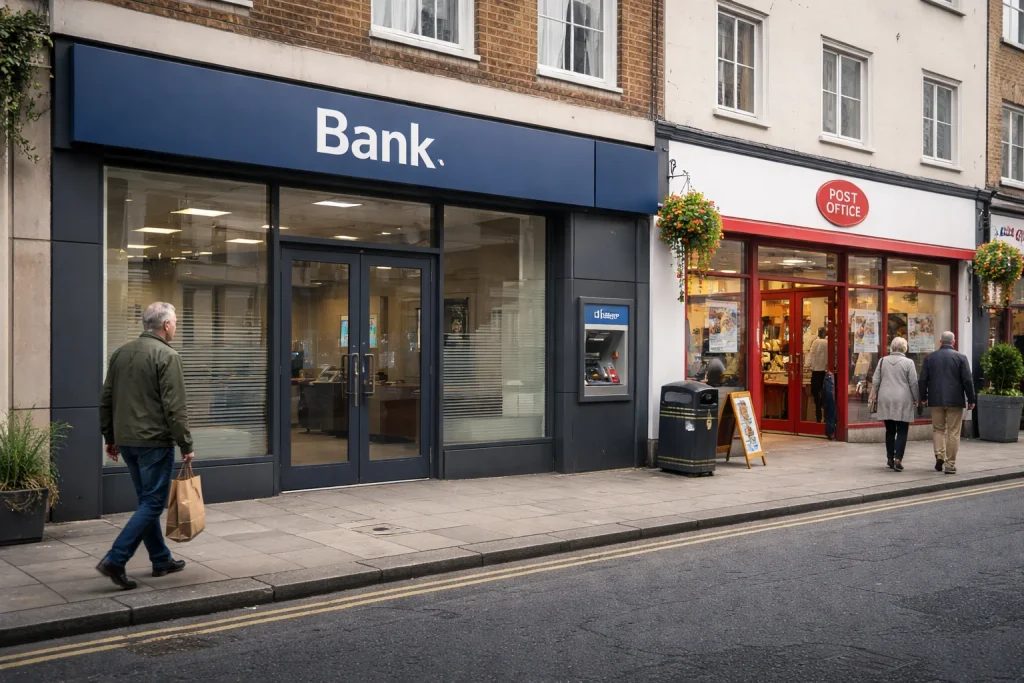
Recent announcements show that dozens of branches are either already closed or scheduled to shut over the coming months. Many affected customers are now being redirected toward Post Office banking services, shared Banking Hubs, and digital support channels.
The latest closure wave forms part of a wider trend affecting banks across the UK, with major lenders continuing to scale back physical branch operations due to declining in-person transactions and rising digital banking usage.
Key Lloyds Bank Closure Highlights:
- Lloyds Banking Group continues branch closures across the UK in 2026
- Lloyds, Halifax, and Bank of Scotland branches are all affected
- Many closures are linked to lower in-branch customer visits
- Customers are increasingly being redirected to Post Office services
- Banking Hubs and Community Bankers are being introduced in some areas
- More branch closure announcements are expected later in 2026
What Is the Official Reason Behind These Branch Closures?
Lloyds Banking Group, which includes Lloyds Bank, Halifax and Bank of Scotland, has explained that the ongoing branch closures reflect a long‑term shift in how customers choose to bank.
More and more people now prefer to carry out everyday tasks such as checking balances, paying bills, or transferring money through mobile apps or online platforms, a trend that has accelerated significantly over the past decade.
The group has said that, in some of the branches set to close, footfall and transaction volumes have declined sharply as customers move towards digital services.
Alongside this structural shift in behaviour, Financial Conduct Authority (FCA) requirements mean banks must also consider how closures will affect local access to essential services such as cash withdrawal and deposits before they proceed with shutting a branch.
Crucially, Lloyds positions these closures as part of a broader reconfiguration of its customer services, not a simple retreat from the high street.
The bank has emphasised that it aims to offer customers a mix of digital, telephone and in‑person options, and in some cases establishes alternative local support such as Community Bankers, Banking Hubs or extended services through shared partner locations.
How Is Lloyds Banking Group Planning to Support Customers Who Lose Their Local Branch?
Lloyds has stated that it follows FCA guidance when planning branch closures, which includes assessing the impact on customers and evaluating how essential services such as access to cash will continue in affected areas.
When a branch closes, customers are increasingly encouraged to use digital tools and telephone banking to manage their accounts. However, recognising that some people, particularly older customers and those who are not comfortable online, still value face‑to‑face interaction, Lloyds may send a Community Banker to visit local customers after closure.
In certain areas, the bank or its partners may also establish a Banking Hub or Deposit Service nearby to retain some physical access to everyday banking.
One Post Office employee in Preston, when I asked about these closures, shrugged and said:
“We’ve seen more people walking through our doors since the bank announced it was shutting. Some are relieved they can still sort out their cash here, others are frustrated that they have to make the trip at all.”

What Does “Co‑Servicing” Mean for Customers?
Part of Lloyds’ strategy to reshape its retail network involves a concept called co‑servicing. This essentially means that customers holding accounts with any of the group’s brands, Lloyds Bank, Halifax or Bank of Scotland, can be served at any of those branches.
Whether someone banks with Lloyds in one town and Halifax in another, co‑servicing aims to allow access to services across all three brands without requiring separate accounts or relationships.
According to the official guidance on branch closures from Lloyds Bank, this integrated approach is intended to give customers “more ways you can manage any personal accounts you have with Lloyds, Halifax or Bank of Scotland in one place”, whether online, over the phone, or in person.
In my conversations with people at the Preston Post Office and local library, one retiree said:
“I’m all for apps if they work, but when it comes to explaining something tricky, I want someone in front of me. I’m not sure a Community Banker or shared hub will feel the same.”
Latest Lloyds Bank Branch Closures and Closure Status Updates
The latest Lloyds Bank closures announced throughout 2026 continue to affect branches across England, Scotland, and Wales. Lloyds Banking Group, which also includes Halifax and Bank of Scotland, says the reductions are part of its wider transition toward digital banking services and lower in-branch customer demand.
Several locations are currently included within the latest branch closure programme, while others remain under ongoing review as Lloyds continues assessing customer usage trends and branch performance.
| Branch Area | Closure Status | Alternative Banking Access |
| Preston | Included in current 2026 closure programme | Post Office services available |
| Moston | Scheduled branch closure review | Nearby shared banking access |
| Totton | Closure programme confirmed | Community Banker support |
| Penzance | Included in latest Lloyds closure wave | Banking Hub alternatives |
| Stamford | Under ongoing branch review | Nearby Lloyds branch services |
Customers are advised to regularly monitor official Lloyds branch review documents for the latest updates, closure timings, and replacement banking support available in their area.
Which Bank Branches Are Closing? Full A–Z List With Links

The table below includes the latest confirmed Lloyds Bank branch closures announced across the UK as of May 2026. It includes affected towns, branch locations, expected closure timings, and links to official branch review documents where available.
Because Lloyds Banking Group continues to update its closure programme throughout the year, customers are advised to regularly check official branch review documents for any timetable changes or additional announcements.
A–Z Lloyds Bank Branch Closures With Review Documents
| Branch Name | Brand | Address / Location |
| Gillingham (Dorset) | Lloyds | High Street, Gillingham, Dorset SP8 4AQ |
| Totnes | Lloyds | 31 Fore Street, Totnes, Devon TQ9 5HH |
| Bideford | Lloyds | 5 High Street, Bideford, Devon EX39 2AD |
| Fleet | Lloyds | 174 Fleet Road, Fleet, Hampshire GU51 4DD |
| Chester-Le-Street | Lloyds | 81-85 Front Street, County Durham DH3 3AJ |
| Ivybridge | Lloyds | 13 Fore Street, Ivybridge, Devon PL21 9AD |
| New Addington | Lloyds | 13 Central Parade, New Addington, Surrey CR0 0JB |
| Alfreton | Lloyds | 21 High Street, Alfreton, Derbyshire DE55 7DR |
| Havant | Lloyds | 4 West Street, Havant, Hampshire PO9 1PE |
| Lewes | Lloyds | 8 High Street, Lewes, East Sussex BN7 2AD |
| Swadlincote | Lloyds | 59 High Street, Swadlincote, Derbyshire DE11 8JA |
| Petersfield | Lloyds | 5 The Square, Petersfield, Hampshire GU32 3HL |
| Penzance | Lloyds | Market House, Penzance, Cornwall TR18 2TN |
| Southampton – Hedge End | Lloyds | St John’s Centre, Hedge End, Southampton SO30 4QU |
| Deal | Halifax | High Street, Deal, Kent |
| Hedon | Lloyds | 25 St Augustines Gate, Hedon, East Yorkshire HU12 8EU |
| Thornbury (Avon) | Lloyds | 5 High Street, Thornbury, Gloucestershire BS35 2AE |
| Leominster | Lloyds | 9 Corn Square, Leominster, Herefordshire HR6 8LT |
| Peterlee – Yoden Way | Lloyds | 31 Yoden Way, Peterlee, County Durham SR8 1AW |
| Peterlee | Halifax | Yoden Way, Peterlee, County Durham |
| Hucknall | Lloyds | 5 High Street, Hucknall, Nottinghamshire NG15 7HQ |
| Brigg | Lloyds | 69 Wrawby Street, Brigg, Lincolnshire DN20 8JG |
| Caterham | Lloyds | 21 Station Avenue, Caterham, Surrey CR3 6YT |
| Glossop | Lloyds | 2 High Street East, Glossop, Derbyshire SK13 8DA |
| Tunstall | Lloyds | Tower Square, Tunstall, Stoke-on-Trent ST6 5DL |
| Houghton-le-Spring | Lloyds | 33 Newbottle Street, Tyne and Wear DH4 4AP |
| Manchester Moston | Lloyds | 276 Moston Lane, Moston, Greater Manchester M40 9WB |
| Seaton | Lloyds | The Square, Seaton, Devon EX12 2QH |
| Sleaford | Lloyds | 2 Northgate, Sleaford, Lincolnshire NG34 7BL |
| Wymondham | Lloyds | 4 Market Place, Wymondham, Norfolk NR18 0AG |
| Okehampton | Lloyds | Fore Street, Okehampton, Devon EX20 1HJ |
| Falmouth | Lloyds | 11-12 Killigrew Street, Falmouth, Cornwall TR11 3RA |
| Glossop | Lloyds | 2 High Street East, Glossop, Derbyshire SK13 8DA |
| Mitcham | Lloyds | 9 Majestic Way, St Marks Place, Mitcham, Surrey CR4 2JS |
| Ammanford | Lloyds | 19 Quay Street, Ammanford, Carmarthenshire SA18 3DB |
The full list continues below in the same format for all remaining towns named in the official Lloyds list.
Upcoming Closures (June 2026 and Beyond)
The following Lloyds Bank branches have confirmed scheduled closure dates as part of the latest 2026 branch reduction programme announced across the UK.
These branches are currently open but have confirmed, scheduled closure timelines.
| Branch Name | Brand | Region / Location | Scheduled Closure Date |
| Norwich (Aylsham Road) | Lloyds | Norfolk | June 2, 2026 |
| Birmingham (Kingstanding) | Lloyds | West Midlands | June 3, 2026 |
| Cardiff (Victoria Park) | Lloyds | Wales | June 3, 2026 |
| London Bridge | Lloyds | London | June 3, 2026 |
| Birmingham (Maypole) | Lloyds | West Midlands | June 4, 2026 |
| Birkenhead | Lloyds | Merseyside | June 8, 2026 |
| Golders Green | Lloyds | London | June 8, 2026 |
| Lymington | Lloyds | Hampshire | June 8, 2026 |
| Altrincham | Lloyds | Greater Manchester | June 9, 2026 |
| Crowborough | Lloyds | East Sussex | June 9, 2026 |
| Lancaster | Lloyds | Lancashire | June 9, 2026 |
| Southam | Lloyds | Warwickshire | June 9, 2026 |
| Birmingham (Blackheath) | Lloyds | West Midlands | June 10, 2026 |
| Moreton-in-Marsh | Lloyds | Gloucestershire | June 15, 2026 |
| Birmingham (Bordesley Green) | Lloyds | West Midlands | June 16, 2026 |
| Llangefni | Lloyds | Wales | June 16, 2026 |
| Wareham | Lloyds | Dorset | June 16, 2026 |
| Camborne | Lloyds & Halifax | Market Square, Cornwall TR14 8JT | October 7, 2026 |
| Chepstow | Lloyds | 7 Manor Way, Monmouthshire NP16 5HZ | October 7, 2026 |
| Deal | Lloyds | 2 High Street, Deal, Kent CT14 7AD | October 8, 2026 |
| Harborne | Lloyds | 125 High Street, Birmingham B17 9NP | October 8, 2026 |
| Gorseinon | Lloyds | 113 High Street, Swansea SA4 4BR | October 12, 2026 |
| Southampton – Totton | Lloyds | 30 Commercial Road, Totton SO40 3TH | October 12, 2026 |
| Stamford | Lloyds | 65 High Street, Stamford PE9 2AT | October 13, 2026 |
| Clevedon | Lloyds | Somerset | March 15, 2027 |
| Ebbw Vale | Lloyds | Wales | March 15, 2027 |
| Honiton | Lloyds | Devon | March 16, 2027 |
What Does This Mean for Customers in Affected Areas?
For the people I spoke to in Preston, and many others across the country, the closure of local branches represents not only practical inconvenience but a symbolic loss of community infrastructure.
For customers who are less mobile or unfamiliar with digital banking tools, losing the nearby branch can feel like being left behind by the shift towards digital services. Many communities rely on face‑to‑face advice not just for basic transactions but for navigating more complex banking needs, from mortgage questions to saving strategies.
The Financial Conduct Authority’s Access to Cash rules, which require an assessment of local withdrawal and deposit options before a closure, mean banks must carefully consider the risk of leaving an area without adequate access.
In some towns, this has led not just to closure announcements but plans for alternative services such as Banking Hubs, shared spaces where basic transactions and advice can be accessed for more than one bank brand.
At a nearby Post Office, a local pensioner told me:
“I know I can do some things online, but when there’s a problem, I’d rather speak to someone than battle with the screen. If the bank’s gone, this is where I have to come.”
For many towns across the UK, losing a local bank branch is about far more than convenience. Community groups and local residents increasingly argue that branch closures weaken already struggling high streets and reduce access to essential financial services.
Older customers, disabled residents, and people living in rural areas are often among the most affected. In some communities, travelling to the nearest remaining branch may now require long bus journeys or additional transport costs.
Small businesses are also facing disruption. Retailers and café owners that regularly deposit cash or rely on in-person banking support say digital alternatives cannot always replace face-to-face services.
Concerns have also been raised about digital exclusion, particularly among customers who are not confident using mobile banking apps or online platforms for managing savings, payments, or financial advice.
How Are Customers Responding to These Changes?

Across the UK, the reaction to branch closures has been varied. Some customers, particularly younger or tech‑savvy account holders, have embraced mobile banking and find the digital services efficient and convenient. Others, though, express a deep sense of loss and frustration.
Small business owners who once relied on in‑branch support for cash deposits, handling payments, or getting personalised advice are among those most affected.
One café owner in Preston remarked:
“Online banking is fine for checking figures, but when I need to sort out a cash deposit or talk through something complex, nothing beats a face‑to‑face conversation.”
Feedback from consumer groups also reflects this division: while many welcome the convenience of apps, there remains concern that vulnerable populations, elderly people, those without reliable internet access, and individuals who prefer in‑person interaction are struggling as more branches close.
What Practical Steps Can Affected Customers Take?
If your local branch is scheduled to close, there are several steps you can take to prepare and adapt:
- Review the official branch review documents linked in the table above to understand the closure timeline and proposed alternatives.
- Familiarise yourself with Lloyds’ digital banking platforms, including apps and online services, so you can manage day‑to‑day banking without needing to visit a branch.
- Ask about telephone or assisted support if you prefer speaking to a person rather than using digital tools.
- Visit your local Post Office, which can handle many basic banking transactions even if your bank branch is closed.
- Check whether a Banking Hub or Community Banker will be available in your area for face‑to‑face assistance.
One Preston resident summed up the transition aptly:
“I’m trying the app, but if something goes wrong, I still want someone to talk to. I just hope there’s somewhere local I can go that feels real – not just a phone line.”
How Many Lloyds Bank Branches Have Closed in Recent Years?
The current closure programme forms part of a much wider decline in high street banking across the UK. Over recent years, thousands of bank branches operated by major lenders including Lloyds, Barclays, NatWest, and HSBC have disappeared from town centres as digital banking usage has increased.
Consumer groups continue to warn that while online banking offers convenience for many customers, branch closures can leave vulnerable residents with fewer options for accessing cash, financial advice, and in-person support.
Conclusion – A Changing High Street and Customer Landscape
The closure of Lloyds Bank and related branches across the UK is part of a wider structural shift in banking. Over the past decade, thousands of bank branches have already shut as customers increasingly use digital channels to manage their finances.
While this transition brings undeniable convenience for many, it also presents challenges. Access to cash, personal support, and local economic activity are all affected when a branch disappears from the high street.
Lloyds Banking Group’s efforts to balance these changes through co‑servicing, Community Bankers and shared Banking Hubs reflect this tension between digital evolution and community needs.
With further Lloyds Bank closures expected to be announced throughout 2026, many customers will continue monitoring whether their local branch remains at risk.
As Lloyds Banking Group continues reshaping its branch network, customers across the UK are being encouraged to adapt to a more digital banking environment while still making use of available alternatives such as Post Office services and Banking Hubs where possible.
FAQs
Is my Lloyds Bank branch closing in 2026?
Lloyds Banking Group continues to announce branch closures throughout 2026. Customers should check official branch review documents for the latest updates affecting their area.
Why is Lloyds shutting so many branches?
Lloyds says branch usage has fallen significantly as more customers now use online and mobile banking services for everyday transactions.
Are Halifax and Bank of Scotland branches also closing?
Yes. Lloyds Banking Group’s closure programme includes Lloyds Bank, Halifax, and Bank of Scotland branches across the UK.
Can I still use the Post Office if my branch closes?
Yes. Many Lloyds customers can continue carrying out basic transactions such as cash withdrawals and deposits through Post Office branches.
What is a Banking Hub?
Banking Hubs are shared banking facilities designed to provide basic banking services and cash access in communities that lose local branches.
Will Lloyds replace every closed branch with a Banking Hub?
Not always. Banking Hubs are introduced based on community need and independent cash access assessments.
What should I do if my local branch is closing?
Customers are advised to review closure documents, explore alternative branches, set up online banking access, and check local Post Office services available nearby