
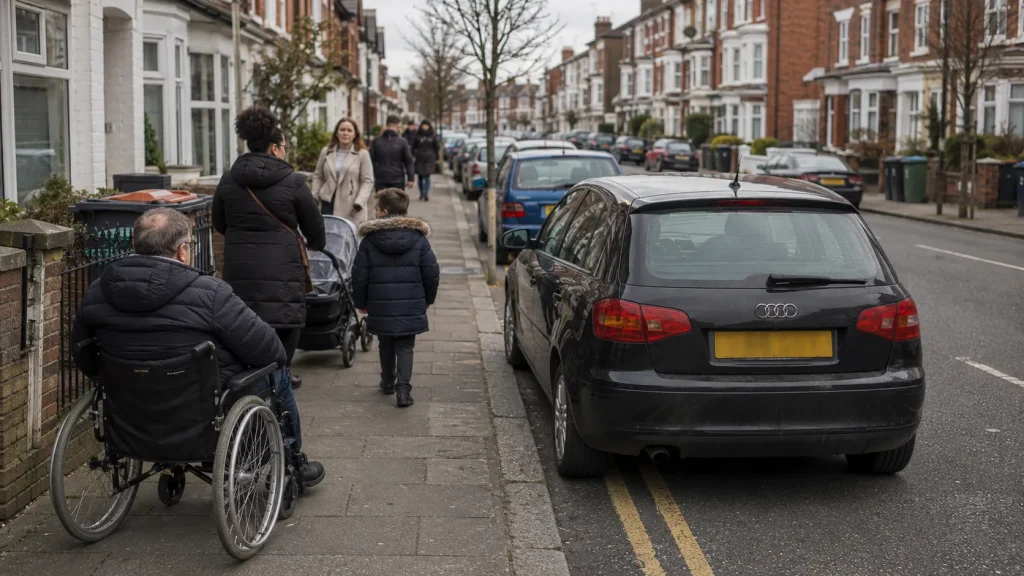
Parking on the pavement is not governed by one identical rule across the UK.
It is generally prohibited in London and Scotland, unless an authorised exemption applies.
England outside London, Wales and Northern Ireland do not currently have a complete nationwide ban, although drivers can still be fined where they breach yellow-line restrictions, local parking orders or rules covering particular locations. Police can also act when a vehicle causes an unnecessary or wilful obstruction.
England’s position is changing. The English Devolution and Community Empowerment Act 2026 creates a framework through which local transport authorities can be given wider powers to prohibit pavement parking.
However, the new system requires supporting regulations and local implementation.
It does not mean that every pavement in England automatically became subject to a blanket ban when the Act received Royal Assent on 29 April 2026.
What Changed for Pavement Parking in England in 2026?
The UK Government confirmed a new approach to pavement parking in England on 8 January 2026 after responding to a consultation that had originally opened in 2020.
Rather than imposing a single national prohibition across England, the government chose a locally led model.
Local transport authorities are to receive powers allowing them to prohibit pavement parking across wider areas, while retaining the ability to create exemptions where limited pavement parking may be necessary.
New Council Powers Are Now Included in Primary Legislation
The English Devolution and Community Empowerment Act 2026 received Royal Assent on 29 April 2026.
Schedule 32 allows the Secretary of State to make regulations giving English local transport authorities the power to prohibit motor vehicles from parking on footways and verges.
The legislation also allows future regulations to cover exemptions, consultation, signs, defences and civil enforcement.
A prohibition introduced through this system would become a civil parking contravention.
That would allow an authorised council enforcement officer to issue a Penalty Charge Notice rather than leaving every obstruction case to the police.
The Act Does Not Create an Immediate Blanket Ban
The enabling power should not be confused with an automatic national prohibition.
The government must introduce regulations setting out how the system will operate.
Relevant authorities must then decide whether and how to use their powers locally. Streets, vehicle categories or particular circumstances may be excluded under the framework.
In its cycling and walking investment strategy published in June 2026, the government said it intended to regulate during 2026 to make unnecessary pavement obstruction civilly enforceable.
It also said the wider area-based powers contained in the 2026 Act would be implemented as soon as possible.
Consequently, drivers should check the latest information published by their council rather than assuming that the same rule applies in every English town or county.
Current Pavement-parking Rules Across the UK
| Area | General position in July 2026 | Typical civil penalty |
| London | Pavement parking is generally prohibited unless signs or markings permit it | Up to £160 or £140 at the higher level, depending on the London charging band |
| England outside London | No blanket prohibition currently applies everywhere; existing restrictions and obstruction laws remain enforceable | Usually £70 or £50 for existing council parking contraventions outside London |
| Scotland | National prohibition on pavement parking, subject to limited exceptions and authorised exemptions | £100, reduced to £50 if paid within 14 days |
| Wales | No complete national pavement-parking ban; local restrictions and obstruction laws apply | Commonly £70 or £50 where an existing parking restriction is breached |
| Northern Ireland | No general ban, but pavement parking is prohibited at certain locations and restrictions apply on urban clearways | £90, reduced to £45 if paid within 14 days |
Penalty levels depend on the precise contravention and location. The figures above should not be treated as a guarantee of the amount on an individual notice.
Is Parking on the Pavement Illegal in London?
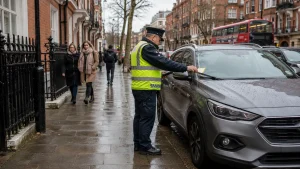
Yes. Parking wholly or partly on the pavement has generally been prohibited throughout Greater London since 1974.
The restriction applies where even one or more wheels are on the footway, verge or another part of the road outside the carriageway. It normally applies at all times, including evenings and weekends.
Rule 244 of the Highway Code states that drivers must not park partially or wholly on the pavement in London unless a permitted exception applies.
When is Pavement Parking Allowed in London?
A London borough can authorise pavement parking on a particular street or part of a street.
Permitted areas should normally be identified by official signs and, where appropriate, marked parking bays. A driver should not assume that pavement parking is allowed merely because other vehicles are doing it.
A Blue Badge does not provide a general exemption. Official guidance tells badge holders not to park on a pavement unless signs specifically allow it.
What is the Pavement-parking Fine in London?
Pavement parking is treated as a more serious parking contravention because it can cause an obstruction.
London’s current higher-level parking penalties are:
- £160 in Band A, reduced to £80 when paid during the 14-day discount period.
- £140 in Band B, reduced to £70 when paid during the discount period.
The applicable band depends on the borough or location. Lower-level penalties of £110 in Band A and £90 in Band B normally apply to less serious matters, such as overstaying where parking was otherwise permitted.
A vehicle may also be removed in some circumstances, creating additional recovery and storage costs.
Is Parking on the Pavement Illegal Elsewhere in England?
Outside London, pavement parking is not automatically prohibited on every road. However, that does not mean drivers have an unrestricted right to park on the footway.
Rule 244 of the Highway Code says drivers should not park partially or wholly on the pavement outside London unless signs permit it.
The difference between “should not” and “must not” is important: the Highway Code warning reflects the risk and expected standard of behaviour, but the general rule outside London has historically lacked the same universal statutory prohibition that applies in London.
When Can Councils Currently Issue a Ticket?
A council outside London can already take action in several circumstances.
Yellow-line Restrictions
Single and double yellow-line restrictions generally apply from the centre of the carriageway to the road boundary. This includes the pavement and verge.
Parking with the wheels on the pavement does not allow a driver to avoid a yellow-line restriction. A council may issue a PCN for the underlying waiting contravention.
Local Pavement-parking Restrictions
Councils can use Traffic Regulation Orders to prohibit pavement parking on selected streets or within designated areas.
The restriction must normally be communicated through the appropriate signs and markings. Parking in breach of the order can result in a PCN.
Heavy Commercial Vehicles
Goods vehicles with a maximum laden weight exceeding 7.5 tonnes must not be parked on a verge, pavement or land between carriageways unless a limited legal exception applies, such as essential loading or unloading.
Dangerous or Obstructive Parking
Police can take action where a vehicle creates an unnecessary or wilful obstruction.
Section 137 of the Highways Act 1980 makes it an offence, without lawful authority or excuse, to wilfully obstruct free passage along a highway. The legislation provides for a fine at level three on the standard scale following conviction.
Whether a particular vehicle amounts to an obstruction depends on the circumstances.
Relevant factors may include the remaining pavement width, whether pedestrians can pass safely, the presence of wheelchair users or pushchairs, the duration of the obstruction and whether reasonable alternative parking was available.
There is no simple national rule stating that leaving a particular number of centimetres automatically makes pavement parking legal. The government’s consultation acknowledged that defining unnecessary obstruction can depend on the immediate circumstances.
How Much Could the New England Pavement-parking Fine Be?
As of 23 July 2026, the official government documents cited in this article do not set out one final nationwide penalty amount for the planned civil offence of unnecessary pavement obstruction.
The legislation creates the framework for civil enforcement, while regulations and statutory guidance are expected to provide the operational detail. Claims that every driver in England already faces an automatic £100 pavement-parking fine should therefore be treated cautiously.
Under the existing civil parking system outside London, PCNs are commonly:
- £70 for a higher-level contravention, reduced to £35 if paid within 14 days.
- £50 for a lower-level contravention, reduced to £25 if paid within 14 days.
The government may use the existing structure or set a specific level through regulations. Drivers should wait for confirmed regulations and local council notices rather than relying on speculative penalty figures.
Can You Park on the Pavement?
Answer a few questions to receive general guidance based on your location, nearby restrictions and possible pedestrian obstruction.
Where is the vehicle parked?
Pavement-parking rules differ across the four UK nations and London.
Are there parking restrictions?
Select the option that most closely describes the location.
What is being blocked?
Select every situation that applies. Leave all options unticked if nothing appears to be blocked.
Is the vehicle covered by an exception?
An exception should not be assumed simply because the road is narrow or other vehicles are parked in the same way.
Guidance unavailable
Test What You Learned
Choose one answer for each question and check your score.
What Are the Pavement-parking Rules in Scotland?
Scotland has a national prohibition covering pavement parking, double parking and parking at dropped kerbs.
Local authorities have been able to enforce the rules since 11 December 2023. A council can issue a £100 PCN, reduced to £50 when paid within 14 days.
Are There Exemptions in Scotland?
Limited statutory exceptions apply, including certain emergency situations, roadworks and qualifying deliveries or collections.
Councils can also exempt particular sections of pavement where strict conditions are satisfied. An authorised exemption should be clearly signed and marked. Drivers should not treat a narrow road or a lack of driveway space as an automatic exemption.
Enforcement began at different times in some council areas while authorities surveyed roads, considered exemptions and prepared local enforcement arrangements. The underlying national prohibition nevertheless applies across Scotland.
Is Pavement Parking Illegal in Wales?
Wales does not currently have a complete national ban equivalent to Scotland’s system.
The Welsh Government previously proposed allowing councils to enforce unnecessary obstruction of the road as a civil contravention. However, implementation was delayed while local authorities dealt with other transport-policy work.
A House of Commons Library briefing published in April 2026 reported that Wales was also considering whether it could participate in the developing UK legislative approach.
Existing parking rules still apply. A driver may receive a PCN for parking on a pavement beside yellow lines, within a locally restricted area, near a bus stop or where another enforceable restriction applies.
Where a Welsh council issues an ordinary parking PCN, the charge is commonly £70 for a more serious contravention or £50 for a lower-level contravention, normally reduced by half for prompt payment.
Police may also deal with vehicles that cause an obstruction or danger.
What Are the Rules in Northern Ireland?
Northern Ireland does not have a general prohibition covering every pavement.
However, rules introduced on 3 November 2023 prohibit pavement parking at a number of specified locations.
These include footways next to bus lanes, bus stops, bus stands, cycle lanes and school keep-clear areas. Urban clearways are also subject to pavement-parking restrictions.
Where an applicable restriction is breached, the standard PCN is £90. It is reduced to £45 if paid within 14 days.
If there are no marked restrictions and the vehicle is not in one of the specifically protected locations, a traffic attendant cannot normally issue a PCN merely because the vehicle is on the pavement. The PSNI may still act when the vehicle causes an obstruction.
Does Leaving Enough Room Make Pavement Parking Legal?
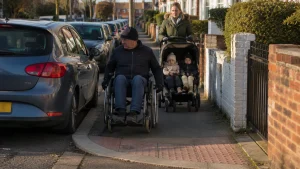
Not necessarily.
Leaving room for one pedestrian does not automatically remove the possibility of an offence.
A route that appears passable to an able-bodied adult may remain inaccessible to a wheelchair user, mobility-scooter user, person with a guide dog or parent using a double pushchair.
Drivers must also consider tactile paving, dropped kerbs, bus stops, school entrances, property access and visibility at junctions. Rule 243 of the Highway Code identifies several places where parking can create particular danger or obstruction.
Where pavement parking is expressly prohibited, leaving a wide gap does not cancel the prohibition. In London or Scotland, the vehicle may still be in contravention unless the location is authorised for pavement parking or a statutory exception applies.
Can Blue Badge Holders Park on the Pavement?
A Blue Badge is not permission to park anywhere.
Official guidance for England states that badge holders should not park on a pavement unless signs permit it. They must also avoid causing danger or obstruction to pedestrians and other road users. Similar warnings apply in Wales and Northern Ireland.
In London, Blue Badge holders are not generally exempt from the pavement-parking prohibition. In Scotland, drivers must comply with the national ban unless the location is formally exempt or another specific legal exception applies.
How Should Obstructive Pavement Parking Be Reported?
The correct authority depends on the location and type of contravention.
Report the vehicle to the local council where it is breaching yellow lines, a signed pavement-parking prohibition, a controlled parking rule or the Scottish national prohibition.
Contact the police through their non-emergency reporting service where a vehicle is causing a serious obstruction but the council lacks the relevant civil enforcement power. Use the emergency service only where there is an immediate threat to life or safety.
Reports are more useful when they include the street, time, registration number and photographs showing the obstruction. Photographs should be taken safely and without confrontation.
What Drivers Should Do Now?
Drivers should treat the pavement as pedestrian space unless official signs and markings clearly indicate that parking is allowed.
Before leaving a vehicle, check:
- Whether the road is in London or Scotland.
- Whether yellow lines extend alongside the parking position.
- Whether signs, bays or a local order restrict pavement parking.
- Whether a wheelchair, mobility scooter or pushchair can pass without entering the road.
- Whether the vehicle blocks a dropped kerb, school entrance, bus stop, cycle facility or property access.
- Whether the council has introduced new rules under the developing 2026 framework.
The safest legal choice is to find a marked bay or another location where the vehicle can remain entirely on the carriageway without obstructing traffic.
Legal Information Notice
This article provides general information and reflects published sources available on 23 July 2026. Parking rules, council policies and penalty levels can change. Drivers should check current signs and official guidance from the relevant local authority before parking.