
Paying tax on savings interest depends on how much interest a person receives, their other taxable income and which tax-free allowances are available to them.
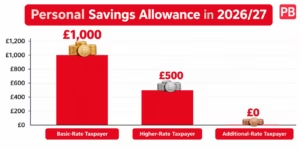
For the 2026/27 tax year, most basic-rate taxpayers can receive up to £1,000 of savings interest through the Personal Savings Allowance without paying tax on it.
Higher-rate taxpayers normally receive a £500 allowance, while additional-rate taxpayers do not receive a Personal Savings Allowance.
Some people on lower incomes can receive significantly more interest tax-free because the Personal Allowance and the starting rate for savings may also apply.
The key point is that tax is generally charged on the interest earned, not on the amount of money sitting in a savings account.
How Is Savings Interest Taxed in the UK?
Interest from savings is generally treated as income for Income Tax purposes.
A person may therefore have tax to pay when interest from taxable savings exceeds the allowances available to them.
Banks and building societies normally pay savings interest without deducting Income Tax first. This means receiving interest in full does not necessarily mean it is tax-free. HM Revenue and Customs can calculate any tax that is subsequently due.
Tax may apply to interest from several types of savings and investments, including:
- Bank Savings Accounts
- Building Society Accounts
- Credit Union Accounts
- Fixed-Rate Savings Accounts
- Regular Saver Accounts
- Peer-To-Peer Lending
- Government Or Company Bonds
- Certain Trust Funds And Investments
Interest earned within tax-free products such as qualifying ISAs is treated differently.
What Counts as Savings Interest?
Savings interest is broadly the return a saver receives for keeping money with a bank, building society or another qualifying savings provider.
If £20,000 is held in a taxable savings account, the £20,000 itself is not treated as taxable savings interest. Instead, any interest generated by that money may need to be considered when calculating Income Tax.
Interest across multiple taxable accounts must be considered together rather than each account receiving its own separate Personal Savings Allowance.
Is Tax Charged on the Savings Balance or Only the Interest?
Income Tax is not normally charged simply because someone has a large cash savings balance.
The potential tax liability arises from the interest or other taxable savings income generated by that money.
For example, holding £50,000 in a savings account does not automatically create an Income Tax bill. The relevant figure is the amount of taxable interest received and whether that interest is covered by the person’s available allowances.
This distinction is particularly important when savings rates are relatively high because a saver may exceed the Personal Savings Allowance even without increasing the amount originally deposited.
How Much Savings Interest Is Tax-Free in 2026/27?
There are three important allowances or tax-free bands that can potentially affect savings interest in the 2026/27 tax year:
- Personal Allowance
- Starting Rate For Savings
- Personal Savings Allowance
A person’s entitlement depends on their overall income.
Personal Savings Allowance
The Personal Savings Allowance allows many taxpayers to receive a set amount of savings interest without paying Income Tax on it.
For 2026/27:
| Income Tax Position | Personal Savings Allowance |
| Basic-Rate Taxpayer | £1,000 |
| Higher-Rate Taxpayer | £500 |
| Additional-Rate Taxpayer | £0 |
A basic-rate taxpayer whose taxable savings interest remains within £1,000 will usually have no tax to pay on that interest under the Personal Savings Allowance.
A higher-rate taxpayer can normally receive up to £500 under the allowance.
Additional-rate taxpayers do not receive a Personal Savings Allowance.
The taxpayer’s overall income matters because savings interest itself is included when determining the relevant tax band. This means interest can sometimes affect which allowance applies.
Personal Allowance And The £5,000 Starting Rate For Savings
The standard Personal Allowance for 2026/27 is £12,570 for most people, although it can be reduced for people with sufficiently high income.
If someone’s wages, pension or other taxable income do not use their full Personal Allowance, the unused portion may be available against savings interest.
Lower-income savers may also qualify for the starting rate for savings.
The maximum starting rate band is £5,000.
However, the full £5,000 is not available to everyone. It is reduced by £1 for every £1 of other taxable income above the Personal Allowance.
If other taxable income reaches £17,570 or more, there is normally no starting rate for savings available.
A saver with relatively low earnings or pension income could therefore potentially benefit from:
- Unused Personal Allowance
- Up To £5,000 Starting Rate For Savings
- Personal Savings Allowance
These rules can make a substantial difference for pensioners, part-time workers and others whose non-savings income is comparatively low.
How Much Tax Is Paid on Savings Interest Above the Allowance?
When taxable savings interest exceeds the available allowances, Income Tax is normally charged on the excess.
For the 2026/27 tax year, the savings rates are:
| Savings Income Tax Rate | 2026/27 |
| Basic Rate | 20% |
| Higher Rate | 40% |
| Additional Rate | 45% |
The amount someone pays therefore depends not only on how much interest they receive but also on where that income falls within the tax bands.
A person should not assume that every pound of savings interest is taxed at the same rate if their total income crosses a tax-band boundary.
Can Savings Interest Push Someone Into a Higher Tax Band?
Yes. Savings interest is included when HMRC considers a person’s overall taxable income.
This matters because additional interest can potentially move part of a person’s income into a higher tax band.
It can also affect the size of the Personal Savings Allowance.
For example, a person who remains a basic-rate taxpayer may qualify for a £1,000 Personal Savings Allowance. If total income moves into the higher-rate band, the allowance can fall to £500.
This means people who are close to a tax threshold should consider their total taxable income rather than looking only at salary or pension income.
Scottish taxpayers have different rates and bands for certain non-savings income. Savings income itself is subject to UK savings-income rules, so the interaction between Scottish earnings and savings can require additional care.
How Does HMRC Deal With Tax on Savings Interest?
In many cases, savers do not need to manually calculate and send a separate payment every time interest is received.
Banks and building societies generally report interest paid to customers to HMRC after the end of the tax year.
HMRC can then use that information together with other tax records to determine whether additional Income Tax is due.
How Banks Report Interest to HMRC?
After the end of each tax year, banks and building societies provide HMRC with information about savings interest paid to their customers.
When someone has more than one account, HMRC can combine the reported interest to determine the total amount received.
This is important because the Personal Savings Allowance applies to the taxpayer rather than separately to every account.
A person with several accounts should therefore keep their own records rather than assuming that interest below £1,000 in each account is automatically tax-free.
How Tax Is Collected?
How HMRC collects tax depends on the person’s circumstances.
For someone who is employed or receives a pension through PAYE, HMRC may adjust the tax code so that tax due on savings interest is collected automatically.
HMRC may use interest received in a previous year to estimate interest for the current year when setting the tax code.
People who complete Self Assessment normally report relevant savings interest through their tax return.
Someone with savings and investment income above the relevant Self Assessment registration threshold may also need to register even if they have not previously completed a tax return.
People who are not employed, do not receive a pension and do not complete Self Assessment may be contacted by HMRC if tax is due.
It is worth checking HMRC calculations carefully, particularly where interest rates or account balances have changed significantly from one year to the next.
When Is Savings Interest Taxable?
The tax year in which savings interest is counted can matter just as much as the amount received.
A UK tax year runs from 6 April to 5 April.
For straightforward easy-access accounts, identifying the relevant tax year is often simple because interest is regularly credited and available to the account holder.
Fixed-term products can be more complicated.
Fixed-Term Savings Accounts
With a fixed-term savings account, the tax position can depend on the terms governing when interest is paid and when the saver can actually access it.
Some accounts pay interest annually.
Others accumulate interest and make it available only when the fixed term ends.
Where interest cannot be accessed until maturity, a significant amount of accumulated interest could potentially become taxable in a single tax year rather than being spread evenly across several years.
This can have consequences for the Personal Savings Allowance.
A saver considering a multi-year fixed account should therefore check:
- When Interest Is Credited
- When Interest Becomes Accessible
- Whether Interest Can Be Withdrawn Before Maturity
- Whether Interest Is Paid Annually Or At The End Of The Term
The tax treatment can depend on the specific account conditions, so savers should not assume that all fixed-rate products are treated identically.
Joint Savings Accounts
For a standard joint savings account, HMRC normally treats the interest as being divided equally between the account holders.
If two people jointly hold an account that produces £1,200 in interest, HMRC would normally attribute £600 to each person.
Each person’s share is then considered against their own tax position and allowances.
If beneficial ownership is genuinely different from an equal split, the position may need to be reported differently to HMRC.
Joint ownership does not create one combined Personal Savings Allowance. Each account holder has their own tax position.
Is ISA Interest Taxable?
Interest earned within an Individual Savings Account is generally free from Income Tax.
This means interest from a Cash ISA does not normally use any of the saver’s Personal Savings Allowance.
A person could therefore receive interest from an ISA tax-free while still retaining their Personal Savings Allowance for eligible interest received outside the ISA.
This is one reason ISAs can become particularly relevant for people whose taxable savings interest is approaching or exceeding their allowance.
The tax treatment of an ISA is separate from the Personal Savings Allowance.
A saver should therefore distinguish between:
- Interest Earned Inside An ISA
- Interest Earned In Ordinary Taxable Savings Accounts
- Other Savings Or Investment Income
Some National Savings and Investments products also provide tax-free returns. Premium Bond prizes, for example, are generally tax-free rather than being counted as taxable savings interest.
What Changes to Savings Tax Are Coming From April 2027?
A significant change is already legislated for the 2027/28 tax year.
From 6 April 2027, the tax rates applying to savings income above available allowances are due to increase by two percentage points.
The rates will become:
| Savings Income Tax Rate | 2026/27 | 2027/28 |
| Basic Rate | 20% | 22% |
| Higher Rate | 40% | 42% |
| Additional Rate | 45% | 47% |
The structure of the Personal Savings Allowance and starting rate for savings is set to remain in place.
That means the principal change is not that all savings interest suddenly becomes taxable. Instead, savers who already have taxable interest above their available allowances will face a higher rate on that taxable portion from 6 April 2027.
The starting rate limit for savings remains £5,000 under the current legislation.
This makes the distinction between the 2026/27 and 2027/28 tax years important when reviewing savings that generate interest around the end of a tax year.

How Can Savers Reduce Tax on Savings Interest?
There are legitimate ways to manage how much savings interest falls within the taxable system.
The most appropriate approach depends on the saver’s personal circumstances and wider financial position.
Possible considerations include:
- Using Available ISA Allowances
- Checking Whether The Starting Rate For Savings Applies
- Using Any Available Personal Savings Allowance
- Reviewing How Savings Are Held Between Spouses Or Civil Partners
- Checking The Maturity Date Of Fixed-Term Accounts
- Keeping Records Of Interest Across Multiple Accounts
- Reviewing Tax Codes After Major Changes In Savings Interest
Moving money solely to avoid a small amount of tax is not automatically the best financial decision. Interest rates, access requirements, protection arrangements and other financial objectives should also be considered.
Married couples and civil partners may wish to review which person holds taxable savings where one partner has unused allowances or is subject to a lower tax rate.
Transfers should reflect genuine ownership of the money and the tax consequences should be understood before changes are made.
ISAs can also be useful where interest outside tax-free accounts is already exceeding the Personal Savings Allowance.
Conclusion
Paying tax on savings interest in the UK does not mean that the savings balance itself is taxed. The key issue is the amount of taxable interest generated and how that interest interacts with the saver’s wider income and tax allowances.
For 2026/27, the Personal Savings Allowance remains £1,000 for basic-rate taxpayers and £500 for higher-rate taxpayers. Additional-rate taxpayers receive no Personal Savings Allowance.
Lower-income savers may also benefit from unused Personal Allowance and up to £5,000 through the starting rate for savings.
Interest from ordinary savings accounts, fixed-term products and other taxable sources should be considered together. Interest held within qualifying ISAs is generally tax-free and does not use the Personal Savings Allowance.
Frequently Asked Questions
How Much Savings Interest Can Someone Earn Tax-Free In 2026?
A basic-rate taxpayer can usually receive up to £1,000 of savings interest tax-free, while a higher-rate taxpayer can usually receive up to £500.
Does Someone Pay Tax If Savings Interest Is Less Than £1,000?
Not always. It depends on the person’s tax band and whether other allowances, such as the starting rate for savings, also apply.
Does HMRC Automatically Know About Bank Interest?
Banks and building societies generally report savings interest to HMRC, which can use the information to calculate any tax due.
Is Fixed-Term Savings Interest Taxed Every Year Or At Maturity?
It depends on when the interest is paid or becomes accessible. Some fixed accounts may result in interest being taxed at maturity.
Is Interest From A Joint Savings Account Taxable?
Yes, it can be. HMRC normally splits the interest equally between joint account holders unless the beneficial ownership is different.
Is Cash ISA Interest Included In The Personal Savings Allowance?
No. Interest earned in a qualifying Cash ISA is generally tax-free and does not use the Personal Savings Allowance.
Are Savings Tax Rates Changing In 2027?
Yes. From 6 April 2027, the savings basic, higher and additional rates are set to rise to 22%, 42% and 47%, respectively.