

The 1131N tax code normally means that a taxpayer has transferred part of their Personal Allowance to their husband, wife or civil partner through Marriage Allowance.
For the 2026/27 tax year, the standard Personal Allowance is £12,570. Marriage Allowance allows an eligible person to transfer £1,260 of that allowance to their partner. This leaves £11,310, which is reflected in the number 1131.
The letter N tells HMRC, the employer or pension provider that the person is the partner transferring the allowance.
The basic calculation is:
£12,570 Personal Allowance − £1,260 Marriage Allowance = £11,310
HMRC confirms that an N tax code means 10% of the Personal Allowance has been transferred to a partner. The receiving partner will normally have a tax code ending in M. Check what tax code letters mean on GOV.UK
How Does the 1131N Tax Code Work in 2026/27?
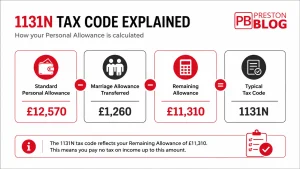
The numbers in a PAYE tax code broadly show how much tax-free income a person can receive from that employment or pension before Income Tax is deducted.
HMRC normally starts with the taxpayer’s Personal Allowance and then adjusts it for relevant allowances, deductions, benefits or other circumstances.
For someone whose only relevant adjustment is Marriage Allowance:
- Standard Personal Allowance: £12,570
- Marriage Allowance Transferred: £1,260
- Remaining Allowance: £11,310
- Typical Tax Code: 1131N
The £12,570 Personal Allowance remains unchanged for 2026/27. The wider effect of frozen tax thresholds is also relevant because rising wages and pensions can bring more income into tax even where the headline allowance does not change. The current position is examined in the HMRC Personal Allowance allocation changes for 2026/27.
What Does the Number 1131 Mean?
The number 1131 normally represents £11,310 of tax-free coding allowance.
HMRC generally removes the final digit from the amount of tax-free income when creating the numerical part of a standard PAYE tax code. An allowance of £11,310 therefore normally produces the number 1131.
However, taxpayers should not assume that every tax code is calculated only from the standard Personal Allowance. HMRC can also adjust codes for untaxed income, taxable employment benefits, earlier tax underpayments and other items.
What Does the Letter N Mean on a Tax Code?
The letter N identifies the taxpayer as the person transferring Marriage Allowance.
In simple terms:
- L: Standard Personal Allowance applies
- M: Marriage Allowance has been received from a partner
- N: Marriage Allowance has been transferred to a partner
This is why one partner may have 1131N while the other has a code ending in M.
What Is New for the 1131N Tax Code in 2026/27?
HMRC’s current 2026/27 guidance does not introduce a replacement for the 1131N tax code or change the core Marriage Allowance calculation.
For the tax year running from 6 April 2026 to 5 April 2027:
- Personal Allowance Remains: £12,570
- Marriage Allowance Remains: £1,260
- Typical Transferred Allowance Position: £11,310
- Standard PAYE Code Remains: 1257L for most people with one job or pension
- Marriage Allowance N Suffix Remains: In use for the transferring partner
HMRC also updated its online tax-code checker on 6 April 2026 to reflect the 2026/27 rates.
Another important development is the longer-term freeze in the Personal Allowance. Government policy maintains the £12,570 allowance through to 5 April 2031. That does not change the meaning of 1131N today, but it makes tax-code accuracy increasingly important as earnings and pensions rise against fixed thresholds.
The wider tax environment following the Spring Statement 2026 also matters when households assess how frozen thresholds interact with changes in earnings and other income.
Why Has My Tax Code Changed From 1257L to 1131N?
A change from 1257L to 1131N will commonly happen when HMRC applies a Marriage Allowance transfer.
The standard 1257L code generally reflects the full £12,570 Personal Allowance. When £1,260 is transferred to an eligible spouse or civil partner, the transferring person’s allowance can reduce to £11,310.
Their PAYE code may therefore change to 1131N.
This can happen after:
- A New Marriage Allowance Claim: HMRC has accepted an application to transfer the allowance
- An Existing Claim Continues: Marriage Allowance normally carries forward into later tax years
- HMRC Updates PAYE Records: A new tax-code notice may be issued to an employer or pension provider
- Personal Circumstances Change: HMRC may revise a code after receiving updated information
Marriage Allowance normally continues automatically each year until it is cancelled. HMRC states that changes to PAYE tax codes following a successful application can take up to two months.
Who Can Have a 1131N Tax Code?
An 1131N tax code is most closely associated with someone who qualifies to transfer Marriage Allowance.
The person transferring the allowance must normally:
- Be Married or in a Civil Partnership: Unmarried couples living together do not qualify for Marriage Allowance
- Have Low Enough Income: The transferring partner normally pays no Income Tax or has income below the Personal Allowance
- Have an Eligible Partner: The receiving partner must fall within the permitted Income Tax rates
- Have a Personal Allowance: The transfer depends on eligibility for the allowance
The official Marriage Allowance eligibility rules on GOV.UK confirm that the transfer is £1,260 and can reduce the couple’s overall Income Tax bill by up to £252 in a tax year.
Receiving a pension does not automatically prevent someone from qualifying for Marriage Allowance.
People born before 6 April 1935 should also check whether Married Couple’s Allowance may be more appropriate. Marriage Allowance and Married Couple’s Allowance cannot normally be claimed at the same time.
Are the Rules Different in Scotland?
Marriage Allowance is available in Scotland, but Scottish Income Tax bands differ from those applying in England, Wales and Northern Ireland.
For current Marriage Allowance eligibility, HMRC states that a partner in Scotland must normally pay the starter, basic or intermediate rate. This usually corresponds to income between £12,571 and £43,662 before receiving Marriage Allowance.
Scottish taxpayers may also see an S prefix on their tax code because Scottish rates apply to their employment or pension income.
The distinction is particularly relevant in 2026/27 because Scotland has its own Income Tax thresholds and rates. The Scottish Income Tax changes for 2026/27 provide additional context for taxpayers comparing Scottish PAYE deductions with the rest of the UK.
1131N vs 1257L vs 1383M: What Is the Difference?
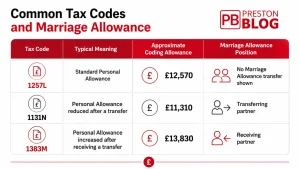
The codes 1131N, 1257L and 1383M can all relate to the Personal Allowance, but they reflect different circumstances.
| Tax Code | Typical Meaning | Approximate Coding Allowance | Marriage Allowance Position |
| 1257L | Standard Personal Allowance | £12,570 | No Marriage Allowance transfer shown |
| 1131N | Personal Allowance reduced after a transfer | £11,310 | Transferring partner |
| 1383M | Personal Allowance increased after receiving a transfer | £13,830 | Receiving partner |
The figures are straightforward where Marriage Allowance is the only adjustment. An individual’s actual code may differ where HMRC has included taxable benefits, untaxed income or other PAYE adjustments.
What Is the Difference Between an M and N Tax Code?
The distinction is based on which partner gives and which partner receives the allowance.
An N code applies to the transferor. An M code applies to the recipient.
For a standard 2026/27 Personal Allowance:
Transferor: £12,570 − £1,260 = £11,310
Recipient: £12,570 + £1,260 = £13,830
That is why 1131N and 1383M are commonly seen on opposite sides of a Marriage Allowance arrangement.
How Does Tax Code 1131N Affect Take-Home Pay?
An 1131N tax code reduces the amount of Personal Allowance available to the transferring partner under PAYE.
This can mean more of their employment or pension income becomes taxable.
If the entire £1,260 transferred amount would otherwise have been taxed at 20%, the tax associated with that amount is:
£1,260 × 20% = £252
However, this does not mean every person moving to 1131N will automatically lose £252 of take-home pay.
A lower earner who remains below £11,310 may pay no additional Income Tax. Someone earning between £11,310 and £12,570 may begin paying tax on part of their income after making the transfer.
HMRC gives an example where the transferring partner earns above the reduced £11,310 allowance. In that situation, the transferor pays some additional tax but the couple can still make an overall saving.
Take-home pay is also affected by pension contributions, National Insurance and other payroll deductions. For example, the interaction between pension deductions and PAYE can be seen in the 2026/27 USS pension contribution rates.
A change in gross salary can also alter net pay without any error in the tax code. The effect is visible in pay updates such as the NHS pay rise for 2026/27, where the amount reaching an employee’s bank account depends on tax codes and other deductions as well as the headline salary.
Is 1131N an Emergency Tax Code?
1131N on its own is not an emergency tax code.
HMRC currently identifies emergency PAYE treatment through markers including:
- W1: Week 1 basis
- M1: Month 1 basis
- X: Emergency basis where pay dates vary
- NONCUM: Non-cumulative emergency treatment shown by some payroll systems
A taxpayer could therefore potentially see an N-based tax code with an additional emergency marker. The emergency status comes from the W1, M1, X or NONCUM marker, not from the N suffix itself.
Can the 1131N Tax Code Be Wrong?
Yes. An 1131N tax code can be incorrect if the Marriage Allowance transfer no longer reflects the taxpayer’s circumstances or if HMRC holds outdated information.
Someone should consider checking the code if:
- Income Has Changed: One partner may no longer meet the Marriage Allowance conditions
- The Relationship Has Ended: Divorce, dissolution or legal separation can affect the claim
- Marriage Allowance Was Cancelled: PAYE records may need to reflect the cancellation
- Employment Has Changed: A new job can produce a revised tax code
- Pension Income Has Started: HMRC may allocate allowances between PAYE income sources
- There Are Multiple Jobs or Pensions: Each employment or pension can have its own tax code
- Take-Home Pay Changed Unexpectedly: A new coding notice should be checked against the payslip
Pensioners should be particularly careful where several taxable income sources are involved. With the full new State Pension now close to the standard Personal Allowance, the wider State Pension tax position in 2026 can make PAYE coding more significant for people who also receive workplace or private pensions.
How Can Someone Check Whether 1131N Is Correct?
The first step is to compare the tax code on the latest payslip or pension statement with HMRC’s current records.
A taxpayer should then review the calculation behind the code rather than looking only at the four digits and letter.
Check the Payslip or Pension Statement
Look for:
- Current Tax Code: Confirm whether it shows 1131N
- Gross Pay or Pension: Check the income before deductions
- Income Tax Deducted: Compare current deductions with previous periods
- PAYE Source: Confirm which employer or pension provider is using the code
Check the HMRC Tax-Code Calculation
HMRC provides an online service covering the current tax year from 6 April 2026 to 5 April 2027.
Taxpayers can use it to review:
- Their Current Tax Code
- Their Personal Allowance
- Estimated Employment and Pension Income
- Expected Income Tax
- Recent Tax-Code Changes
- Employer or Pension Provider Information
The HMRC current-year Income Tax service can also be used to update relevant income details or report information affecting a tax code.
Contact HMRC if the Information Is Incorrect
Before contacting HMRC, it can help to have:
- The Current Tax Code
- Recent Payslips or Pension Statements
- The HMRC Coding Notice
- Estimated Annual Income
- Marriage Allowance Details
- Information About Recent Changes
An employer normally applies the code HMRC supplies. It is therefore HMRC, rather than the employer, that should generally be contacted when the underlying allowance or tax-code calculation is wrong.
How Do You Cancel Marriage Allowance and Remove an N Tax Code?
Marriage Allowance can be cancelled where circumstances change or the couple no longer wants the transfer to continue.
HMRC says Marriage Allowance must be cancelled when:
- The Relationship Ends: This includes divorce, dissolution of a civil partnership or legal separation
- Income Changes: One or both partners may no longer meet the eligibility conditions
- The Couple No Longer Wants the Claim: The existing transfer can be stopped
Where the relationship has ended, either partner can cancel.
For another reason, such as a change in income, the person who originally made the Marriage Allowance claim must normally cancel it.
If cancellation is due to an income change, the allowance usually continues until the end of that tax year on 5 April.
If the relationship ends, HMRC says the change may instead be backdated to the beginning of the tax year.
After cancellation, HMRC can issue revised PAYE codes. The replacement will not necessarily be 1257L because other adjustments may still affect the taxpayer’s Personal Allowance.
Can Marriage Allowance Be Backdated?
Yes. As of August 2026, HMRC states that qualifying Marriage Allowance claims can be backdated to 6 April 2022, covering earlier tax years in which the couple met the relevant conditions.
This is particularly important for couples who were eligible for Marriage Allowance but did not claim immediately.
Eligibility must be considered separately for each tax year being claimed.
A successful backdated claim can reduce the receiving partner’s tax bill for eligible years. The exact repayment depends on the allowance and tax position for each year.
HMRC’s postal Marriage Allowance guidance was updated on 6 April 2026 specifically to confirm that claims can currently be backdated to 6 April 2022.
Does 1131N Mean Someone Has Overpaid or Underpaid Tax?
No. Having the 1131N tax code does not by itself mean a person has overpaid or underpaid Income Tax.
The code simply tells an employer or pension provider how HMRC wants PAYE calculated based on the information currently held.
An overpayment may arise if too much tax was deducted because the code was wrong or changed late.
An underpayment may arise where too little tax was collected or HMRC did not have complete information about income.
PAYE may be worth reviewing when:
- Net Pay Changes Unexpectedly: Compare the code with the previous payslip
- Marriage Allowance No Longer Applies: Check whether cancellation has been processed
- Estimated Income Is Wrong: HMRC may be using outdated figures
- Several PAYE Sources Exist: Allowances may be allocated between different jobs or pensions
- A New Pension Starts: The coding position may change as taxable pension income is added
The tax code is therefore an instruction for PAYE rather than final proof of a person’s total annual tax liability.
What Should Someone Do After Seeing 1131N on a Payslip?
Someone who sees 1131N for the first time should check whether the Marriage Allowance transfer is expected before assuming there is a payroll problem.
Useful steps include:
- Confirm Marriage Allowance: Check whether a Marriage Allowance claim was made.
- Review Both Partners’ Income: Make sure the current eligibility conditions are still met.
- Check the Coding Notice: Review how HMRC calculated the tax-free amount.
- Confirm the PAYE Source: Identify which employment or pension carries the 1131N code.
- Check Estimated Income: Make sure HMRC’s figures reflect current earnings and pensions.
- Report Relevant Changes: Update HMRC where income or relationship circumstances have changed.
- Seek Professional Advice if Needed: Complex cases involving several income sources, Self Assessment or previous tax years may require individual tax advice.
Conclusion: What the 1131N Tax Code Means for UK Taxpayers
The 1131N tax code normally means that a taxpayer has transferred £1,260 of their Personal Allowance to an eligible husband, wife or civil partner through Marriage Allowance.
For 2026/27, the standard Personal Allowance remains £12,570. Transferring £1,260 reduces the typical allowance to £11,310, which explains the numerical part of 1131N.
The N suffix identifies the transferring partner, while the receiving partner will normally have a tax code ending in M.
There is no separate 2026/27 announcement changing the basic meaning of 1131N in HMRC’s current published guidance. However, the Personal Allowance remains frozen, HMRC’s tax-code services have been updated for the current tax year, and eligible Marriage Allowance claims can currently be backdated to 6 April 2022.
Anyone whose income, relationship status, employment or pension circumstances have changed should check that the 1131N tax code still reflects the information HMRC holds.
Frequently Asked Questions About the 1131N Tax Code
What Does 1131N Tax Code Mean in the UK?
The 1131N tax code normally means a taxpayer has transferred £1,260 of their Personal Allowance to their spouse or civil partner through Marriage Allowance. For 2026/27, this typically reduces the person’s allowance from £12,570 to £11,310.
Is 1131N a Good or Bad Tax Code?
1131N is neither automatically good nor bad. It is appropriate when a valid Marriage Allowance transfer applies. The important question is whether the taxpayer and their partner remain eligible and whether HMRC’s records reflect their current circumstances.
Why Has HMRC Changed My Tax Code to 1131N?
HMRC may change a code from 1257L to 1131N after Marriage Allowance has been claimed or carried forward from an earlier tax year. The transferring partner’s Personal Allowance is reduced and the recipient receives the corresponding tax benefit.
How Much Can Someone Earn Tax-Free on 1131N?
An 1131N code typically represents £11,310 of tax-free coding allowance for the relevant PAYE source. Other HMRC adjustments can affect individual tax codes, so the taxpayer should check the detailed coding calculation for their own position.
Is 1131N an Emergency Tax Code?
No. 1131N by itself is not an emergency tax code. HMRC uses markers such as W1, M1, X or NONCUM to identify emergency PAYE treatment.
What Is the Difference Between 1131N and 1383M?
1131N normally applies to the partner transferring £1,260 of Personal Allowance. 1383M can apply to the partner receiving that amount, increasing the typical coding allowance from £12,570 to £13,830.
Can Someone Change an 1131N Tax Code Back to 1257L?
A taxpayer cannot simply choose a different PAYE code. If Marriage Allowance is cancelled or circumstances change, HMRC will calculate and issue the appropriate replacement code. It may be 1257L where the standard Personal Allowance applies with no other adjustments, but another code may be necessary in some cases.