

If you get PIP, you do not automatically have to report the PIP award itself to Universal Credit as a new change of circumstances. However, you must tell Universal Credit if your health condition or another relevant circumstance has changed.
This distinction matters. Your PIP claim and your Universal Credit claim are separate, even though both are administered by the Department for Work and Pensions in England and Wales.
Current Universal Credit change of circumstances rules say you must report changes to your health condition, including when it gets better or worse, as well as becoming too ill to work or meet your work coach. Changes should be reported as soon as they happen.
So if you have simply received a PIP decision and nothing about your health or circumstances has changed, that is different from having a new health change that Universal Credit needs to know about.
Can You Get PIP And Universal Credit At The Same Time?
Yes. You can get PIP and Universal Credit at the same time if you meet the separate eligibility rules for each benefit.
PIP is designed to help with some of the extra costs caused by a long-term health condition or disability. It is not means-tested, and your income or savings do not determine how much PIP you receive.
Universal Credit is means-tested and helps with living costs if you are on a low income, out of work or unable to work in certain circumstances.
The two benefits therefore perform different roles.
You can:
- Receive PIP And Universal Credit Together
- Receive PIP Without Universal Credit
- Receive Universal Credit Without PIP
- Work While Receiving PIP
- Work And Still Receive Some Universal Credit If You Remain Eligible
The amount of PIP you receive depends on whether you qualify for the daily living component, mobility component or both. The current PIP monthly payment amounts for 2026 reflect the April 2026 uprating, with PIP normally paid every four weeks rather than once per calendar month.
For 2026/27, the weekly PIP rates are £76.70 or £114.60 for daily living and £30.30 or £80.00 for mobility, depending on whether you receive the standard or enhanced rate.
Does PIP Affect Universal Credit Payments?
Receiving PIP does not normally reduce your Universal Credit simply because you have been awarded PIP.
PIP is a non-means-tested disability benefit, while Universal Credit has its own rules for earnings, other income, savings and household circumstances. GOV.UK also confirms that someone moving onto Universal Credit can continue receiving benefits such as PIP.
This means PIP is not treated in the same way as wages when Universal Credit is calculated.
However, there is an important difference between receiving your regular PIP payment and keeping benefit payments as savings.
If PIP or other benefit money remains unspent, it can eventually form part of the money, savings and investments considered under Universal Credit capital rules. Universal Credit normally takes capital into account when assessing entitlement.
The wider Universal Credit benefit rates for 2025 to 2026 also show how standard allowances, work allowances and health-related additions differ from PIP payments.
Do You Have To Report A PIP Award To Universal Credit?
A new PIP award is not specifically listed in GOV.UK’s Universal Credit guidance as a change of circumstances that every claimant must report.
What matters is whether something relevant to your Universal Credit claim has changed.
You should report a change if:
- Your Health Condition Has Become Worse
- Your Health Condition Has Improved
- You Have Developed A New Health Condition
- Your Condition Now Affects Your Ability To Work
- You Have Become Too Ill To Meet Your Work Coach
- Your Savings Or Household Circumstances Have Changed
- Other Information On Your Universal Credit Claim Is No Longer Correct
If your PIP decision is based on difficulties you already told Universal Credit about and nothing has changed, receiving the decision does not necessarily mean there is a new health change to report.
You should not, however, assume that information provided during a PIP claim automatically updates everything in your Universal Credit account.
If you are unsure whether Universal Credit has the correct information, check your online account and use your journal to ask what is recorded on your claim.
How To Tell Universal Credit About A Relevant Change?
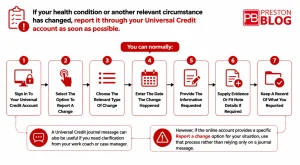
If your health condition or another relevant circumstance has changed, report it through your Universal Credit account as soon as possible.
You can normally:
- Sign In To Your Universal Credit Account
- Select The Option To Report A Change
- Choose The Relevant Type Of Change
- Enter The Date The Change Happened
- Provide The Information Requested
- Supply Evidence Or Fit Note Details If Required
- Keep A Record Of What You Reported
A Universal Credit journal message can also be useful if you need clarification from your work coach or case manager.
However, if the online account provides a specific Report a change option for your situation, use that process rather than relying only on a journal message.
What Happens If Your Health Condition Has Changed?
Changes to your health can affect your claimant commitments, fit-note requirements and whether the DWP considers you for a Work Capability Assessment.
| Your Situation | What It Could Mean For Universal Credit | What You May Need To Do |
| You Develop A New Health Condition | Your ability to work or meet existing commitments may be affected | Report the new condition through your UC account |
| Your Existing Condition Gets Worse | The information currently held by Universal Credit may no longer reflect your circumstances | Report the change and provide fit-note details if requested |
| Your Condition Improves | Your work-related requirements may need to be reconsidered | Report the relevant change |
| Your Condition Affects Your Ability To Work For More Than Seven Days | Fit-note requirements can apply | Obtain a fit note and enter the details in your UC account |
| Your Condition Continues For More Than 28 Days | You may be considered for a Work Capability Assessment | Continue following DWP instructions and providing fit notes where required |
| You Are Waiting For A WCA Decision | Your existing requirements normally continue until a decision is made | Keep providing fit-note information when required |
| Nothing About Your Health Has Changed | A PIP award alone does not necessarily represent a new UC health change | Check that the information already held on your UC claim remains correct |
DWP guidance updated in August 2026 confirms that claimants whose health affects their capability to work for longer than seven days may need a fit note and that a Work Capability Assessment may be required if the condition continues for longer than 28 days.
Does Getting PIP Automatically Mean You Get LCWRA?
No. Receiving PIP does not automatically mean you qualify for Limited Capability for Work and Work-Related Activity.
PIP and LCWRA assess different things.
PIP considers how your health condition or disability affects specified daily living and mobility activities.
Universal Credit’s Work Capability Assessment considers how your condition affects your capability for work and work-related activity.
| Issue | PIP | Universal Credit Health Assessment |
| Main Purpose | Daily living and mobility difficulties | Capability for work and work-related activity |
| Means-Tested | No | Universal Credit is means-tested |
| Can You Work | Yes | Yes, depending on your circumstances |
| Automatic Qualification For The Other | No | No |
| Separate Decision Required | Yes | Yes |
It is therefore possible to receive PIP without LCWRA, LCWRA without PIP or both at the same time.
From April 2026, Universal Credit also introduced different LCWRA amounts for different groups of claimants.
The health-related changes sit alongside wider Universal Credit rate changes in 2026 and mean the date you declared your health condition can matter when the DWP decides which rate applies.
Can PIP Affect The Benefit Cap?
Yes. PIP can affect your Universal Credit position even though it is not simply deducted from your UC payment.
Under current benefit cap rules, a household is not affected by the cap if you, your partner or a child under 18 living with you receives PIP.
This can be particularly important if your Universal Credit was previously reduced because of the benefit cap.
If you have recently been awarded PIP and your household was subject to the cap, check your Universal Credit account to make sure your circumstances have been reflected correctly.
Can You Work While Getting PIP And Universal Credit?
Yes. You can work while receiving PIP.
PIP is not means-tested and is available to people both in and out of work. Starting a job does not by itself mean that your PIP award should end.
You can also receive Universal Credit while working if your income and circumstances mean you remain eligible. Your earnings may reduce your UC payment through the Universal Credit taper.
If you have LCW or LCWRA, you may also qualify for a work allowance before earnings begin reducing your Universal Credit.
What Changed With PIP And Universal Credit In 2026?
Several 2026 developments are relevant if you receive PIP, Universal Credit or both.
Right To Try Rules Took Effect On 30 April 2026
New regulations took effect on 30 April 2026 to make clear that starting paid work or voluntary work is not, by itself, a relevant change of circumstances that triggers a Universal Credit Work Capability Assessment reassessment.
The same legislation also provides that doing paid or voluntary work is not, by itself, a reason for carrying out a fresh PIP assessment.
The 2026 Universal Credit, PIP and ESA amendment regulations put that protection into legislation. A reassessment can still happen for another valid reason, such as a relevant change in your health circumstances.
This change is especially relevant if you have been reluctant to try work because you were worried that employment alone would automatically trigger a PIP or WCA reassessment.
The policy now sits alongside the wider DWP PIP reforms taking place in 2026, which continue to shape discussions about how disability and health-related support should work.
PIP And WCA Assessments Are Now Recorded By Default
From 29 June 2026, DWP changed the assessment process so telephone and face-to-face health assessments are audio recorded as standard.
The change covers:
- Personal Independence Payment Assessments
- Universal Credit Work Capability Assessments
- Employment And Support Allowance Assessments
- Industrial Injuries Disablement Benefit Assessments
You can opt out of the recording, and DWP says you should not be disadvantaged for choosing not to have your assessment recorded.
This does not change whether you need to tell Universal Credit about a PIP award, but it is a significant procedural change for anyone going through a PIP or UC health assessment in 2026.
The Timms Review Published Its Interim Findings In July 2026
The Timms Review of Personal Independence Payment published its interim report on 9 July 2026.
The review is examining how PIP works and how the system could be improved. Its interim report did not make final recommendations, meaning claimants should not treat possible reforms being discussed as current PIP eligibility rules.
The Timms Review statement to Parliament confirmed that further work would continue before recommendations are made.
For now, the existing PIP assessment rules remain important, while the developing PIP benefit changes for 2026 should be separated carefully from proposals that have not yet become entitlement rules.
Universal Credit Health Rules Changed From April 2026
From 6 April 2026, Universal Credit began using two LCWRA rates for different groups of claimants.
For 2026/27, the lower LCWRA amount is £217.26 per month and the higher amount is £429.80 per month.
The rate that applies can depend on when you declared your health condition and whether you fall within particular protected groups, including rules for severe and lifelong conditions or people nearing the end of life.
A PIP award does not automatically decide which LCWRA rate you receive.
PIP Review Periods Have Also Changed
DWP told Parliament in June 2026 that review periods had been lengthened for many PIP claimants aged over 25.
For most of these claimants, the first review is now expected to be at least three years after an award and, where entitlement continues, a subsequent review is expected after five years. Long-term awards can still have different arrangements depending on individual circumstances.
These review changes form part of the broader debate around PIP reform in 2026 but do not remove your responsibility to report a relevant change in how your condition affects you.
Do PIP And Universal Credit Have The Same Reporting Rules?
No. You should treat your PIP and Universal Credit reporting responsibilities separately.
For PIP, changes that can matter include changes in the help you need with daily living or mobility, certain periods in hospital or care, changes in immigration status and some periods abroad.
Universal Credit has its own change-of-circumstances rules covering health, earnings, savings, housing, household composition and other matters.
This means telling one part of the DWP about something does not necessarily mean you should assume every other benefit record has been updated.
Travel is a good example. The PIP rules for going on holiday or travelling abroad differ from the reporting requirements that apply to Universal Credit, so each benefit needs to be considered separately.
What Should You Do After You Get A PIP Award?
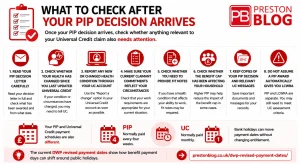
Once your PIP decision arrives, check whether anything relevant to your Universal Credit claim also needs attention.
- Read Your PIP Decision Letter Carefully
- Check Whether Your Health Has Changed Since You Last Updated Universal Credit
- Report Any New Or Changed Health Condition Through Your UC Account
- Make Sure Your Current Claimant Commitments Reflect Your Circumstances
- Check Whether You Need To Provide Fit Notes
- Check Whether The Benefit Cap Has Been Affecting Your Household
- Keep Copies Of Your PIP Decision And Relevant UC Messages
- Do Not Assume A PIP Award Automatically Gives You LCWRA
Your PIP and Universal Credit payment schedules are also different.
PIP is normally paid every four weeks while Universal Credit is normally paid monthly, and bank holidays can move payment dates without changing entitlement. The current DWP revised payment dates show how benefit payment days can shift around public holidays.
Conclusion: Do I Need To Tell Universal Credit If I Get PIP?
If you are asking “do I need to tell Universal Credit if I get PIP?”, the key point is that receiving a PIP award and reporting a Universal Credit change of circumstances are not the same thing.
A PIP award itself is not specifically listed as a Universal Credit change that every claimant must report. However, you must report relevant changes to your health condition and other circumstances.
You can receive PIP and Universal Credit together, and PIP does not automatically reduce your UC payment. It also does not automatically qualify you for LCWRA.
Your PIP award can still matter to your wider benefits position, particularly where the benefit cap, work capability or other circumstances are involved.
Check that the information in your Universal Credit account remains accurate after receiving PIP and report any relevant changes promptly.
With several PIP and Universal Credit changes already taking effect in 2026 and further PIP recommendations expected later in the year, current rules should always be distinguished from proposals that have not yet become law.
Frequently Asked Questions
Do I Need To Tell Universal Credit If I Get PIP?
You do not automatically have to report a PIP award simply because it has been granted. However, you must report relevant changes to your health condition or circumstances to Universal Credit. If your PIP award reflects a new or worsening condition that UC does not already know about, update your Universal Credit account.
Does PIP Count As Income For Universal Credit?
PIP is not deducted from Universal Credit in the same way as earnings. You can receive both benefits together. However, unspent PIP payments can eventually form part of your savings or capital, which can matter under Universal Credit capital rules.
Will Getting PIP Reduce My Universal Credit?
Getting PIP does not normally reduce Universal Credit simply because you receive PIP. Your UC amount can still change because of earnings, savings, housing costs, household circumstances or other factors.
Can I Get PIP And Universal Credit At The Same Time?
Yes. PIP and Universal Credit can be paid together because they have different purposes and separate eligibility tests.
Does Getting PIP Automatically Give Me LCWRA?
No. PIP and LCWRA use different assessment criteria. You normally need a separate Universal Credit Work Capability Assessment decision to establish LCW or LCWRA status unless specific rules allow you to be treated as having limited capability without the usual assessment.
Should I Put My PIP Award In My Universal Credit Journal?
You can mention the award in your journal if you want to ask whether Universal Credit needs any further information. If there has also been a formal change of circumstances, use the appropriate reporting function in your UC account rather than relying only on a journal message.
What Happens If My Health Gets Worse After I Receive PIP?
Report the health change to Universal Credit as soon as possible. You may be asked to provide fit-note details, and a Work Capability Assessment may be considered depending on how long your condition affects your ability to work and your existing UC status.
This article provides general information about UK benefits and does not determine individual entitlement. Your circumstances can affect which rules apply to your claim.