

A Universal Credit Budgeting Advance is an interest-free, repayable payment for eligible Universal Credit claimants who need help with certain one-off expenses, such as essential furniture, a washing machine, clothing, home repairs, funeral costs or moving expenses.
You can borrow at least £100, with the maximum depending on your household:
| Your Circumstances | Maximum Budgeting Advance |
| Single | £348 |
| Part Of A Couple | £464 |
| Have Children | £812 |
| Minimum Advance | £100 |
You normally need to have received Universal Credit or certain qualifying benefits for at least six months, although this condition can be waived when the money is needed to help you start a job or stay in work.
You must also meet the earnings rules and have repaid any previous Budgeting Advance.
The current official GOV.UK Budgeting Advance guidance explains the eligible costs, maximum amounts, application options and repayment rules.
What Is A Universal Credit Budgeting Advance?

A Universal Credit Budgeting Advance is an advance payment of Universal Credit designed to help you meet an irregular or unexpected one-off expense that may be difficult to cover from your normal income.
It is not a grant and it is not an extra benefit payment that you can keep without repayment. The Department for Work and Pensions, or DWP, recovers the money through deductions from future Universal Credit payments.
DWP material describes a Budgeting Advance as an interest-free payment for one-off items. This means you repay the amount borrowed rather than paying commercial loan interest on top.
When Did The Budgeting Advance Start?
Budgeting Advances were introduced alongside the early rollout of Universal Credit.
The Social Security (Payments on Account of Benefit) Regulations 2013 created the Budgeting Advance system, with Budgeting Advances replacing Social Fund Budgeting Loans for eligible Universal Credit claimants from 29 April 2013.
Universal Credit itself began its first Pathfinder rollout in Ashton-under-Lyne that month.
Budgeting Loans did not disappear completely. They continued for people receiving certain legacy benefits, while Universal Credit claimants moved onto the Budgeting Advance system.
What Is Happening With Budgeting Advances Right Now?
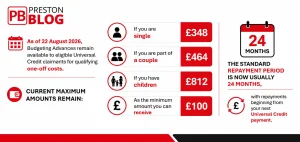
As of 22 August 2026, Budgeting Advances remain available to eligible Universal Credit claimants for qualifying one-off costs.
The current maximum amounts remain:
- £348 If you are single
- £464 If you are part of a couple
- £812 If you have children
- £100 As the minimum amount you can receive
The standard repayment period is now usually 24 months, with repayments beginning from your next Universal Credit payment.
Latest Budgeting Advance Changes In 2026
There has not been a new maximum Budgeting Advance amount introduced in the current 2026 GOV.UK guidance. Instead, the most important recent changes affecting claimants continue to be changes introduced in late 2024 and 2025.
The maximum repayment period for new Budgeting Advances increased from 12 months to 24 months in December 2024. The government announced the change at Spring Budget 2024 as a way of reducing monthly repayment pressure.
A further Universal Credit change followed in April 2025, when the Fair Repayment Rate reduced the overall deductions cap from 25% to 15% of the claimant’s standard allowance, subject to specific rules and exceptions.
Recent DWP Announcements About Budgeting Advances
DWP’s latest published Universal Credit deductions data provides a useful picture of what is happening after these changes.
The latest DWP Universal Credit deductions statistics confirm that the Budgeting Advance maximum repayment period increased to 24 months in December 2024.
The statistics also show that, across Universal Credit advances generally, the average monthly advance deduction was £35 in February 2026.
This figure covers advance deductions overall and should not be treated as the typical repayment for a Budgeting Advance specifically.
Are There Any Future Plans For Budgeting Advances?
Current published GOV.UK guidance continues to show the existing £348, £464 and £812 maximums and the usual 24-month repayment period. It does not currently set out a further increase to these Budgeting Advance maximums.
Future Budgets, legislation or DWP policy changes could alter the amounts, eligibility conditions or repayment arrangements. For this reason, you should check the current official rules if you are reading this article significantly after its last-updated date.
Could Budgeting Advance Rules Change?
Yes. Budgeting Advances operate under social security legislation and DWP policy, so their rules can be amended.
The move from 12-month to 24-month repayment periods demonstrates that significant changes can occur without the basic purpose of the scheme changing.
The maximum amounts, earnings conditions, repayment arrangements and other eligibility rules should therefore always be checked against current guidance before you apply.
What Can A Universal Credit Budgeting Advance Be Used For?
A Universal Credit Budgeting Advance is intended for qualifying one-off costs, rather than ordinary day-to-day living expenses.
Current GOV.UK guidance gives examples including:
Household Furniture And Essential Appliances
You may be able to request a Budgeting Advance for items such as:
- Furniture
- A Cooker
- A Washing Machine
- A Vacuum Cleaner
- Certain Essential Household Items
- A Television In Some Circumstances
The fact that an item appears as an example does not mean you are automatically entitled to the maximum advance. DWP will consider the amount you need and whether you meet the other conditions.
Clothing And Essential Family Items
Eligible one-off expenses can also include clothing, footwear and essential family items.
GOV.UK gives mobility aids and child safety products as examples of essential family items that may qualify.
Home Repairs And Security Costs
A Budgeting Advance can potentially help with necessary repairs or security measures for your home.
You should explain what the expense is and how much you need when making your application.
Moving Home And Tenancy Costs
Moving-related expenses can qualify in certain circumstances.
These can include:
- A Tenancy Deposit
- Removal Costs
GOV.UK also advises claimants to check whether their local council can provide help towards a housing deposit.
Funeral And Other Eligible One-Off Expenses
Funeral expenses are another type of one-off cost listed in the official guidance.
Depending on your circumstances, other forms of government support may also exist for a particular expense, so it can be worth checking whether non-repayable assistance is available before taking an advance that will reduce future Universal Credit payments.
What Can You Not Use A Budgeting Advance For?
The Universal Credit Budgeting Advance is not intended to cover normal recurring household expenditure.
Current GOV.UK rules say it cannot be used for:
- Ongoing Food Costs
- Gas Or Electricity Bills
- Rent
- Paying Off Debts
Can You Get A Budgeting Advance For Food?
No. Current official guidance specifically lists ongoing food costs among the expenses that a Budgeting Advance cannot cover.
If you are struggling to afford food, you may need to check other financial support available through Universal Credit, your local authority or appropriate emergency support schemes.
Can You Get A Budgeting Advance For Rent?
You cannot use a Budgeting Advance to pay your normal ongoing rent.
However, this should not be confused with certain moving costs. A tenancy deposit or removal expenses when moving home can be among the qualifying one-off expenses.
Can You Use A Budgeting Advance To Pay Debts?
No. Paying off debts is specifically excluded under current GOV.UK guidance.
If debt deductions are already reducing your Universal Credit, the rules around deductions and your ability to repay may also affect the amount of further support available.
Put The Expense Through The Budgeting Advance Desk
Some one-off costs can be considered for an advance while ordinary household spending cannot. Test the expense, change the household ceiling and check the rules before assuming what you could receive.
A washing machine is specifically listed as an example of a household item a Budgeting Advance can potentially cover.
Choose An Expense
Current guidance includes a washing machine among the examples of one-off household costs that can potentially be covered. That does not guarantee an award or the household maximum.
The minimum Budgeting Advance is £100. DWP considers how much you need, your circumstances and whether the advance can reasonably be recovered. Capital above £1,000 can also reduce the potential amount.
How Much Universal Credit Budgeting Advance Can You Get In 2026?
The minimum Universal Credit Budgeting Advance is £100.
The maximum is currently:
- £348 if you are single
- £464 if you are part of a couple
- £812 if you have children
These are maximum limits rather than guaranteed payment amounts.
Does Everyone Receive The Maximum Budgeting Advance?
No.
The amount you receive depends on how much you need and your circumstances. DWP must also be satisfied that the advance can reasonably be recovered, taking account of relevant debts and liabilities.
Being eligible for a Budgeting Advance does not automatically mean you will receive £348, £464 or £812.
Can Savings Affect How Much You Receive?
Yes.
The underlying Budgeting Advance rules provide that if you and your partner, where applicable, have capital above £1,000, the potential Budgeting Advance is reduced by the amount above that threshold.
For example, the legislation states that capital exceeding £1,000 reduces the amount that would otherwise be payable. If this calculation takes the possible advance below £100, no Budgeting Advance is payable.
Who Is Eligible For A Universal Credit Budgeting Advance?
You normally need to satisfy several conditions before receiving a Budgeting Advance.
The Six-Month Qualifying Rule
You will normally need to have been receiving one of the following for six months or more:
- Universal Credit
- Employment And Support Allowance
- Pension Credit
The current GOV.UK Budgeting Advance page lists these benefits when explaining the qualifying-period condition.
Exception If You Need The Money For Work
The six-month requirement does not necessarily apply if you need the money to help you start a new job or remain in work.
There may also be separate help with employment expenses. GOV.UK says support can sometimes be available for costs such as uniforms, equipment, travelling to interviews or upfront childcare, and this type of employment support does not usually have to be repaid.
Budgeting Advance Earnings Limits In 2026
You will not normally qualify if your earnings during the previous six months exceeded:
- £2,600 if you are single
- £3,600 Combined If you are a couple
These thresholds remain listed in current GOV.UK guidance.
Can You Get Another Budgeting Advance If You Already Have One?
Normally, no.
You must have paid off any previous Budgeting Advance before another can be awarded. Current rules allow only one outstanding Budgeting Advance at a time.
Does DWP Consider Your Ability To Repay?
Yes. The rules require DWP to consider whether the advance can reasonably be recovered after taking account of debts and other liabilities. This means affordability can be relevant to the decision and amount offered.
Universal Credit Budgeting Advance Eligibility Checklist
Before applying, check whether:
- You Currently Receive Universal Credit Or Meet The Relevant Qualifying Rules
- You Have Usually Been On A Qualifying Benefit For At Least Six Months
- You Meet The Work-Related Exception If The Six-Month Rule Does Not Apply
- Your Previous Six Months’ Earnings Are Within The Relevant Limit
- You Have Repaid Any Previous Budgeting Advance
- Your Expense Is A Qualifying One-Off Cost
- You Need At Least £100
- You Understand That Future Universal Credit Payments Will Be Reduced While You Repay It
- You Have Considered Whether Savings Above £1,000 Could Reduce The Amount Available
Meeting these points does not guarantee that DWP will award an advance.
How To Apply For A Universal Credit Budgeting Advance?

You currently have three main ways to apply for a Budgeting Advance.
Apply Through Your Universal Credit Journal
You can request a Budgeting Advance by updating your Universal Credit journal.
It is sensible to explain:
- That You Want To Apply For A Budgeting Advance
- What The One-Off Expense Is
- Approximately How Much You Need
- Why The Cost Is Necessary
Your journal is part of your online Universal Credit account and provides a record of communication between you and Universal Credit.
Ask Your Work Coach Or Jobcentre
You can ask a Universal Credit contact at your local Jobcentre or speak to your work coach about applying.
They can tell you how to proceed based on your claim.
Apply Through The Universal Credit Helpline
You can also apply by calling the Universal Credit helpline.
The current telephone number is 0800 328 5644, with opening hours listed as Monday to Friday, 8am to 6pm. Welsh-language and accessibility contact options are also available.
What Happens After You Apply For A Budgeting Advance?
DWP will consider your circumstances and whether you meet the Budgeting Advance conditions.
This can include your qualifying-benefit history, earnings, existing Budgeting Advance debt, the amount required, capital and whether the advance can reasonably be repaid.
Is A Budgeting Advance Guaranteed?
No. The maximum amount available for your UK household is a ceiling, not a guaranteed award.
Even if you satisfy some of the basic eligibility rules, DWP still needs to determine whether a Budgeting Advance can be made and how much is appropriate.
What If Your Budgeting Advance Is Refused?
A Budgeting Advance decision is different from an ordinary Universal Credit entitlement decision.
Guidance from welfare-rights sources indicates that there is no standard statutory appeal against a refusal in the same way as many benefit entitlement decisions, although you can ask DWP to reconsider the matter or look again where relevant information has not been taken into account.
If you believe important information has been missed, contact Universal Credit promptly and ask what review options are available in your particular case.
How Do You Repay A Universal Credit Budgeting Advance?
A Budgeting Advance is normally repaid automatically through deductions from future Universal Credit payments.
How Long Do You Have To Repay A Budgeting Advance?
Current GOV.UK guidance says you will usually repay a Budgeting Advance over 24 months, beginning with your next Universal Credit payment.
The 24-month maximum repayment period was introduced for new Budgeting Advances from December 2024, replacing the previous 12-month period.
What Happens If You Cannot Afford The Repayments?
Do not ignore the issue if the deductions are leaving you unable to manage essential expenses.
GOV.UK says that if you cannot afford your Budgeting Advance repayments, you can ask for them to be delayed.
You can make the request through:
- Your Universal Credit Journal
- Your Local Jobcentre Or Work Coach
- The Universal Credit Helpline
Can Budgeting Advance Repayments Be Delayed?
Yes. Current GOV.UK guidance says you can ask for Budgeting Advance repayments to be delayed for up to six months if you cannot afford them.
A delay is something you need to request rather than something that happens automatically.
What Happens If You Stop Claiming Universal Credit?
Leaving Universal Credit does not normally cancel the outstanding Budgeting Advance.
If you move onto another benefit, deductions will usually continue from that benefit. If you stop receiving benefits, DWP Debt Management can contact you about arranging repayment.
Budgeting Advance Vs Other Universal Credit Advances
The phrase “Universal Credit advance” can refer to several different forms of repayable support, so it is important to know which one applies to you.
Budgeting Advance Vs First-Payment Advance
A first-payment advance is designed for someone waiting for their first Universal Credit payment.
A Budgeting Advance is designed for an existing eligible claimant who needs help with a qualifying one-off expense.
The two payments have different eligibility conditions and purposes.
Budgeting Advance Vs Hardship Payment
A hardship payment can potentially be available when Universal Credit has been stopped or reduced because of certain sanctions or penalties and you cannot meet essential needs.
That is different from a Budgeting Advance for an irregular one-off expense.
Budgeting Advance Vs Budgeting Loan
A Budgeting Loan and a Budgeting Advance are not the same thing.
If you currently receive Universal Credit, GOV.UK states that you cannot get a Budgeting Loan and should apply for a Budgeting Advance instead.
Budgeting Loans remain available to some people receiving qualifying legacy benefits, including Income Support, income-based Jobseeker’s Allowance, income-related Employment and Support Allowance and Pension Credit.
Should You Check For Help You Do Not Have To Repay First?

Because a Budgeting Advance reduces future Universal Credit payments while it is repaid, it can make sense to check whether another suitable source of support is available first.
Local Welfare Assistance
Your local council may operate welfare assistance or other schemes for residents facing financial difficulty.
Availability, qualifying conditions and the type of help offered vary by council, so check the arrangements where you live rather than assuming the same support exists throughout the UK.
Flexible Support Fund And Employment Help
If the cost is connected to getting or starting work, speak to your work coach before automatically requesting a Budgeting Advance.
Current GOV.UK guidance says employment-related support can cover some costs associated with finding or starting work and does not usually need to be repaid.
Charitable Grants
Some charities and trusts provide grants for specific groups, occupations, health circumstances or household needs.
Unlike a Budgeting Advance, a genuine grant does not normally need to be repaid, although eligibility can be narrow and an award is never guaranteed.
Other Government Support
The correct type of support depends on the expense.
For example, specific schemes can exist for childcare, housing, health costs, funeral expenses or employment-related costs.
Checking these options before borrowing can help you avoid unnecessary deductions from future Universal Credit where another appropriate form of assistance is available.
What Should You Do Before Applying?
Before requesting a Universal Credit Budgeting Advance, it can help to:
- Check the Expense Is Eligible: Make sure it is a qualifying one-off cost rather than an excluded ongoing expense.
- Check Your Eligibility: Consider the qualifying period, earnings limits, existing Budgeting Advance and savings rules.
- Work Out What You Actually Need: Request an amount based on the genuine cost rather than assuming you will receive the household maximum.
- Consider Future Deductions: Remember that repayment will reduce future Universal Credit payments.
- Check Other Support: Look for appropriate grants, council assistance or work-related help that may not need to be repaid.
- Keep Relevant Information Ready: Be prepared to explain what you need the money for and how much the expense is likely to cost.
- Contact Universal Credit Early If Repayments Become Difficult: Current rules allow you to ask for a repayment delay of up to six months if you cannot afford the deductions.
Conclusion: Is A Universal Credit Budgeting Advance Right For You?
A Universal Credit Budgeting Advance can provide useful short-term help when an essential one-off expense arrives and you cannot cover it from your normal income.
In 2026, the minimum remains £100, while the maximum is £348 for a single claimant, £464 for a couple and £812 where you have children.
You will normally need to satisfy the six-month qualifying rule, stay within the earnings limits and have repaid any previous Budgeting Advance.
The money is interest-free but it is not free money. It normally has to be repaid through deductions from Universal Credit over a period of up to 24 months. If you are struggling with the repayments, current guidance allows you to ask for a delay of up to six months.
Before applying, check whether the expense qualifies and whether suitable non-repayable support is available.
Benefit rules can change, so confirm the current position with DWP or GOV.UK if your circumstances are unusual or you are applying after this article’s last-updated date.
Frequently Asked Questions
Can I Get A Universal Credit Budgeting Advance In 2026?
You may be able to get one if you receive Universal Credit, need help with an eligible one-off expense and meet the qualifying-period, earnings, repayment and other applicable conditions. The award is not automatic.
How Much Is A Universal Credit Budgeting Advance?
The minimum is £100. The current maximum is £348 if you are single, £464 if you are part of a couple and £812 if you have children. Your actual award can be lower.
Can I Get A Budgeting Advance For A Washing Machine?
A washing machine is specifically listed by GOV.UK as an example of a household item that a Budgeting Advance can potentially cover. You still need to satisfy the eligibility rules.
Can I Apply For A Budgeting Advance Through My Universal Credit Journal?
Yes. Updating your Universal Credit journal is one of the official application routes. You can also speak to your work coach or another Universal Credit contact at your Jobcentre, or call the Universal Credit helpline.
Can I Get A Second Budgeting Advance?
You generally cannot receive another Budgeting Advance while an earlier one remains unpaid. Current eligibility rules require you to have paid off a previous Budgeting Advance first.
Can I Get A Budgeting Advance If I Have Been On Universal Credit For Less Than Six Months?
Possibly. You normally need six months on Universal Credit or another listed qualifying benefit, but the six-month condition can be waived when you need the money to help you start a new job or stay in work.
Can I Get A Budgeting Advance If I Am Working?
Working does not automatically prevent you from receiving a Budgeting Advance. However, you will normally be ineligible if you earned more than £2,600 as a single claimant or £3,600 jointly as a couple during the previous six months.