

A work capability assessment phone call is used to understand how a health condition or disability affects your ability to work and carry out relevant everyday activities.
The healthcare professional may ask about your symptoms, treatment, mobility, concentration, communication, mental health and the help you need from other people.
The assessment is not simply about your diagnosis. Two people with the same medical condition can experience very different limitations, so the conversation focuses on what happens in your individual circumstances.
For Universal Credit, a Work Capability Assessment can take place by telephone, video call or in person. Before the assessment, you will normally be asked to complete a WCA50 Capability for Work questionnaire and may provide supporting medical information.
Telephone assessments remain a major part of the system. DWP statistics published in 2026 show that telephone consultations continued to account for the largest share of Work Capability Assessment consultations.
Understanding what is likely to happen can make the call less daunting and help you give a clear and accurate account of how your condition affects you.
What Can You Expect During a Work Capability Assessment Phone Call?
During a Work Capability Assessment phone call, an approved healthcare professional will discuss your health and how it affects your functioning.
They may already have information from your WCA50 questionnaire and other evidence supplied with your claim. The phone conversation gives them an opportunity to explore relevant areas in greater detail.
Questions may cover:
- Your Health Conditions
- Your Current Symptoms
- Medication And Treatment
- Walking And Moving Around
- Sitting And Standing
- Using Your Hands And Arms
- Communication Difficulties
- Memory And Concentration
- Learning And Completing Tasks
- Mental Health Symptoms
- Coping With Other People
- Leaving Home And Travelling
- Help From Other People
- How Your Condition Changes Over Time
The assessor may also ask about ordinary activities such as shopping, preparing food, attending appointments or travelling somewhere.
These questions are not necessarily being asked because the activity itself determines whether you can work. Your answers can help the healthcare professional understand how your condition affects your wider functional ability.
Someone experiencing depression or anxiety, for example, may have difficulties involving concentration, social interaction or leaving home.
The wider range of benefits that may be available for depression and anxiety also uses different eligibility tests, so an award under one benefit does not automatically determine another.
What Is a Work Capability Assessment?
A Work Capability Assessment, commonly called a WCA, is used to help determine how much a health condition or disability limits a person’s capability for work.
For Universal Credit, GOV.UK says the assessment looks at what you can do as well as what you cannot do. If your health condition affects your capability to work for an extended period, you may be referred for an assessment.
You will normally receive a WCA50 Capability for Work questionnaire before the assessment. The form replaced the older UC50 and ESA50 terminology.
You can usually send relevant medical information with the questionnaire, such as treatment plans or test results. In some cases, a decision can be reached from the available paperwork without a telephone, video or face-to-face consultation.
A Work Capability Assessment is different from a Personal Independence Payment assessment. PIP focuses on specified daily living and mobility activities, while the WCA considers capability for work and work-related activity.
This is why receiving PIP does not automatically result in an LCW or LCWRA decision, as reflected in the separate rules around PIP and Universal Credit.
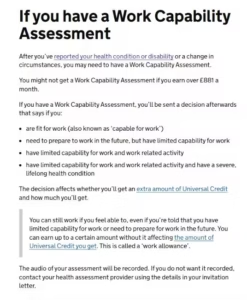
GOV.UK confirms that a Work Capability Assessment can take place in person, by video call or on the phone and that another person can be present for support.
Why You May Be Asked to Have a Work Capability Assessment by Phone?
Being given a telephone appointment does not mean you are undergoing a different type of Work Capability Assessment.
Telephone, video and face-to-face appointments are different ways of gathering the information required for the same overall assessment process.
A consultation may be required where the information already available does not allow the process to be completed on the paperwork alone.
According to DWP statistics covering January 2021 to July 2026, telephone consultations were the most commonly used WCA consultation channel over that period.
Telephone assessments accounted for 80.2% of WCA consultations overall, although face-to-face consultations became more common during 2026.
The method used should therefore not be interpreted as an indication of whether you will receive LCW, LCWRA or another outcome.
How to Prepare for a Work Capability Assessment Phone Call?
Preparation does not mean learning scripted answers. It means having the information you may need readily available so that you can explain your circumstances accurately.
Before the call, consider having:
- Your Appointment Letter
- Your WCA50 Questionnaire
- Your Medication List
- Relevant Treatment Details
- Medical Evidence You Have Submitted
- Notes About Your Main Difficulties
- Examples From Everyday Life
- Information About Any Help You Receive
- Details Of How Your Symptoms Vary
It can be useful to read your WCA50 again before the appointment. This may remind you what you previously reported and help you explain any changes that have happened since completing the form.
Think about what happens when you attempt relevant activities rather than just whether you can technically do them.
For example, consider whether you:
- Need To Stop And Rest
- Experience Significant Pain
- Become Breathless
- Need Someone To Help You
- Require Prompting Or Supervision
- Take Much Longer Than Expected
- Experience Symptoms Afterwards
- Cannot Repeat The Activity Reliably
If your condition changes from day to day, think about how often you have better and worse days rather than describing only how you feel on the day of the assessment.
You should also make practical preparations. Charge your phone, check that you have a reliable signal and try to take the call somewhere private and reasonably quiet.
If financial difficulties are creating additional pressure while you are receiving Universal Credit, some claimants may separately qualify for a Universal Credit Budgeting Advance for certain eligible one-off expenses. That process is separate from the Work Capability Assessment.
What Questions Are Asked During a Work Capability Assessment?
There is no universal list of Work Capability Assessment questions that every person will be asked in exactly the same way.
The questions depend on your condition, the information already available and the areas the healthcare professional needs to explore.
For physical conditions, you may be asked about walking, standing, sitting, reaching, lifting or using your hands.
For mental health, cognitive or neurological conditions, the conversation may cover concentration, memory, completing tasks, coping with changes, social interaction or leaving home.
You may also be asked about:
- Current Medication
- Medication Side Effects
- Hospital Treatment
- Specialist Appointments
- Therapy Or Rehabilitation
- Daily Routines
- Shopping
- Cooking
- Travelling
- Hobbies
- Caring Responsibilities
- Support From Friends Or Family
Do not assume that mentioning an everyday activity automatically proves you can or cannot work.
If you say you go shopping, for example, the relevant context may include whether someone accompanies you, how long you can remain in the shop, whether anxiety causes distress, whether you use mobility aids or whether you need to recover afterwards.
If you say you prepare meals, the assessor may need to understand whether you can do this regularly, safely and without assistance.
The purpose is to establish a fuller picture of your functional ability.
How Should You Answer the Questions?
The most important principle is to give an honest and specific description of what normally happens.
Do not exaggerate your limitations, but do not unintentionally minimise them either.
People who have lived with a condition for a long time sometimes describe something as manageable even when they have adapted considerably to complete it.
For each relevant difficulty, explain factors such as:
- What Happens When You Try
- How Long You Can Continue
- How Far You Can Go
- Whether You Need A Break
- Whether You Need Assistance
- Whether You Need Prompting
- Whether There Is A Safety Risk
- How Often The Problem Occurs
- How Long Recovery Takes
- Whether You Can Repeat The Activity
Specific examples can make an answer easier to understand.
For example, simply saying, “I can walk to the shop”, gives very little information.
A fuller answer might explain that the shop is a short distance away, that you need to stop several times, that someone usually accompanies you and that your symptoms become worse afterwards.
Similarly, saying that you can attend appointments does not explain whether you travel alone, require reminders, experience severe anxiety beforehand or regularly cancel because of your condition.
Do not try to guess which answer will produce a particular outcome. The aim is to describe your actual circumstances as accurately as possible.
Can Someone Support You During the Phone Assessment?
Yes. GOV.UK confirms that someone else can be with you during a Work Capability Assessment, such as a friend or support worker.
For telephone assessments, official ESA guidance also says you can ask the assessor to call your support person if they are not physically with you when the assessment starts.
Having another person present may be particularly useful if you:
- Have Difficulty Remembering Information
- Become Distressed During Phone Calls
- Have Communication Difficulties
- Need Help Explaining Your Condition
- Normally Depend On Another Person For Support
The assessment remains focused on you, but a support person may help you participate and provide relevant information where appropriate.
What Happens During and After the Phone Assessment?
The amount of time a work capability assessment phone call takes can vary substantially.
There is no official fixed duration that applies to every claimant. Someone with several conditions or complex circumstances may require a different level of discussion from someone whose relevant difficulties can be established more quickly.
The length of the assessment should not be treated as a prediction of the outcome.
A significant procedural change also took effect in 2026.
From 29 June 2026, telephone and face-to-face health assessments for Universal Credit, Employment and Support Allowance, Personal Independence Payment and Industrial Injuries Disablement Benefit began being audio recorded automatically.
You can ask for the assessment not to be recorded. DWP states that choosing to opt out will not disadvantage you.
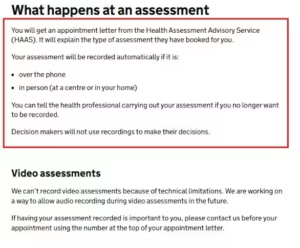
DWP guidance confirms that telephone and face-to-face health assessments have been automatically audio-recorded since 29 June 2026 unless the claimant opts out.
After the assessment, the healthcare professional’s role is to provide assessment information and advice for the decision-making process.
The assessor does not simply decide during the telephone conversation whether you will receive LCW or LCWRA. DWP makes the relevant benefit decision after considering the evidence.
The distinction matters because the Work Capability Assessment is an evidence-gathering process rather than a benefit decision being announced by the healthcare professional at the end of the call.
What Are the Possible Work Capability Assessment Outcomes?
For Universal Credit, the assessment process can result in different findings.
| Outcome | What It Generally Means |
| Fit For Work | You have not been found to have limited capability for work under the applicable rules |
| Limited Capability For Work | Your condition limits your capability for work and different work-related requirements can apply |
| Limited Capability For Work And Work-Related Activity | Your condition meets the relevant LCWRA criteria and you are not required to look for work or prepare for work |
| LCWRA With A Severe Lifelong Health Condition | Additional rules apply where the severe lifelong condition criteria are met |
The financial consequences depend on your benefit and circumstances.
Universal Credit health-related payment rules changed from April 2026, including different LCWRA rates for different groups. Wider Universal Credit benefit rates and health-element changes therefore need to be considered separately from the assessment outcome itself.
Receiving LCW or LCWRA does not necessarily mean you are forbidden from working.
Current GOV.UK guidance says someone with LCWRA can work if they feel able to do so. Rules introduced in 2026 also mean starting paid or voluntary work is not, by itself, a reason for automatically carrying out a new Work Capability Assessment.
That change forms part of the wider DWP disability and PIP reforms in 2026, although proposed future reforms should not be confused with rules already in force.
What If You Disagree With the Decision?
If you disagree with the decision you receive after your Work Capability Assessment, start by reading the decision notice carefully.
Look at what DWP has decided and which parts you believe do not reflect your circumstances.
Depending on the benefit and decision, you may be able to ask DWP to reconsider it through a Mandatory Reconsideration.
If you are challenging a decision, consider:
- Checking The Deadline
- Reading The Decision Reasons
- Identifying The Points You Disagree With
- Providing Relevant Evidence
- Using Specific Real Examples
- Keeping Copies Of Documents
- Keeping Relevant Assessment Records
- Getting Independent Welfare Rights Advice
If the decision remains unchanged after Mandatory Reconsideration, appeal rights may be available depending on the circumstances.
Do not assume that receiving another disability benefit automatically proves that the WCA decision is wrong. PIP, Universal Credit and ESA can apply different legal tests even when they concern the same underlying health condition.
Work Capability Assessment Phone Call Checklist
Before your assessment, check that you have everything you are likely to need.
- Confirm The Appointment Date And Time
- Charge Your Phone
- Check Your Signal
- Keep Your Appointment Letter Nearby
- Have Your WCA50 Available
- Keep Your Medication List Ready
- Have Relevant Medical Information Nearby
- Write Down Important Examples
- Think About Better And Worse Days
- Note Any Help You Regularly Need
- Arrange A Support Person If Needed
- Choose A Quiet And Private Location
- Keep Water Or Medication Nearby If Required
These notes are there to help you remember relevant information. They should not be used to create rehearsed or exaggerated answers.
Conclusion
A work capability assessment phone call is designed to gather information about how your health condition or disability affects your capability for work and relevant everyday activities.
The most useful preparation is to review the information you have already supplied, keep important documents nearby and think of specific examples that show what happens in everyday life.
When answering questions, explain more than whether you can technically perform an activity. Where relevant, describe pain, fatigue, distress, assistance, safety issues, recovery time, variation and whether you can repeat the activity.
You should give an accurate account rather than trying to predict what the assessor wants to hear.
Remember that the healthcare professional contributes to the assessment process, while the eventual benefit decision is made through DWP’s decision-making process. If you disagree with that decision, formal reconsideration and appeal routes may be available.
Frequently Asked Questions
What Happens During a Work Capability Assessment Phone Call?
A healthcare professional asks questions about your health condition or disability and how it affects relevant everyday activities and your capability for work. The discussion may cover physical health, mental health, mobility, concentration, communication, treatment and support needs.
What Questions Are Asked in a Work Capability Assessment?
Questions vary according to your circumstances. They may cover walking, sitting, standing, reaching, concentration, memory, communication, social interaction, leaving home, treatment, medication and everyday activities.
How Long Does a Work Capability Assessment Phone Call Take?
There is no fixed duration that applies to every assessment. The length depends on the person’s circumstances and the amount of information that needs to be discussed. A short or long call does not by itself predict the outcome.
Can Someone Be With Me During the Phone Assessment?
Yes. You can have another person with you, such as a friend or support worker. For a telephone assessment, you may also be able to ask the assessor to include the support person on the call if they are elsewhere.
Are Work Capability Assessment Phone Calls Recorded?
Telephone Work Capability Assessments are now audio recorded as standard. The change took effect on 29 June 2026. You can ask not to have your assessment recorded, and DWP says opting out will not disadvantage you.
What Happens If I Miss the Assessment Phone Call?
Contact the health assessment provider promptly using the details in your appointment correspondence. Explain why you missed the appointment and ask what action you need to take. Do not assume another appointment will automatically be arranged.
Does the Assessor Decide Whether I Get LCW or LCWRA?
No. The healthcare professional provides assessment information and advice. DWP uses the available evidence to make the relevant benefit decision.
How Long Does It Take to Get a Decision After a Work Capability Assessment?
There is no guaranteed universal timeframe for every claimant. Processing times can differ depending on the circumstances and whether further information is required.