
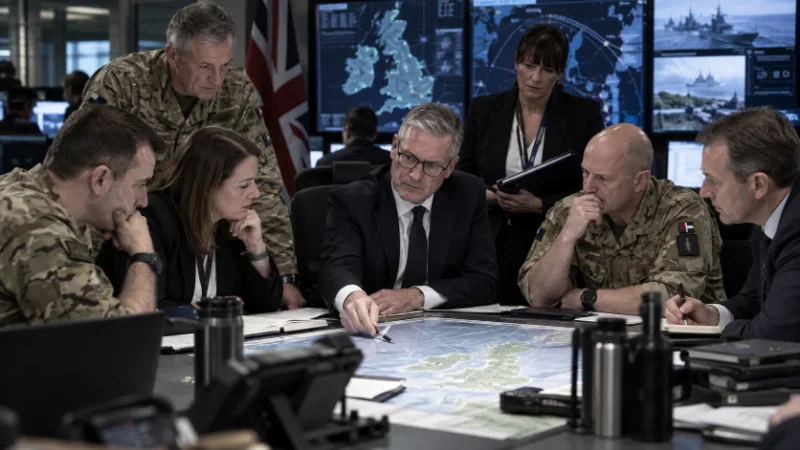
The UK has not declared war in 2026, and there is no official announcement that Britain is about to enter a direct war with Russia or another country. What has changed is the level of preparation.
Government departments are refreshing classified crisis plans known as War Books, defence investment is increasing, national resilience planning has accelerated and a major home-defence exercise is planned for 2027.
The government’s approach is currently centred on deterrence, preparedness and resilience, rather than announcing an intention to begin a war.
| 2026 Position | What It Means |
| UK At War With Russia | No |
| War Books Being Updated | Yes |
| Defence Spending Increasing | Yes |
| National Resilience Planning Increasing | Yes |
| Major Home Defence Exercise Planned | Yes, for 2027 |
| Immediate Civilian Wartime Restrictions Announced | No |
Last Updated: 17.09.2026
Why Is The UK Updating War Plans In 2026?
Britain’s security planning has changed considerably because the government believes threats against the UK can no longer be viewed purely as overseas military issues.
The Home Defence Programme is bringing civilian and military preparations together so the country can respond if international hostilities begin affecting the UK directly.
This includes conventional military threats as well as cyber attacks, sabotage, disruption to infrastructure and pressure on essential supply chains.
The government’s current approach involves:
- Updating Departmental Plans: Whitehall departments are refreshing crisis procedures
- Protecting Infrastructure: Energy, transport and communication systems are receiving greater resilience attention
- Improving Coordination: Military, government, businesses and local responders are expected to work more closely
- Testing Preparedness: A large national home defence exercise is planned for 2027
- Increasing Defence Investment: Spending is being directed towards equipment, technology and readiness
These preparations do not establish that a war is about to begin. They are intended to identify weaknesses before a major national security crisis occurs.
What Is The Government War Book?
The Government War Book is a system of contingency planning that tells different parts of government what they would be expected to do if Britain faced war or another severe national security emergency.
Its origins date to 1912, before the First World War. Similar plans were extensively developed during the Cold War, when Britain prepared for the possibility of a major confrontation involving the Soviet Union.
The traditional War Books were later archived following the end of the Cold War as the perceived risk of a direct attack on Britain declined.
That position has now changed.
Under the Home Defence Programme, classified government crisis plans commonly referred to as War Books are being updated again. The Cabinet Office coordinates the work, while individual departments need plans relevant to their own responsibilities.
The updated documents could cover areas such as:
| Area | Likely Planning Priority |
| Government | Continuity of decision-making |
| Energy | Keeping essential power systems operating |
| Transport | Maintaining critical movement and logistics |
| Healthcare | Continuity of essential health services |
| Communications | Protecting networks and information systems |
| Supply Chains | Maintaining access to essential goods |
| Cybersecurity | Responding to hostile digital activity |
Many operational details are expected to remain classified.
Does Updating War Plans Mean The UK Is Going To War?
Updating emergency plans is different from deciding to enter a conflict.
Governments prepare for events they hope never happen. The UK also maintains contingency arrangements for pandemics, terrorism, severe weather, cyber attacks and infrastructure failures.
The renewed War Book is therefore better understood as an attempt to answer questions such as:
- Who Makes Decisions: Which departments take responsibility during a national security crisis?
- How Services Continue: How can essential public services remain operational?
- Where Resources Are Needed: Which capabilities require additional investment?
- How Britain Responds: How would civilian and military authorities coordinate?
This distinction is important when asking whether the UK is going to war in 2026.
Increased preparation shows that officials consider the international security environment more serious, but preparation itself does not confirm that conflict has been decided.
How Did The Russia-Ukraine War Develop, And How Has The UK Responded?
Russia’s full-scale invasion of Ukraine began on 24 February 2022, although the current conflict has deeper roots in Russia’s annexation of Crimea and fighting in eastern Ukraine from 2014.
The UK’s response developed gradually from diplomatic pressure and sanctions into extensive military, financial and humanitarian support.
| Period | UK Response And Wider Development |
| 2014 | Russia annexed Crimea and fighting intensified in eastern Ukraine |
| February 2022 | Russia launched its full-scale invasion |
| 2022 | UK sanctions and military assistance expanded significantly |
| 2023–2024 | Training, ammunition, missiles, vehicles and other assistance continued |
| 2024 | UK Home Defence planning began receiving greater attention |
| 2025 | Defence policy increasingly emphasised readiness and European security |
| 2026 | War Books, national resilience and military readiness became major government priorities |
| End Of 2026 | Departments are expected to have substantially advanced refreshed War Book planning |
| 2027 | A large national Home Defence exercise is planned |
By August 2026, Britain had pledged around £25 billion in support to Ukraine since February 2022, including £16 billion in military financing.
How Has The UK’s Approach Changed From Supporting Ukraine To Strengthening Its Own War Readiness In 2026?
The biggest change is that UK policy is no longer focused only on what Britain can provide to Ukraine.
Officials are also examining what the war demonstrates about Britain’s own security.
Lessons from Ukraine have influenced planning around drones, ammunition, air defence, communications, supply chains and the speed at which military technology needs to evolve.
The Ministry of Defence has explicitly said it is learning from Ukraine’s use of unmanned systems and the need for faster adaptation.
The UK’s approach in 2026 can therefore be viewed as having two connected elements: continuing to support Ukraine while improving Britain’s ability to withstand or respond to a future crisis affecting the UK itself.
What Is Exercise ALBISTON SHADOW And Why Does It Matter?
One of the clearest developments in UK preparedness is Exercise ALBISTON SHADOW, planned for 2027.
The government has described it as the largest UK home-defence exercise in decades. Ministers, local responders and hundreds of government and public-sector officials are expected to be involved.
The exact scenario will remain classified, but the government says the multi-day exercise will test responses to hybrid attacks against the UK.
These could combine several forms of disruption rather than a conventional military attack alone.
For example, an exercise could test coordination during simultaneous problems affecting communications, infrastructure and public services.
ALBISTON SHADOW is also expected to complement NATO’s CMX27 Crisis Management Exercise, allowing Britain to examine how its domestic response connects with wider NATO arrangements.
What Does The National Risk Register 2026 Say?
The National Risk Register 2026 was published in July and updated in August.
It is the public version of the government’s National Security Risk Assessment and identifies serious risks that could affect Britain and its interests.
Importantly, it does not deal only with military conflict.
The register assesses a much wider range of threats and hazards, helping government, businesses, voluntary organisations and resilience planners understand the potential consequences of major emergencies.
Being included in the register does not mean an event is expected to happen. Risk planning considers both probability and potential impact so organisations can prepare even for unlikely but serious scenarios.
This makes the 2026 preparedness programme broader than simply preparing soldiers for war.
How Is The UK Strengthening National Resilience?
National resilience has become one of the central themes of UK security policy.
Modern conflicts can place pressure on a country without enemy forces physically entering its territory.
Energy networks, telecommunications, transport systems, financial services and government databases can all become targets.
The government’s Home Defence Programme therefore focuses on aligning military and civilian efforts.
Cybersecurity And Critical Infrastructure
Cyber attacks are particularly important because much of modern Britain depends on connected digital systems.
A serious attack could potentially affect communications, businesses, public services or infrastructure without resembling traditional warfare.
The government has therefore been increasing attention on cyber resilience alongside physical defence.
Energy, Transport And Essential Services
Energy and transport are equally important.
Military and civilian responses during a national emergency depend on roads, railways, ports, fuel, electricity and telecommunications continuing to function.
Government planning therefore includes sector-specific resilience work rather than concentrating entirely on Armed Forces capability.
Could UK Civilians Be Affected By A Future Conflict?
A major conflict involving Britain could affect civilians, but there is no announced programme of wartime restrictions for the UK population in 2026.
Historical War Books contained provisions dealing with issues such as supplies, government continuity and civil defence.
Those historical policies should not automatically be presented as measures Britain intends to introduce today.
Current preparations focus more clearly on keeping essential systems working.
For households and businesses, that could mean greater emphasis on:
- Emergency Preparedness: Knowing what to do during prolonged disruption
- Business Continuity: Ensuring essential organisations can continue operating
- Communication: Maintaining reliable public information during emergencies
- Infrastructure Resilience: Reducing disruption to energy, transport and digital systems
There is currently no basis for treating food rationing, compulsory evacuation or widespread school closures as confirmed UK policies for 2026.
How Does NATO Affect UK War Planning?
NATO is central to Britain’s defence strategy, but Article 3 and Article 5 perform different roles.
| NATO Provision | What It Means |
| Article 3 | Members develop their individual and collective ability to resist armed attack |
| Article 5 | An armed attack against one Ally can be treated as an attack against all Allies |
Article 3 helps explain the current focus on infrastructure, resilience and domestic preparedness.
Article 5 relates to collective defence. It does not mean Britain automatically responds identically to every crisis involving another NATO country. Each Ally takes the action it considers necessary under the treaty framework.
The aim of NATO’s wider deterrence strategy is to reduce the likelihood of attack by demonstrating that members are prepared to defend themselves and each other.
How Is UK Defence Spending And Military Readiness Changing In 2026?
The government’s Defence Investment Plan, published on 30 June 2026, sets out approximately £298 billion of defence investment over four years.
It includes an additional £15 billion between 2026/27 and 2029/30 compared with the previous spending settlement.
| Period | Core NATO Defence Spending |
| 2026/27 | 2.6% Of GDP |
| 2027/28 | 2.7% Of GDP |
| 2028/29 | 2.7% Of GDP |
| 2029/30 | 2.7% Of GDP |
| Longer Term | Commitment towards 3.5% by 2035 alongside NATO allies |
Funding is being directed towards military equipment, training, drones, autonomous systems, aircraft, naval capability and other areas intended to improve readiness.
However, military preparedness cannot be judged from spending alone.
Personnel numbers, equipment availability, ammunition, industrial production, logistics and infrastructure also affect how quickly and effectively Britain could respond to a major crisis.
What Has Changed In UK War Preparedness During 2026?
The main shift in 2026 is that preparedness is increasingly being treated as a whole-of-society issue rather than solely a military responsibility.
Several major developments are now moving forward at the same time:
| 2026 Development | Why It Matters |
| War Books Refreshed | Defines departmental responsibilities during conflict |
| Home Defence Programme Accelerated | Links military and civilian preparedness |
| National Risk Register Updated | Refreshes assessment of major UK risks |
| Defence Investment Plan Published | Increases long-term military investment |
| Defence Readiness Legislation Planned | Could create additional powers for severe crises |
| 2027 National Exercise Announced | Will test whether plans work in practice |
The Strategic Defence Review has also recommended Defence Readiness legislation giving government powers that could be held in reserve if tensions escalated towards a war involving the UK or its allies.
The government said in July 2026 that it intends to bring forward legislation later in the current Parliament.
Separately, the Civil Contingencies Act framework is being reviewed to examine whether existing emergency arrangements remain suitable for today’s risks.
What Could Happen Next?
The next major stage is likely to involve turning planning documents into tested systems.
Through the remainder of 2026, departments are expected to continue developing their War Books and wider Home Defence arrangements.
Attention will then move towards the 2027 national exercise.
Three developments will be particularly important to watch:
- War Book Completion: How far departmental plans have progressed by the end of 2026
- Defence Readiness Legislation: What additional emergency powers Parliament is asked to consider
- ALBISTON SHADOW: What lessons emerge from testing civilian and military coordination in 2027
Further defence investment and the continuing security situation in Europe could also influence how UK policy develops.
Conclusion
So, are the UK going to war in 2026? Britain has not declared war, and the government has not announced that a direct conflict with Russia or another state is about to begin.
What is clear is that the UK is preparing more seriously for the possibility of future conflict.
The Russia-Ukraine war has changed Europe’s security environment, while cyber threats, infrastructure risks and wider geopolitical instability have increased concern about how Britain would cope during a major crisis.
War Books are being refreshed, civilian and military planning is becoming more closely connected, defence investment is increasing and a major national exercise is planned for 2027.
The key distinction is between preparing for the possibility of war and deciding to go to war. Britain’s current policy is centred on preparedness, resilience and deterrence rather than an announced decision to enter a new conflict.
Frequently Asked Questions
Is the UK Going To War In 2026?
The UK has not declared war in 2026. Government departments are increasing preparedness because of international security risks, but this does not mean a direct war has been announced.
Has The UK Declared War On Russia?
No. Britain provides military, financial and political support to Ukraine and has imposed sanctions connected with Russia’s invasion, but the UK has not declared war on Russia.
Why Is The UK Government Preparing For War?
Officials are preparing for risks including conventional conflict, cyber attacks, sabotage, infrastructure disruption and other hybrid threats that could affect the UK.
What Is The UK Government War Book?
The War Book is a system of government contingency planning setting out how departments would operate during conflict or a severe national security crisis.
Could Civilians Be Affected By UK War Planning?
National resilience planning includes essential services, infrastructure, businesses and communities, but there are no announced general wartime restrictions for UK civilians in 2026.
Could NATO Bring The UK Into A War?
NATO’s Article 5 creates a collective defence commitment following an armed attack on an Ally. The exact UK response would depend on the circumstances and decisions made under the treaty framework.
Is The UK Military Ready For War In 2026?
The government is increasing spending and readiness, but military capability depends on personnel, equipment, ammunition, logistics, industry and infrastructure as well as the defence budget.