

The NHS Wales pay rise for 2026/27 is 3.3% for Agenda for Change pay points, effective from 1 April 2026.
This covers many NHS workers, including nurses, healthcare support workers, cleaners, porters, administrative staff and allied health professionals employed on Agenda for Change terms.
Lower-paid workers can see increases of around 3.8% to 5.9% because NHS Wales had already committed to the Real Living Wage Foundation rate of £13.45 per hour. A later correction also increased the Band 3 entry salary to £26,813.
Key figures for 2026/27 include:
- Band 2: £26,300
- Band 3: £26,813 to £27,890
- Band 5: £32,557 to £39,631
- Band 6: £40,559 to £48,841
- Band 7: £50,129 to £57,365
- Band 9: £114,475 to £131,732
Band 1 remains closed to new entrants.
Latest NHS Wales Pay Update For 2026
The initial NHS Wales 2026/27 pay circular confirmed the 3.3% Agenda for Change increase in February 2026. It set revised salaries to apply from 1 April.
One important change happened after those original figures were published.
June 2026 Band 3 Pay Correction
The original 2026/27 pay scale placed the entry point for both Band 2 and Band 3 at £26,300.
This effectively removed the previous salary difference between an employee at the top of Band 2 and somebody entering Band 3.
NHS Wales subsequently issued a payroll correction dated 1 June 2026, increasing the Band 3 entry point by a further 1.95%.
The corrected Band 3 scale is:
| Band 3 Pay Point | 2026/27 Salary |
| Entry | £26,813 |
| Top | £27,890 |
The purpose of the adjustment was to restore a pay difference between Band 2 and the starting point of Band 3.
This update is particularly important because some early 2026 pay tables may still show £26,300 as the Band 3 starting salary.
Last Updated: 10.09.2026
Why Do Some Staff Receive More Than 3.3%?
The headline Agenda for Change award is 3.3%, but that does not mean every employee’s salary is only 3.3% higher than it was during 2025/26.
NHS Wales increased its minimum Agenda for Change hourly rate to the £13.45 Real Living Wage Foundation rate from April 2026.
As a result, the Welsh Government said increases for the lowest-paid NHS workers would range between approximately 3.8% and 5.9%.
Band 2 provides a clear example. The entry salary increased from £24,833 in 2025/26 to £26,300 in 2026/27, an increase of £1,467.
That works out at around 5.9%, considerably more than the general 3.3% award.
NHS Wales Pay Scales 2026/27 By Band
The following table shows the updated Agenda for Change salaries in Wales. The Band 3 figure includes the later 2026 correction.
| Band | Entry Salary | Intermediate Salary | Top Salary | Approx. Entry Hourly Rate |
| Band 1* | £26,300 | — | £26,300 | £13.45 |
| Band 2 | £26,300 | — | £26,300 | £13.45 |
| Band 3 | £26,813 | — | £27,890 | £13.71 |
| Band 4 | £28,819 | — | £31,626 | £14.73 |
| Band 5 | £32,557 | £35,114 | £39,631 | £16.64 |
| Band 6 | £40,559 | £42,805 | £48,841 | £20.74 |
| Band 7 | £50,129 | £52,712 | £57,365 | £25.63 |
| Band 8a | £58,379 | £61,317 | £65,723 | £29.85 |
| Band 8b | £67,583 | £71,952 | £78,530 | £34.55 |
| Band 8c | £80,698 | £85,611 | £92,984 | £41.26 |
| Band 8d | £95,773 | £101,643 | £110,448 | £48.96 |
| Band 9 | £114,475 | £121,377 | £131,732 | £58.53 |
*Band 1 is closed to new entrants.
Hourly figures are approximate equivalents based on standard full-time NHS working hours.
Actual hourly earnings can differ where an employee works reduced hours, receives unsocial-hours enhancements or has other contractual arrangements.
Employees also do not automatically move through each pay point purely because another year has passed. Agenda for Change pay progression rules and eligibility requirements continue to apply.
NHS Wales Pay Rise 2025 Vs 2026
The general NHS Wales Agenda for Change award was 3.6% in 2025/26, compared with 3.3% in 2026/27.
Despite the smaller headline percentage, lower-paid employees have experienced larger increases because of the Real Living Wage changes.
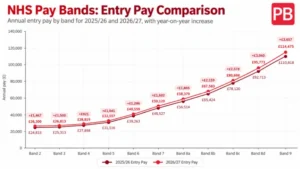
| Band | 2025/26 Entry Pay | 2026/27 Entry Pay | Annual Increase |
| Band 2 | £24,833 | £26,300 | £1,467 |
| Band 3 | £25,313 | £26,813 | £1,500 |
| Band 4 | £27,898 | £28,819 | £921 |
| Band 5 | £31,516 | £32,557 | £1,041 |
| Band 6 | £39,263 | £40,559 | £1,296 |
| Band 7 | £48,527 | £50,129 | £1,602 |
| Band 8a | £56,514 | £58,379 | £1,865 |
| Band 8b | £65,424 | £67,583 | £2,159 |
| Band 8c | £78,120 | £80,698 | £2,578 |
| Band 8d | £92,713 | £95,773 | £3,060 |
| Band 9 | £110,818 | £114,475 | £3,657 |
Band 3 stands out because its final 2026 starting salary reflects both the wider pay changes and the subsequent correction designed to restore the differential above Band 2.
For Bands 4 and above, the percentage movement between equivalent points is generally close to the headline 3.3% increase.
How Much More Will NHS Wales Staff Earn?
Looking at the percentage increase alone does not always show what the award means to an employee’s monthly budget.
The following examples compare entry salaries before tax and other deductions.
| Example | Annual Increase | Average Gross Monthly Increase |
| Band 2 Entry | £1,467 | £122.25 |
| Band 3 Entry | £1,500 | £125.00 |
| Band 5 Entry | £1,041 | £86.75 |
| Band 6 Entry | £1,296 | £108.00 |
| Band 7 Entry | £1,602 | £133.50 |
These are gross increases, not the amount employees will necessarily see added to their bank account each month.
Actual take-home gains depend on Income Tax, National Insurance, NHS Pension contributions, student loan repayments, salary sacrifice arrangements and other deductions.
An employee who moves to another pay step at around the same time could also see a larger change than the pay award alone.
Who Is Eligible For The NHS Wales Pay Rise?
The 3.3% award applies to NHS Wales employees whose salaries are set under Agenda for Change terms and conditions.
This includes many:
- Nurses
- Midwives
- Healthcare support workers
- Porters
- Cleaners
- Administrative workers
- Allied health professionals
- Technical staff
- Ambulance and support employees
- Professional and managerial staff covered by Agenda for Change
Part-time employees receive the relevant salary on a pro-rata basis according to their contracted hours.
Part-Time And Bank Staff
NHS bank workers are also important because they do not always have exactly the same employment status as substantive employees.
Under the All-Wales Terms of Engagement arrangements, bank workers are paid using the Welsh NHS pay scales for the duties they perform.
When those Welsh scales increase, the relevant new rates therefore apply to bank workers.
The minimum payment for bank workers is also linked to the Living Wage Foundation rate.
The amount earned by an individual bank worker will still depend on factors such as their band, shifts worked and applicable enhancements.
NHS Wales Allowances And Additional Payments In 2026
Basic salary is only one part of NHS earnings. Certain employees can receive additional contractual payments depending on their working arrangements.
The 2026/27 Welsh pay circular increased the sleeping-in and Wales on-call allowances by 3.3%.
| Allowance | 2026/27 Rate |
| Sleeping In | £44.82 |
| Wales On Call Public Holiday | £52.08 |
| Wales On Call Weekday/Weekend | £26.05 |
These should not be confused with London’s Higher Cost Area Supplements.
NHS Wales does not use the London HCAS pay structure simply because an employee works in a more expensive Welsh city.
London HCAS figures found in English NHS salary tables should therefore not be added to Welsh Agenda for Change salaries.
Other earnings can depend on an employee’s contractual conditions, working pattern and whether particular shifts qualify for enhancements.
Do Doctors And Dentists In Wales Get The Same Pay Rise?
No. Doctors and dentists are generally covered by separate medical and dental pay arrangements rather than the Agenda for Change system.
For 2026/27, the Welsh Government accepted a 3.5% consolidated pay increase from 1 April 2026 for groups including:
- Consultants
- Speciality, specialist and associate specialist doctors and dentists
- Resident doctors and dentists
- Locally employed doctors
Salaried dentists working in Community Dental Services and the Public Dental Service received a 3.75% consolidated uplift.
This distinction matters because somebody searching for the NHS Wales pay rise may assume every member of NHS staff received the same 3.3%.
The 3.3% figure specifically relates to the Agenda for Change award.
NHS Wales Pay Vs NHS England In 2026
NHS Wales and NHS England both use Agenda for Change, but their salary figures are not identical.
Welsh starting salaries for several bands are higher than the corresponding standard England rates in 2026/27.
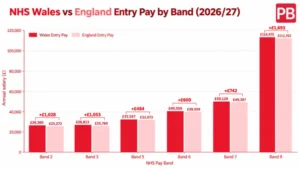
| Band | Wales Entry Pay | England Entry Pay | Wales Difference |
| Band 2 | £26,300 | £25,272 | +£1,028 |
| Band 3 | £26,813 | £25,760 | +£1,053 |
| Band 5 | £32,557 | £32,073 | +£484 |
| Band 6 | £40,559 | £39,959 | +£600 |
| Band 7 | £50,129 | £49,387 | +£742 |
| Band 9 | £114,475 | £112,782 | +£1,693 |
The comparison is based on standard basic salaries.
London supplements and other location-related English payments are separate and should not be used as a direct comparison with standard Welsh pay.
This is one reason employees should check a Wales-specific pay table rather than assuming a UK-wide NHS salary table applies to them.
How Will The Pay Rise Affect Take-Home Pay?
A £1,000 increase in annual salary does not mean an employee receives an extra £1,000 in cash over the year.
The pay rise increases gross salary first. Several deductions may then affect the amount reaching the employee.
Income Tax can increase when taxable earnings rise. The exact effect depends on the employee’s tax code and total taxable income.
National Insurance may also be deducted from the additional earnings where applicable.
NHS Pension contributions are based on pensionable earnings and contribution arrangements, meaning an increase in salary can increase the amount contributed towards the pension.
Student loan repayments can change where additional income is above the employee’s relevant repayment threshold.
Employees receiving benefits linked to household earnings may also need to consider whether higher pay changes their entitlement.
For this reason, the gross monthly figures in salary tables should be treated as a guide to the size of the pay award rather than a guaranteed increase in take-home pay.
NHS Wales Pay Rise Timeline: Where It Started, What Changed And What Comes Next?
The 2026 pay award developed through several stages rather than being a single change announced and completed on one date.
| Date | Development | What It Meant For Staff |
| January 2026 | Real Living Wage adjustment confirmed | Lowest Agenda for Change rates moved towards £13.45 per hour |
| February 2026 | 3.3% Agenda for Change award accepted | Revised 2026/27 pay scales were confirmed |
| 1 April 2026 | New pay award became effective | New salary rates applied from the start of the financial year |
| June 2026 | Band 3 entry point corrected | Starting Band 3 salary increased to £26,813 |
| Ongoing In 2026 | Structural pay discussions continue | Further changes to parts of Agenda for Change remain possible |
| Future Plans | Wider pay structure reform | Lowest-paid and graduate salary structures remain areas of focus |
Where It Started?
The first significant development came with the decision to increase the minimum Agenda for Change rate in line with the Living Wage Foundation rate of £13.45 per hour.
This particularly affected employees at the bottom of the NHS Wales salary structure.
What Changed?
In February, the Welsh Government accepted the NHS Pay Review Body recommendation for a general 3.3% consolidated increase, effective from April.
The Band 3 issue then emerged because the original calculation left Band 3 entry pay equal to Band 2. The June correction increased Band 3 starting pay to £26,813.
What Is Ongoing?
The Welsh Government has also been involved in discussions over wider Agenda for Change structural reform alongside other parts of the NHS system.
Areas identified for attention include pay for the lowest-paid staff and graduate-level starting salaries.
The aim is not simply to apply annual percentage increases but also to consider how the structure works between bands and career stages.
What Are The Future Plans?
Further structural changes remain possible if agreement is reached.
The Welsh Government previously stated that agreed structural reforms would be effective from and backdated to April 2026.
That does not mean another across-the-board NHS Wales pay rise has already been guaranteed.
It means specific structural changes could produce further adjustments for affected staff if negotiations result in an agreement.
Employees should therefore distinguish between the confirmed 3.3% 2026/27 pay award and any separate reforms that may subsequently alter particular bands or pay points.
Could NHS Wales Pay Change Again In 2026/27?
Yes, certain pay points could potentially change again, although staff should not assume another general percentage increase will automatically be announced during the same financial year.
The Band 3 correction already demonstrates that a published pay scale can be amended where a structural issue needs to be addressed.
Further Agenda for Change reforms could affect areas such as:
- Pay differences between neighbouring bands
- Starting salaries for graduate roles
- Pay for lower-paid NHS workers
- Career and pay progression
- Wider Agenda for Change structures
Until additional changes are formally agreed and published, the confirmed 2026/27 salaries remain the appropriate figures to use.
Conclusion
The NHS Wales pay rise for 2026 is 3.3% for Agenda for Change staff, effective from 1 April 2026, but the final impact varies across the workforce.
The Real Living Wage adjustment means some of the lowest-paid NHS staff have received increases approaching 5.9%, while the later Band 3 correction raised the starting salary to £26,813.
For most established Agenda for Change points above the lowest bands, the 3.3% uplift is reflected directly in the new salary scale. Doctors and dentists sit outside this award and have their own 2026/27 increases.
Further structural reform remains one of the main areas to watch because future agreements could lead to additional changes for particular groups even after the main annual award has taken effect.
FAQs
When Did The NHS Wales 2026 Pay Rise Start?
The 2026/27 Agenda for Change pay award is effective from 1 April 2026. The general consolidated increase is 3.3%.
Is The NHS Wales Pay Rise Backdated To April 2026?
The confirmed Agenda for Change rates apply from 1 April 2026. Later adjustments affecting a pay point may also require arrears where the revised rate applies retrospectively.
What Is The NHS Wales Band 3 Salary In 2026?
Following the June correction, Band 3 pays £26,813 at entry and £27,890 at the top for 2026/27.
What Is The NHS Wales Band 5 Salary In 2026?
Band 5 runs from £32,557 to £39,631, with an intermediate pay point of £35,114.
Are NHS Wales Bank Staff Included?
Bank workers are paid according to Welsh NHS pay scales for the work they undertake, meaning revised Welsh pay rates are applied to relevant bank work.
Why Is NHS Wales Pay Different From England?
Agenda for Change operates across both systems, but the devolved governments can implement different salary rates and arrangements. Wales also made specific changes connected with the Real Living Wage.
Will There Be Another NHS Wales Pay Rise?
Another general 2026/27 award has not been confirmed. However, continuing Agenda for Change structural reform could result in further changes to particular pay points if agreements are reached.