
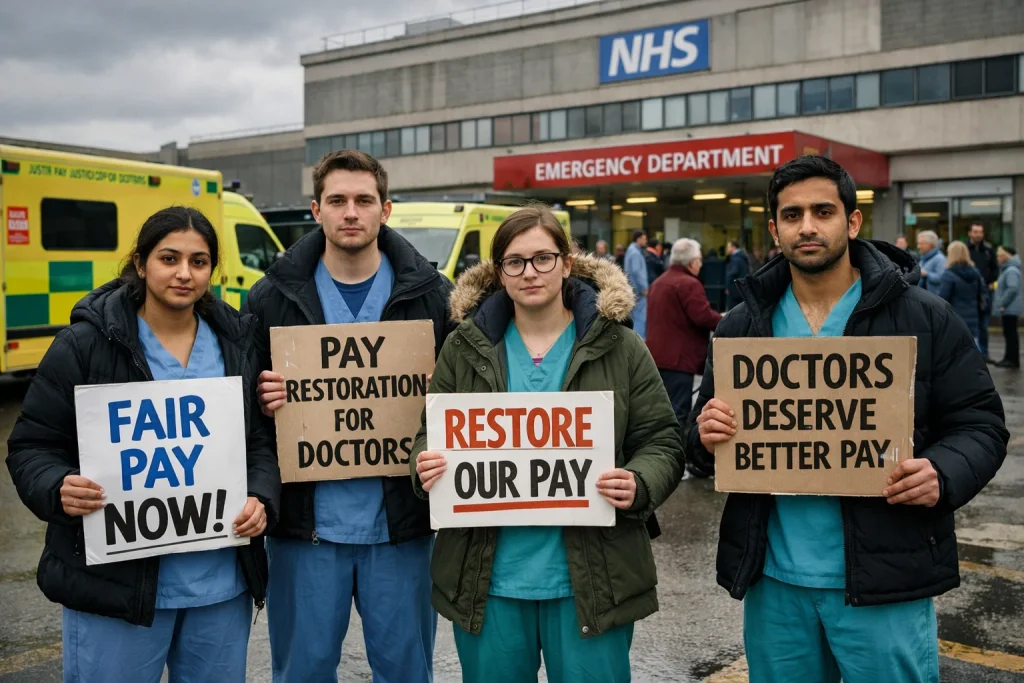
Resident Doctors Strikes 2026
Resident doctors across England will strike from 7 April to 13 April 2026 following rejection of a government pay offer.
The dispute centres on long-term pay erosion, with doctors demanding full pay restoration rather than phased increases spread over multiple years.
📅 Strike Dates
7 April to 13 April 2026 across England
💰 Pay Dispute
Focus on restoring real-term pay lost over years
🏥 NHS Impact
Delays expected for routine care and appointments
🚑 Emergency Care
Critical and emergency services will continue
Insight:
The 2026 strikes highlight ongoing workforce challenges within the NHS, including retention pressures and dissatisfaction with pay progression, raising concerns about long-term system sustainability.
Stay updated with NHS announcements and official guidance to plan around service disruptions during the strike period.
What Are the Resident Doctors Strikes in 2026?
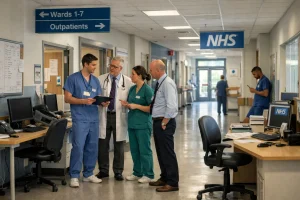
The resident doctors strikes in 2026 represent a major phase of industrial action within the National Health Service in England.
These strikes involve resident doctors, often still widely referred to as junior doctors, who play a central role in delivering frontline care across hospitals, clinics, and emergency services.
Resident doctors are fully qualified medical professionals who are undergoing specialist training. They are responsible for a significant proportion of patient care, including diagnosing conditions, prescribing treatments, and managing hospital wards.
Despite their responsibilities, their pay and working conditions have been at the centre of a long-running dispute.
The 2026 strikes have been organised following continued dissatisfaction with pay offers and working conditions.
The British Medical Association, which represents doctors, has coordinated the industrial action after negotiations with the government failed to produce an agreement acceptable to its members.
This wave of strikes is not an isolated event. It follows years of tension between healthcare workers and policymakers, with repeated warnings about staffing shortages, increasing workload, and declining real-term pay. The situation has gradually escalated into one of the most significant workforce disputes in recent NHS history.
When Are the Resident Doctors Strikes Happening in April 2026?
The April 2026 strike action has been scheduled over a six-day period, making it one of the longest consecutive strikes undertaken by resident doctors.
| Detail | Information |
| Start Date | 7 April 2026 |
| Start Time | 7:00 AM |
| End Date | 13 April 2026 |
| End Time | 6:59 AM |
| Total Duration | Nearly 6 full days |
The extended duration of this strike is particularly significant because it increases the likelihood of widespread disruption across NHS services.
Unlike shorter strikes, which may cause temporary delays, a prolonged period of reduced staffing places sustained pressure on hospitals and care systems.
Hospitals typically prepare contingency plans in advance. These plans include redeploying senior doctors, postponing elective procedures, and prioritising urgent care.
However, even with these measures, the absence of a large portion of the workforce inevitably leads to delays.
Patients are most likely to experience:
- Postponed outpatient appointments
- Delayed elective surgeries
- Longer waiting times for non-urgent care
The timing of the strike also adds pressure, as April is often a busy period for the NHS following winter demand.
Why Are Resident Doctors Striking in the UK?
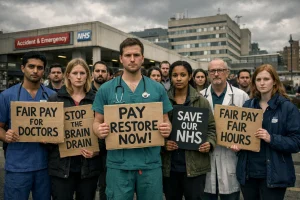
At the core of the resident doctors strikes is a dispute over pay, specifically the concept of pay restoration. Doctors argue that their salaries have not kept pace with inflation over the past decade and a half, leading to a significant reduction in real-term earnings.
The disagreement intensified after the government proposed a pay deal that included a modest increase spread over three years. While this approach was presented as a balanced solution, many doctors viewed it as insufficient and delayed.
What Is Pay Restoration and Why Does It Matter?
Pay restoration refers to the effort to bring doctors’ salaries back in line with their 2008 value when adjusted for inflation. Since that time, pay has gradually eroded due to below-inflation increases.
| Year | Approx Real Pay Change |
| 2008 | Baseline |
| 2012 | Around -10 percent |
| 2016 | Around -16 percent |
| 2020 | Around -20 percent |
| 2023 | Around -32 percent |
| 2026 Forecast | Around -21 percent |
This long-term decline has had a direct impact on morale and retention. Many doctors feel that their level of responsibility is not matched by fair compensation.
A healthcare workforce specialist described the issue in practical terms:
“When people hear percentages, it can seem abstract, but in reality it affects everyday decisions. Doctors are reconsidering career paths, working abroad, or leaving the profession entirely because the financial trajectory no longer feels sustainable.”
The issue of pay restoration is therefore closely linked to broader concerns about staffing shortages and workforce stability.
What Did the Government Offer in 2026?
The government’s proposal included a pay uplift combined with a structured increase over multiple years. This was intended to balance fiscal constraints with workforce demands.
| Component | Details |
| Base Pay Uplift | 3.5 percent recommended |
| Additional Increase | Spread across three years |
| Total Impact | Gradual improvement rather than immediate restoration |
Doctors argued that spreading increases over several years weakens the effectiveness of the proposal. From their perspective, it delays meaningful progress and does not adequately address the scale of pay erosion.
The rejection of this offer led directly to the decision to proceed with strike action.
How Much Has Resident Doctors’ Pay Fallen Over Time?
The decline in real-term pay for resident doctors is one of the most documented aspects of the dispute. Over time, pay increases have consistently lagged behind inflation, resulting in a steady decrease in purchasing power.
| Year | Change in Real Pay |
| 2008 to 2010 | Near stable |
| 2011 to 2014 | Gradual decline reaching around -14 percent |
| 2015 to 2018 | Further decline reaching around -20 percent |
| 2019 to 2021 | Continued pressure around -20 to -26 percent |
| 2022 to 2023 | Sharp drop to around -32 percent |
| 2024 to 2026 | Partial recovery but still below -21 percent |
This trend illustrates that the issue is not the result of a single decision but rather a long-term pattern.
A hospital registrar shared their perspective on this decline:
“You notice it over time rather than all at once. Costs go up, expectations stay high, and gradually it feels like the job is becoming harder to justify financially.”
The cumulative effect of these changes has contributed to growing dissatisfaction across the workforce.
What Does the Pay Restoration Timeline Look Like?

The timeline for achieving full pay restoration varies significantly depending on the size of annual pay increases. Smaller increases result in much longer recovery periods.
| Annual Uplift | Estimated Time to Full Restoration |
| 3 percent | No meaningful progress |
| 4 percent | Around 30 years |
| 5 percent | Around 14 years |
| 6 percent | Around 9 years |
| 8 percent | Around 5 years |
| 10 percent | Around 4 years |
| 12 percent | Around 3 years |
| 14 percent or more | Around 2 years |
This table highlights why many doctors are pushing for higher increases. From their perspective, incremental changes extend the problem into future decades.
The concept of full pay restoration is not just about reaching a numerical target. It also represents a broader attempt to reset the value placed on medical professionals within the healthcare system.
What Were the Results of the Strike Ballot?
The decision to proceed with the resident doctors strikes was based on a formal ballot conducted among eligible members. The results demonstrated strong support for industrial action.
| Category | Number |
| Eligible Voters | 54,432 |
| Total Votes Cast | 28,598 |
| Turnout | 52.54 percent |
| Yes Votes | 26,696 |
| No Votes | 1,885 |
| Yes Percentage | 93.40 percent |
The high percentage of votes in favour indicates a clear and unified stance among those who participated.
A resident doctor involved in the process explained the sentiment:
“There was a real sense that this was a decisive moment. People wanted to send a clear message that the current situation is not acceptable and cannot continue indefinitely.”
The ballot result provided the mandate required for the British Medical Association to move forward with strike action.
How Will the NHS Be Affected by the Resident Doctors Strikes?
The impact of the resident doctors strikes on the NHS is expected to be extensive, particularly given the duration of the action. Resident doctors form a large part of the workforce, and their absence creates immediate operational challenges.
Hospitals will prioritise essential services, but many routine functions will be scaled back or postponed.
Key areas likely to be affected include:
- Elective procedures such as planned surgeries
- Outpatient clinics and follow-up appointments
- Diagnostic services that are not urgent
Emergency care will continue to operate, although it may experience increased pressure due to reduced staffing levels.
Which NHS Services Will Still Operate?
Despite the disruption, certain services are maintained to ensure patient safety.
| Service Type | Availability |
| Emergency Care | Fully operational |
| Critical Care Units | Operational |
| Urgent Treatments | Prioritised |
| Routine Procedures | Likely delayed |
| Outpatient Services | Partially reduced |
Senior doctors and consultants often step in to cover essential roles during strike periods, but this is not a complete substitute for the regular workforce.
What Should Patients Do During the Strike?
Patients are advised to stay informed and take appropriate steps to manage their healthcare needs during the strike period.
- Check appointment status before attending
- Use NHS services responsibly
- Seek emergency care when necessary
The goal is to ensure that those who need urgent care receive it without overwhelming the system.
Can the Resident Doctors Strikes Still Be Avoided?
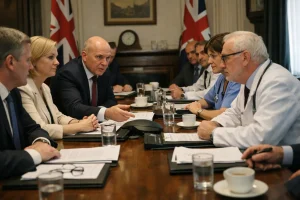
Although the strike dates have been confirmed, there remains a possibility that the action could be avoided if negotiations resume and produce a revised agreement.
The British Medical Association has indicated that it is open to further discussions, provided that any new proposal meaningfully addresses pay restoration.
For the government, the challenge lies in balancing financial constraints with the need to maintain a stable and motivated workforce.
The situation remains dynamic, and developments could occur in the days leading up to the planned strike. However, without significant changes to the current offer, the likelihood of the strikes proceeding remains high.
What Is the Long-Term Impact of These NHS Strikes?
The long-term implications of the resident doctors strikes extend beyond immediate disruption. They highlight deeper structural issues within the NHS, including workforce planning, funding, and staff retention.
One of the most significant concerns is the potential for increased waiting times. Delays caused by strike action can take months to resolve, adding to existing backlogs.
Another issue is the impact on workforce morale. Prolonged disputes can lead to frustration and burnout, making it more difficult to retain experienced staff.
A healthcare policy observer summarised the situation:
“Strikes are often seen as isolated events, but in reality they are symptoms of underlying problems. Unless those root issues are addressed, the cycle is likely to repeat.”
The resident doctors strikes in 2026 therefore represent not only a dispute over pay but also a broader conversation about the future of healthcare in the UK.
Conclusion
The resident doctors strikes in 2026 highlight a critical moment for the NHS. At the centre of the dispute is the issue of pay restoration and the long-term sustainability of the healthcare workforce.
With strong support from doctors and growing public awareness, the outcome of this dispute could shape the future of NHS staffing and funding.
Whether through negotiation or continued industrial action, the coming weeks will be crucial in determining how the situation unfolds.
FAQs About Resident Doctors Strikes
What are resident doctors called in the UK?
Resident doctors are commonly referred to as junior doctors in the UK, although the term “resident doctors” is increasingly being used.
Will A&E departments be open during the strikes?
Yes, emergency departments will remain open, and urgent care will still be provided.
Why are NHS doctors asking for pay restoration?
They are seeking to restore their real-term pay to 2008 levels after years of decline due to inflation.
How long will the April 2026 strikes last?
The strikes are scheduled to last from 7 April to 13 April 2026.
Can my hospital appointment be cancelled due to strikes?
Yes, non-urgent appointments and elective procedures may be postponed.
Who represents resident doctors in these negotiations?
The British Medical Association (BMA) represents resident doctors in pay negotiations.
Is there a chance the strikes could be cancelled?
Yes, if the government and BMA reach an agreement before the strike dates.