
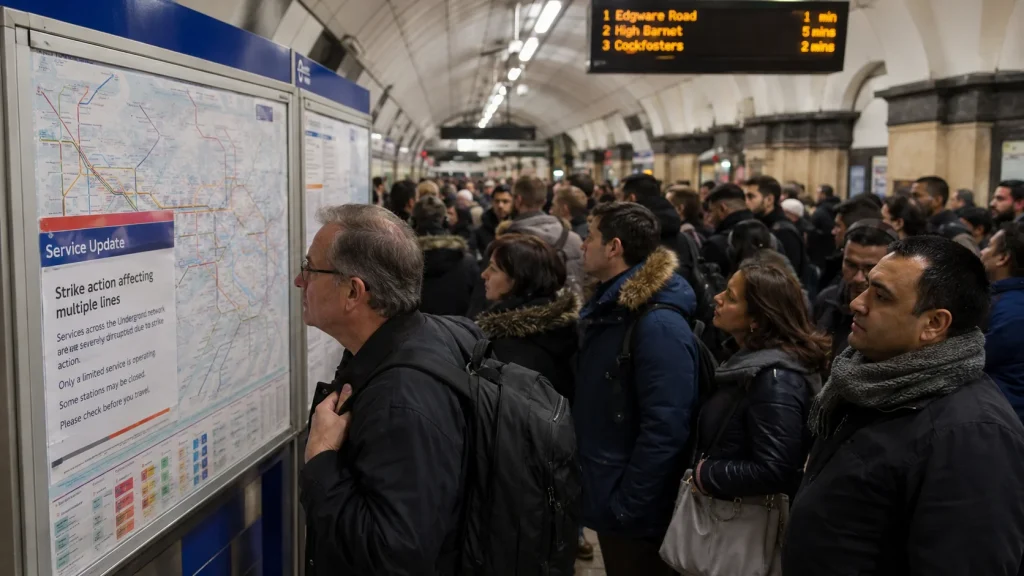
Key Takeaways:
Latest TfL Strike June Update (2 June 2026):
As of 2 June 2026, the planned RMT strike action is going ahead after last-minute negotiations through ACAS failed to secure an agreement between Transport for London (TfL) and union representatives. The dispute continues to centre on TfL’s proposed voluntary four-day working week for Tube drivers.
Passengers travelling across London should expect severe disruption on affected Underground routes, particularly during peak commuting hours. TfL has stated that some services will continue operating, but journey times may be significantly longer than usual. Additional disruption is also expected during the mornings following each strike day as normal service levels gradually recover.
What Is the TfL Strike June 2026 and Why Is It Happening?

The TfL Strike June dispute centres on proposed changes to working arrangements for London Underground drivers. Transport for London has suggested introducing a voluntary four-day working week that would allow drivers to work slightly longer shifts while reducing their overall weekly and annual hours.
Although the proposal was accepted by members of the Aslef union, the RMT has raised concerns about the practical impact of these changes. The union argues that the proposals could affect driver wellbeing, increase fatigue risks, and reduce flexibility in working patterns.
Following unsuccessful negotiations through the Advisory, Conciliation and Arbitration Service (ACAS), the strike action proceeded as planned, leading to significant disruption across London’s transport network.
Why Have RMT Drivers Decided to Take Industrial Action?
The primary reason for industrial action is concern over the long-term implications of the proposed working arrangements.
RMT officials have stated that drivers are worried about extended shift durations and the potential impact on physical and mental fatigue. While participation in the four-day working week would be voluntary, many members remain concerned that operational pressures could eventually make such arrangements more widespread.
The union also believes that more assurances are required before significant changes are implemented within the Underground network.
Railway safety consultant Martin explained the concern clearly: “Tube driving demands continuous concentration and decision-making. Even where proposals are voluntary, staff naturally want robust guarantees that safety standards and fatigue management will remain fully protected.”
What Is TfL’s Proposed Four-Day Working Week for Tube Drivers?
TfL’s proposal is designed to modernise scheduling practices and offer employees greater flexibility in their working lives.
Under the proposal, drivers would work slightly longer days but fewer days overall during the week. The result would be a reduction in total working hours across the year while creating more consecutive days off for participating employees.
TfL believes the proposal could improve workforce satisfaction while maintaining service levels across the network.
How the Voluntary Four-Day Work Week Would Work?
The proposal is based on voluntary participation rather than mandatory implementation.
Drivers choosing the arrangement would move to compressed working schedules. This means that while individual shifts may be longer, the overall number of working days would decrease.
TfL has repeatedly emphasised that no driver would be required to join the scheme and that participation would remain entirely optional.
Why Is the RMT Union Opposing the Four-Day Working Week Proposal?
The RMT’s opposition is rooted in concerns about operational realities rather than opposition to flexibility itself.
Union representatives argue that longer shifts could increase the risk of fatigue, particularly in a role where attention and vigilance are constantly required. They also fear that scheduling flexibility currently enjoyed by drivers could be diminished over time.
The union maintains that stronger safeguards are necessary before any changes can be introduced.
Concerns Over Driver Fatigue and Safety
Driver fatigue remains one of the most significant concerns raised by the union.
Operating trains within one of the world’s busiest underground systems requires sustained concentration throughout each shift. Any increase in shift duration naturally raises questions about fatigue management and overall safety performance.
The RMT argues that these concerns require further evaluation before implementation proceeds.
Issues Surrounding Shift Lengths and Flexibility
Beyond fatigue, union members are concerned about how shift patterns could evolve in the future.
Many drivers value the flexibility currently available within existing scheduling arrangements. There are concerns that compressed working weeks could eventually lead to reduced options for shift preferences and work-life balance.
This issue has become a central point of disagreement during negotiations.
What Happened During the Latest ACAS Negotiations?

The final round of negotiations was held through ACAS in an attempt to avoid disruption.
Discussions reportedly lasted several hours, with both sides presenting their positions regarding the four-day working week proposal. Despite these efforts, no agreement was reached.
The RMT stated that TfL failed to provide sufficient assurances regarding fatigue, safety, and flexibility concerns. As a result, the strike action proceeded according to schedule.
What Are the Exact TfL Strike Dates in June 2026?
The industrial action consists of two separate 24-hour walkouts organised by the RMT union.
| Strike Day | Duration |
| Tuesday 2 June 2026 | 00:01 until 23:59 |
| Thursday 4 June 2026 | 00:01 until 23:59 |
Although the strikes officially last for 24 hours, disruption frequently continues into the following morning. Train positioning, staff availability and timetable recovery can all contribute to delays even after strike action has ended.
Passengers travelling on Wednesday 3 June and Friday 5 June should also allow additional time for their journeys due to possible residual disruption.
Which London Underground Lines Are Affected by the TfL strike action in June?
The TfL Strike June disruption is concentrated on specific Underground routes where driver availability has been significantly reduced.
Passengers travelling across central and outer London have experienced service suspensions, timetable reductions, and station congestion.
| Underground Line | Expected Impact |
| Circle Line | No service expected |
| Piccadilly Line | No service expected |
| Metropolitan Line | Severe disruption and partial closures |
| Central Line | Severe disruption and reduced services |
| Jubilee Line | Reduced frequency |
| Northern Line | Reduced frequency |
| Victoria Line | Reduced frequency |
| Elizabeth Line | Operating normally |
| DLR | Operating normally |
Passengers should be aware that service levels may vary throughout the day depending on staff availability. TfL has advised travellers to check live service updates before starting their journeys, as conditions may change at short notice.
Circle Line Disruptions
The Circle line has experienced some of the most severe disruption during the strike period.
Passengers who normally rely on this route for travel around central London have been forced to seek alternative transport options.
Piccadilly Line Service Suspensions
The Piccadilly line has also been heavily impacted.
Given its importance for connections to Heathrow Airport and key business districts, disruptions on this route have affected both commuters and visitors.
Metropolitan Line Closures
Sections of the Metropolitan line have been suspended due to reduced driver availability.
This has created challenges for passengers travelling between outer London areas and the city centre.
Central Line Service Reductions
Parts of the Central line have experienced operational restrictions.
As one of London’s busiest transport corridors, even limited disruption on the Central line can create significant ripple effects throughout the wider network.
Will There Be Disruption on Non-Strike Days?
Many passengers assume disruption ends immediately once strike action finishes. However, this is rarely the case on the London Underground network.
Recovery operations can take several hours after a strike concludes. Trains must be repositioned across the network and staff schedules gradually restored to normal operating levels.
As a result, commuters travelling on Wednesday 3 June and Friday 5 June may still encounter delayed services, longer waiting times and overcrowding at major stations during the morning peak period.
Normal service levels are expected to return progressively throughout the day.
How Will London Commuters Be Impacted During the Strike Period?
Commuters are among those most heavily affected by the industrial action.
Many passengers face longer journey times due to reduced Underground services and increased demand on alternative transport options. Peak travel periods are expected to be particularly challenging, with bus routes and rail services experiencing heavier passenger volumes than usual.
Those travelling into central London may need to allow additional time and consider alternative routes.
Transport planning analyst Sarah Whitmore observed: “When Underground capacity falls significantly, demand quickly shifts to buses, Overground routes and walking corridors. The challenge is that these alternatives often become congested within a matter of hours.”
Can You Still Travel During the TfL Strike?
Yes, travel across London remains possible during the strike period, although passengers should prepare for longer journeys and busier services.
Several alternative transport networks are expected to continue operating throughout the industrial action.
| Alternative Service | Status During Strike |
| Elizabeth Line | Operating |
| London Buses | Operating |
| London Overground | Operating |
| DLR | Operating |
| Trams | Operating |
| National Rail | Mostly Operating |
Many commuters are expected to switch to these services, which could result in significant crowding during peak travel times. Travellers are encouraged to leave earlier than usual and consider alternative routes where possible.
How Busy Will Alternative Transport Routes Be During the Strike?
Alternative transport services are expected to experience substantial increases in passenger demand.
During previous Underground strikes, buses and rail services frequently operated near capacity throughout peak periods. Similar conditions are anticipated during the current industrial action.
Travellers should prepare for extended waiting times, crowded vehicles, and potentially longer overall journeys.
What Service Levels Has TfL Promised During the Industrial Action?
TfL has committed to operating as many services as possible despite the strike.
TfL has stated that some Underground services will continue operating, although service levels may vary depending on staff availability and operating conditions.
Passengers are advised to check real-time updates before travelling.
How Does the Current Strike Compare with Previous London Underground Strikes?
London’s transport network has experienced several major strikes in recent years, and the current dispute follows a familiar pattern of negotiations, industrial action, and service disruption.
The scale of the current disruption is comparable to previous walkouts that affected significant portions of the Underground network.
Why May’s Planned Strikes Were Suspended?
Planned strike action in May was suspended after progress was made during negotiations.
At that stage, both parties expressed optimism that a compromise could be reached. However, subsequent discussions failed to produce a final agreement, resulting in the current strike action.
What Are the Main Arguments Presented by the RMT Union?
The RMT has consistently focused on safety, fatigue, and working conditions.
Union representatives argue that longer working days could increase pressure on drivers and potentially affect wellbeing. They also believe that more detailed guarantees are necessary before implementing substantial changes to shift structures.
These concerns form the foundation of the union’s industrial action strategy.
How Has TfL Responded to the Union’s Concerns?
TfL has defended the proposal as a voluntary initiative designed to improve flexibility for employees.
Officials have repeatedly stressed that participation is optional and that the arrangement would reduce total working hours rather than increase them.
TfL has also expressed disappointment that negotiations failed to prevent disruption while reiterating its willingness to continue discussions.
Labour relations specialist David Harrington noted: “Disputes involving scheduling reforms often hinge on trust as much as technical details. Even when proposals appear beneficial on paper, workforce confidence is essential before major operational changes can succeed.”
What Does the Strike Mean for London Businesses and the Local Economy?

The strike has implications beyond transport alone.
Businesses that rely on commuter footfall may experience reduced customer numbers, while employers face challenges associated with delayed staff arrivals and disrupted meetings.
Retail, hospitality, and service sectors are particularly vulnerable to transport disruptions, especially in central London where Underground connectivity is crucial.
Some organisations have responded by encouraging remote working arrangements where possible.
How Can Commuters Prepare for Network Delays and Travel Disruption?
Advance planning is essential during periods of transport disruption.
Passengers should monitor service updates, consider alternative routes, and allow additional travel time. Flexibility can help minimise inconvenience and reduce stress during busy periods.
Journey Planning Advice
Travellers should consult official transport updates before departing.
Checking service status information can help identify route changes, station closures, and expected congestion levels.
Where possible, avoiding peak travel periods may also improve journey reliability.
Alternative Travel Options
Walking, cycling, and alternative rail routes may provide practical solutions for some passengers.
Many London residents have successfully adapted to previous strikes by combining multiple transport modes to complete their journeys.
Could Further TfL Strike Action Take Place Later in 2026?
Additional industrial action remains possible if negotiations fail to produce an agreement.
The outcome will largely depend on whether TfL and the RMT can bridge differences regarding safety assurances, working conditions, and scheduling flexibility.
Both sides have indicated a willingness to continue discussions, leaving the possibility of future progress open.
Conclusion
The TfL Strike June dispute highlights the complex balance between modernising workplace practices and maintaining confidence among frontline transport workers. While TfL views the voluntary four-day working week as a positive step towards greater flexibility, the RMT continues to express concerns regarding fatigue, safety, and operational impacts.
The resulting strike action has disrupted travel across key Underground routes and affected thousands of commuters and businesses. As negotiations continue, both parties face growing pressure to reach a sustainable agreement that protects passenger services while addressing workforce concerns within one of London’s most important transport networks.
FAQs
What time did the TfL strike officially begin?
The strike officially began at 00:01 BST on the scheduled strike day. Services were significantly reduced from the start of the action, with limited operations available during certain periods of the day.
Which Tube lines are completely suspended during the strike?
The Circle and Piccadilly lines are among the most heavily affected routes, with services suspended during the strike. Parts of the Metropolitan and Central lines are also subject to closures and severe service reductions.
Are London buses operating during the TfL strike?
Yes, London’s bus network continues to operate during the strike period. However, passengers should expect buses to be much busier than normal as commuters seek alternatives to affected Underground services.
Why did the RMT union reject TfL’s four-day working week proposal?
The union has raised concerns about longer shifts, driver fatigue, reduced flexibility, and potential safety implications. It argues that stronger assurances are needed before the proposal can be accepted.
Will the Elizabeth line be affected by the strike action?
The Elizabeth line is expected to continue operating normally throughout the strike. As a result, it is likely to become one of the busiest alternative travel options available to commuters.
Is there expected to be disruption after the strike ends?
Yes, residual disruption often continues into the morning following strike action. Train positioning, staffing arrangements, and timetable recovery can all contribute to delays even after the strike officially concludes.
Could further negotiations prevent future TfL strikes?
Further negotiations remain possible, and both TfL and the RMT have indicated a willingness to continue discussions. A successful agreement could help avoid additional industrial action later in the year.
How can passengers check live TfL service updates during the disruption?
Passengers can monitor live service information through TfL travel tools, station announcements, and transport information platforms. Checking updates before travelling can help avoid delays and identify alternative routes.