M6 Protest Quick Summary (April 15–17, 2026):
- Protest Status: Active (12:00 PM – 6:00 PM daily).
- Primary Impact Zones: M6 Junction 20 (Lymm Interchange), M6/M74 Border (Gretna), and M6 Junctions 31–32 (Preston).
- Current Delay Estimate: 45–90 minutes during peak convoy hours.
- Recommended Action: Use the M61 for North/South travel or the A6 for local Preston diversions.
Why Is the Fuel Protest on the M6 Taking Place?
The Fuel Protest M6 has been organised in response to rapidly increasing petrol and diesel prices across the UK. Protest groups argue that rising costs are affecting not only drivers, but also businesses, farms and haulage companies that rely heavily on fuel every day.
According to the RAC, petrol currently costs around £1.58 per litre, while diesel has reached approximately £1.91 per litre. Some motorway service stations are charging close to, or even above, £2.00 per litre for diesel. For many drivers and businesses, this has become unsustainable.
Rising Fuel Costs Across the UK
The recent surge in fuel prices has been linked to global instability and the continuing conflict in the Middle East. These international events have pushed oil prices higher, with the impact now being felt by UK households and businesses.
Farmers, transport firms and tradespeople are among those most affected because they often cannot reduce the amount of fuel they use. For them, every increase in the cost of diesel or petrol has an immediate effect on their day-to-day operations.
| Fuel Type | Current UK Average Price | Typical Motorway Price |
| Petrol | £1.58 per litre | £1.70 – £1.85 per litre |
| Diesel | £1.91 per litre | £1.95 – £2.05 per litre |
Many campaigners believe the Government has not done enough to reduce the pressure. Organisers say the M6 protest is intended to send a clear message about the financial strain facing key industries.
William Taylor, Farmers For Action Co-ordinator, said: “Farmers are at breaking point because fuel is now one of the biggest costs affecting every stage of food production. If diesel remains close to £2 per litre, many family farms and small businesses simply will not survive another year.”
Concerns From Farmers, Hauliers and Small Businesses
The protest is expected to attract strong support from several sectors. Farmers are likely to join because tractors, machinery and transport vehicles all rely on diesel. Haulage firms are also expected to participate because fuel represents one of their largest operating costs.
Small businesses are facing similar pressures. Delivery firms, builders, electricians and mobile workers often spend a large part of their working week on the road. Every rise in fuel prices increases their costs and can eventually lead to higher prices for customers.
Several groups involved in organising the protest have already taken part in previous demonstrations about farming costs and taxation. Those existing networks are now being used to organise this larger protest across the UK.
Some of the main concerns raised by campaigners include:
- Rising diesel prices above £2 per litre
- Increased costs for transporting food and goods
- Pressure on small businesses and self-employed workers
- Concerns about inflation and the wider cost-of-living crisis
- Lack of Government action to reduce fuel prices
When and Where Will the M6 Fuel Protest Happen?
The Fuel Protest M6 is planned to take place over three days: 15 April, 16 April and 17 April. Protesters are expected to gather from 12 noon each day at several major locations across the UK.
The M6 has been identified as one of the key routes because it is one of Britain’s busiest motorways and is heavily used by HGVs, farmers and commercial traffic.
Protest Dates and Times
Organisers have said participants should begin gathering from midday. Traffic disruption is therefore likely to build throughout the afternoon and could continue into the evening.
Drivers using the M6 during these periods should prepare for slower journeys and possible delays around motorway junctions.
| Date | Start Time | Expected Impact |
| 15 April | 12:00 noon | Moderate to severe delays |
| 16 April | 12:00 noon | Significant congestion possible |
| 17 April | 12:00 noon | Delays likely during afternoon and evening |
Main M6 Protest Locations
The protest is expected to affect several important points along the M6 route. The most significant locations include Junction 20, sections near Preston and the M6/M74 border area near Scotland.
Other motorway routes across the country are also expected to be involved, which could increase traffic on the M6 if drivers attempt to avoid disruption elsewhere.
| Main Protest Location | Area Likely to Be Affected |
| M6 Junction 20 | Cheshire and North West routes |
| M6 near Preston | Lancashire traffic and local roads |
| M6/M74 Border | Traffic entering and leaving Scotland |
| M6 Spaghetti Junction | West Midlands motorway traffic |
Drivers travelling through Lancashire should be particularly cautious because Preston sits on a major section of the M6 and is likely to become a key bottleneck.
How Could the M6 Fuel Protest Affect Traffic Around Preston?
Preston is expected to experience some of the worst delays because it lies close to several major motorway junctions and connecting routes. The M6 through Preston already carries high levels of commuter, freight and long-distance traffic.
If protest convoys move slowly along the motorway or gather near key junctions, traffic around Preston could quickly back up onto local roads.
Dr Rachel Hargreaves, Transport Analyst at Lancashire Travel Research Group, said: “Preston is particularly vulnerable because it acts as a link between the M6, M55 and M61. Even a small reduction in motorway speed can create long queues across the wider road network within an hour.”
Northbound and Southbound Delays
Northbound drivers heading towards Lancaster, Cumbria or Scotland may experience delays if traffic builds near Preston or around the M6/M74 route.
Southbound traffic could also be affected, particularly for drivers travelling towards Birmingham, Manchester or Cheshire. Slow-moving convoys often have a knock-on effect across several junctions.
Motorists may notice:
- Longer journey times through Preston
- Queues near motorway slip roads
- Heavy congestion on connecting routes
- Increased traffic through nearby villages and towns
Impact on Local Roads Around Preston
When motorway traffic slows down, many drivers leave the M6 and attempt to use local roads instead. This often causes congestion in surrounding areas.
Local Traffic Disruption: Preston and Lancashire
While the main convoy targets the motorway, the “ripple effect” will significantly impact Preston’s arterial roads.
Based on previous demonstrations, the following areas are high-risk for gridlock:
- A59 (Preston New Road): Expected heavy congestion as drivers attempt to bypass Junction 31.
- Junction 32 (Broughton Interchange): Significant merging delays where the M6 meets the M55.
- Local Advice: If you are traveling toward the Capitol Centre or Deepdale, avoid the motorway links entirely and stick to inner-city routes like Blackpool Road (A583) to stay moving.
Drivers should allow extra time if travelling anywhere in the Preston area during the protest period.
What Route Delays and Road Closures Are Expected on the M6?
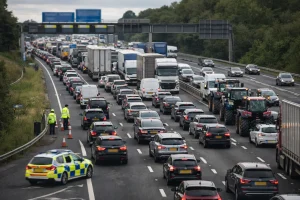
At this stage, there is no indication that the motorway will be completely closed. Instead, the protest is expected to involve slow-moving vehicles travelling along the M6 and gathering at key points.
This means delays are more likely than full closures. However, temporary lane restrictions or rolling roadblocks may be used if police believe they are necessary for safety reasons.
Slow-Moving Convoys
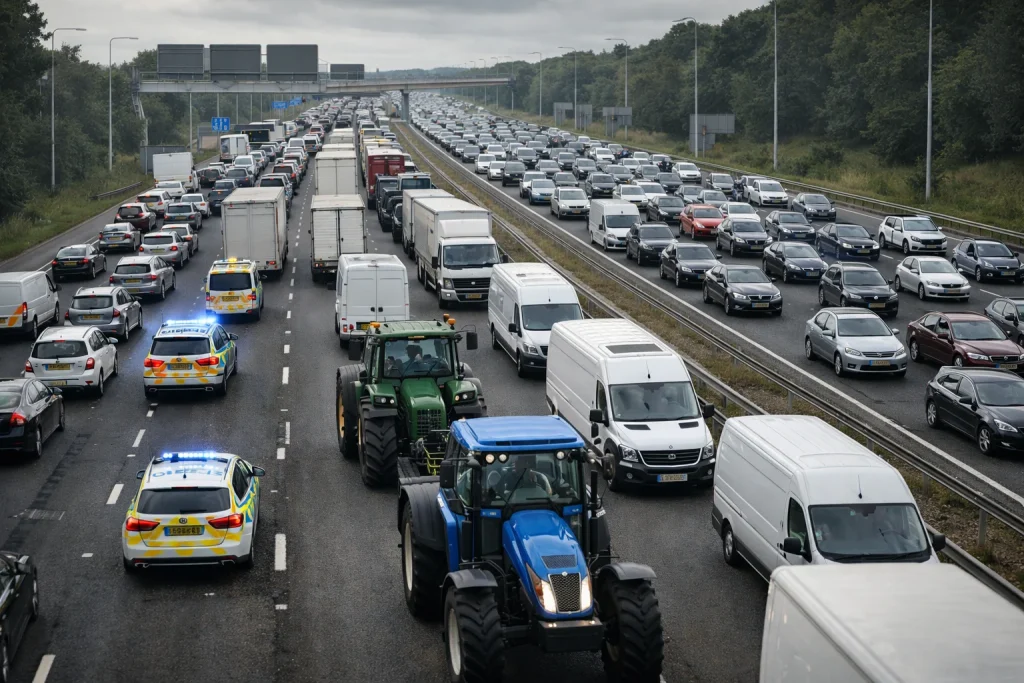
The most likely form of protest is a convoy of tractors, HGVs and other vehicles travelling slowly along the motorway. This can reduce traffic speeds dramatically, especially on sections with fewer lanes.
A convoy moving at 30mph or 40mph on the M6 could quickly create queues stretching for several miles.
Police Traffic Management Measures
Police and National Highways are expected to monitor the protest closely. If traffic becomes unsafe or congestion reaches a critical level, temporary measures could be introduced.
These may include:
- Closing slip roads for short periods
- Diverting traffic away from key junctions
- Using rolling roadblocks
- Restricting access to affected lanes
| Potential Delay Type | Likely Duration |
| Slow-moving convoy | 30 minutes to 2 hours |
| Temporary lane closure | 15 to 60 minutes |
| Slip road restrictions | 20 to 45 minutes |
| Wider traffic congestion | Several hours |
Drivers should not assume that normal journey times will apply during the protest period.
Which Alternative Routes Can Drivers Use Around Preston?
Drivers travelling through Lancashire may need to consider alternative routes if the M6 becomes heavily congested. However, it is important to remember that many diversion routes may also become busier.
The best alternative route depends on whether a driver is travelling northbound or southbound.
Alternative Routes for Northbound Drivers
Drivers heading north towards Lancaster, Cumbria or Scotland may wish to leave the M6 before Preston and use smaller roads or nearby motorways.
Possible alternatives include:
- M61 to the A6
- A59 towards Clitheroe and Skipton
- M55 and local Lancashire roads
These routes may help avoid the worst congestion, although they are likely to take longer than usual.
Alternative Routes for Southbound Drivers
Drivers heading south may wish to leave the M6 near Preston and use routes through Chorley or Wigan before rejoining further south.
Possible options include:
- A49 through Wigan
- M61 towards Bolton and Manchester
- A6 through Chorley
Drivers should use live traffic maps and sat-nav updates before making any changes to their route.
How are the police and National Highways Preparing for the Protest?
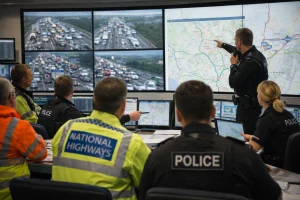
Police forces and National Highways are expected to prepare for the protest by monitoring traffic levels and coordinating responses across affected regions.
Because the protest is expected to take place across several days and in multiple locations, authorities are likely to share information regularly and respond quickly if conditions change.
Live Traffic Monitoring
National Highways will probably use motorway cameras, traffic officers and digital signs to keep drivers informed. Messages warning of delays or alternative routes may appear on motorway signs.
Drivers should regularly check:
- National Highways updates
- Local police announcements
- Live traffic apps
- Radio travel bulletins
Martin Keane, Former National Highways Operations Manager, said: “The biggest challenge during a motorway protest is keeping drivers informed early enough to change their route. Once traffic builds on the M6, it can take several hours for the network to recover.”
Safety and Emergency Access
One of the main priorities for police will be ensuring emergency vehicles can still travel safely. Ambulances, fire engines and police vehicles may need to move through traffic quickly if incidents occur.
To maintain safety, police could:
- Escort protest convoys
- Keep one lane open for emergency access
- Restrict protest vehicles from certain areas
- Redirect traffic before major junctions
Although authorities are expected to allow peaceful protest, they are also likely to act if disruption becomes too severe.
What Have Protest Organisers Said About Fuel Prices?
Organisers say the protest is not only about fuel prices but also about the wider cost-of-living crisis. Many believe the Government has failed to respond effectively to the pressure facing households and businesses.
Reports suggest campaign groups want to raise awareness of how rising fuel costs are affecting every part of the economy.
Farmers and HGV Drivers Speak Out
Farmers and haulage firms are expected to play a leading role in the protest because they rely heavily on diesel every day.
Some campaigners have argued that the situation is becoming impossible. They say rising fuel costs are increasing the price of food, transport and everyday goods.
One organiser involved in discussions about the protest said: “We have hit the £2 mark on a litre of diesel. That is a frightening place to be. People can no longer absorb these costs, and many believe they have no option but to take action.”
Pressure on Families and Businesses
The impact of higher fuel prices is not limited to those working in transport or farming. Families are also facing higher travel costs, while businesses are paying more to move products around the country.
This means the protest could attract wider public support over the coming weeks if fuel prices continue to rise.
Why Are UK Ministers Concerned About Further Fuel Protests?

The Government is believed to be drawing up plans in case the current protest leads to larger demonstrations in the future. Ministers are particularly concerned that rising fuel costs could trigger wider unrest linked to the cost-of-living crisis.
Recent reports suggest officials are monitoring the situation closely because fuel protests have caused major disruption in the past.
Fears of Wider Disruption
If the protest gains support, more roads and transport hubs could be affected in the coming weeks. Campaigners have already identified locations including the M25, M1, M4 and Dartford Crossing.
This means the M6 protest may only be the beginning of a wider national campaign.
Possible Government Response
Ministers may face increasing pressure to take action if public frustration continues to grow. Possible measures could include:
- Reducing fuel duty
- Reviewing taxes on diesel and petrol
- Providing support for farmers and haulage firms
- Introducing measures to reduce the cost of transport
The coming days are likely to be important in determining whether the protest remains limited or expands further.
Conclusion
The Fuel Protest M6 is expected to create major disruption between 15 and 17 April, particularly around Preston, Junction 20 and the M6/M74 route. Rising diesel and petrol prices have led to frustration among farmers, HGV drivers and small businesses, with many believing fuel costs have become unsustainable.
Although full motorway closures are unlikely, drivers should still prepare for delays, congestion and temporary diversions. Anyone travelling on the M6 during the protest period should check live traffic updates, allow extra time and consider alternative routes where possible. Careful planning will be essential to avoid the worst disruption.
Frequently Asked Questions
Will the M6 fuel protest close the motorway completely?
The motorway is not expected to close completely. The protest is more likely to involve slow-moving vehicles and temporary delays rather than a full closure.
Which M6 junctions are most likely to be affected?
M6 Junction 20, areas near Preston and the M6/M74 border are currently expected to experience the heaviest disruption.
How long are delays likely to last?
Delays may last from 30 minutes to several hours depending on the size of the protest and the response from police and National Highways.
Who is expected to take part in the protest?
Farmers, HGV drivers, small business owners and members of the public are all expected to take part.
When will the protest start each day?
Organisers have said participants are expected to gather from 12 noon on 15, 16 and 17 April.
What is the best way to avoid M6 congestion?
Drivers should check live traffic updates before travelling and consider alternative routes such as the A6, A59 or M61 if congestion becomes severe.
Could other roads outside the M6 be affected?
Yes. Other planned protest locations include the M25, M1, M4, M8 and several major transport hubs across the UK.