
Last Updated: 26.10.2026
Homeowners across Preston and the rest of England are being given greater freedom to install electric vehicle chargers, following another significant change to planning regulations that came into force on 21 October 2026.
The latest changes make it easier for people without private driveways to install home charging equipment, while earlier reforms introduced in May 2025 had already simplified installations for households with off-street parking.
For residents in Fulwood, Ashton, Deepdale, Ribbleton and other parts of Preston, these developments could make switching to an electric car more practical and affordable.
However, the new England driveway EV charger rules do not mean homeowners can install charging equipment anywhere they choose. Planning restrictions, electrical safety requirements and local highway permissions still apply in certain circumstances.
The Government estimates that removing planning permission requirements for qualifying cross-pavement charging installations could save households up to £300 in associated costs.
Meanwhile, September 2026 saw electric car sales increase by 36% compared with the previous year, highlighting why access to affordable charging is becoming increasingly important.
We examined the latest planning changes, Lancashire County Council’s guidance, installation costs and available government support to establish what the rules mean for local homeowners and drivers.
What Are the New England Driveway EV Charger Rules in 2026?
Two important changes have reshaped the rules for installing electric vehicle chargers at residential properties in England.
The first came into force on 29 May 2025, when the Government expanded permitted development rights for EV charging equipment.
The second took effect on 21 October 2026, extending permitted development rights to qualifying cross-pavement charging solutions and associated domestic charging points.
Permitted development means certain improvements can be undertaken without submitting a full planning application, provided the installation satisfies the relevant legal conditions.
The changes are intended to reduce unnecessary administration and make home charging more accessible.
| Rule or requirement | Position in October 2026 |
| Standard charger on a private driveway | Usually permitted without planning permission |
| Wall-mounted domestic charger | Permitted if applicable location and size conditions are met |
| Freestanding domestic charger | Usually permitted within the relevant height and siting limits |
| Cross-pavement charging installation | New permitted development rights apply from 21 October 2026 |
| Highway authority permission | Still required for cross-pavement channels |
| Listed buildings | Additional planning or heritage permissions may be needed |
| Conservation areas | Additional restrictions apply to certain installations |
| Electrical safety standards | Remain compulsory |
| Government financial assistance | Available to eligible households |
The most important distinction for Preston residents is between a charger installed entirely on private land and equipment requiring access across a public pavement.
A homeowner with a lawful driveway will generally face fewer administrative requirements than someone who needs to connect a terraced house to a car parked on the street.
What Changed on 21 October 2026?
The Government announced that qualifying cross-pavement EV charging installations would no longer automatically require planning permission.
These systems enable a charging cable to pass through an approved channel embedded in the pavement, connecting a domestic electricity supply to a vehicle parked on the road.
Previously, the planning application process could add expense and delay to installations.
Under the new arrangements, eligible projects can proceed using permitted development rights, subject to the legal conditions and the necessary highway authority authorisation.
According to the Department for Transport’s official announcement, the changes could save drivers up to £300 in planning-related costs.
However, this saving is not guaranteed for every applicant. It depends on whether planning permission would otherwise have been needed and whether the installation qualifies for the exemption.
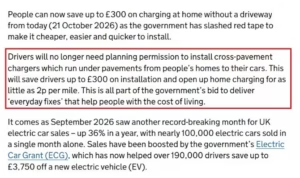
The Department for Transport confirmed on 21 October 2026 that qualifying cross-pavement EV charging installations no longer require planning permission.
What Changed in May 2025?
The earlier reform, introduced on 29 May 2025, removed a restriction affecting wall-mounted electric vehicle charging outlets facing and located within two metres of a highway.
The changes also expanded permitted development rights for larger charging infrastructure in certain non-domestic parking areas.
This was particularly relevant to properties where a driveway or parking space sits close to the public road.
The subsequent October 2026 legislation introduced additional rules, including specific restrictions affecting chargers mounted on building walls that immediately adjoin a highway.
Consequently, homeowners should assess proposed installations against the regulations currently in force rather than relying solely on information published when the original 2025 changes were announced.
The updated permitted development arrangements also contain transitional provisions allowing development under the previous rules until 20 October 2027 where those provisions apply.
Do You Need Planning Permission to Install an EV Charger on Your Driveway?
For most homeowners in England, planning permission is not required when installing a standard EV charging point on an existing lawful private driveway.
However, the charger must comply with permitted development requirements, and the property must not be subject to restrictions that prevent the relevant development.
For example, someone living in a detached house in Fulwood with a private driveway may be able to install a 7kW smart charger without applying for planning permission.
The situation can become more complicated for residents living in listed properties, conservation areas, flats or terraced houses without dedicated parking.
Our examination of the rules highlights three different circumstances.
- Homeowners with private driveways
Most standard installations qualify for permitted development, provided the charger complies with the relevant conditions. Electrical installation and certification requirements remain applicable.
- Households with on-street parking
Residents may qualify for the newer cross-pavement provisions. However, an authorised pavement crossing is required, and the local highway authority must approve the proposed works.
- Properties subject to additional restrictions
Listed buildings, scheduled monuments, Article 4 directions and certain conservation-area installations may require planning approval or other consent.
Another important consideration is whether the parking area is legally established. A front garden does not automatically become a lawful driveway simply because a vehicle can physically fit on it.
Creating a driveway, changing access arrangements or lowering a kerb can involve separate approval requirements.
What Are the Size and Placement Restrictions for Home EV Chargers?
Removing the need for a planning application does not remove the physical limits governing charging equipment.
The permitted development rules contain specific restrictions depending on whether the charger is wall-mounted, freestanding or installed to serve on-street parking.
| Installation requirement | Relevant restriction |
| Wall-mounted outlet and casing | Maximum volume of 0.2 cubic metres |
| Wall-mounted outlet height | No more than 1.6 metres above ground level |
| Freestanding residential charging upstand | Maximum height of 1.6 metres |
| Freestanding upstand in qualifying non-domestic off-street parking | Maximum height of 2.7 metres |
| Domestic upstands | No more than one per parking space |
| Domestic wall outlet serving on-street parking under the expanded right | Normally limited to one outlet within the property’s curtilage |
| Wall immediately adjoining a highway | Additional projection and carriageway-distance restrictions apply |
Under the October 2026 provisions, an outlet mounted on a dwelling wall immediately adjoining a highway must satisfy specific conditions concerning its projection from the wall and its distance from the carriageway.
In particular, permitted development is restricted where the outlet protrudes more than 0.2 metres from the wall or is within 1.5 metres of the carriageway edge.
These particular restrictions should not be interpreted as applying to every charger located somewhere near a road.
A front-wall charger facing a private driveway and a charger attached directly to a terraced house beside the pavement can fall under different provisions.
For homeowners, getting the proposed location checked before purchasing equipment is more sensible than assuming every commercially available charger automatically qualifies.
What Are the EV Charger Rules for Preston Homes Without Driveways?
This is arguably the most significant practical change for Preston residents.
Many older streets contain terraced properties where vehicles are parked outside homes rather than on private driveways.
For these households, affordable domestic charging has historically been more difficult because the vehicle and the home’s electricity supply are separated by a public pavement.
The introduction of permitted development rights for cross-pavement charging is intended to address that problem.
A cross-pavement channel allows the charging cable to run below pavement level while the vehicle is being charged.
It reduces the risk of pedestrians encountering a loose cable across a public walkway.
However, installing a pavement channel is not something a homeowner can undertake independently.
Lancashire County Council Still Requires Permission
In Preston, Lancashire County Council is generally responsible for the public highway, while Preston City Council handles local planning matters.
The distinction is important because obtaining planning permission, or qualifying for permitted development, does not automatically authorise work on a public pavement.
Under Lancashire County Council’s home charging guidance, homeowners without private parking must obtain approval for an appropriate cross-pavement solution.
The council also sets out practical safety requirements.
Vehicles using this arrangement must be parked on the same side of the road as the charger, should remain at least 2.5 metres from relevant electrical equipment, and must not obstruct pedestrians or other road users.
The council does not support loose charging cables or temporary protective rubber mats across public pavements.
Residents considering a cable channel can contact Lancashire County Council at lhscustomerservice@lancashire.gov.uk to enquire about the application process and suitability of their property.
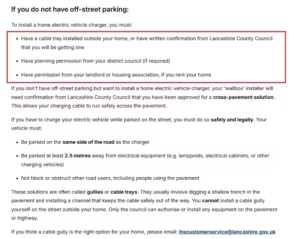
Lancashire County Council requires approval for cross-pavement EV charging installations and sets out safety requirements for vehicles parked on the street.
Does a Cross-Pavement Charger Reserve the Parking Space Outside Your House?
No. Installing an authorised charging channel does not give the homeowner exclusive ownership of the public parking space outside their property.
Other motorists may still be entitled to park there, subject to the usual restrictions.
For households considering this arrangement, parking availability should be assessed before committing to installation.
A charging channel may be technically suitable, but if the nearest lawful parking space is rarely available, the homeowner might struggle to use it regularly.
The financial value of an installation therefore depends not only on the initial cost, but also on how frequently the household can access the charging facility.
Do Listed Buildings and Conservation Areas Have Different Rules?
Yes. Some of Preston’s older properties require additional care before charging equipment can be installed.
The city has several designated conservation areas, including Avenham, Winckley Square, Fishergate Hill, Moor Park and parts of Fulwood.
These areas are protected because of their architectural or historic importance.
The restrictions are not necessarily identical for every property or charger design.
Some installations on lawful private parking areas may qualify for permitted development, while particular installations under the expanded 2026 provisions can be excluded in conservation areas.
Listed buildings and scheduled monuments also have additional restrictions.
Residents should therefore establish whether their property is protected and whether the particular installation qualifies.
A listed building may also require listed building consent where the proposed works affect its special architectural or historic interest.
For someone considering installing a charger on a period property, the equipment’s location, cable routing, fixings and visual impact can all influence what consent is needed.
If the planning position is uncertain, a lawful development certificate may provide formal confirmation that a proposed installation is permitted.
How Much Does It Cost to Install an EV Charger at Home in 2026?
Planning changes may reduce administrative costs, but homeowners still need to budget for the charger, installation and electrical work.
Published UK installation price guides in 2026 generally place straightforward domestic 7kW charging installations at approximately £800 to £1,300, including equipment and labour.
More complicated installations can cost substantially more.
| Installation expense | Indicative UK cost |
| Standard 7kW charger supplied and installed | £800–£1,300 |
| Charger unit purchased separately | £350–£900 |
| Additional electrical alterations | Varies by property |
| Consumer unit replacement, if necessary | Several hundred pounds or more |
| Extended cable routing or groundworks | Quoted separately |
| Qualifying planning application avoided | Potential saving, depending on circumstances |
| Cross-pavement channel | Subject to council assessment and quotation |
These figures are indicative rather than fixed local quotations.
A house with a modern consumer unit and a short cable route to the driveway will generally be easier to equip than a property requiring substantial electrical upgrades.
For example, an installation that looks inexpensive initially could become more costly if the electricity supply needs upgrading or if underground cabling must be installed across part of the property.
Homeowners should request a written quotation covering the equipment, protective devices, cable routing, electrical testing, network notification and certification.
It is also sensible to ask whether groundworks and any additional visits are included.
The Government’s potential £300 planning-related saving should not be confused with a guaranteed £300 discount on the charger itself.
Are Government Grants Available for Home EV Chargers in 2026?
Government assistance remains available for certain households, although eligibility depends on the property and parking arrangements.
From 1 April 2026, the maximum support available under several qualifying electric vehicle chargepoint schemes increased from £350 to £500.
The grants generally cover up to 75% of eligible purchase and installation costs, subject to the relevant maximum.
Funding under the current schemes is scheduled to continue until 31 March 2027.
| Applicant category | Potential support |
| Eligible renters with private off-street parking | Up to £500 |
| Eligible flat owners | Up to £500 |
| Eligible households with on-street parking installing a cross-pavement solution | Up to £500 |
| Qualifying residential landlords | Up to £500 per socket |
| Eligible businesses under the Workplace Charging Scheme | Up to £500 per socket |
How Does the 75% Grant Work?
Suppose an eligible household receives a quotation of £1,000 for the purchase and installation of a charging point.
Although 75% of £1,000 equals £750, the grant is capped at £500.
The household would therefore pay £500 towards the qualifying installation, subject to the scheme’s conditions.
If the eligible cost were £600, the potential grant would be £450, leaving £150 to pay.
The percentage alone does not determine the final grant because the maximum award still applies.
Importantly, an owner-occupier living in a conventional house with a private driveway is generally not eligible for the renters and flat owners grant.
Households without off-street parking may be eligible for the separate on-street charging grant, provided they satisfy its requirements and obtain the necessary highway authority consent.
The grant cannot normally be claimed retrospectively after a chargepoint has already been installed.
There may also be separate local support towards the cost of an eligible pavement channel. Availability and contributions depend on the scheme operating in the relevant local authority area and should be confirmed before work is commissioned.
Is Home EV Charging Cheaper Than Public Charging?
For many motorists, lower running costs are one of the biggest financial advantages of installing a home charger.
The difference depends on the household electricity tariff, vehicle efficiency, charging losses and the public chargepoint prices used for comparison.
HMRC’s advisory electric rates introduced in September 2026 provide a useful illustration.
For fully electric company cars, the published rates were:
| Charging location | HMRC advisory electric rate |
| Home charging | 7p per mile |
| Public charging | 15p per mile |
Based on those reimbursement benchmarks, the home charging rate is approximately 53% lower than the public charging rate.
These are advisory reimbursement rates, not guaranteed electricity costs for individual drivers.
A household’s actual spending could be higher or lower.
What Could a Preston Driver Save?
Consider an illustrative charging session adding 40kWh of electricity.
| Charging option | Illustrative electricity tariff | Energy cost |
| Off-peak home charging | 10p/kWh | £4 |
| Standard home charging | 28p/kWh | £11.20 |
| Public charging | 60p/kWh | £24 |
At these hypothetical tariffs, off-peak home charging would cost approximately 83% less than the public charging example.
However, this comparison excludes charging losses, any tariff standing charges and other contractual costs.
Some specialist EV tariffs also apply different rates during daytime hours. Homeowners should compare their full household electricity bill rather than concentrating only on the advertised overnight rate.
For a business owner or self-employed driver using an electric vehicle regularly, predictable charging costs can also make monthly transport budgeting easier.
The main financial question is whether the savings generated over time justify the upfront installation expense.
What Electrical Safety Rules Must Home EV Chargers Follow?
Planning permission and electrical compliance are two separate matters.
An installation can qualify for permitted development while still requiring electrical work, inspection and documentation.
EV chargers draw substantial electrical power for extended periods, making appropriate circuit protection, cable sizing and earthing arrangements essential.
A competent installer should assess the property’s electricity supply before the charger is connected.
Important considerations include the consumer unit, available supply capacity, protective devices, earthing arrangements and any need for load management.
Is a 7kW Charger Suitable for Most Houses?
A 7kW charger is a common choice for domestic charging because it generally works with a suitable single-phase electrical supply.
A higher-powered 22kW AC charger typically requires a three-phase supply and a compatible vehicle.
Installing a more powerful charger does not automatically result in faster charging if the car cannot accept the additional power.
For many Preston households, a correctly specified 7kW smart charger can provide sufficient overnight charging without the additional cost of a more complex installation.
Do Installers Need to Notify the Electricity Network?
Yes. EV charging installations require appropriate notification to the relevant distribution network operator.
Depending on the existing supply and proposed equipment, the installer may need approval before connecting the charger or may be able to notify after installation under the applicable process.
Homeowners should confirm that the contractor is managing this requirement.
Electrical work must also comply with applicable building regulations, including Part P where relevant, and appropriate wiring standards.
Where the work is notifiable, the homeowner should receive the necessary building regulations documentation.
A proper electrical installation certificate and evidence of relevant notifications can also be valuable when the property is sold.
What Are the Smart EV Charger Requirements?
Smart charging regulations are separate from the planning changes.
Since June 2022, most new private chargepoints sold for use in Great Britain have been required to meet smart charging standards. Additional security requirements followed in December 2022.
These rules cover features such as smart functionality, interoperability and the ability to manage when electricity is used.
Smart charging enables motorists to schedule charging sessions around their electricity tariff and household requirements.
For example, a driver arriving home at 6pm may connect the vehicle immediately but programme charging to begin later when an off-peak tariff becomes available.
Some systems can also work alongside solar generation or household energy-management equipment.
These features may lower running costs, but savings depend on the tariff and the way the equipment is configured.
Before purchasing a charger, homeowners should check whether it supports their preferred energy supplier, whether subscription fees apply and whether all advertised smart features are included.
How Can Preston Homeowners Install an EV Charger Legally?
The most reliable approach is to establish the permissions and technical requirements before paying for the equipment.
The following sequence applies to a typical domestic installation.
- Check the parking arrangement. Confirm whether the vehicle will be parked on a lawful private driveway, in a garage, in a shared car park or on the public road.
- Establish whether planning permission is needed. Check the property’s status and relevant permitted development restrictions, particularly if it is listed or lies within a conservation area.
- Obtain highway approval where necessary. If the charging cable must cross a public pavement, contact Lancashire County Council about an authorised cable channel.
- Arrange an electrical assessment. Ask a competent installer to inspect the electricity supply, proposed charging location and any additional electrical work.
- Check grant eligibility before installation. Some schemes require approval before the charger is fitted.
- Obtain a detailed quotation. Request an itemised cost covering the charger, electrical work, certification, possible upgrades and groundworks.
- Complete the installation and testing. The installer should test the equipment, provide the appropriate documentation and manage the network notification process.
- Set up smart charging. Check charging schedules, access controls and electricity tariffs before routine use.
For a straightforward installation on a private driveway, the physical fitting may be completed within a few hours.
However, additional electrical work, planning applications or pavement channel arrangements can considerably extend the overall process.
Can Preston Residents Charge Electric Cars Across the Pavement?
Only through an arrangement that is lawful and acceptable to the relevant highway authority.
The October 2026 changes do not create a general right to place an unprotected charging cable across a public walkway.
In particular, Lancashire County Council does not support temporary rubber cable mats as a substitute for an authorised pavement channel.
The council’s position reflects concerns about pedestrian safety, accessibility and the potential for obstructions.
These issues matter for wheelchair users, people using mobility scooters, parents pushing prams and pedestrians with visual impairments.
There is also an important distinction between parking a vehicle legally and using the surrounding pavement for charging equipment.
A vehicle parked lawfully at the roadside does not automatically give its owner permission to run a cable across the footway.
The wider UK pavement parking rules remain relevant because drivers must not assume that charging an electric vehicle permits them to obstruct pedestrian access.
Do the New EV Charger Rules Change Driveway Parking Laws?
No. The planning changes concern charging infrastructure rather than the rules governing where vehicles may park.
They do not give motorists new rights to block dropped kerbs, obstruct pavements or use restricted parking spaces.
Homeowners wanting to create a new driveway may still need separate permission to install a dropped kerb.
There can also be planning requirements when replacing a front garden with hardstanding, particularly where drainage rules or protected property conditions apply.
For Preston residents considering both a driveway conversion and an EV charger, the two projects should be assessed separately.
A charger that qualifies for permitted development does not mean associated driveway construction automatically qualifies.
What Do the Changes Mean for Local Businesses?
Although the main residential changes are aimed at individual households, the wider EV charging reforms also have implications for businesses and commercial property owners.
Companies operating electric delivery vehicles, service vans or employee charging facilities may benefit from simpler planning arrangements and improved access to charging infrastructure.
For small employers, however, the financial implications extend beyond the cost of the equipment.
Businesses should consider electricity capacity, parking availability, installation costs, ongoing maintenance and whether charging will be restricted to employees or made available to customers.
The Workplace Charging Scheme provides support for eligible organisations, with funding of up to £500 per socket under the arrangements introduced in April 2026.
Businesses may apply for support for up to 40 eligible sockets across their sites.
For smaller organisations operating a limited number of vehicles, the financial case will depend on vehicle usage, annual mileage, installation costs and whether vehicles can be charged at lower-cost times.
Commercial charging installations can also have different planning and electrical requirements from ordinary residential projects.
What Happens if You Cannot Install a Charger at Home?
Not every property will be suitable for an EV charger.
Some households lack usable parking spaces, others face restrictions involving protected buildings, and certain streets may not be suitable for a cross-pavement solution.
In those circumstances, motorists may need to rely on public charging facilities.
Preston drivers can explore charging options at supermarkets, commercial car parks and other locations.
For example, the expansion of Aldi car park EV charging facilities illustrates how additional charging infrastructure is being incorporated into everyday shopping locations.
However, public chargepoints differ considerably in charging speed, price and availability.
Motorists should also check parking restrictions separately from charging arrangements.
A functioning charger does not necessarily mean a vehicle can remain in the car park for an unlimited period.
Why Are the Changes Important for England’s Electric Vehicle Market?
The latest policy changes arrive during a period of growing electric vehicle ownership.
According to the Government’s October 2026 announcement, electric car sales in September were 36% higher than in the equivalent month a year earlier.
However, providing convenient charging remains an important obstacle, particularly for drivers without private parking.
Vicky Edmonds, Chief Executive of EVA England, welcomed the change, saying:
“Removing the need for planning permission for cross-pavement charging is a really welcome and meaningful step towards a fairer transition.”
The association also reported research indicating that 60% of petrol and diesel drivers without off-street parking would never consider an electric vehicle.
That figure relates to the association’s research findings, rather than a survey conducted locally in Preston.
Nevertheless, it illustrates why improved access to home charging has become a policy priority.
From an economic perspective, the reforms could help reduce one element of the cost of switching to electric vehicles.
However, reducing planning costs does not necessarily resolve all affordability problems.
The price of the vehicle, home charging installation costs, electricity tariffs and access to reliable parking will continue to influence household decisions.
Are Further EV Charging Rule Changes Expected?
Further changes are being considered, but proposals should not be confused with legislation already in force.
On 21 October 2026, the Government launched consultations concerning electric vehicle charging access for tenants and leaseholders, alongside possible amendments to charging requirements for buildings.
One area under consideration is whether landlords and freeholders should face clearer requirements when responding to requests from residents who want to install charging equipment.
Another proposal concerns extending certain EV charging infrastructure requirements to covered car parks.
The consultations are scheduled to close on 16 December 2026.
These proposals could become relevant to people living in flats or rented properties across Preston, but no final outcome should be assumed before the Government publishes its decisions and makes any necessary legal changes.
Conclusion
The England driveway EV charger rules have changed significantly over the past two years, with the latest measures taking effect on 21 October 2026.
For Preston homeowners with private driveways, standard charging installations will generally continue to be possible without a formal planning application, provided the relevant permitted development conditions are satisfied.
For people without driveways, the latest reforms could make home charging more accessible by removing planning requirements for qualifying cross-pavement installations.
However, highway approval remains essential, and households should not mistake the removal of planning permission for unrestricted access to public pavements.
Financial support of up to £500 is also available to certain eligible residents, while domestic charging can offer significant running-cost advantages compared with relying entirely on public chargepoints.
For local residents, the most sensible approach is to establish the legal position, obtain a professional electrical assessment and compare the full installation costs before proceeding.
The biggest benefit of the changes is not that every homeowner can now install a charger without restrictions. It is that more households have a practical route towards affordable home charging, provided they meet the appropriate safety, planning and highway requirements.
Frequently Asked Questions About England Driveway EV Charger Rules
Can I install an EV charger on my driveway without planning permission in 2026?
Yes, in most cases. A standard charger installed on a lawful private driveway in England will usually qualify for permitted development if the relevant size, location and property conditions are satisfied.
When did the new EV charger planning rules come into force?
The earlier changes came into force on 29 May 2025. Further rules covering qualifying cross-pavement charging installations took effect on 21 October 2026.
Can I run an EV charging cable across the pavement outside my home?
You cannot assume that loose cables or temporary cable mats are permitted. In Lancashire, residents must obtain approval for an authorised cross-pavement solution, and the county council does not support temporary rubber cable mats.
Do I need permission to install an EV charger on a terraced house?
It depends on the property, charger location and parking arrangement. Homes without off-street parking may qualify for the October 2026 permitted development provisions, but an approved pavement crossing will still be necessary where the cable passes across a public footway.
How much does a home EV charger cost in 2026?
A straightforward domestic 7kW charger installation typically costs around £800 to £1,300, although electrical upgrades, groundworks and other complications can increase the price.
Can I claim a £500 government grant for installing an EV charger?
Eligible renters, flat owners and certain households with on-street parking may qualify for assistance of up to £500. The grant generally covers up to 75% of eligible costs, subject to scheme conditions.
Does installing an EV charger increase the value of a property?
A convenient charging facility may be attractive to prospective buyers who own electric vehicles. However, there is no guaranteed percentage increase in property value, and the effect depends on local demand, property characteristics and installation quality.
Can I install an EV charger in a conservation area?
Some installations may be allowed, but additional restrictions apply to particular locations and types of development. Check the exact planning position before arranging work.
Can a landlord refuse permission for an EV charger?
Tenants generally need the relevant property owner’s permission for installation work. The Government is consulting on possible changes to improve charging access for tenants and leaseholders, but those proposals are not yet established requirements.
Are the new driveway EV charger rules the same throughout the UK?
No. The permitted development changes discussed here relate specifically to England. Scotland, Wales and Northern Ireland have their own applicable planning frameworks.