
Key Takeaways:
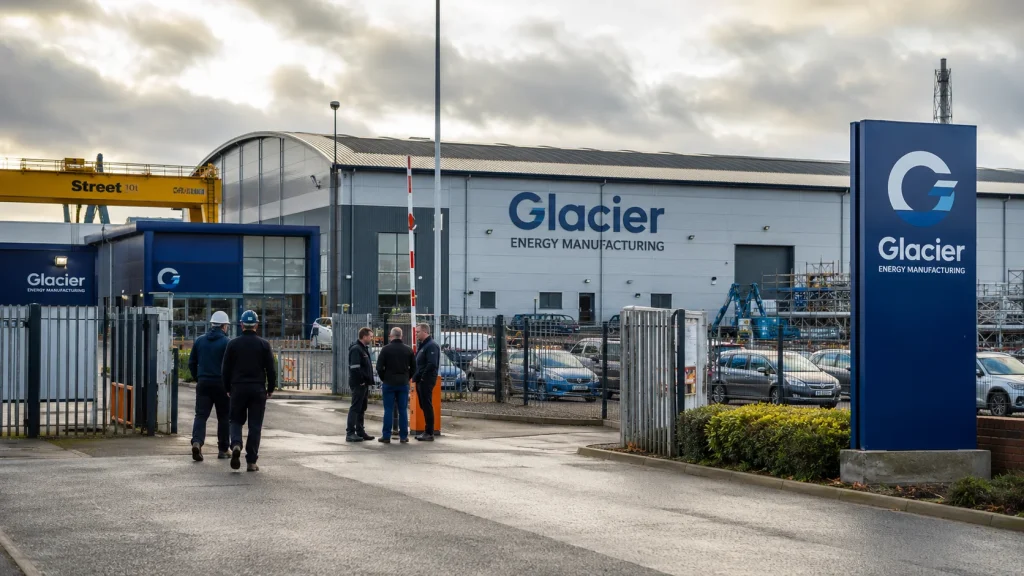
- Administration Process: Glacier Energy Manufacturing Limited entered administration after prolonged financial difficulties.
- Site Closures: The Stockton-on-Tees facility was closed, while the Rotherham site had already been shut during restructuring efforts.
- Job Losses: A total of 53 employees were made redundant following the company’s collapse.
- Market Challenges: Weak demand in North Sea oil and gas markets significantly affected trading performance.
- Failed Recovery Efforts: Turnaround strategies and cost reductions were unable to restore profitability.
- Ongoing Operations: Other Glacier Group divisions continue trading and serving energy and industrial customers.
What Happened When Glacier Energy Manufacturing Entered Administration?
Glacier Energy Manufacturing Limited formally entered administration in October 2025 following a period of sustained losses and deteriorating trading conditions.
Administrators reported that the business had struggled to achieve profitability despite restructuring efforts, cost reductions, and attempts to diversify into emerging energy markets.
The administration resulted in the immediate closure of the company’s Stockton-on-Tees manufacturing operation and the redundancy of 53 employees. The decision followed an extensive strategic review that concluded significant additional funding would be required to return the business to a sustainable position.
Although the manufacturing division ceased trading, Glacier Group’s wider engineering and inspection businesses continued operating independently of the administration process.
What Is Glacier Energy Manufacturing and How Did It Fit Into the UK Energy Sector?
Glacier Energy Manufacturing Limited operated as part of the wider Glacier Group, an engineering business headquartered in Aberdeen. The company specialised in manufacturing and engineering services that supported energy infrastructure projects, particularly within the oil and gas industry.
Its operations were closely connected to the North Sea energy market, which has long been a significant contributor to the UK’s industrial economy.
Manufacturers such as Glacier Energy play an important role by supplying equipment, engineering expertise, refurbishment services, and specialist industrial solutions that help energy companies maintain and develop critical infrastructure.
The company became part of a complex supply chain serving offshore operators, energy contractors, and industrial clients. However, businesses operating within this sector often face fluctuating demand as investment levels rise and fall according to market conditions, government policies, and energy transition trends.
Why Did Glacier Energy Manufacturing Enter Administration?
The company’s administration was the result of multiple financial and market pressures that developed over an extended period. According to administrators, trading conditions began to weaken shortly after incorporation, creating challenges that became increasingly difficult to overcome.
One of the most significant issues was the decline in large-scale capital expenditure projects across traditional oil and gas markets. Rather than investing in new infrastructure, many customers shifted their focus towards maintaining existing assets and controlling expenditure.
This change reduced demand for manufacturing services and created a difficult operating environment for companies dependent on new project activity.
In addition, expectations that emerging energy sectors would generate replacement opportunities did not materialise quickly enough. Although the energy transition has created new markets, many projects have developed at a slower pace than anticipated.
As losses continued to grow, directors ultimately concluded that administration was the most appropriate option to protect creditor interests.
How Did the North Sea Oil and Gas Downturn Contribute to the Company’s Collapse?
The downturn in North Sea activity played a central role in the company’s financial decline. For many years, engineering manufacturers relied heavily on investment from offshore oil and gas operators.
However, changing market dynamics altered spending patterns throughout the sector. Energy companies increasingly prioritised efficiency, maintenance, and cost management rather than investing in major expansion projects.
This shift directly affected businesses supplying manufacturing and engineering services.
The reduction in project activity created a ripple effect across the supply chain. Manufacturers experienced fewer orders, lower production volumes, and increasing pressure on profit margins.
Mark Reynolds, a North Sea energy market analyst, explained: “Many engineering suppliers built their business models around steady project pipelines. When capital investment slowed significantly, even well-established manufacturers found it difficult to maintain sustainable revenue levels.”
As demand weakened across the market, Glacier Energy Manufacturing found itself operating in an increasingly challenging commercial environment.
Did the Francis Brown Acquisition Deliver the Expected Recovery?
The acquisition of Francis Brown through a pre-pack administration transaction in August 2024 was intended to provide a platform for recovery and future growth.
Management hoped that operational improvements, enhanced manufacturing capabilities, and stronger customer relationships would help restore profitability. However, broader market conditions continued to deteriorate.
Although integration work progressed, the anticipated increase in project activity failed to materialise. As a result, the business remained exposed to the same structural challenges affecting many engineering suppliers serving the North Sea energy market.
Why Did Turnaround Efforts and Cost-Cutting Measures Fail?
Management introduced several measures aimed at improving financial performance and reducing losses. These included operational reviews, restructuring initiatives, and cost-control programmes.
However, successful turnaround plans typically require both internal improvements and external market support. While Glacier Energy could control certain aspects of its operations, it could not influence broader market conditions.
The continuing weakness in its core markets meant that revenue generation remained below expectations. Cost reductions alone were insufficient to compensate for declining demand.
Furthermore, the company required significant funding to achieve a break-even position. Without access to the necessary capital, recovery efforts became increasingly difficult.
The Closure of the Rotherham Facility
In July 2025, directors made the decision to close the company’s Rotherham facility as part of a broader restructuring programme.
The closure was intended to reduce operating costs and improve efficiency. However, it resulted in approximately 20 redundancies and highlighted the severity of the financial pressures facing the business.
Although the move reduced expenditure, it did not address the fundamental challenge of weak market demand.
Why Was the Stockton-on-Tees Manufacturing Facility Shut Down?
The closure of the Stockton-on-Tees facility marked the end of Glacier Energy Manufacturing’s operations.
Despite efforts to stabilise the business, directors concluded that continuing losses had become unsustainable. The facility’s performance was heavily influenced by declining activity within the North Sea oil and gas sector.
The decision was not taken lightly. Manufacturing facilities often represent significant investments and provide important employment opportunities within local communities.
The closure reflected the difficult reality facing the company and demonstrated how broader industry challenges can directly affect regional employment and economic activity.
What Did the Administrators Reveal About the Company’s Financial Difficulties?
The first administrators’ report provided important insight into the company’s decline.
According to the report, Glacier Energy Manufacturing experienced worsening trading conditions from an early stage. A combination of lower customer spending, reduced project activity, and weak demand created persistent financial pressure.
The report also highlighted the company’s reliance on sectors that were experiencing declining investment levels. This made it difficult to replace lost revenue and maintain profitability.
Findings from the First Administrators’ Report
| Key Finding | Impact on Business |
| Softening trading conditions | Reduced order volumes and revenue generation |
| Decline in capital expenditure projects | Fewer opportunities for manufacturing contracts |
| Weak North Sea demand | Lower utilisation of facilities and resources |
| Slower energy transition opportunities | Limited replacement income streams |
| Need for material funding | Increased financial uncertainty |
| Lack of turnaround certainty | Administration became the preferred option |
The findings illustrate that the company’s difficulties were not caused by a single event but rather by a combination of interconnected challenges.
How Did Weak Demand and Reduced Capital Investment Affect the Business?
Capital investment projects are often a major source of revenue for engineering manufacturers. These projects typically involve new facilities, equipment installations, upgrades, and infrastructure development.
When customers reduced spending on such projects, suppliers across the value chain experienced lower demand.
Instead of commissioning new developments, many clients concentrated on maintaining existing assets. While maintenance work can provide revenue opportunities, it often generates lower income compared with large-scale construction and manufacturing contracts.
This shift placed considerable pressure on companies that relied on project-driven growth.
Why Were New Energy Market Opportunities Unable to Offset Losses?
Many businesses serving traditional energy sectors have attempted to diversify into renewable energy and other emerging markets.
While these opportunities continue to grow, the pace of development has often been slower than anticipated.
Glacier Energy Manufacturing expected new energy markets to provide replacement demand as traditional oil and gas activity declined. However, these opportunities did not develop quickly enough to compensate for falling revenue in established markets.
This mismatch between declining and emerging markets contributed significantly to the company’s financial difficulties.
How Many Jobs Were Lost and What Has Been the Impact on Employees?
The administration resulted in the loss of 53 jobs, affecting employees across the business.
For workers, administration often creates immediate uncertainty regarding employment, financial security, and future career opportunities. Redundancies can also have wider implications for local communities, particularly when specialist industrial employers close operations.
The closure of manufacturing facilities can affect suppliers, service providers, and local economies that depend on industrial activity.
Employment Impact Overview
| Area | Impact |
| Total Job Losses | 53 positions |
| Rotherham Site | Around 20 redundancies during closure |
| Stockton-on-Tees Facility | Remaining workforce affected by administration |
| Local Communities | Reduced industrial employment opportunities |
| Supply Chain Partners | Potential reduction in commercial activity |
| Regional Economy | Loss of manufacturing capability and spending power |
Although the wider Glacier Group continues operating, the impact on affected employees remains significant.
What Does the Administration Mean for Customers, Suppliers, and Creditors?

Administration primarily aims to protect creditor interests while managing the affairs of an insolvent company.
For customers, administration may create uncertainty regarding ongoing contracts, product availability, and service continuity. Suppliers can also face challenges if outstanding payments remain unresolved.
Creditors typically rely on administrators to maximise recoveries from remaining assets and determine the most appropriate course of action.
The process seeks to balance competing interests while ensuring compliance with insolvency regulations.
What Parts of Glacier Group Continue to Operate?
Importantly, the administration affects Glacier Energy Manufacturing Limited rather than the entire Glacier Group.
The parent organisation continues to trade through several divisions that focus on engineering and industrial services.
These include mechanical solutions operations that provide site machining and equipment services, alongside inspection businesses specialising in non-destructive testing and industrial inspections.
The continued operation of these divisions demonstrates that the challenges were concentrated within the manufacturing business rather than across the entire group.
How Is Glacier Group Positioning Itself After the Manufacturing Division’s Closure?
The group’s future strategy appears focused on strengthening business areas that continue to perform well and generate sustainable demand.
By concentrating on specialised engineering services, inspection solutions, and maintenance-related activities, Glacier Group may be better positioned to navigate changing market conditions.
James Thornton, a corporate restructuring adviser, noted: “Many engineering groups are reassessing where long-term demand exists. Service-based divisions often provide more stable revenue streams than manufacturing operations tied closely to capital investment cycles.”
This strategic focus could help the group maintain resilience despite challenges within specific business units.
What Does This Case Reveal About Challenges Facing the UK Energy Manufacturing Sector?
The administration highlights broader pressures affecting many companies within the UK’s energy manufacturing sector.
Businesses must navigate evolving energy policies, changing investment priorities, fluctuating commodity markets, and increasing competition.
At the same time, the transition towards lower-carbon energy systems is creating both opportunities and uncertainties. Companies must invest in new capabilities while managing risks associated with declining traditional markets.
This balancing act has become one of the defining challenges facing engineering and manufacturing organisations across the sector.
Glacier Energy Manufacturing Administration: Key Events and Timeline
| Date | Event |
| August 2024 | Francis Brown acquired through pre-pack administration |
| Late 2024 | Trading conditions continue to weaken |
| Early 2025 | Reduced North Sea spending affects order flow |
| July 2025 | Rotherham facility closes and around 20 jobs lost |
| September 2025 | Strategic review identifies funding requirement |
| October 2025 | Company enters administration |
| October 2025 | Stockton-on-Tees facility closes |
| October 2025 | 53 employees made redundant |
| June 2026 | Wider Glacier Group continues trading through other divisions |
Conclusion
The Glacier Energy Manufacturing administration illustrates the challenges facing engineering and manufacturing businesses operating within changing energy markets.
Weak demand in the North Sea oil and gas sector, declining capital investment, and slower-than-expected growth in new energy opportunities combined to create unsustainable financial pressures.
Despite restructuring efforts, site closures, and cost reductions, the company was unable to reverse its losses. While the wider Glacier Group continues to operate through other successful divisions, the closure of Glacier Energy Manufacturing serves as a reminder of the importance of diversification, adaptability, and long-term strategic planning in today’s evolving energy landscape.
Frequently Asked Questions
What is Glacier Energy Manufacturing administration?
Glacier Energy Manufacturing administration refers to the insolvency process that began in October 2025 after the company experienced prolonged financial difficulties and trading losses.
Why did Glacier Energy Manufacturing go into administration?
The company was affected by weak North Sea oil and gas investment, reduced customer spending, and slower-than-expected growth in emerging energy markets.
How many jobs were lost when Glacier Energy Manufacturing collapsed?
The administration resulted in 53 redundancies at the Stockton-on-Tees facility, following earlier job losses during restructuring efforts.
Is Glacier Group still trading in 2026?
Yes, while the manufacturing division entered administration, other Glacier Group businesses continue operating across engineering, inspection, and mechanical services.
What happened to the Stockton-on-Tees facility?
The Stockton-on-Tees manufacturing site ceased trading immediately after the company entered administration and remains closed as of June 2026.
Did the Francis Brown acquisition prevent administration?
No. Although the acquisition was intended to support recovery and growth, ongoing market challenges prevented the business from returning to profitability.
What does the Glacier Energy Manufacturing case reveal about the UK energy sector?
The case highlights the challenges engineering manufacturers face when traditional energy investment declines faster than new energy opportunities develop.