
Key Takeaways:
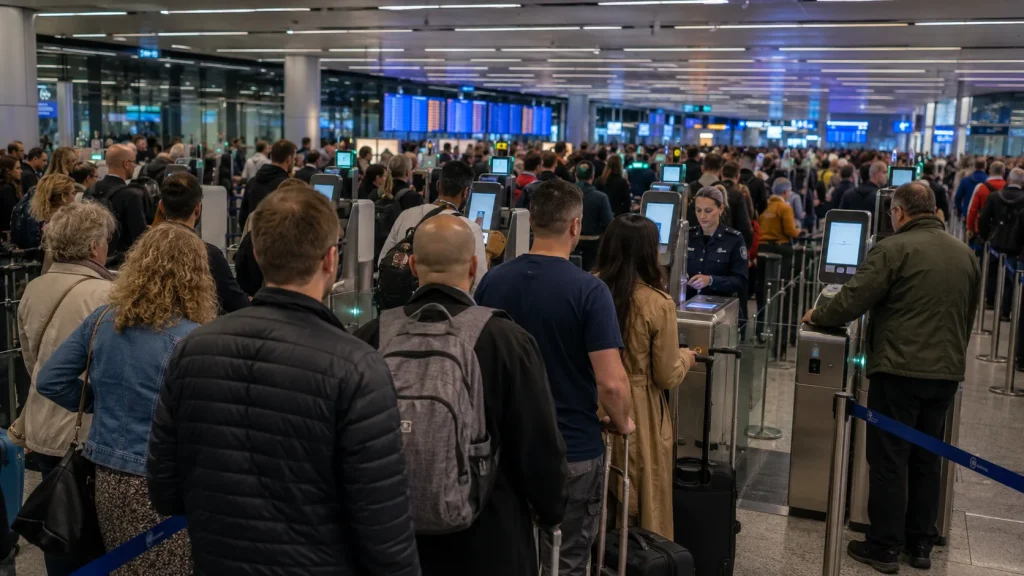
- EU airport border check delays are currently reaching up to 6 hours in peak travel periods across major European airports.
- The delays are mainly caused by the rollout of the Entry/Exit System (EES), which requires biometric registration for non-EU travellers.
- UK travellers are among the most affected due to post-Brexit classification as non-EU passengers.
- Airports in Spain, Portugal, Italy, and Germany are experiencing the most severe congestion.
- First-time biometric onboarding is significantly slowing down border processing times at Schengen entry points.
- Airlines such as Ryanair, Wizz Air, and Jet2 are advising passengers to arrive earlier than usual due to unpredictable queues.
- Peak delays are most common during morning and evening arrival windows when multiple flights land simultaneously.
- Delays are expected to continue throughout the 2026 transition phase of EES rollout.
EU Airport Border Check Delays (June 2026)
EU airport border check delays continue to remain highly disruptive in June 2026, particularly across southern European holiday gateways.
Current reports indicate that average waiting times range between 2 to 6 hours depending on airport congestion and EES biometric onboarding speed.
The most severe delays are still being recorded during peak morning and evening arrival windows, especially for non-EU travellers such as UK passport holders.
Airports are reporting that first-time Entry/Exit System registrations are the main cause of extended queues, as biometric scanning must be completed before clearance.
Travel operators confirm that congestion levels remain inconsistent, meaning passengers may experience significantly different wait times even within the same airport on the same day.
Key current patterns:
- Peak delays are still concentrated during 06:00–11:00 and 17:00–22:00 arrival windows
- First-time EES registration is creating the longest queues
- Family and group travellers experiencing higher processing delays
- Southern EU airports remain the most impacted
Why Are EU Airport Border Check Delays Reaching Extreme Levels Across Europe?
EU airport border check delays have escalated sharply due to the simultaneous introduction of new biometric border controls and a surge in international travel demand.
The Entry/Exit System (EES) requires every non-EU traveller to be digitally registered, meaning first-time visitors must undergo full identity verification at immigration points. This process includes facial recognition and fingerprint scanning, which takes significantly longer than traditional passport stamping.
Airports across Europe are also dealing with uneven staffing levels and high seasonal tourism demand, especially in southern holiday destinations.
As a result, border control lanes are becoming congested during peak arrival waves, causing cascading delays that affect connecting flights and departure schedules.
What Role Does the Entry/Exit System (EES) Play in Current Airport Queues?
The Entry/Exit System has become the central driver of current airport congestion. It replaces manual passport stamping with a digital record system that tracks entry and exit data for non-EU travellers. While designed to improve long-term border security and efficiency, its initial rollout has created operational bottlenecks.
Biometric Registration Requirements for First-time Travellers
Every first-time traveller under the system must register biometric data before clearance. This includes scanning fingerprints, capturing facial images, and linking personal travel history to a digital profile. The process can take several minutes per passenger, which multiplies into hours during peak arrival periods.
System-wide Implementation Challenges Across Schengen Airports
Airports across the Schengen zone are not operating at the same technological readiness level. Some hubs have advanced automated gates, while others still rely heavily on manual processing, creating inconsistent queue speeds and delays at transfer points.
Which EU Airports Are Experiencing the Worst Border Control Delays Right Now?
EU airport border check delays are currently most severe at high-volume tourist entry points where EES biometric onboarding is still creating processing bottlenecks.
🔴 Current Highest-Delay Airports (June 2026):
| Airport | Average Delay | Main Cause |
| Palma de Mallorca | 4–6 hours | Peak summer tourism + first-time EES registration backlog |
| Alicante Airport | 4–6 hours | High UK passenger volume + limited biometric lanes |
| Faro Airport | 3–5 hours | Seasonal arrivals + staffing shortages |
| Lisbon Airport | 3–4 hours | Mixed Schengen + non-EU congestion |
| Rome Fiumicino | 3–5 hours | Biometric processing delays during peak waves |
| Frankfurt Airport | 2–4 hours | System congestion + connecting passenger overload |
These airports are experiencing the highest pressure during overlapping flight arrivals, particularly when multiple non-EU flights land within short time windows.
How Are Airlines Responding to EU Airport Border Check Delays?
Airlines are actively adjusting passenger guidance as border delays begin to affect flight punctuality and schedule reliability across European routes.
Ryanair has issued repeated alerts warning passengers that immigration delays may significantly extend total journey time on UK–EU routes, especially during peak holiday periods. Wizz Air has advised travellers to arrive at airports earlier than usual, recommending additional buffer time due to unpredictable border queues.
Jet2 has similarly informed passengers that both arrivals and departures may involve extended waiting times, particularly in high-traffic tourist destinations.
Why Are UK Travellers More Affected by EU Airport Queues After Brexit?
UK travellers are experiencing longer delays because they are now classified as non-EU passengers. This classification places them under full EES biometric screening requirements, unlike EU citizens who typically use faster lanes or automated systems.
Since Brexit, UK passport holders must undergo full registration when entering Schengen countries, which includes biometric verification at border control. This has increased processing times significantly during peak travel windows, especially at leisure destinations popular with British tourists.
A traveller perspective:
A frequent flyer, Mark Ellison, a UK-based travel consultant, described the situation: “Many passengers still expect the old passport stamping speed. The reality now is that every UK traveller is effectively treated as a first-time system entry under EES, which changes the entire airport experience.”
Why EU Airport Delays Are Worse in 2026 Compared to 2025?
EU airport border check delays have intensified in 2026 due to the expansion phase of the Entry/Exit System (EES), where biometric onboarding is still being rolled out across all Schengen entry points.
Unlike 2025, when only partial implementation was active, 2026 has seen a wider rollout across major tourist airports. This has created a backlog of first-time registrations, especially during peak holiday travel periods.
Another key factor is that repeat travellers are not yet fully processed in the system, meaning many passengers are still treated as first-time entrants requiring full biometric registration.
Airports are also facing increased pressure from simultaneous international arrivals, which has amplified queue formation during peak hours.
How is Biometric Data Collection Slowing Down EU Border Processing?
Biometric systems have introduced a more secure but time-intensive process at EU entry points. Unlike traditional passport stamping, each passenger must be digitally verified and stored in a centralised database.
First-time Enrolment Delays at Border Checkpoints
The first interaction with the system is the slowest stage, as it requires full biometric onboarding. This creates long queues when multiple flights arrive simultaneously, particularly from the UK and other non-EU countries.
Limited Processing Capacity During Peak Arrival Periods
Even automated systems struggle during peak travel hours when multiple aircraft land within short intervals. The mismatch between passenger flow and processing capacity is the primary cause of bottlenecks.
Traditional vs EES Processing Time
| Process Type | Steps Involved | Average Time | Impact on Queue |
| Passport Stamping | Manual check only | 30–60 seconds | Low congestion |
| EES Biometric Entry | Scan + registration | 3–7 minutes | High congestion |
| Secondary Checks | Manual verification | 5–15 minutes | Very high congestion |
Are Emergency Measures Reducing EU Airport Border Check Delays?
Some airports have attempted to ease congestion through temporary operational adjustments, but these measures have only provided limited relief.
Temporary Suspension of Biometric Checks During Peak Times
In extreme cases, certain airports have temporarily reduced biometric requirements to speed up queues. However, this is not a permanent solution and is only applied during peak overload periods.
Operational Strain Despite Contingency Measures
Even with additional staff deployment and lane reconfiguration, airports continue to struggle with passenger surges, indicating that structural capacity issues remain unresolved.
What Are Aviation Authorities Saying About the Ongoing Airport Disruption in Europe?

Aviation organisations are increasingly concerned about the broader impact of EES rollout on European travel reliability and tourism flow.
ACI Europe has reported that multiple airports are operating near or above optimal capacity during peak hours, highlighting systemic strain across the network.
Meanwhile, IATA has warned that prolonged delays could damage passenger confidence and create ripple effects across international travel schedules if infrastructure is not upgraded quickly.
What Passengers Are Reporting at EU Airports?
Recent passenger experiences highlight the real-world impact of EU airport border check delays, particularly for UK travellers entering popular holiday destinations.
Travellers have reported long waiting times at arrivals, with some passengers missing connecting flights due to extended biometric processing queues. Families arriving in Spain and Portugal have described congestion inside immigration halls during peak landing periods, where queues can stretch beyond the arrival gates.
A UK travel consultant described the situation:
“Many passengers are still unprepared for the time needed at EES checks. What used to be a 20-minute arrival process can now take several hours during peak arrivals.”
These experiences are becoming more common during summer 2026 travel periods.
How Are EU Airport Border Check Delays Impacting Holiday Travel Plans?
Holiday travel plans are being significantly disrupted as passengers face unpredictable wait times at border control. Missed flights, delayed transfers, and extended arrival processing are becoming more common, particularly in popular summer destinations.
Families and group travellers are most affected because even small delays at immigration can result in missed connections or disrupted itineraries. Travel insurance claims related to missed flights are also reportedly increasing in high-traffic EU corridors.
What Can Passengers Do to Reduce the Impact of EU Airport Queues?
Passengers are increasingly advised to build additional time into their travel schedules, especially when flying into Schengen countries for the first time under EES rules. Arriving earlier than standard guidance and monitoring airline alerts has become essential for avoiding disruptions.
Travellers are also encouraged to avoid tight layovers, particularly when connecting through major hubs like Frankfurt or Rome, where border control delays are more frequent during peak hours.
Will EU Airport Border Check Delays Improve Once the EES System Stabilises?
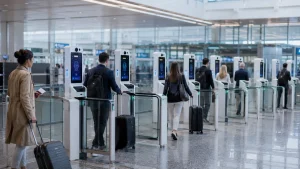
Experts suggest that delays will gradually reduce once biometric onboarding becomes more widespread and repeat travellers are fully registered in the system. However, during the transition phase, variability in processing times is expected to continue.
Peak travel seasons will likely remain challenging, especially at tourist-heavy airports, until infrastructure upgrades and staffing levels fully align with the new digital border system.
Will EU Airport Border Check Delays Improve in Late 2026?
EU airport border check delays are expected to gradually stabilise as more travellers complete their biometric registration under the Entry/Exit System. Once repeat traveller data becomes fully established in the system, processing times are likely to reduce significantly at major airports.
However, seasonal peaks such as summer holidays and Christmas travel periods will continue to cause temporary congestion, particularly at high-traffic tourist destinations.
Infrastructure upgrades and additional border staffing are also expected to play a role in improving processing efficiency across Schengen entry points.
Conclusion
EU airport border check delays are currently being driven by the transition to the Entry/Exit System, which has introduced biometric registration requirements for non-EU travellers.
While the system is designed to improve long-term border security and efficiency, the short-term impact has been significant congestion across major European airports.
Travellers, particularly from the UK, are experiencing longer waiting times, missed connections, and travel uncertainty. Although improvements are expected over time, passengers should continue to plan for extended processing delays during peak travel periods.
FAQs
What is the main reason for EU airport border check delays?
The main reason is the rollout of the Entry/Exit System, which requires biometric registration for non-EU travellers. This new process takes longer than traditional passport stamping and is causing congestion at border control points.
Why are UK travellers facing longer delays in EU airports?
UK travellers are now classified as non-EU passengers after Brexit, meaning they must undergo full biometric screening under the EES system. This increases processing time compared to EU citizens.
Which airports are most affected by border control delays in Europe?
Airports in Spain, Portugal, Italy, and Germany are currently the most affected. High tourist volumes combined with biometric onboarding have created severe congestion at these hubs.
How long are passengers waiting at EU border control?
Waiting times vary from around two hours in moderate cases to as long as six hours at heavily congested airports during peak arrival periods.
Are airlines responsible for delays caused by border control?
In most cases, airlines are not responsible for immigration delays, as border control is managed by national authorities rather than carriers. However, airlines may assist with rebooking missed flights.
Will airport delays improve in the future?
Yes, delays are expected to reduce once more travellers are fully registered in the EES system. However, peak travel seasons may still experience congestion.
What is the best way to avoid long EU airport queues?
Passengers can reduce disruption by arriving earlier, avoiding tight connections, and monitoring airline travel advisories before departure.