
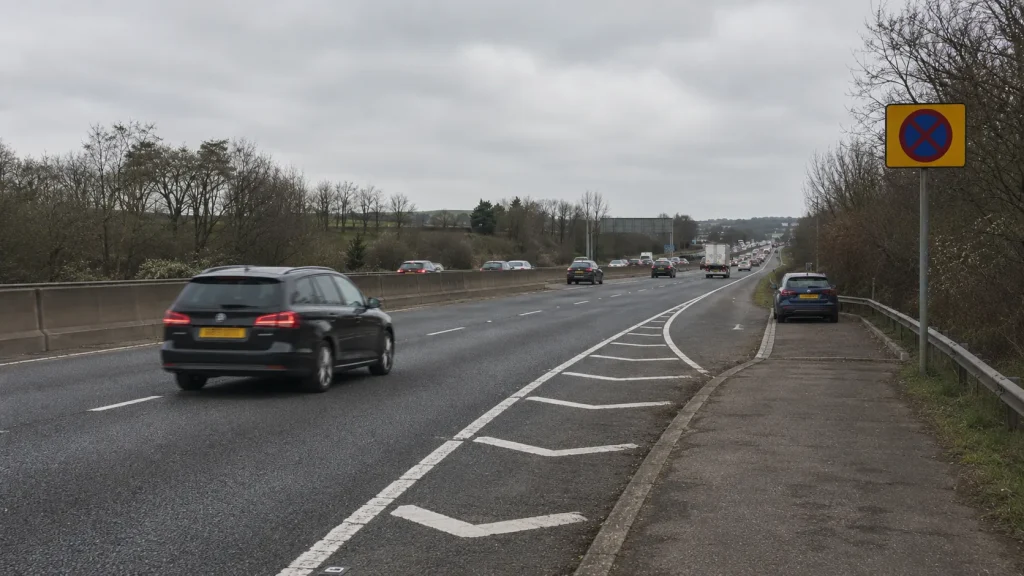
When may you stop on a clearway? On a standard or 24-hour clearway, you must not voluntarily stop on the restricted main carriageway, even to pick up or set down passengers.
However, Department for Transport guidance says you may normally stop in a lay-by unless separate signs prohibit it. An urban clearway works differently: during its signed hours of operation, you may stop to pick up or set down passengers, but you must not otherwise stop or park.
A genuine emergency, sudden breakdown or another situation that makes stopping unavoidable should not be confused with choosing to park or stop for convenience. I would not treat an emergency as a blanket permission to stop wherever I choose; the circumstances, the applicable restriction and any local traffic order may matter.
The Highway Code states that drivers must not stop or park on a clearway and must not stop or park on an urban clearway during its operating hours except to pick up or set down passengers.
Department for Transport guidance further explains that a 24-hour clearway normally covers the main running carriageway, slip roads and acceleration and deceleration areas.
The Driving Theory Test Answer Versus the Real-world Answer
For a straightforward driving theory test question asking “When may you stop on a clearway?”, the expected answer may simply be “Never”. The reference page supplied for this article uses that answer because the question is testing the basic no-stopping rule.
In real-world driving, however, I would look more closely at the type of clearway and the exact signs. A 24-hour clearway, an urban clearway and a red route do not all operate in exactly the same way. A lay-by can also have separate restrictions.
Key Takeaways About When You May Stop on a Clearway:
- A standard or 24-hour clearway generally means no voluntary stopping on the restricted main carriageway
- You cannot normally stop on a 24-hour clearway simply to pick up or drop off passengers
- Department for Transport guidance says you may stop in a lay-by unless signs say otherwise
- An urban clearway usually prohibits stopping during the times shown on the signs, but passenger pick-up and drop-off are allowed
- Loading or unloading is not a general exception to the no-stopping rule on an urban clearway during its operating hours
- A Blue Badge does not provide a general right to park on a clearway
- A police officer or other authorised officer can lawfully direct you to stop
- Penalties can vary according to the location, enforcement authority and type of contravention, so there is no single universal clearway fine UK amount.
These distinctions are why I would always identify the precise road restriction rather than assuming every road described as a clearway has identical rules.
What Is a Clearway and What Does the Clearway Sign Mean?
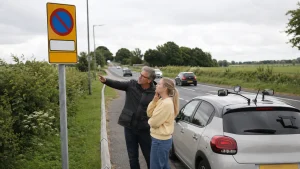
A clearway is a road or section of road where stopping is prohibited under the restriction shown by the traffic signs. The purpose is to keep the road clear so vehicles are not obstructed by stopped or parked traffic.
The familiar clearway sign is a blue circular sign with a red border and a red cross. The Department for Transport explains that the red cross means no stopping, including stopping to pick up or set down passengers when it indicates a 24-hour clearway.
What Does the Blue Clearway Sign With a Red Cross Mean?
The no stopping clearway sign tells me that I should not voluntarily stop where the restriction applies.
On a 24-hour clearway, the Department for Transport says the prohibition applies to:
- the main running carriageway
- slip roads
- acceleration and deceleration areas
A permitted lay-by can be treated differently unless signs impose their own restriction.
Does a Clearway Need Yellow Lines on the Road?
No. A 24-hour clearway does not need special road markings to create the visual appearance many drivers associate with parking restrictions.
This is important because I would never assume that the absence of yellow or red lines automatically means I can stop. Clearway restrictions can be shown by upright signs, with repeater signs used along the route to remind drivers.
Why Are Clearways Used on Busy and High-speed Roads?
Clearways are designed to prevent stopped vehicles from interfering with the movement of traffic. They are commonly associated with roads where keeping the running carriageway unobstructed is particularly important.
For a learner driver, the practical principle is simple: when the road has been designated as a clearway, I should look for somewhere outside the restricted carriageway rather than treating the roadside as an ordinary stopping place. The supplied theory-test reference similarly explains that clearways are intended to keep traffic flowing without obstruction from parked vehicles.
What Is the Difference Between a Clearway and an Urban Clearway?
The main difference is that a standard 24-hour clearway generally prohibits stopping on the restricted carriageway at all times, while an urban clearway normally operates only during the times shown and allows passenger pick-up and drop-off.
That distinction is central to understanding when you can stop on a clearway.
Standard or 24-hour clearway
A 24-hour clearway normally prohibits stopping on the main running carriageway at any time.
I would not stop there to:
- wait for another person
- make a phone call
- check directions
- load or unload ordinary goods
- pick up passengers
- set down passengers
Department for Transport guidance specifically states that the red-cross clearway restriction means no stopping, including passenger pick-up and set-down.
Urban Clearway
An urban clearway is generally used in a built-up area and operates during the days and times shown on the signs.
During its operating period, stopping is not allowed on the carriageway or verges except to pick up or set down passengers. The Highway Code makes the same distinction in Rule 240.
Outside the signed hours of operation, the urban clearway restriction itself is not operating, although another parking, waiting or stopping restriction may still apply. I would therefore check all nearby signs and road markings before assuming that parking is permitted.
Why the Distinction Matters Before You Stop?
Confusing a 24-hour clearway with an urban clearway can lead to the wrong decision.
For example, passenger drop-off is specifically allowed on an urban clearway during its operating hours, but it is not normally allowed on the main carriageway of a 24-hour clearway. That is why the exact sign matters more than the general word “clearway”.
When Can You Stop on a Clearway?
On a standard clearway, the normal rule is that you must not voluntarily stop on the restricted carriageway.
Situations involving an unavoidable emergency, a breakdown, a lawful instruction to stop or a location outside the restricted carriageway require separate consideration.
Can You Stop on a Clearway in an Emergency?
A genuine emergency may make stopping unavoidable, but I would be careful about describing this as a universal clearway exception.
The Highway Code gives a direct rule that drivers must not stop or park on a clearway. The precise legal position in an exceptional situation can depend on the circumstances and the traffic order governing that particular restriction.
A sudden event that leaves a driver with no safe or practical ability to continue is very different from voluntarily stopping for convenience.
Examples of a Genuine Emergency
Circumstances that could make a stop unavoidable may include:
- a sudden and serious medical emergency
- a mechanical failure that prevents the vehicle from continuing
- a collision or immediate danger
- an obstruction that physically prevents progress
- a lawful direction from a police officer or another authorised officer
The important distinction I would make is between choosing to stop and being forced by circumstances to stop.
Does an Emergency Create a General Parking Exemption?
No. An emergency should not be treated as a general licence to park on a clearway.
Once the immediate danger has been addressed, the appropriate action will depend on the circumstances.
Evidence such as recovery records, medical evidence, photographs or other documentation may become relevant if enforcement action follows, but no particular evidence guarantees that a challenge will succeed.
Can You Stop if Your Car Breaks Down on a Clearway?
If a vehicle genuinely breaks down and cannot safely continue, the stop may be unavoidable. That is fundamentally different from deciding to park on a clearway.
I would not describe a breakdown as permission to remain on the road longer than necessary. The priority is dealing with the immediate safety problem and arranging appropriate assistance.
Drivers should also remember that a particular lay-by may itself have a separate “No stopping except in emergency” restriction.
Department for Transport guidance shows that such restrictions can be used in lay-bys, with the restricted length indicated separately.
Can Police or Authorised Officials Direct You to Stop?
Yes. A driver must obey lawful signals given by authorised persons.
The Highway Code states that drivers must obey signals given by police officers, traffic officers and certain other authorised officials. If the police direct me to pull over, I must stop as soon as it is safe to do so.
Can You Pick Up or Drop Off Passengers on a Clearway?
It depends on the type of clearway. You cannot normally stop on a 24-hour clearway to pick up or set down passengers, but you can do so on an urban clearway during its operating hours.
Passenger Rules on a Standard or 24-hour Clearway
On a standard 24-hour clearway, passenger pick-up and drop-off are not normal permitted reasons for stopping on the restricted main carriageway.
If I need to collect or drop off a passenger, I should instead look for a lawful lay-by, parking area or another location where stopping is permitted.
Passenger Rules on an Urban Clearway
On an urban clearway, I may stop during the signed operating hours to pick up or set down passengers.
This is the specific exception identified by Highway Code Rule 240 and Department for Transport guidance. It does not turn the road into a waiting or parking area.
Why You Must Check the Exact Sign Before Stopping?
The wording, symbol and operating times determine the restriction.
A driver who sees the word “clearway” but does not distinguish between a 24-hour clearway and an urban clearway could apply the wrong rule. I would always read the full sign before making a decision to stop.
Can You Stop in a Lay-by on a Clearway?
Yes, a lay-by may be available for stopping on a 24-hour clearway unless signs say otherwise.
Department for Transport guidance specifically states that the 24-hour clearway prohibition applies to the main running carriageway and associated areas described in the guidance, while a driver may stop in a lay-by unless separate signs prohibit it.
When a Lay-by Has Its Own Restrictions?
A lay-by can have separate rules.
For example, a sign may prohibit stopping except in an emergency, or other parking and waiting controls may apply. I would therefore check the signs within or beside the lay-by rather than assuming every lay-by is unrestricted.
Why a Lay-by is Different From Stopping on the Running Carriageway?
A lay-by is physically separated from the main flow of the carriageway to some degree, which is why Department for Transport guidance treats it differently for a standard 24-hour clearway.
The key point is that “you may stop in a lay-by” does not mean “every lay-by is unrestricted”. A separate sign can still prohibit or limit stopping.
Can You Load or Unload on a Clearway?
Loading and unloading are not general exceptions to a clearway no-stopping restriction.
On a 24-hour clearway, the rule is no stopping on the restricted main carriageway. On an urban clearway during its operating hours, Highway Code Rule 240 identifies passenger pick-up and set-down as the exception; it does not provide a general loading or unloading exception.
Does Loading Count as a Reason to Stop?
Not on a standard clearway simply because goods need to be collected or delivered.
The distinction matters because other road restrictions may allow loading even where ordinary parking is prohibited. A clearway is stricter because it is a no-stopping restriction.
Why Local Signs Must Always Be Checked?
Different restrictions can appear similar but operate differently.
Loading bays, red routes, yellow-line restrictions and clearways each have their own rules. On red routes, for example, specially signed bays may allow parking or loading at particular times.
I would therefore rely on the actual sign and road marking at the location rather than applying a rule from another type of restriction.
Do Blue Badge Holders Have an Exemption on a Clearway?
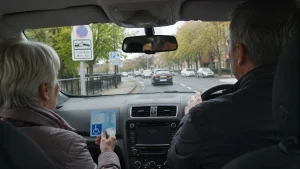
A Blue Badge does not provide a general exemption allowing a vehicle to park on a clearway.
For England, official Department for Transport Blue Badge guidance lists clearways (no stopping) among the places where a Blue Badge holder cannot park.
It also states that, on an urban clearway during its operating hours, passengers may be picked up or dropped off but parking is forbidden.
Why Yellow-line Concessions Should Not Be Confused With Clearway Rules?
In England, Blue Badge holders may generally park on single or double yellow lines for up to three hours in certain circumstances, subject to restrictions such as loading bans and local rules.
That concession does not mean the same parking right applies to a clearway. I would treat the two restrictions separately.
What a Blue Badge Holder Should Check Before Stopping?
I would check:
- whether the road is a clearway, urban clearway or red route
- the exact operating times
- any separate bay or lay-by signs
- the local authority’s rules
- the national Blue Badge guidance that applies in the relevant part of the UK
The GOV.UK Blue Badge guidance cited here applies specifically to England and notes that concessions can differ elsewhere in the UK.
Clearway, Urban Clearway or Red Route: What Is the Difference?
All three can restrict stopping, but they are not interchangeable.
| Restriction | General rule | Passenger pick-up or drop-off | Typical signs or markings |
| 24-hour clearway | No stopping on the restricted main carriageway | Normally not permitted | Blue circular sign with red cross; no special road marking required |
| Urban clearway | No stopping during signed operating hours | Permitted | Yellow urban clearway signs showing operating times |
| Red route | No stopping where red-line restrictions apply, subject to signed exceptions | Depends on the road, vehicle and signed rules | Single or double red lines and signed bays |
A 24-hour clearway can allow stopping in a lay-by unless separately restricted. An urban clearway allows passenger pick-up and set-down during operating hours. Red routes use their own system of red lines, signs and permitted bays.
For example, Transport for London states that double red lines operate at all times, while single red lines operate during the times shown. TfL also has particular rules for taxis, private hire vehicles and Blue Badge passenger pick-up or drop-off.
Are Any Clearway Rules Changing?
As of 13 July 2026, I did not identify an announced UK-wide change that removes or fundamentally changes the core Highway Code Rule 240 clearway restriction.
The current Highway Code continues to state that drivers must not stop or park on a clearway and that an urban clearway allows passenger pick-up or set-down during its operating hours. The official Highway Code update record shows later amendments in 2025, but the listed updates did not replace this core clearway rule.
This does not mean every road restriction will remain unchanged. Local authorities can introduce, alter or remove traffic restrictions through the relevant legal processes, and signs at a particular location may change.
Confirmed Rules Versus Proposed or Local Changes
I would separate a national Highway Code rule from a local road-management change.
A council could change the restriction applying to a particular road without the UK Government rewriting the general meaning of every clearway. For that reason, current road signs remain essential.
Why Local Traffic Orders Can Still Matter?
The legal restriction at a specific location may be created or supported by a traffic regulation order or another applicable legal instrument.
That means the exact road, authority and wording of the restriction can matter in an enforcement dispute.
The Road Traffic Regulation Act 1984 remains a central part of the legal framework and was shown by legislation.gov.uk as up to date with known changes in force up to 12 July 2026 when checked for this article.
What Happens If You Stop on a Clearway?
Stopping where a clearway restriction prohibits it can lead to enforcement action, which may include a Penalty Charge Notice or another form of parking enforcement depending on the road and responsible authority.
I would avoid quoting one universal clearway fine UK figure because penalty levels and enforcement systems are not identical throughout the country.
Can You Receive a Penalty Charge Notice for Stopping on a Clearway?
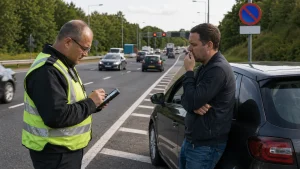
Yes, a PCN may be issued where a civil enforcement authority is responsible for the restriction.
The Highway Code notes that local traffic authorities enforce many parking contraventions under decriminalised parking enforcement arrangements.
GOV.UK also explains that PCNs can be issued by local councils and that red-route PCNs are handled by Transport for London.
How Much is the Clearway Penalty Fine?
There is no single penalty amount that applies to every clearway throughout the UK.
The amount can depend on:
- where the contravention took place
- the enforcement authority
- the applicable penalty band
- how the contravention is classified
- whether a discount period applies
- whether the penalty increases because payment or appeal deadlines are missed
For an example of current regional variation, London borough parking PCNs are currently set at £160 or £110 in Band A and £140 or £90 in Band B, depending on whether the contravention is classed at the higher or lower level. These figures should not be treated as a universal UK clearway fine.
GOV.UK advises motorists to check the ticket because the payment process depends on the type of notice and the issuer. A PCN is usually payable within 28 days, and some notices offer a reduction for payment within 14 days.
Can You Appeal a Clearway PCN?
Yes. A motorist who believes a PCN is wrong may be able to challenge it through the procedure stated on the notice.
Depending on the type of PCN, the process may involve:
- an informal challenge;
- a formal representation; and
- an appeal to an independent tribunal if the formal representation is rejected.
GOV.UK states that supporting evidence and a clear explanation should be provided when making a formal representation. I would always follow the deadlines and instructions on the actual notice rather than relying on a general online example.
A genuine breakdown or emergency may be relevant to a challenge, but I would not promise that it will automatically cancel a penalty. The decision depends on the facts, evidence and applicable rules.
Conclusion: When May You Stop on a Clearway?
When may you stop on a clearway? The safest general answer is that you must not voluntarily stop on the restricted main carriageway of a standard or 24-hour clearway.
The important exceptions and distinctions are more precise than a simple “never”:
A Department for Transport 24-hour clearway normally still allows stopping in a lay-by unless signs prohibit it. An urban clearway allows you to stop during its operating hours to pick up or set down passengers.
A lawful direction from the police or another authorised officer must be obeyed, and a genuine emergency or breakdown may make stopping unavoidable.
I would therefore base every decision on the exact clearway sign, the type of restriction and any additional signs at the location.
That approach gives a more accurate understanding of clearway stopping rules UK than assuming that every clearway, urban clearway and red route works in exactly the same way.
Frequently Asked Questions
Does a clearway mean no stopping at any time?
A 24-hour clearway normally means no stopping on the restricted main carriageway at any time. Always check the signs for the exact restriction.
Can I briefly stop on a clearway if I stay inside my car?
No. Staying inside the vehicle does not make a prohibited stop legal, because clearway restrictions apply to stopping itself.
Can I use hazard lights while stopped on a clearway?
No. Hazard lights do not create an exemption or make an otherwise prohibited stop legal.
Can I stop on a clearway if my vehicle breaks down?
A genuine breakdown may make stopping unavoidable. You should deal with the safety issue and arrange assistance as soon as reasonably possible.
Can I stop in a lay-by on a clearway?
You may normally stop in a lay-by on a 24-hour clearway unless separate signs restrict or prohibit stopping there.
Can a Blue Badge holder stop on a clearway?
A Blue Badge does not provide a general right to park on a clearway. The exact restriction and local rules should always be checked.
Can I challenge a clearway Penalty Charge Notice?
Yes. You may be able to challenge a PCN if you believe it was issued incorrectly or there were relevant circumstances, but you must follow the procedure and deadlines on the notice.
Editorial note: I have based this guide on current Highway Code and Department for Transport guidance. Clearway restrictions can also depend on the exact signs, local traffic orders and the authority responsible for enforcement, so I recommend checking the signs at the location and any official notice you receive
Sources
- The Highway Code – Waiting and Parking
https://www.gov.uk/guidance/the-highway-code/waiting-and-parking-238-to-252 - Know Your Traffic Signs – Department for Transport
https://assets.publishing.service.gov.uk/media/656ef4271104cf0013fa74ef/know-your-traffic-signs-dft.pdf - Blue Badge Scheme: Rights and Responsibilities in England
https://www.gov.uk/government/publications/the-blue-badge-scheme-rights-and-responsibilities-in-england/the-blue-badge-scheme-rights-and-responsibilities-in-england - Parking Tickets and Penalty Charge Notices
https://www.gov.uk/parking-tickets - Challenging a Parking Ticket
https://www.gov.uk/parking-tickets/challenging-a-ticket