

If you buy a used car from a dealer or other trader, the Consumer Rights Act 2015 generally requires the vehicle to be of satisfactory quality, fit for purpose, and as described.
Your rights and possible remedies depend on factors including when the fault appeared, the nature of the problem, the age and mileage of the vehicle, what you were told before buying it, and whether the car was purchased from a trader or a private seller.
For a qualifying fault, your options may include:
- using the short-term right to reject within the first 30 days
- requesting a repair or replacement
- seeking a price reduction
- exercising the final right to reject where the legal conditions are met
The Consumer Rights Act 2015 used car rules do not mean that every problem automatically entitles you to a full refund. A used vehicle is assessed in context. An older, higher-mileage car will not necessarily be expected to meet the same standard as a nearly new vehicle.
Key Takeaways:
The most important points to remember about faulty used car rights are:
- A used car bought from a trader should be of satisfactory quality, fit for purpose and as described
- The age, mileage, price and condition of the vehicle can affect what counts as satisfactory quality
- You may have a short-term right to reject a qualifying faulty vehicle within the first 30 days
- After the first 30 days, repair or replacement will often become the first remedy considered
- Where a fault appears within the first six months, the Consumer Rights Act contains an important presumption about whether the goods conformed to the contract at delivery, subject to exceptions
- After six months, you may face a greater evidential burden in showing that the problem relates to the vehicle’s condition at the time of delivery.
- A dealer warranty does not replace your statutory rights
- Your rights against a private seller are generally more limited than your rights against a motor trader
- Keep the advert, purchase documents, messages, diagnostic reports and repair records if a dispute develops
What Does the Consumer Rights Act 2015 Mean for a Used Car?

The Consumer Rights Act 2015 sets legal standards for goods supplied by traders to consumers. A vehicle is classed as goods for these purposes.
When considering Consumer Rights Act 2015 used cars, three requirements are particularly important: satisfactory quality, fitness for a particular purpose and conformity with the description.
A breach of these requirements may give you access to legal remedies. However, the correct remedy depends on the circumstances and the stage at which the problem is raised.
What Does “Satisfactory Quality” Mean for a Used Car?
A used vehicle should meet the standard that a reasonable person would consider satisfactory, taking account of relevant circumstances.
Those circumstances can include:
- the vehicle’s age
- its mileage
- its price
- its advertised condition
- statements made by the dealer
- other relevant information available at the time of purchase
For example, a relatively new, low-mileage car sold at a substantial price may reasonably be expected to be in better condition than a much older, inexpensive vehicle with significant mileage.
However, the fact that a car is used does not automatically excuse every fault. A serious defect that is inconsistent with the car’s age, mileage, price or description could still raise a question about whether the vehicle was of satisfactory quality.
What Does “Fit for Purpose” Mean?
A vehicle should be fit for its normal purposes. In most cases, this includes being capable of being used as a car in a reasonable and lawful manner.
The legal position may also be relevant where you tell the dealer about a particular purpose before buying and rely on the dealer’s judgement.
For example, suppose you clearly explain that you need a vehicle capable of performing a particular function and the trader recommends a specific car as suitable. If it is not reasonably capable of that purpose, you may have grounds to argue that it was not fit for the purpose made known to the seller.
What Does “As Described” Mean?
A used car should match material descriptions made about it.
This can potentially include information provided through:
- the online advert
- the dealership’s website
- a written vehicle description
- statements made by the salesperson
- specific features represented as being present or working
If a vehicle is materially different from what you were told, the issue may fall within your used car rights from a dealer.
Does a Used Car Have to Be Perfect?
No. A used car is not required to be perfect simply because it was purchased from a dealership.
Normal deterioration, age-related wear and faults that should reasonably be expected given the car’s age, mileage and price may not necessarily amount to a breach of the Consumer Rights Act.
The key question is not simply whether the car has developed a problem. The question is whether, in the circumstances, the vehicle failed to meet the legal standards required when it was supplied.
Consumer Rights Act 2015 Used Car Rules: What Happens When a Fault Appears?
The timing of the fault is one of the most important parts of a Consumer Rights Act 2015 used car claim.
The first 30 days, the period after 30 days and the first six months can affect the remedy available and the evidential position.
What Happens If the Car Is Faulty Within the First 30 Days?
If the vehicle fails to meet the legal requirements of satisfactory quality, fitness for purpose or conformity with description, you may be able to use the short-term right to reject.
The 30-day period generally begins when the statutory conditions for the time limit are met, including transfer of ownership or possession as applicable.
You should notify the trader promptly if you intend to rely on this right.
What Is the Short-Term Right to Reject?
The short-term right to reject is a remedy that can allow a consumer to reject goods that do not conform to the contract during the relevant 30-day period.
For a used car, this does not mean you can automatically return the vehicle for any reason. There must be a legal basis for rejection, such as a qualifying failure to meet the standards required by the Consumer Rights Act.
Can You Ask for a Full Refund?
Where the short-term right to reject is validly exercised, the Act provides for a refund.
However, disagreements can arise about whether the vehicle was actually faulty, whether the problem was present or developing when the car was supplied, and whether the issue is significant in the context of the vehicle’s age and condition.
That is why evidence can be important even when the fault appears quickly.
When Might a Dealer Dispute Your Right to Reject the Car?
A dealer might dispute a rejection by arguing that:
- there is no actual fault
- the problem is normal wear and tear
- the damage was caused after delivery
- the issue was disclosed before the sale
- the vehicle remains of satisfactory quality given its age, mileage and price
- the complaint does not amount to a breach of the Consumer Rights Act
A dispute does not automatically mean the dealer is correct. Equally, describing a vehicle as faulty does not automatically establish a legal right to reject it. The evidence and circumstances matter.
What Happens If the Fault Appears After 30 Days?

Once the short-term right to reject has expired, the statutory remedy structure normally changes.
In many cases, you will first need to give the trader an opportunity to provide a repair or replacement before moving to a price reduction or the final right to reject.
When Can You Ask for a Repair or Replacement?
If the vehicle does not conform to the contract, you may be entitled to require the trader to repair or replace it, subject to the statutory rules.
The remedy must be provided within a reasonable time and without significant inconvenience to you.
A replacement vehicle may not always be practical in a used car transaction because each second-hand vehicle can differ in age, mileage, specification and condition. As a result, repair is often the more realistic remedy.
Does the Dealer Get a Chance to Repair the Car?
After the first 30 days, the law generally gives the trader an opportunity to repair or replace qualifying faulty goods before the consumer moves to certain further remedies.
This is why immediately demanding a full used car refund after the first 30 days may not always reflect the statutory remedy process.
What Happens If the Repair Fails?
Depending on the circumstances, you may be able to seek a price reduction or exercise the final right to reject if:
- a repair or replacement is unsuccessful
- the trader fails to provide the remedy within a reasonable time
- the process causes significant inconvenience
The precise legal position depends on the facts and the statutory conditions.
What Happens If a Used Car Develops a Fault Within Six Months?
The first six months are important because the Consumer Rights Act contains a presumption concerning goods that do not conform to the contract during that period.
Broadly, where goods fail to conform within six months of delivery, they are generally presumed to have failed to conform at the time of delivery unless that presumption is incompatible with the nature of the goods or the nature of the failure.
This does not mean that every fault appearing within six months automatically produces a refund.
The nature of the fault, the age and mileage of the vehicle, the remedy already attempted and the surrounding evidence can still matter.
What Happens If the Fault Appears After Six Months?
You may still have legal rights after six months, but proving your claim can become more difficult.
You may need evidence showing that the underlying problem was present, developing or otherwise connected with the vehicle’s condition when it was supplied.
Useful evidence might include:
- an independent engineer’s report
- diagnostic records
- photographs or videos
- a documented repair history
- expert evidence
- records showing when symptoms first appeared
A later fault does not automatically mean you have no claim. However, the evidential position can be more challenging.
Can You Return a Used Car Within 30 Days?
You may be able to return a faulty used car within the first 30 days where the legal requirements for the short-term right to reject are satisfied.
The key point is that the 30-day right to reject is not a general cooling-off period for every car purchased at a dealership.
A qualifying breach of your statutory rights is normally required.
Can You Return a Used Car Simply Because You Changed Your Mind?
If you bought the car in person at a dealership, you do not generally have an automatic right under the Consumer Rights Act to return it simply because you have changed your mind.
A dealer may voluntarily offer a returns policy, but that is separate from your statutory rights.
Different rules can apply to qualifying distance or off-premises contracts.
Do Different Rules Apply to Online or Distance Car Purchases?
Potentially, yes.
Where the complete sales contract is concluded at a distance, such as entirely online or by telephone without simultaneous physical presence, the Consumer Contracts Regulations may provide a cancellation period.
The exact position depends on how the transaction was concluded. Simply viewing an advert online before visiting a dealership and completing the purchase in person does not necessarily make the sale a distance contract.
Distance-sale cancellation rights and faulty used car rights under the Consumer Rights Act are separate legal protections and should not be confused.
What Counts as a Fault Under Used Car Consumer Rights?

There is no universal list of problems that automatically gives a buyer the right to reject a used car.
The legal question is whether the vehicle met the standards required by the contract and the Consumer Rights Act.
Examples of Problems That May Be Relevant
Depending on the circumstances, potentially relevant problems can include:
- a serious engine defect
- a significant gearbox problem
- major electrical faults
- safety-related defects
- undisclosed mechanical problems
- a vehicle that materially differs from its advert
- incorrect information about specification or condition
- repeated breakdowns inconsistent with reasonable expectations for the car
The existence of one of these problems does not guarantee a particular remedy. Its seriousness, cause, timing and relationship to the vehicle’s condition at delivery must still be considered.
What Is Normal Wear and Tear?
Normal wear and tear is deterioration that can reasonably be expected through age, mileage and ordinary use.
Items such as tyres, brake components, clutches and other parts can wear over time. However, simply labelling a problem “wear and tear” does not settle a dispute.
A component that fails almost immediately after purchase may still require closer examination, particularly where its condition was inconsistent with reasonable expectations or representations made before the sale.
Can a Dealer Refuse a Claim Because the Car Is Old or Has High Mileage?
A dealer can take the age, mileage, price and condition of the vehicle into account when responding to a claim, because those factors can be relevant to satisfactory quality.
However, an older or higher-mileage car does not automatically fall outside the Consumer Rights Act.
The central question remains whether the vehicle met the standard a reasonable person would consider satisfactory in the circumstances.
What Are a Used Car Dealer’s Legal Obligations?
A trader selling a vehicle to a consumer cannot normally remove statutory rights simply by using wording such as “sold as seen”, where the Consumer Rights Act applies.
The vehicle should meet the legal standards required of goods supplied under the contract.
Must a Dealer Repair a Faulty Used Car?
Not in every situation.
Within the first 30 days, a consumer with a valid short-term right to reject may choose to reject rather than accept a repair.
After the initial 30-day period, repair or replacement will commonly form the next stage of the statutory remedy process.
The precise remedy depends on the circumstances and the relevant provisions of the Act.
How Many Chances Does a Dealer Get to Repair a Car?
The Consumer Rights Act contains provisions that can allow a consumer to move to a price reduction or final right to reject after one repair or one replacement has been carried out and the goods still do not conform to the contract.
However, real disputes can be fact-sensitive. For example, arguments can arise over whether a later problem is the same defect, a different fault or an unrelated issue.
Keep clear records of every diagnosis, repair attempt, invoice and conversation.
Can a Dealer Refuse to Give You a Refund?
A dealer can dispute a refund request where they believe the legal requirements have not been met.
For example, they may argue that:
- there is no qualifying fault
- the issue is reasonable wear and tear
- the problem was caused after purchase
- you are seeking the wrong remedy at that stage
- the car was accurately described and reasonably satisfactory given its age and condition
If you disagree, the dispute may need to be supported by evidence and, where appropriate, escalated through a complaint or dispute-resolution process.
Can a Dealer Tell You to Claim Under the Warranty Instead?
A warranty does not normally replace your statutory rights.
A dealer or manufacturer warranty can provide additional contractual protection, but its terms are separate from the rights provided by law.
Depending on the circumstances, using a warranty may be convenient, but you should not assume that the existence or expiry of a warranty determines whether you have a claim under the Consumer Rights Act.
Repair, Replacement, Price Reduction, or Refund: What Remedy May Apply?
The correct remedy depends on the timing of the complaint and what has already happened.
Understanding the sequence is important when dealing with a Consumer Rights Act car refund dispute.
When Can You Request a Repair?
After the short-term right to reject period, repair may be one of the main remedies where a car fails to conform to the contract.
The repair should be completed within a reasonable time and without significant inconvenience.
What counts as reasonable can depend on factors such as:
- the complexity of the fault
- parts availability
- the nature of the vehicle
- the practical impact on you
When Might a Replacement Be Available?
Replacement is another statutory remedy, but it may be less practical in the used car market.
A second-hand vehicle is often unique in terms of its mileage, service history, age, specification and condition. A genuinely equivalent replacement may therefore be difficult to provide.
When Can You Ask for a Price Reduction?
A price reduction may become available where the statutory conditions are satisfied, including circumstances in which repair or replacement has not successfully brought the vehicle into conformity.
The reduction can potentially reflect the difference between what you paid and the value of what you received.
When Can You Use the Final Right to Reject?
The final right to reject may become relevant after the statutory repair or replacement process has failed or where other conditions under the Act are satisfied.
Because the remedy depends on the precise history of the case, keep a clear timeline showing:
- when the car was delivered
- when the fault first appeared
- when you notified the dealer
- what remedy you requested
- what repair work was attempted
- whether the fault remained or returned
Can a Refund Be Reduced Because You Used the Car?
The Consumer Rights Act includes specific rules allowing a deduction for use in certain cases involving the final right to reject.
Motor vehicles receive particular treatment under these provisions, so a deduction for use can potentially apply even within the first six months where the final right to reject is exercised.
This should be distinguished from a valid exercise of the short-term right to reject during the initial 30-day period.
Because refund deductions can become disputed, ask the trader to explain clearly how any proposed deduction has been calculated.
Used Car Rights Timeline
| Time since delivery or purchase stage | Potential position | Possible remedy or consideration |
| First 30 days | The car does not conform to the contract | The short-term right to reject may apply |
| After 30 days | A qualifying fault exists | Repair or replacement will commonly be considered first |
| Within six months | The car fails to conform | The statutory six-month presumption may apply, subject to exceptions |
| After six months | A fault is discovered | You may need stronger evidence about the condition of the car at delivery |
| After a failed repair or replacement | The car still does not conform | A price reduction or final right to reject may become relevant |
This table is a general guide rather than a guarantee of outcome. The nature of the fault, the purchase circumstances and the evidence available can affect your rights.
What Evidence Should You Collect Before Rejecting a Used Car?
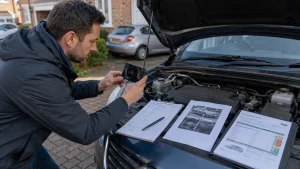
Evidence can be crucial in a dispute over a faulty vehicle, particularly where the dealer disagrees about the cause or timing of the problem.
Keep the Sales Agreement and Vehicle Advert
Save copies of:
- the invoice
- sales contract
- finance documents
- online advert
- vehicle description
- warranty documents
- messages exchanged before the purchase
The advert can be especially important where your complaint involves a vehicle that was not as described.
Photograph or Record the Fault
Where possible and safe, keep photographs or videos showing:
- dashboard warning lights
- visible defects
- fluid leaks
- unusual smoke
- error message
- other symptoms
Do not take risks to create evidence. If the vehicle may be unsafe, stop using it and seek appropriate assistance.
Keep Diagnostic and Repair Reports
Written reports can help establish:
- what the problem is
- when it may have developed
- whether it is consistent with the age and mileage of the car
- what repairs are required
- whether previous repair attempts were successful
Consider an Independent Vehicle Inspection
An independent vehicle inspection may be useful where the cause of the fault is disputed, particularly after the first six months.
Before paying for a report, consider what questions the expert needs to answer and whether the cost is proportionate to the dispute.
Communicate With the Dealer in Writing
When you report the fault to the dealer, written communication creates a clear record.
Include:
- the vehicle details
- the purchase date
- when the problem started
- a clear description of the fault
- supporting evidence
- the remedy you are seeking
Avoid continuing to use the vehicle unnecessarily where doing so could worsen the problem or create a safety risk.
Does the Consumer Rights Act Apply to a Car Bought on Finance?
Consumer protection can still apply when a car is bought on finance, but you need to identify the legal structure of the transaction.
With some finance agreements, the finance company is the supplier or owner of the vehicle during the agreement.
Who Should You Contact About a Faulty Car Bought on Finance?
Check your agreement and notify the relevant parties promptly.
Depending on the type of finance, this may include:
- the dealership
- the finance provider
- both
Keep all correspondence and explain the fault, when it appeared and what resolution you are seeking.
Can the Finance Company Have Responsibilities?
Potentially, yes.
The finance provider’s responsibilities depend on the form of agreement and the legal relationship between the parties.
Do not assume that a dealership is the only organisation you can contact simply because it physically supplied the car.
Why You Should Check the Type of Finance Agreement?
Hire purchase, personal contract purchase and other credit arrangements can create different contractual relationships.
Review the agreement carefully before deciding whom to pursue. For a disputed or high-value claim, specialist consumer or legal advice may be appropriate.
Conclusion: Understanding Your Consumer Rights Act 2015 Used Car Protection
Understanding the Consumer Rights Act 2015 used car rules can help you respond more effectively when a vehicle purchased from a dealer develops a problem.
A used car supplied by a trader should be of satisfactory quality, fit for purpose and as described. However, your remedy depends on more than the simple fact that something has gone wrong.
The timing of the fault is important. The first 30 days may involve the short-term right to reject, while faults raised later may normally move through the repair or replacement process before a price reduction or final right to reject becomes available.
The age, mileage, price and condition of the car also matter when deciding what a reasonable person would consider satisfactory.
If you are dealing with a faulty used car, keep your documents, preserve evidence and communicate clearly in writing. For a disputed claim, check current official guidance and consider obtaining independent advice based on your specific circumstances.
FAQs
Can I reject a used car if a warning light appears after purchase?
Possibly, but the appearance of a warning light does not automatically create a right to reject the car. The underlying fault must be considered, along with when it appeared and whether the vehicle met the legal requirements of satisfactory quality, fitness for purpose and conformity with its description. A diagnostic report may help identify the cause.
What happens if the dealer says the fault is normal wear and tear?
The dealer may argue that the problem is consistent with the car’s age, mileage and condition. Whether that argument is valid depends on the circumstances. An independent technical report can be useful where you and the dealer disagree about whether the problem is genuine wear and tear or an unreasonable defect.
Can I drive a car after telling the dealer I want to reject it?
Continuing to use a rejected vehicle can complicate a dispute, particularly if the use increases the mileage or worsens the fault. The safest approach depends on the circumstances. If the vehicle may be dangerous, do not drive it. Ask the dealer to arrange collection where appropriate and keep written records.
Do I need an independent report before asking for a refund?
Not always. Whether you need an independent report depends on the timing and nature of the dispute. Evidence can become particularly important where the dealer disputes the fault or where a problem is raised after the first six months.
What happens if the dealer repaired the car but the same fault returned?
If the car still fails to conform to the contract after a repair, you may be able to consider further remedies under the Consumer Rights Act, including a price reduction or the final right to reject where the statutory conditions are met. Keep all records of the original complaint and repair.
Can I claim for recovery, diagnostic, or repair costs?
You may be able to seek reimbursement or damages for certain reasonably incurred losses in some circumstances, but entitlement is fact-specific. Avoid authorising expensive third-party repairs without considering whether the seller should first have an opportunity to inspect or remedy the problem.
What if I part-exchanged my old car when buying the faulty vehicle?
A part-exchange can make the financial position more complicated if the new vehicle is later rejected. The appropriate resolution can depend on the terms of the transaction and what happened to the part-exchanged vehicle. Obtain advice if the dealer and buyer cannot agree on how the value should be handled.
Can a dealer make me use the warranty before considering my statutory rights?
A warranty does not replace your statutory consumer rights. The dealer may suggest using a warranty because it offers a practical route to repair, but the existence of a warranty does not normally remove rights you may have under the Consumer Rights Act 2015.
Last updated: 14 July 2026
Editorial note: This guide provides general information about UK consumer rights. The outcome of a used car dispute depends on the facts of the individual case. For personalised legal advice, consider speaking to a qualified adviser.
Sources
- UK Legislation — Consumer Rights Act 2015
- Citizens Advice — Problems with a used car
- The Motor Ombudsman — What is the Consumer Rights Act?
- UK Legislation — Consumer Contracts Regulations 2013