

Yes, PIP is usually paid every four weeks in the UK. This means regular payments normally follow a 28-day cycle rather than being paid once per calendar month.
Because four weeks is shorter than most calendar months, the payment date can move across the calendar instead of arriving on the same numbered date each month.
The claimant’s decision letter usually confirms the first payment date and the weekday on which future PIP payments are normally made.
Is PIP Paid Every 4 Weeks or Monthly?
Personal Independence Payment (PIP) is usually paid every four weeks, rather than once per calendar month. A four-week payment cycle lasts 28 days, while calendar months normally contain 30 or 31 days, apart from February.
This distinction matters because someone receiving PIP should not expect the payment to arrive on the same numbered date each month. Instead, the normal payment will generally fall on the same day of the week every four weeks.
GOV.UK confirms that PIP is usually paid every four weeks and that a claimant’s decision letter states the date of the first payment and the weekday on which they will usually be paid.
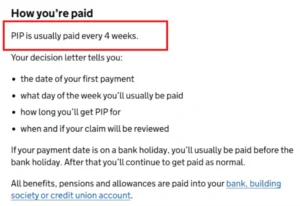 GOV.UK confirms that Personal Independence Payment is usually paid every four weeks and explains how the normal payment day is communicated.
Four-Weekly Payments Are Different From Monthly Payments
Four weeks always equals 28 days. A calendar month does not.
For example, if a normal PIP payment arrives on Thursday 8 January, adding four weeks would make the next normal payment Thursday 5 February. Another four weeks would make the following payment Thursday 5 March.
This is why PIP payment dates gradually move through the numbered dates of the calendar rather than remaining on a fixed date such as the 1st or 15th of each month.
Those comparing their payment with monthly household bills may also find it useful to look at the current PIP monthly payment amounts for 2026, which separates actual four-week payments from average calendar-month equivalents.
Why There Can Be 13 Four-Weekly Payment Cycles In 52 Weeks?
A full 52-week period contains 13 blocks of four weeks:
52 ÷ 4 = 13
This means a person who remains entitled throughout a continuous 52-week period would normally pass through 13 four-week payment periods.
That should not be interpreted as a guarantee that exactly 13 payments will fall between 1 January and 31 December in every individual case. The number of payments appearing within a particular calendar year depends on where the person’s four-week cycle falls.
The important point is that PIP follows a four-week payment schedule, not a 12-payment monthly schedule.
How Does The PIP 4-Week Payment Cycle Work?
The legal rules behind PIP are more specific than simply saying it is normally paid every four weeks.
Regulation 48 of the Universal Credit, Personal Independence Payment, Jobseeker’s Allowance and Employment and Support Allowance (Claims and Payments) Regulations 2013 states that PIP is generally paid at intervals of four weeks in arrears, subject to specified exceptions.
PIP Is Normally Paid In Arrears
Being paid in arrears means the regular payment relates to a period that has already passed rather than paying four weeks of benefit in advance.
This is different from some other benefit arrangements and helps explain why the first payment or certain exceptional payments may not always look identical to later regular payments.
Claimants looking at current award values should also distinguish payment frequency from the amount awarded.
Current PIP benefit changes and rates for 2026 affect how much someone may receive, while the usual four-week payment cycle determines how frequently regular payments arrive.
Does PIP Arrive On The Same Day Of The Week?
A PIP decision letter tells the claimant what day of the week they will usually be paid.
For someone normally paid on a Thursday, regular payments would therefore normally remain four weeks apart and continue to fall on a Thursday.
The weekday may remain consistent, while the numerical date changes.
For example:
| Payment | Example Date | Interval |
| Payment 1 | Thursday 8 January | Starting Date |
| Payment 2 | Thursday 5 February | 28 Days |
| Payment 3 | Thursday 5 March | 28 Days |
| Payment 4 | Thursday 2 April | 28 Days |
These dates are illustrative rather than a universal PIP payment calendar.
How Can Someone Work Out Their Next PIP Payment Date?
A claimant can usually estimate the next normal PIP payment by taking the previous scheduled payment date and adding 28 days.
A simple way to check is:
- Find The Previous Normal Payment Date
- Add 28 Days
- Check For A Bank Holiday Or Weekend
- Compare The Result With The Decision Letter
- Check GOV.UK If The Expected Date Appears Different
GOV.UK has also introduced a service that allows people receiving PIP and several other benefits to check their next payment and recent payments online. The service can show when the next payment is due and how much it will be.
Simple PIP Payment Date Example
Suppose a claimant normally receives PIP on Wednesday 4 February.
Adding 28 days gives:
Wednesday 4 February + 28 days = Wednesday 4 March
Adding another four weeks gives:
Wednesday 4 March + 28 days = Wednesday 1 April
The example shows why asking whether PIP is monthly can cause confusion. Although one payment may appear early in one calendar month, the payment schedule itself is still based on four-week intervals.
What Happens If A PIP Payment Date Falls On A Bank Holiday?
When a normal PIP payment date falls on a bank holiday, GOV.UK says the claimant will usually be paid before the bank holiday. After that, payments continue as normal.
More generally, GOV.UK states that benefits due on a weekend or bank holiday are usually paid on the working day before.
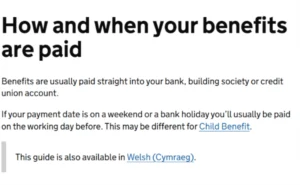
GOV.UK states that benefit payments due on a weekend or bank holiday are usually made on the previous working day.
For example, if someone’s normal payment is due on a Monday that is a bank holiday, the payment may appear on the preceding working day instead.
This does not mean the claimant has been given an extra payment. It is normally the scheduled payment being released early because of the bank holiday.
Specific holiday changes can vary according to the dates involved, so the current DWP revised payment dates can be useful when a bank holiday is approaching.
Does An Early Bank Holiday Payment Change The Next PIP Date?
An early bank holiday payment does not normally mean that a completely new four-week cycle begins from the earlier date.
GOV.UK states that after an early PIP payment caused by a bank holiday, the claimant will continue to be paid as normal.
As a result, someone paid early should be careful about simply adding 28 days to the date on which the money actually reached the account. The normal scheduled payment date remains important.
When Is The First PIP Payment Made?
There is no single first PIP payment date that applies to everyone.
When a PIP claim is successful, the decision letter tells the claimant the date of their first payment. GOV.UK also states that the letter explains how long the award will last and when, or whether, the claim may be reviewed.
The first payment should therefore be checked against the award decision rather than estimated from another person’s payment date.
After regular payments begin, PIP will usually follow the claimant’s four-week schedule unless an exception or payment-date adjustment applies.
Is PIP Always Paid Every Four Weeks?
PIP is usually paid every four weeks, but the word “usually” is important.
The regulations provide limited circumstances in which a different payment arrangement can apply.
Weekly Payments In Certain End-Of-Life Cases
The regulations allow the Secretary of State to arrange PIP payments at one-week intervals in advance for certain claimants covered by the relevant end-of-life provisions.
Current GOV.UK guidance also provides a different PIP claim route for people nearing the end of life, for example because of a life-limiting illness.
The normal four-week arrangement should therefore not be presented as an absolute rule applying without exception.
Other Limited Payment Arrangements
The regulations also provide that when the amount of PIP payable is less than £5 a week, the Secretary of State may arrange for it to be paid in arrears at different intervals, up to a specified maximum period.
There are also separate rules covering particular circumstances such as payments calculated at a daily rate between certain periods in hospital or other accommodation.
For most claimants receiving a standard ongoing award, however, the four-week payment cycle remains the relevant schedule.
Where Is PIP Paid?
PIP is normally paid directly into a claimant’s:
- Bank Account
- Building Society Account
- Credit Union Account
GOV.UK confirms that benefits, pensions and allowances are generally paid into one of these types of account.
The account details are provided during the claim process.
PIP is separate from Universal Credit, and receiving PIP does not mean both benefits follow the same payment timetable. People receiving both benefits may therefore see payments arrive on different cycles.
The interaction is covered in more detail in whether Universal Credit needs to be told when someone gets PIP.
What Should Someone Do If Their PIP Payment Is Late?
A payment that has not appeared on the expected date does not automatically mean an award has stopped. The claimant should first establish the normal scheduled date and rule out a calendar or account issue.
Check The Expected Payment Date
The claimant can check the previous normal payment date and calculate 28 days forward.
They should also check whether a weekend or bank holiday has affected the expected date.
GOV.UK now allows eligible users to check the next and recent payments for PIP through its online benefits and State Pension payment service.
Check The PIP Decision Letter
The decision letter states the first payment date and the weekday on which the claimant will usually receive PIP.
This can help establish whether the claimant has calculated the date correctly.
Check The Relevant Account
The claimant should check the bank, building society or credit union account into which PIP is normally paid.
Looking at previous PIP transactions can also help establish the regular four-week pattern.
Contact The PIP Enquiry Line If Necessary
If an expected PIP payment is genuinely missing, a claimant with an existing claim can contact the PIP enquiry service.
GOV.UK currently lists the PIP enquiry line as 0800 121 4433, Monday to Friday from 9am to 5pm.
Contact information can change, so it is sensible to check the current GOV.UK Disability Service Centre page before calling.
PIP Every 4 Weeks: Example Payment Schedule
The following example demonstrates how a four-week PIP payment cycle differs from a monthly payment.
| Payment | Example Payment Date | Time Since Previous Payment |
| Payment 1 | 8 January | Starting Date |
| Payment 2 | 5 February | 28 Days |
| Payment 3 | 5 March | 28 Days |
| Payment 4 | 2 April | 28 Days |
| Payment 5 | 30 April | 28 Days |
| Payment 6 | 28 May | 28 Days |
| Payment 7 | 25 June | 28 Days |
The dates move earlier within some calendar months because PIP is following a fixed 28-day cycle, not waiting for the same date in the following month.
The example also demonstrates why four-week and monthly budgeting figures should not be treated as interchangeable.
A claimant’s actual payment dates should always be based on their own award and payment information rather than this illustrative schedule.
Conclusion
Yes. PIP is usually paid every four weeks in the UK, meaning regular payments normally follow a 28-day cycle rather than arriving once per calendar month.
GOV.UK confirms this payment frequency, while the regulations state that PIP is generally paid at four-week intervals in arrears.
The claimant’s decision letter gives the first payment date and usual payment weekday. If a scheduled payment falls on a bank holiday, it will usually arrive earlier, after which the normal payment schedule continues.
Although a continuous 52-week period contains 13 four-week cycles, individual calendar-year payment counts depend on where a claimant’s payment dates fall. Limited exceptions to the normal four-week arrangement also apply in certain circumstances.
Frequently Asked Questions
Is PIP Paid Every Four Weeks?
Yes. PIP is usually paid every four weeks, which means regular payments are normally 28 days apart.
Is PIP Paid Every 28 Days?
Usually, yes. Four weeks equals 28 days, so standard four-weekly PIP payments normally follow a 28-day cycle.
Is PIP Paid Monthly Or Every Four Weeks?
PIP is usually paid every four weeks rather than monthly. This is why the numbered calendar date of the payment can change from month to month.
Does PIP Get Paid On The Same Day Every Four Weeks?
The decision letter tells the claimant the weekday on which they will usually be paid. Regular four-week payments would therefore normally fall on that weekday.
How Many PIP Payments Are There In 52 Weeks?
There are 13 four-week periods in 52 weeks. The exact number of payments falling inside a particular calendar year can depend on the individual’s payment dates.
What Happens If PIP Is Due On A Bank Holiday?
A PIP payment due on a bank holiday will usually be paid earlier. GOV.UK says the normal payment schedule then continues.
Can PIP Be Paid Weekly?
In limited circumstances, yes. The regulations allow weekly payments in advance for certain people covered by the relevant end-of-life provisions.