
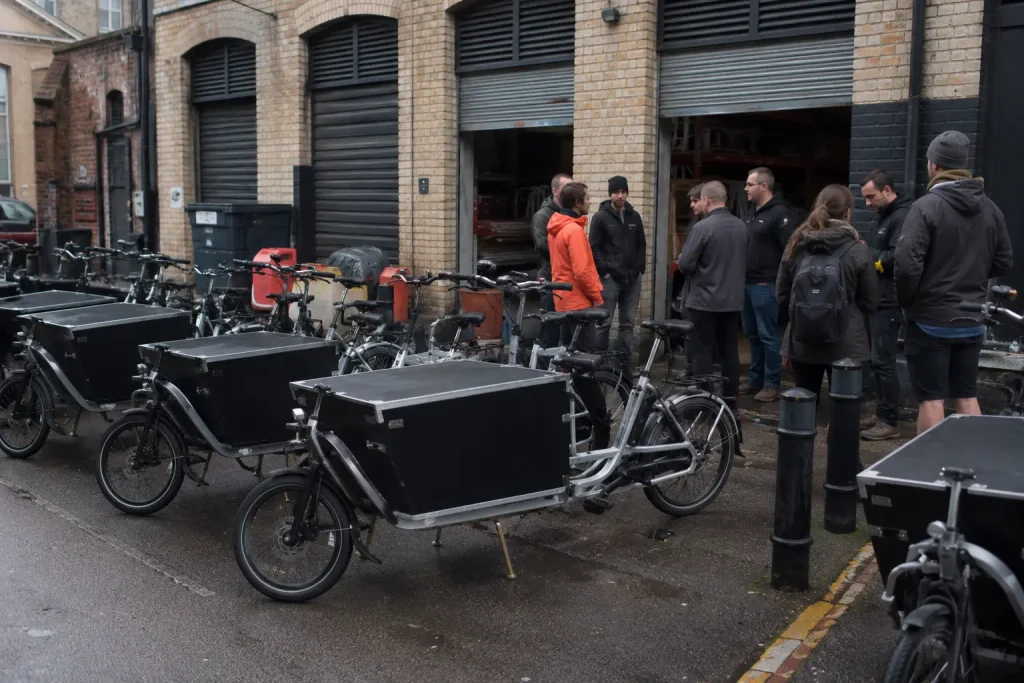
Pedal & Post, an Oxford-based cargo bike courier company, entered voluntary liquidation in January 2026 after 14 years of operation. The environmentally focused delivery business ceased trading and shed 60 jobs following the sudden loss of a major contract with micromobility firm Voi, which wiped out roughly 25% of the company’s revenue.
Despite exploring alternative options to remain viable, the sudden revenue drop made financial sustainability impossible, forcing the closure of both its Oxford and London sites.
Key Takeaways:
- 2026 Voluntary Liquidation: The 14-year-old Oxford and London eco-courier Pedal & Post officially entered voluntary liquidation in January 2026, forcing a sudden halt to all sustainable operations.
- Voi Contract Termination: The primary cause of the collapse was a sudden 30-day operational termination notice from micromobility client Voi, which instantly wiped out 25% of the courier’s total revenue.
- 60 Job Losses & Significant Debt: The business shutdown resulted in approximately 60 immediate redundancies and left the firm with roughly £300,000 in total debt, including unpaid HMRC VAT.
- £500,000 Crowdfund Wiped Out: Shareholders and crowd-investors are unlikely to recover investments, including £500,000 raised in a 2023 crowdfunding round and a recent £30,000 personal loan injected by founder Chris Benton.
- Severe Evri Parcel Disruption: The liquidation caused massive local logistical issues, disrupting Evri’s final-mile deliveries in Oxford’s Zero Emission Zone and leaving households without packages for weeks.
- Broader Eco-Courier Pressures: The collapse highlights intense financial margins within green logistics, occurring closely alongside the recent administration of competitor cargo-bike operator Zedify.
What Happened to Pedal & Post?

For more than a decade, the company built its reputation around providing environmentally friendly deliveries using cargo bikes rather than conventional delivery vans. Its model was designed to reduce traffic congestion, improve air quality, and offer a practical alternative to vehicle-based urban logistics.
The closure affects both its Oxford headquarters and its London operations, ending a business that many regarded as a pioneer within the UK’s growing cargo bike delivery sector.
Rather than being a sudden shutdown, the closure appears to have followed a period of financial strain that became impossible to overcome. The company stated that it explored multiple routes to remain operational but ultimately concluded that continuing the business was no longer financially viable.
Why Has Pedal & Post Closed After 14 Years in Business?
The primary catalyst for the sudden liquidation was a 30-day contract termination notice served by micromobility company Voi at the end of January 2026.
While the termination was operational rather than performance-related, losing the contract delivered a critical blow to the firm’s finances.
According to founder and CEO Chris Benton, the Voi contract represented an estimated 25% of Pedal & Post’s overall revenue. Because of the high profitability of the micromobility segment, its contribution to the company’s profit margins was even higher, sitting at roughly 36%.
Without this core predictable income, the business could no longer raise funds or carve out a realistic path to financial sustainability.
Financial Deficits and Lost Crowdfunding
Official documents filed with Companies House revealed that Pedal & Post collapsed with approximately £300,000 in total debt.
These heavy liabilities included significant claims for employee redundancies, unpaid VAT owed to HM Revenue and Customs, and money backed by personal loans from the founder himself.
The liquidation process means that the company’s shareholders and crowd-investors are highly unlikely to see a return on their investments.
This financial loss includes a successful £500,000 capital injection raised through a public crowdfunding campaign in 2023, alongside a recent personal input of £30,000 made by Chris Benton to keep the business afloat.
What Was Pedal & Post’s Role in Oxford’s Delivery Network?
Pedal & Post became an important part of Oxford’s delivery infrastructure over the past 14 years. Its cargo bikes were frequently seen transporting parcels, documents, supplies, and other items across the city.
Oxford’s historic streets and growing efforts to reduce vehicle emissions made it an ideal environment for cycle-based logistics. Cargo bikes can often navigate congested urban areas more efficiently than vans, particularly during busy periods.
The company demonstrated that sustainable delivery methods could operate successfully within a commercial environment while meeting customer expectations for reliability and speed.
Its contribution extended beyond parcel delivery. Pedal & Post also helped showcase how urban logistics could evolve in response to environmental concerns and changing transport priorities.
How Did Pedal & Post Help Reduce Traffic and Emissions in Oxford?
One of the company’s most significant achievements was demonstrating that cargo bikes could replace a meaningful number of van journeys.
Over its 14-year history, Pedal & Post stated that it helped remove countless vehicle trips from urban roads. Every delivery completed by cargo bike represented a delivery that might otherwise have required a van or other motor vehicle.
This reduction contributed to broader environmental objectives, including lower carbon emissions and improved air quality.
Benefits of Cargo Bike Deliveries
| Advantage | Impact |
| Lower Emissions | Supports environmental goals |
| Reduced Congestion | Frees road space in cities |
| Faster Urban Travel | Avoids traffic bottlenecks |
| Lower Operating Costs | Reduced fuel and maintenance expenses |
| Better City Access | Easier navigation through restricted areas |
In cities such as Oxford, where congestion and air quality remain ongoing concerns, the value of alternative delivery methods has become increasingly important.
What Services Did Pedal & Post Provide to Local Organisations?

Pedal & Post served a diverse range of clients throughout its history. These included businesses, public sector organisations, and healthcare providers.
Key Partnerships and Delivery Contracts
One of the company’s notable partnerships involved Oxford University Hospitals NHS Trust. Delivering supplies efficiently within healthcare environments requires reliability, punctuality, and operational consistency.
The company’s ability to secure such contracts demonstrated confidence in its service model and operational capabilities.
Beyond healthcare, Pedal & Post worked with local businesses and organisations seeking environmentally responsible delivery solutions.
Executive and Shareholder Reactions
In a communication addressed to shareholders, CEO Chris Benton expressed deep regret over the rapid turn of events:
“I fully recognise how hard this will be to hear and I am deeply sorry to be sharing this update in these circumstances… losing this work fundamentally changes the business outlook.”
The abruptness of the shutdown caught many longtime backers by surprise. Richard Lofthouse, a major shareholder who had supported Pedal & Post since its inception in 2013, voiced both shock and scrutiny regarding the liquidation:
“I anticipate that many shareholders will wonder why the company has thrown in the towel after surviving for the past 14 years, including through Covid. Sadness and shock will be followed by questions. The liquidation process will be followed very closely.”
How Have Customers and Business Partners Reacted to the News?
The reaction from customers, partners, and members of the local community has been largely one of disappointment. Many viewed Pedal & Post as more than simply a courier company. It represented a practical example of how businesses could operate in a more environmentally conscious way without sacrificing service quality.
Several customers expressed appreciation for the company’s reliability and commitment to sustainable deliveries. For organisations that prioritised environmental responsibility, Pedal & Post provided a service that aligned with their broader sustainability objectives.
Business partners also recognised the company’s contribution to Oxford’s logistics ecosystem. The closure has created uncertainty about who may fill the gap left behind, particularly for organisations that specifically sought low-emission delivery options.
The reaction illustrates how strongly the company had embedded itself within Oxford’s business community over more than a decade of operation.
What Has the Coalition for Healthy Streets and Active Travel Said?
The Coalition for Healthy Streets and Active Travel was among the organisations that publicly responded to the closure announcement. The group expressed sadness at seeing the company cease operations and acknowledged its visible presence within Oxford’s transport landscape.
The organisation praised Pedal & Post for helping demonstrate the value of active travel and sustainable logistics. For many years, the company’s cargo bikes became a familiar sight on Oxford’s streets, serving as a practical example of how deliveries could be completed without relying on traditional vans.
The group’s response also highlighted a wider concern. While the closure marks the end of one company, it raises questions about how cities can continue supporting environmentally friendly transport solutions.
At the same time, the organisation expressed hope that other cycle-based logistics businesses may emerge to continue the work that Pedal & Post helped pioneer.
Could Pedal & Post Have Avoided Liquidation?
Determining whether liquidation could have been avoided is difficult without access to the company’s full financial records. However, the information available suggests that management explored numerous possibilities before reaching the decision to close.
Businesses facing significant contract losses often consider a range of options, including cost reductions, restructuring programmes, investment opportunities, and the pursuit of replacement contracts. The company’s public statement indicates that such avenues were investigated.
The challenge for specialist logistics businesses is that replacing a major contract quickly is rarely straightforward. New contracts often require lengthy negotiations, operational planning, and onboarding periods.
Financial Pressures on Sustainable Logistics Businesses
While environmentally focused delivery services have gained popularity, they still face many of the same financial pressures as traditional logistics providers.
| Financial Challenge | Impact on Sustainable Couriers |
| Rising wage costs | Increased operating expenses |
| Equipment investment | High upfront costs for cargo bikes |
| Insurance costs | Ongoing financial commitments |
| Contract dependency | Revenue concentration risks |
| Competition | Pressure on pricing |
| Economic uncertainty | Reduced business spending |
These factors can become particularly challenging when revenue suddenly declines.
The Risk of Relying on Major Contracts
One of the clearest lessons from the Pedal & Post collapse is the importance of revenue diversification.
Many businesses naturally pursue larger contracts because they provide stability and predictable income. However, overreliance on a small number of major clients can create vulnerability if one of those relationships ends unexpectedly.
Michael Thornton, a transport sector restructuring specialist, commented: “The strongest logistics businesses often balance large contracts with a broad customer base. Diversification doesn’t eliminate risk entirely, but it can reduce the impact when a significant client leaves.”
This principle applies across multiple industries but is particularly relevant in logistics, where operational costs continue regardless of changing customer volumes.
What Does the Closure Mean for Oxford’s Sustainable Transport Goals?
Oxford has positioned itself as a city that supports sustainable transport initiatives. Measures designed to improve air quality, reduce emissions, and encourage active travel have become increasingly prominent over recent years.
Pedal & Post contributed directly to these goals by offering a commercially viable alternative to van-based deliveries. Its closure removes one visible example of how sustainable logistics can operate within an urban environment.
This does not necessarily mean that Oxford’s environmental ambitions are under threat. Numerous organisations continue to support low-carbon transport solutions, and other logistics providers may seek to expand their presence within the city.
However, the closure does represent a setback for those who viewed Pedal & Post as evidence that environmentally focused business models could thrive commercially over the long term.
The situation may encourage policymakers, businesses, and transport organisations to examine what additional support sustainable logistics providers may require in future.
How Will the Closure Affect Local Businesses and Delivery Services?
For some customers, the closure may require relatively minor adjustments. Alternative courier providers operate throughout Oxford and can potentially absorb additional delivery demand.
For others, particularly organisations that specifically chose Pedal & Post because of its environmental credentials, the transition may prove more challenging.
The impact is likely to vary depending on factors such as delivery volume, service requirements, and sustainability priorities.
| Stakeholder Group | Potential Impact |
| Local businesses | Need to identify alternative couriers |
| Sustainability-focused organisations | Reduced access to specialised services |
| Existing customers | Possible service disruption |
| Competing couriers | Opportunity for growth |
| Oxford transport sector | Loss of a recognised operator |
Although replacement services are available, replicating the exact combination of local knowledge, sustainability focus, and operational experience built over 14 years may take time.
What Does This Mean for Employees and Riders?
The closure inevitably affects employees and riders who helped build the company over the years. For many workers, Pedal & Post represented more than employment. It offered an opportunity to participate in a business with a strong environmental mission.
Job losses are often one of the most immediate consequences of business closures. Staff members may now need to seek opportunities elsewhere within the logistics sector or related industries.
The skills developed through cargo bike logistics remain valuable. Route planning, customer service, delivery management, and urban navigation are transferable capabilities that can support future employment opportunities.
At the same time, the closure serves as a reminder that even mission-driven businesses remain subject to commercial realities.
Are Cargo Bike Delivery Services Still a Viable Business Model?
The closure of Pedal & Post should not automatically be interpreted as evidence that cargo bike logistics are unviable. In fact, many indicators suggest that demand for sustainable urban deliveries continues to grow.
Across the UK and Europe, cities are increasingly exploring low-emission transport solutions. Cargo bikes have attracted attention because they can reduce congestion, lower emissions, and improve efficiency in dense urban environments.
The viability of the model depends on numerous factors, including market demand, operational efficiency, client diversification, and local infrastructure.
Pedal & Post successfully operated for 14 years, which itself demonstrates that the model can work under the right conditions. The company’s longevity suggests that the underlying concept retains significant value despite its eventual closure.
Could Other Cycle-Based Logistics Companies Fill the Gap?
The departure of Pedal & Post creates an opportunity for other operators to expand within Oxford.
Existing courier companies may explore cargo bike services, while specialist sustainable logistics firms could view Oxford as an attractive market due to its established support for active travel initiatives.
Several factors make the city particularly suitable for cycle-based logistics. These include its compact geography, cycling infrastructure, environmental policies, and population density.
Any business seeking to fill the gap will still need to address the challenges that contributed to Pedal & Post’s closure. Financial resilience, customer diversification, and long-term contract management will remain critical considerations.
The opportunity exists, but success will depend on balancing environmental ambitions with sustainable commercial operations.
How Does This Closure Reflect Wider Trends in the Logistics Industry?

The collapse of Pedal & Post reflects several broader trends affecting the logistics sector both in the UK and internationally.
Over recent years, delivery companies have faced increasing cost pressures. Rising wages, higher insurance premiums, increased operating expenses, and economic uncertainty have created challenges for businesses of all sizes.
At the same time, customer expectations continue to rise. Clients increasingly demand faster deliveries, greater transparency, and more flexible service options. Meeting these expectations often requires additional investment in technology, infrastructure, and workforce development.
The logistics industry is also undergoing a sustainability transition. Businesses, consumers, and governments are placing greater emphasis on reducing emissions and improving environmental performance.
The table below highlights some of the key trends shaping the sector.
| Industry Trend | Impact on Logistics Companies |
| Sustainability targets | Increased demand for low-emission delivery solutions |
| Rising operational costs | Greater pressure on profit margins |
| Urban congestion | Growing interest in alternative transport methods |
| Technology adoption | Need for investment in digital systems |
| Customer expectations | Faster and more flexible services required |
| Contract competition | Increased pressure on pricing and service quality |
Pedal & Post operated within this changing environment. While its environmentally friendly model aligned well with emerging sustainability goals, the business still faced the same commercial pressures affecting the wider logistics industry.
What Could the Future Hold for Sustainable Urban Deliveries in Oxford?
Although the closure of Pedal & Post represents a setback, it does not necessarily signal the end of sustainable urban logistics in Oxford.
The city remains one of the UK’s strongest markets for alternative transport solutions. Oxford’s cycling culture, environmental ambitions, and urban layout continue to create favourable conditions for cargo bike operations.
Demand for low-emission deliveries is also expected to remain strong. Many businesses are actively seeking ways to reduce their environmental impact, and delivery services form an important part of those efforts.
Future developments may include:
- Expansion by existing cargo bike operators.
- New market entrants specialising in sustainable logistics.
- Greater collaboration between businesses and local authorities.
- Increased investment in cycling infrastructure.
- Enhanced use of technology to improve route efficiency.
The closure of one company does not eliminate the underlying demand that helped support the sector’s growth.
In many ways, Pedal & Post helped establish a foundation that future operators may build upon. The company’s work demonstrated that cargo bike logistics can function effectively in a real-world commercial environment and that many customers are willing to embrace greener delivery options.
Whether through new businesses or expanded services from existing operators, sustainable urban deliveries are likely to remain an important part of Oxford’s transport future.
Conclusion
The collapse of Pedal & Post marks the end of a pioneering chapter in Oxford’s sustainable transport story. For 14 years, the company demonstrated that cargo bike deliveries could provide a practical, reliable, and environmentally responsible alternative to traditional courier services.
While the loss of a major client ultimately proved too difficult to overcome, the company’s legacy extends far beyond its closure. It helped reduce emissions, remove vehicle journeys from city streets, and encourage wider discussions about sustainable logistics.
Although Pedal & Post is no longer operating, the demand for greener urban delivery solutions remains, and its influence on the sector is likely to continue for years to come.
Frequently Asked Questions
Which delivery company has collapsed?
The Oxford and London-based e-cargo bike delivery firm Pedal & Post collapsed into voluntary liquidation in January 2026.
What is Pedal & Post?
Pedal & Post was an eco-friendly courier service founded in 2013 that used cargo bikes instead of traditional vans to handle first- and last-mile urban deliveries.
How many jobs were lost in the Pedal & Post liquidation?
The sudden closure and liquidation of the business resulted in the loss of approximately 60 jobs.
Who founded Pedal & Post?
The sustainable logistics company was founded and managed by Chief Executive Officer Chris Benton.
What was the primary reason Pedal & Post went out of business?
The company was forced to close after micromobility firm Voi unexpectedly terminated a contract that made up 25% of its overall revenue.
Which major parcel courier was disrupted by the closure?
The collapse disrupted Evri’s final-mile logistics network, leaving some Oxford households without parcels for weeks.
What other eco-courier company recently faced financial trouble?
Pedal & Post’s collapse closely followed the recent administration of fellow cargo-bike logistics operator Zedify.