

A UK company can reclaim S455 tax when a qualifying loan to a participator has been repaid, released or written off. However, the refund is not normally available immediately.
Where the loan is cleared after the original Section 455 liability has become payable, relief is generally due nine months and one day after the end of the accounting period in which the repayment, release or write-off took place.
The claim belongs to the company rather than the individual director. Depending on timing, the company may claim through CT600A or use the L2P process. HMRC also imposes a four-year time limit for making most claims.
For UK companies and small businesses, the dates matter as much as the amount repaid. A director clearing an overdrawn loan account today does not necessarily mean the company can receive its S455 tax refund today.
What Is S455 Tax?

Section 455 tax is a Corporation Tax charge that can arise when a close company makes a loan or advance to a participator and that amount remains outstanding beyond the relevant deadline.
A close company is broadly a company controlled by five or fewer participators, or by any number of participators who are also directors.
A participator is generally someone with a share or interest in the capital or income of the company. For many owner-managed UK limited companies, the participator will be a shareholder who is also a director.
An overdrawn director’s loan account is one common way the rules arise.
If a director-shareholder takes money from the business that is not salary, a dividend, an expense reimbursement or another properly accounted-for payment, the amount may become a loan owed to the company.
Section 455 does not apply simply because a director has a loan account. The circumstances, status of the borrower and applicable statutory exceptions need to be considered.
What Is The S455 Tax Rate In 2026?
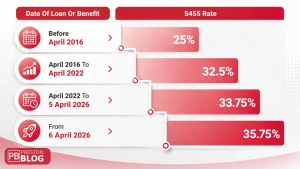
The Section 455 rate increased from 33.75% to 35.75% for loans made or benefits conferred on or after 6 April 2026.
The historical rates are:
| Date Of Loan Or Benefit | S455 Rate |
| Before April 2016 | 25% |
| April 2016 To April 2022 | 32.5% |
| April 2022 To 5 April 2026 | 33.75% |
| From 6 April 2026 | 35.75% |
The date is important because businesses should not automatically apply the newest rate to every historic director’s loan. An older loan may have been charged at an earlier rate.
There is also an unusual 2026 filing issue. HMRC says its Corporation Tax online service will not be updated for the new 35.75% rate until 6 April 2027.
Where the new rate applies and a company needs to file before that date, HMRC currently says the return will need to be amended after 6 April 2027 to reflect the new rate.
This illustrates why businesses should check current HMRC guidance rather than relying solely on an older article or an historic Corporation Tax calculation.
Similar evidence and compliance issues arise across other business tax areas, including HMRC R&D tax claims, where accurate records and support for submitted figures remain important.
When Can S455 Tax Be Reclaimed?
A company can obtain Section 458 relief when the relevant loan has been repaid, released or written off, subject to the conditions applying to the transaction.
The timing depends on when this happens.
Loan Repaid Before S455 Becomes Payable
If a qualifying loan is repaid, released or written off within nine months of the end of the accounting period in which it was made, relief may prevent the Section 455 amount from ultimately being payable.
HMRC’s Company Taxation Manual confirms that relief is available where the qualifying event occurs before the Section 455 tax falls due.
Loan Repaid After S455 Has Been Paid
If the loan remains outstanding beyond the original deadline, the company may have already paid S455 tax.
Once the loan is subsequently repaid, released or written off, the company can become entitled to Section 458 relief.
However, the repayment from HMRC is deferred until nine months and one day after the end of the accounting period in which that qualifying event occurred.
What Does Nine Months And One Day Mean?
There are two dates that are easily confused.
The first relates to when the original Section 455 charge becomes payable. The second relates to when relief becomes payable after a later repayment, release or write-off.
For example, if a company has a 31 March year-end and a director repays the loan during the following accounting year, the company does not simply count nine months from the exact repayment date.
It first identifies the accounting period containing the repayment and then applies the nine-month-and-one-day rule after that period ends.
How To Reclaim S455 Tax From HMRC Step By Step?
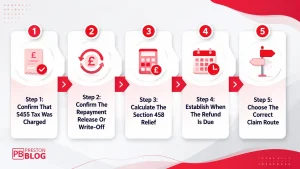
A company looking to reclaim Section 455 tax should work through the underlying records before submitting the claim.
Step 1: Confirm That S455 Tax Was Charged
Check the relevant Company Tax Return, CT600A, Corporation Tax computation and HMRC account.
The business should confirm:
- The Original Loan Amount
- The Date The Loan Was Made
- The Amount Outstanding
- The S455 Rate Applied
- The Amount Of S455 Actually Paid
- The Relevant Accounting Period
This prevents a company from attempting to reclaim an amount that was never actually paid or from using the wrong historical rate.
Step 2: Confirm The Repayment, Release Or Write-Off
The director’s loan account should be reconciled to establish exactly when and how the balance changed.
Evidence might include:
- Company Bank Statements
- Director’s Loan Account Ledger
- Dividend Documentation
- Payroll Records
- Board Records
- Accounting Entries
- Evidence Of A Formal Release Or Write-Off
Accurate financial records are particularly important where a company is facing wider HMRC liabilities.
A business considering closing a limited company with debts to HMRC should establish its Section 455 position before assuming that an anticipated reclaim is immediately available cash.
Step 3: Calculate The Section 458 Relief
If the whole qualifying loan has been repaid, the company may be entitled to relief corresponding to the full relevant S455 charge.
Where only part of the loan has genuinely been repaid, partial relief may be available.
The calculation should be matched to the particular loan, applicable tax rate and repayment history rather than simply applying the current 35.75% rate to an historic balance.
Step 4: Establish When The Refund Is Due
Identify the accounting period in which the loan was repaid, released or written off.
The relief is generally not repayable until nine months and one day after the end of that period. HMRC explicitly states that the company will not receive the repayment before the relief becomes due.
Step 5: Choose The Correct Claim Route
The method depends partly on timing.
HMRC states that where the reclaim is made within two years of the end of the accounting period in which the original loan was taken out, CT600A may be used when preparing or amending the relevant Company Tax Return.
An L2P claim may instead be required where the tax return relates to another accounting period or where an amendment is being made in writing.
Where the reclaim is made two years or more after the end of the accounting period in which the loan was taken out, HMRC directs companies towards L2P.
Reclaim S455 Tax L2P Form
The reclaim S455 tax L2P form is an important part of the refund process, particularly for claims that cannot simply be dealt with through the relevant CT600A.
HMRC’s L2P process allows a close company to claim relief where a loan to a participator has been repaid, released or written off.
A company or its authorised agent can provide information including:
- Company Details And UTR
- Accounting Period Of The Original Loan
- Original Loan Amount
- Repayment, Release Or Write-Off Date
- Amount Cleared
- Accounting Period In Which It Was Cleared
- Amount Of Relief Being Claimed
The S455 tax refund information from Audit Consulting Group also highlights the importance of reconciling the loan account and retaining evidence of the transaction.
However, businesses should use current HMRC guidance for the applicable rate and formal claim requirements, particularly following the April 2026 rate change.
Could Your Company Reclaim S455 Tax?
Build a visual reclaim journey, estimate potential Section 458 relief, explore the historical S455 rate and calculate when relief may become due.
Build The S455 Reclaim Path
Confirm That S455 Tax Was Charged
Start with the Company Tax Return, CT600A, Corporation Tax computation and HMRC account. Confirm that an S455 charge was actually paid before calculating a reclaim.
Section 458 Relief Calculator
Relief is calculated using the qualifying amount cleared and the relevant S455 rate selected above.
A company may potentially obtain proportionate relief where only part of a qualifying loan has genuinely been repaid.
When Could The Relief Become Due?
Enter the accounting-period end rather than simply adding nine months to the repayment date.
Where S455 has already become payable, relief is generally repayable nine months and one day after the end of the accounting period containing the qualifying repayment, release or write-off.
CT600A Or L2P?
How long after the original loan accounting period is the claim being made?
Can the relevant Company Tax Return be prepared or amended through the applicable return process?
CT600A
The relevant Company Tax Return or amendment may provide a route for making the claim.
This navigator is a simplified guide. The final claim method depends on the accounting periods, amendment position and current HMRC requirements.
How The S455 Rate Has Changed
The historical rate matters because an older director’s loan should not automatically be recalculated using the latest percentage.
From Director’s Loan To S455 Reclaim
CT600A Or L2P: Which Should Be Used For An S455 Tax Refund?
CT600A and L2P are related to the same tax regime, but they are not interchangeable in every situation.
| Situation | Possible Route |
| Claim Made Through The Relevant Company Tax Return | CT600A |
| Relevant Return Can Be Amended Online Within The Applicable Period | CT600A |
| Return Relates To A Different Accounting Period | L2P May Be Required |
| Written Amendment Is Being Made | L2P May Be Required |
| Claim Is Two Years Or More After The Original Loan Period | L2P |
HMRC’s current guidance should determine the final route.
The distinction is particularly important for companies with several years of director’s loan transactions, because one loan may span multiple accounting periods.
What Is Section 458 Relief?

Section 458 relief is the mechanism that allows a company to obtain relief from Section 455 tax after the relevant loan has been repaid, released or written off.
The important distinction is that Section 455 creates the charge while Section 458 provides the relief.
The repayment of the director’s loan does not itself represent the HMRC refund. It creates or supports the company’s entitlement to relief, subject to the statutory timing rules.
Where only part of the loan is repaid, the relief can correspond to the qualifying amount rather than necessarily requiring every penny of the outstanding balance to be cleared first.
Worked Example Of Reclaiming S455 Tax
Consider a UK close company that makes a £20,000 loan to a director-shareholder after 6 April 2026.
Because the post-April 2026 Section 455 rate is 35.75%, the potential S455 charge is:
£20,000 × 35.75% = £7,150
Assume the loan remains outstanding beyond the original payment deadline and the company pays £7,150 to HMRC.
The director later repays the full £20,000.
The company has now cleared the loan, but HMRC does not necessarily send back £7,150 immediately. The business must identify the accounting period containing that repayment.
Section 458 relief then becomes repayable after the required nine-month-and-one-day period following the end of that accounting period.
This distinction can matter to cash-flow planning. A company should not treat an expected S455 refund as money already available for spending.
Can A Company Reclaim S455 Tax After A Partial Loan Repayment?
Yes, relief can potentially be available where only part of a qualifying loan is repaid.
For example, if a director owes £20,000 but genuinely repays £8,000, the company may be able to obtain relief corresponding to that qualifying £8,000 rather than waiting for the remaining £12,000 to be cleared.
The position becomes more complicated where there are several loans, repayments and new advances.
HMRC’s anti-avoidance rules may also affect which repayments are recognised. Businesses should therefore maintain a chronological director’s loan ledger showing each advance and repayment separately.
Can A Director’s Loan Be Cleared By Dividend Or Salary?

A director’s loan does not always have to be repaid by transferring cash into the company bank account.
HMRC’s CT600A guidance recognises that repayment methods can include crediting a participator’s loan or current account with a dividend, director’s remuneration or bonus.
However, the underlying transaction must itself be valid.
For a dividend, the company needs sufficient distributable profits and appropriate corporate documentation. The shareholder’s personal dividend tax position also needs to be considered.
Tax changes affecting different income sources can interact with director extraction strategies, making the wider HMRC Personal Allowance rules relevant when assessing salary, dividends and other personal income.
A journal entry should therefore represent a genuine underlying transaction rather than simply being created to make the loan account appear cleared.
What Happens If The Director’s Loan Is Written Off Or Released?
Writing off or formally releasing the loan can potentially give the company Section 458 relief, but that does not mean the transaction is tax-free.
The director or participator may face separate personal tax consequences. National Insurance implications can also arise in particular circumstances.
The company should therefore distinguish between:
- The Company’s Section 455 Position
- The Company’s Section 458 Relief
- The Director’s Personal Tax Position
- Any Payroll Or National Insurance Consequences
This is especially important when a company is approaching closure. Where a solvent business is being wound up, the treatment of remaining assets and liabilities can interact with wider planning around Members’ Voluntary Liquidation tax.
What Is The Four-Year Deadline For An S455 Tax Reclaim?
HMRC states that a company must generally make its claim within four years.
This means an old S455 balance should not be left indefinitely on the assumption that HMRC will eventually refund it automatically.
Companies reviewing historic director’s loan accounts should establish:
- When The Original Loan Was Made
- When S455 Was Paid
- When The Loan Was Repaid
- Which Accounting Period Included The Repayment
- When Section 458 Relief Became Due
- When The Claim Deadline Expires
Older company records may involve several different S455 rates, so the original tax computation should be checked rather than recreating the calculation using today’s percentage.
How Do The S455 Bed And Breakfasting Rules Affect A Refund?
HMRC has anti-avoidance provisions designed to stop a director from apparently repaying a loan only to receive broadly equivalent funds again shortly afterwards.
One rule can apply where repayments of at least £5,000 are followed by new loans or advances of at least £5,000 within a 30-day period.
A separate rule can apply where the outstanding loan is more than £15,000 and arrangements exist for the participator to receive further money from the company.
The detailed statutory conditions matter, so these thresholds should not be treated as stand-alone tests that automatically determine the tax position.
HMRC’s guidance specifically warns that a loan may be treated as not repaid where the anti-avoidance provisions apply.
The practical approach is straightforward. Repayments should be genuine, properly documented and considered alongside any further withdrawals from the company.
Can Interest Paid On S455 Tax Be Reclaimed?

The Section 455 tax itself can potentially be reclaimed once the conditions for relief are met, but HMRC states that a company cannot reclaim interest paid on the Corporation Tax.
This distinction matters where the original S455 liability was paid late.
For example, if a company paid £7,150 of Section 455 tax plus late-payment interest, obtaining full Section 458 relief against the £7,150 does not mean the late-payment interest is also refundable.
How Long Does An S455 Tax Refund Take?
There are two separate questions when considering the timing of an S455 tax refund.
First, when does the company become legally entitled to receive the relief?
That is generally nine months and one day after the end of the accounting period in which the relevant loan was repaid, released or written off.
Second, how long will HMRC take to process the claim after it has become due and has been submitted?
Third-party advisers sometimes publish estimated processing periods. For example, some professional guidance refers to claims taking several weeks, but those estimates should not be treated as a guaranteed HMRC service standard.
The current HMRC director’s loan guidance should be relied on for the formal reclaim rules.
A company should therefore distinguish the statutory relief date from HMRC’s administrative processing time.
Checklist Before Making An HMRC S455 Reclaim
Before submitting an HMRC S455 reclaim, a company should check that it can evidence the complete transaction.
- Confirm The Company Falls Within The Relevant Close-Company Rules
- Identify The Original Loan Or Advance
- Confirm The Applicable S455 Rate
- Check How Much S455 Was Actually Paid
- Reconcile The Director’s Loan Account
- Confirm The Repayment, Release Or Write-Off Date
- Review Any New Advances Around The Repayment
- Calculate The Section 458 Relief
- Identify The Correct Accounting Period
- Establish When Relief Becomes Due
- Check The Four-Year Claim Deadline
- Decide Whether CT600A Or L2P Is Appropriate
- Retain Supporting Bank And Accounting Records
- Reconcile The HMRC Repayment When Received
Good record-keeping is especially valuable if HMRC later reviews the company’s tax position or asks how figures reported in the Corporation Tax return were calculated.
When Should A UK Company Get Professional Advice?
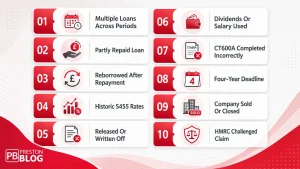
A straightforward S455 reclaim may be relatively easy to identify, but professional advice can become more valuable where transactions overlap several years or tax rules.
A company should consider specialist assistance where:
- There Are Multiple Loans Across Accounting Periods
- Only Part Of The Loan Has Been Repaid
- New Money Was Borrowed Soon After A Repayment
- Historic S455 Rates Apply
- The Loan Has Been Released Or Written Off
- Dividends Or Salary Were Used To Clear The Balance
- The CT600A May Have Been Completed Incorrectly
- The Four-Year Deadline Is Approaching
- The Company Is Being Sold Or Closed
- HMRC Has Challenged The Claim
Tax liabilities can also become significant when a company is already experiencing financial pressure. Businesses facing several creditor or funding problems should consider their complete position rather than dealing with S455 in isolation.
Conclusion
To reclaim S455 tax, a UK company first needs to establish what happened to the original loan, how much Section 455 tax was paid and when the loan was subsequently repaid, released or written off.
The correct sequence is:
Loan Date → Applicable S455 Rate → S455 Paid → Repayment Event → Accounting Period → Relief Date → CT600A Or L2P Claim
For loans made on or after 6 April 2026, the current S455 rate is 35.75%. Older loans may carry different historic rates.
A qualifying repayment can create entitlement to Section 458 relief, but the company may still have to wait until nine months and one day after the relevant accounting period before HMRC can repay it.
Because S455 rules interact with director’s loan accounts, dividends, salary, anti-avoidance provisions and company closure, the accounting records should be reviewed carefully before a claim is submitted.
This article provides general UK tax information and does not replace advice based on a company’s individual circumstances.
Frequently Asked Questions
Can A Company Reclaim S455 Tax?
Yes. A company can generally reclaim S455 tax where the relevant loan has been repaid, released or written off and the conditions for Section 458 relief are satisfied. The refund belongs to the company rather than the individual director.
When Can S455 Tax Be Reclaimed After A Director Repays The Loan?
Where S455 has already become payable, the relief is generally not repayable until nine months and one day after the end of the accounting period in which the loan was repaid, released or written off.
Is An S455 Tax Refund Automatic?
No. Entitlement to Section 458 relief does not mean HMRC will automatically identify and pay every amount without the appropriate Corporation Tax claim or L2P process being completed.
What Form Is Used To Reclaim S455 Tax?
A company may use CT600A in qualifying circumstances. Form L2P is used in other cases, including certain claims made after the normal return or amendment period. The correct route depends on when the loan arose and when the claim is being made.
What Is The S455 Tax Rate From 6 April 2026?
The rate is 35.75% for loans made or benefits conferred on or after 6 April 2026. The previous rate was 33.75% for the period from April 2022 to 5 April 2026.
Can S455 Tax Be Reclaimed After A Partial Repayment?
Potentially, yes. Where part of a qualifying loan has genuinely been repaid, proportionate Section 458 relief may be available. Multiple loans and subsequent advances can make the calculation more complex.
Can Interest On S455 Tax Be Reclaimed?
No. HMRC states that although the Corporation Tax charged on the director’s loan can potentially be reclaimed, interest paid on that Corporation Tax cannot be reclaimed.