

💷STATE PENSION TAX WARNING – 2026 UPDATE
Estimated Full New State Pension (2026): ~£12,540 per year.
With the personal allowance frozen at £12,570 until 2031, the gap between the full state pension and the tax-free threshold could be less than £30.
📌 Why Is the 2026 State Pension Tax Warning Important?
- Frozen Allowance: Personal allowance remains £12,570 until April 2031
- Pension Increase: Triple lock raises payments closer to the tax threshold
- Extra Income Risk: Even small savings interest or private pension income may trigger tax
- Tax Collection: HMRC may adjust tax codes or issue Simple Assessment bills
Why It Matters: The state pension tax warning highlights how rising pensions combined with frozen thresholds could push thousands of UK retirees into paying income tax for the first time.
Tax Snapshot:
- Estimated 2026 State Pension: ~£12,540 per year
- Personal Allowance: £12,570
- Remaining Tax-Free Gap: Less than £30
- Risk Trigger: Private pension, savings interest, or part-time income
- Tax Collection Method: PAYE adjustment or Simple Assessment
- Status: Growing number of pensioners expected to enter tax system
“Many people assume the state pension is tax-free, but in reality it counts as taxable income once total earnings exceed the personal allowance.”
Why Is There a State Pension Tax Warning for 2026?

A growing number of experts and financial advisers are highlighting a state pension tax warning because of a combination of rising pension payments and frozen tax allowances.
At first glance, an increase in the State Pension appears purely positive. However, when tax thresholds remain unchanged for several years, the increase can gradually push people closer to the point where income tax becomes payable.
The Role of “Fiscal Drag”
One of the key reasons behind the current warning is a concept known as fiscal drag. This occurs when tax thresholds remain fixed while incomes rise due to inflation or policy changes.
In the UK, the personal allowance, the amount you can earn before paying income tax, is currently set at £12,570. Government policy has frozen this threshold until April 2031, meaning that while incomes increase, the tax-free limit does not.
As a result, more people gradually cross the threshold and become taxpayers even though tax rates themselves have not changed.
Why the April 2026 increase matters?
The issue becomes particularly significant in 2026 because the full new State Pension is expected to rise to just below the personal allowance.
For many retirees, this leaves almost no room for additional income without triggering tax liability.
Even modest sources of income could cause problems, including:
- Small private or workplace pension payments
- Interest from savings held outside an ISA
- Part-time employment or freelance income
- Rental income or other taxable earnings
When combined with the State Pension, these amounts could push your total income above the tax-free limit.
Alex Edmans, product director at Saga Money, explained the situation clearly:
“We often view the state pension as a guaranteed safety net, but in the eyes of the taxman, it is simply income. Treat it as the foundation of your taxable income rather than a tax-free bonus.”
The rising number of retirees caught by fiscal drag is already visible in government data. Millions more pensioners are expected to pay income tax over the next decade as the freeze continues.
Is the UK State Pension Taxable or Tax-Free?
One of the biggest misconceptions surrounding retirement income is that the State Pension is exempt from tax. In reality, it has always been considered taxable income.
The confusion largely arises because the Department for Work and Pensions (DWP) pays the State Pension without deducting tax at source. As a result, the payment you receive each week or month appears to be tax-free.
However, HMRC still counts it as part of your total income when calculating tax liability.
Why many people misunderstand the rules?
Research indicates that around four in ten adults are unaware that the State Pension is taxable. This misunderstanding has persisted for years because the payment arrives without any visible tax deduction.
Financial experts believe this creates a psychological effect where recipients assume no tax applies.
Sarah Pennells, consumer finance specialist at Royal London, explained the issue:
“The fact that approximately four in ten adults do not know the State Pension is taxable is not surprising because it’s paid without tax being taken off.”
When tax is due, HMRC usually collects it in other ways rather than directly from the pension payment itself.
How the State Pension compares with other pension income?
To understand how the rules work, it helps to look at how different types of retirement income are treated.
| Income Source | Is It Taxable? | Is Tax Deducted Automatically? |
| State Pension | Yes | No – paid gross |
| Workplace pension | Yes | Usually deducted through PAYE |
| Private pension | Yes | Usually deducted through PAYE |
| ISA withdrawals | No | Not taxable |
| Savings interest (outside ISA) | Yes, above allowances | Usually assessed later |
The key takeaway is that while the State Pension itself may not have tax deducted automatically, it still contributes towards your total taxable income.
What Is the Personal Allowance in 2026/27 and Why Does It Matter?
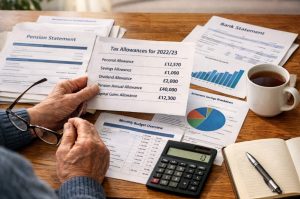
The personal allowance is the amount of income you can earn each year before paying income tax in the UK. For the 2026/27 tax year, the allowance remains £12,570, as it has been frozen for several years.
The concern for many retirees is that the State Pension is gradually moving closer to this limit. By April 2026, the full new State Pension is expected to sit less than £30 below the personal allowance, leaving very little room before tax becomes payable.
This narrow gap means that even small additional income sources could push a retiree over the threshold and trigger income tax.
| Income Example | Total Annual Income | Tax Position |
| State Pension only | Just under £12,570 | Usually no tax |
| State Pension + £200 savings interest | Above £12,570 | Tax may apply |
| State Pension + small private pension | Above £12,570 | Tax likely |
| State Pension + part-time earnings | Above £12,570 | Tax payable |
Common income sources that may push retirees above the threshold include:
- Interest from savings outside an ISA
- Payments from workplace or private pensions
- Earnings from part-time work
- Rental income from property
- Dividends or other investment income
Because many retirees receive multiple small income streams, their combined income can easily exceed the tax-free allowance without them realising.
What Extra Income Can Trigger a Surprise Tax Bill in 2026?
With the State Pension sitting very close to the personal allowance, even small additional income can push retirees into paying tax. Many people may not realise that several minor income streams can quickly increase their total earnings for the year.
Common sources of extra income include:
- Private or workplace pension payments
- Bank interest earned outside an ISA
- Part-time work or casual earnings
- Rental income or shared-ownership payments
- Withdrawals from flexible pension schemes
- Dividends from shares held outside an ISA
Individually, these amounts may appear small, but when combined they can easily push total income above £12,570, triggering income tax.
Defined benefit pensions can also play a role. As payments rise each year, they may push some retirees above the threshold.
As Sarah Pennells of Royal London noted:
“The personal allowance freeze means more people will be caught out simply by routine uprating of pension payments.”
How Does HMRC Actually Collect Tax on the State Pension?

Since the State Pension is paid without tax deductions, HMRC uses other methods to collect any tax owed. Once your total income is assessed, the tax is usually collected through the wider tax system.
If you receive a private or workplace pension under PAYE, HMRC may adjust your tax code. This allows the tax owed on your State Pension to be collected through deductions from that pension income.
If there is no PAYE source, HMRC may issue a bill through Simple Assessment. In this system, HMRC calculates your income using information from the DWP and financial institutions, then sends a notice showing how much tax is due, usually payable by the following January.
Cerys McDonald, a senior HMRC official, recently described the process during discussions with policymakers:
“The mechanism we normally use to recover tax where it has not been deducted is simple assessment. Work is ongoing to ensure the system continues to operate smoothly as pension income changes.”
For some retirees, receiving an unexpected tax calculation in the post can be confusing or worrying, especially if they were not aware their pension income could be taxed.
Who Is Most at Risk of a Surprise Tax Bill in 2026?
The individuals most likely to be affected are those whose income sits close to the personal allowance. You might be one of them if your total income—including both state pension and any other sources, falls just below or just above £12,570.
Those particularly at risk include people who:
- Receive income from several small sources
- Collect savings interest outside an ISA
- Hold a defined benefit pension whose annual increase pushes them into taxable income
- Are recently retired and adjusting to new tax obligations
- Have incorrect or outdated tax codes
A notable risk group is people who only receive the “old” state pension. Although its base rate is lower, many of these individuals have additional state pension (formerly SERPS). These increments can push total income over the threshold.
Does the ‘Old’ State Pension Avoid Tax?
The answer is no. The older pension system, which paid a basic rate supplemented by additional pension entitlements, can still produce taxable income. SERPS, in particular, can be substantial for people who spent many years in higher-paying roles.
This is an area where misunderstanding is widespread. Many assume the basic state pension is low enough to avoid tax altogether. But it is the total income that matters, not the base rate. As soon as SERPS or any other income sources are added, thresholds can easily be exceeded.
In comparison to the new state pension, which is higher but more uniform, the old system creates greater variability in income. It is therefore even more important to check your forecast and understand how your income is built up.
What Size Tax Bill Could You Face and Why Do Some People Pay Thousands?
The idea of being taxed on the state pension may not be new, but the scale of the bills some people face can be surprising.
Research indicates that many retirees pay over £4,500 in tax each year, and more than a quarter pay above £5,000. These amounts do not arise from the state pension alone but from the cumulative effect of multiple income sources.
What makes the situation more difficult is the lack of transparency around tax deductions. Because the state pension is not taxed at source, individuals may not track their total income proactively. When HMRC carries out its end-of-year calculation, the results can feel sudden and unexpected.
Adding to the complexity, two-thirds of pensioners surveyed said they did not know how much tax they paid or could not remember. This lack of awareness makes it harder to anticipate future liabilities, especially under the 2026 rules.
What Should You Do Now to Avoid an Unexpected State Pension Tax Bill?

With the new state pension level approaching the personal allowance, taking a proactive approach is essential. These steps can help you stay informed and reduce the risk of surprise charges:
- Review your tax code through your HMRC account
- Estimate your total income for the next tax year, including all small streams
- Consider using ISA savings instead of taxable accounts for income
- Check whether you are eligible for the Marriage Allowance
- Look at your defined benefit pension forecast
- Assess the advantages and disadvantages of deferring your state pension if you do not need to claim immediately
These actions may not eliminate your tax liability, but they can help you manage it more effectively.
As Alex Edmans reminded retirees in a recent interview:
“A ten-minute tax check today could save you hundreds of pounds next year.”
Will People with Only the State Pension Pay Tax in the Future?
The government has indicated that changes may be introduced to reduce small tax bills for those whose only income is the State Pension.
Announcements suggest that individuals receiving only the basic or new State Pension may not need to pay small amounts of tax through the Simple Assessment system in future.
However, the details of how this will work are still being developed, and legislation may be required before it becomes operational.
For now, the existing rules remain in place, meaning the State Pension continues to count as taxable income.
Until clearer guidance is issued, retirees should plan based on current tax regulations rather than relying on future policy changes.
Conclusion
The growing state pension tax warning highlights a shift in the UK retirement landscape. As pension payments rise while tax thresholds remain frozen, more retirees may begin paying income tax.
Although the State Pension is paid without deductions, it still counts as taxable income and can push total earnings above the personal allowance when combined with other income.
Understanding the rules, reviewing income sources, and checking tax codes can help retirees plan ahead and avoid unexpected tax bills.
FAQs About State Pension Tax Warning
Can the State Pension push me into paying income tax?
Yes. Because it counts as taxable income, the State Pension can push your total income above the personal allowance when combined with other earnings.
Why don’t they deduct tax from the State Pension?
The Department for Work and Pensions pays the pension without deductions, so HMRC collects any tax through other pensions or assessments.
How can I check if I might owe tax?
You can review your State Pension forecast and add it to other income sources to estimate your total taxable income.
Does savings interest affect pension tax?
Yes. Interest earned outside ISAs can count towards taxable income and may push you above the personal allowance.
Are ISA withdrawals taxed?
No. Money withdrawn from ISAs does not count as taxable income.
Can additional State Pension payments be taxed?
Yes. Payments built up through SERPS or other schemes can increase total income and lead to tax liability.
When does HMRC request payment for unpaid pension tax?
If tax cannot be collected through PAYE, HMRC may issue a Simple Assessment notice after the tax year ends.