
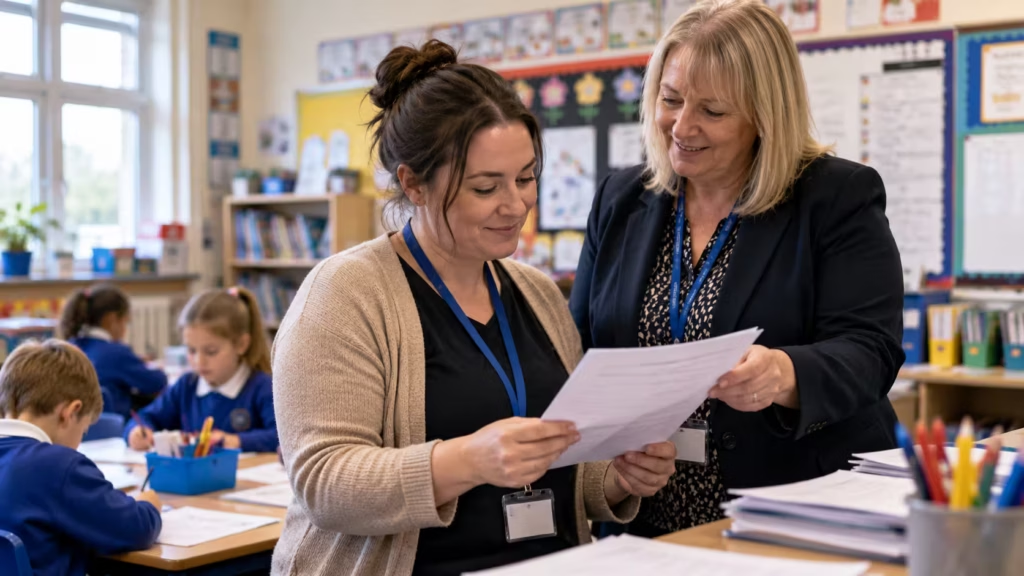
Yes. Many teaching assistants covered by National Joint Council (NJC) pay arrangements are receiving a confirmed 3.3% pay rise for 2026/27, effective from 1 April 2026.
The award runs until 31 March 2027 and is backdated for eligible staff. For 2027/28, however, no new national teaching assistant pay-rise percentage has yet been confirmed.
The distinction between 2026/27 and 2027/28 is important. Teaching assistants covered by the NJC settlement already have a confirmed increase covering the first three months of 2027. What happens from April 2027 is a separate question.
In England, that next stage is particularly significant because the new School Support Staff Negotiating Body (SSSNB) is expected to begin influencing national minimum pay and conditions.
The Department for Education says the first outcomes from the body are expected from 2027/28 at the earliest.
The position also varies according to employer, contract and location, so not every teaching assistant across the UK automatically receives exactly the same increase.
How Much Is the Teaching Assistant Pay Rise in 2026 and 2027?
For 2026/27, the NJC settlement provides a 3.3% permanent and consolidated increase across applicable NJC pay points, effective from 1 April 2026.
The settlement covers NJC spinal column points 3 to 43 and applicable nationally agreed allowances. The increase is incorporated into basic pay rather than being a one-off payment.
The wider local government pay rise for 2026/27 uses the same NJC settlement because the bargaining framework covers council employees as well as many school support staff.
For 2027, there are two different periods to understand:
- January To March 2027: The Confirmed 3.3% 2026/27 NJC Award Remains In Effect
- From April 2027: No New National Teaching Assistant Percentage Has Yet Been Confirmed
- England From 2027/28: The SSSNB Is Expected To Begin Producing Outcomes On Minimum Pay And Conditions
- Individual Pay: The Final Amount Will Still Depend On The Employee’s Contract, Grade, Hours And Employer
That means claims that teaching assistants have already been awarded a particular percentage such as 3%, 4% or 5% for 2027/28 should be treated cautiously unless a new settlement is formally announced.
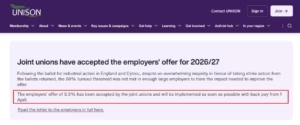
UNISON confirms that the 3.3% 2026/27 pay offer was accepted by the joint unions and will be implemented with back pay from 1 April 2026.
Will Teaching Assistants Get Back Pay for 2026?
Yes, eligible employees covered by the NJC settlement should receive the 3.3% increase from 1 April 2026, even where their employer implemented the revised salary later in the year.
If the new rate was not added to payroll immediately, the difference between the previous rate and the new rate should normally be paid as arrears.
For example, if an eligible full-time salary had been £25,000, a 3.3% increase would be worth approximately £825 a year, taking the salary to around £25,825 before deductions.
The actual amount appearing as back pay will depend on several factors, including:
- Previous Salary: The Pay Rate Before The Award
- Implementation Date: When The Employer Changed Payroll
- Contracted Hours: Whether The Employee Works Full Time Or Part Time
- Working Weeks: Whether The Role Is Full Year Or Term Time Only
- Employment Dates: Whether The Employee Worked Throughout The Backdated Period
Tax, National Insurance, pension contributions and other deductions can also mean the increase in take-home pay is smaller than the gross percentage.
How Much Will Teaching Assistants Earn After the 2026 Pay Rise?
There is no single teaching assistant salary across the UK.
Teaching assistant jobs can sit on different local authority grades and NJC spinal column points depending on responsibilities, experience, job evaluation and employer.
The national NJC pay spine nevertheless provides a useful indication of how the 3.3% award changes full-time equivalent salaries.
| NJC Pay Point | 2025/26 Salary | 2026/27 Salary | 2026/27 Hourly Rate |
| SCP 3 | £24,796 | £25,614 | £13.28 |
| SCP 4 | £25,185 | £26,016 | £13.48 |
| SCP 5 | £25,583 | £26,427 | £13.70 |
| SCP 6 | £25,989 | £26,847 | £13.92 |
| SCP 7 | £26,403 | £27,274 | £14.14 |
| SCP 8 | £26,824 | £27,709 | £14.36 |
| SCP 9 | £27,254 | £28,153 | £14.59 |
| SCP 10 | £27,694 | £28,608 | £14.83 |
| SCP 11 | £28,142 | £29,071 | £15.07 |
These are full-time equivalent national NJC figures. They should not be interpreted as the amount every teaching assistant actually receives.
The statutory UK National Living Wage for 2026 is £12.71 an hour for workers aged 21 and over, but the National Living Wage and the NJC pay spine are separate systems. The lowest 2026/27 NJC hourly rate shown above remains higher than that statutory minimum.
Why Is a Teaching Assistant’s Actual Salary Often Lower Than the Pay Scale?
One of the biggest sources of confusion around teaching assistant salaries is the difference between full-time equivalent pay and actual annual earnings.
Many teaching assistants work term-time-only contracts. A job advert may therefore display an FTE salary of £26,000 or £28,000 while the employee’s actual annual salary is lower because they work fewer hours and fewer weeks than a full-time, full-year employee.
A teaching assistant might, for example, work around 30 hours a week during school terms rather than a standard full-time working week throughout the year.
Their pay is then calculated proportionately.
This is also why comparisons with teachers can be misleading. Permanent teachers are commonly employed on annual salary arrangements, whereas many teaching assistants and other support employees have term-time working patterns.
Receiving a 3.3% increase does not therefore mean a term-time teaching assistant suddenly receives the full NJC annual figure shown in national tables.
What Does the Pay Rise Mean for Teaching Assistants in Preston and Lancashire?
Teaching assistants in Preston should check the grade and spinal column point attached to their individual post.
Lancashire County Council uses local grading arrangements linked to NJC spinal column points, meaning different teaching assistant levels can fall within different grade ranges.
Council documentation for 2026/27 identifies different classifications for Level 1, Level 2, Level 3 and Higher Level Teaching Assistants.
This demonstrates why two teaching assistants working in Lancashire may legitimately receive different salaries despite both benefiting from the same national percentage increase.
A teaching assistant in Preston should therefore check:
- Job Grade: Find The Lancashire Grade Attached To The Role
- Spinal Column Point: Check The SCP Used To Calculate Basic Pay
- Contracted Hours: Confirm The Number Of Paid Hours Each Week
- Working Weeks: Check Whether The Contract Is Term Time Only
- Payslip Rate: Compare The Current Rate With The Revised 2026/27 Rate
- Back Pay: Look For Any Arrears Owed From 1 April 2026
A headline national salary is useful for comparison, but the contract and local grading decision determine what an individual employee should actually receive.
Does Every Teaching Assistant Get the 3.3% Pay Rise?
No. The 3.3% figure applies where the employee’s pay is governed by the 2026/27 NJC settlement.
Many local-authority and maintained-school support employees work under NJC or Green Book arrangements. Some academy trusts also use NJC-linked scales.
However, academies can have different contractual arrangements, particularly where a trust has established its own support-staff pay structure.
The broader school support staff pay rise for 2026 affects more than teaching assistants. NJC-linked roles can include learning support assistants, administrative employees, caretakers, cleaners and other school support workers.
Agency teaching assistants are another important exception.
Their employment relationship is normally with the agency rather than directly with the school, so they should check the agency contract and applicable employment rights rather than assume an NJC award automatically changes their hourly rate.
Are Higher Level Teaching Assistants Getting a Pay Rise?
Higher Level Teaching Assistants can receive the 2026 NJC increase where their salary is linked to NJC arrangements.
HLTAs are usually placed at a higher local grade than entry-level teaching assistants because their responsibilities can include supporting learning at a more advanced level, leading activities and undertaking duties beyond those of standard classroom support roles.
The percentage award may therefore be the same while the cash increase is larger because it is calculated against a higher basic salary.
A 3.3% increase on £30,000, for example, is worth £990 a year before deductions.
Are Teaching Assistants Getting the Same Pay Rise Across the UK?
No. There is no single pay system covering every teaching assistant in England, Wales, Scotland and Northern Ireland.
England
Many school support employees currently have pay linked to NJC arrangements, meaning the 3.3% settlement is relevant to a large number of teaching assistants.
England is also moving towards the new SSSNB system for future school support staff pay and conditions.
Wales
Wales continues to use NJC arrangements for many school support employees rather than moving into England’s SSSNB.
This means the 2026/27 NJC award can also be relevant to eligible Welsh teaching assistants.
Wales has additionally been pursuing reforms to teaching assistant roles and progression, so employees should check Welsh Government and local-authority guidance alongside the NJC settlement.
Scotland
Scotland operates a separate Scottish Joint Council system.
The agreed Scottish local-government settlement provides a 3.5% increase from 1 April 2026 to 31 March 2027, following a 4% increase in the previous year.
Scottish teaching assistants and equivalent support roles should therefore not assume that England’s NJC or future SSSNB arrangements apply to them.
Northern Ireland
The NJC framework remains important for relevant support staff in Northern Ireland.
However, education employment and implementation arrangements can differ from England, meaning employees should check information from their employer, the Education Authority and recognised unions when confirming payment dates and individual entitlement.
What Is Changing for Teaching Assistant Pay in 2027?
The most important 2027 development for teaching assistants in England is the School Support Staff Negotiating Body.
The Employment Rights Act 2025 provides for the SSSNB to negotiate minimum pay, terms and conditions for eligible support employees in state-funded schools in England.
The Department for Education says the new system is intended to cover around 800,000 school support staff employed by local authorities, governing bodies and academy trusts.
Existing terms cannot simply be worsened through the new statutory arrangements, while employers can continue offering more favourable terms.
Crucially, this does not mean a specific 2027 teaching assistant pay rise has already been agreed.
Existing arrangements continue through 2026/27, and the first outcomes from SSSNB negotiations are expected from 2027/28 at the earliest.
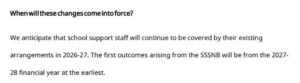
Department for Education guidance confirms that existing arrangements continue in 2026/27 and the first SSSNB outcomes are expected from 2027/28 at the earliest.
The change matters because school support staff in England have historically relied heavily on local-government bargaining arrangements rather than a school-specific national negotiating system.
The SSSNB is designed to create minimum national standards specifically for school support roles, including teaching assistants.
Could Teaching Assistants Receive Another Pay Rise From April 2027?
Another pay settlement is possible, but no specific 2027/28 percentage should currently be treated as confirmed.
The existing 3.3% NJC award covers the period from 1 April 2026 to 31 March 2027.
What follows from April 2027 will depend on the next negotiating process and the transition towards the SSSNB in England.
This is different from teachers in England, who already have a separate multi-year settlement providing a 3.5% increase from September 2026 followed by another 3% from September 2027.
Those teacher figures should not be applied to teaching assistants because the two workforces use different pay frameworks.
Teaching Assistant Pay Rise 2026 and 2027 at a Glance
The position as of October 2026 is:
- 2026/27 NJC Award: 3.3% Confirmed
- Effective Date: 1 April 2026
- Award Period: 1 April 2026 To 31 March 2027
- Back Pay: Payable From April 2026 Where Applicable
- NJC Pay Spine: SCP 3 To SCP 43 Covered By The Main Settlement
- January To March 2027: The 3.3% Award Continues
- 2027/28 Increase: No Specific Percentage Confirmed Yet
- England From 2027/28: SSSNB Outcomes Expected At The Earliest
- Scotland: Separate 3.5% Settlement Applies From April 2026 To March 2027
The most important point is that 2027 does not currently have one confirmed UK-wide teaching assistant pay-rise figure.
What Should Teaching Assistants Do Now?
Teaching assistants do not need to rely solely on headlines to establish whether their salary is correct.
- Check Your Contract: Look For References To NJC, Green Book Or A Local Pay Framework
- Check Your Pay Grade: Identify Your Local Grade And Spinal Column Point
- Review Your Payslip: Confirm Whether The 3.3% Increase Has Been Applied
- Look For Back Pay: Check For Arrears Dating From 1 April 2026
- Check Your Working Pattern: Confirm Whether Your Salary Is Full-Time Equivalent Or Term Time Only
- Ask Your Employer: Contact Payroll Or HR If Your Revised Rate Is Unclear
- Follow 2027 Updates: Watch For Confirmed SSSNB And Pay Negotiation Announcements Rather Than Estimates
For employees whose pay is linked to the wider council framework, the confirmed 2026/27 NJC pay award and updated pay scales can help when checking the national figures against a payslip.
Conclusion: Are Teaching Assistants Getting a Pay Rise in 2026 and 2027?
So, are teaching assistants getting a pay rise in 2026 and 2027?
For many teaching assistants covered by NJC arrangements, the 2026 answer is confirmed. The 2026/27 settlement provides a 3.3% consolidated increase from 1 April 2026, with eligible employees entitled to the revised rate and applicable back pay.
That settlement remains in force until 31 March 2027, meaning the increase also covers January, February and March 2027.
What happens after that is less certain.
There is currently no confirmed percentage teaching assistant pay rise for 2027/28. In England, attention is moving towards the School Support Staff Negotiating Body, which is expected to begin influencing minimum national pay and conditions from 2027/28 at the earliest.
Teaching assistants should therefore distinguish between the confirmed 2026/27 award and any future 2027/28 settlement.
Checking the employment contract, grade, spinal column point and latest payslip remains the most reliable way to establish individual entitlement.
Frequently Asked Questions
Are Teaching Assistants Getting a Pay Rise in 2026?
Yes. Teaching assistants covered by the 2026/27 NJC settlement receive a confirmed 3.3% increase effective from 1 April 2026.
Are Teaching Assistants Getting a Pay Rise in 2027?
The 3.3% 2026/27 award continues until 31 March 2027. A separate percentage increase for 2027/28 has not yet been confirmed.
Will Teaching Assistants Get Back Pay?
Eligible employees covered by the NJC settlement should receive the revised rate from 1 April 2026, including arrears where implementation happened later.
Do Academy Teaching Assistants Get the 3.3% Increase?
Not automatically. It depends on whether the academy trust follows NJC arrangements or has linked the employee’s contract to those pay scales.
Do Term-Time Teaching Assistants Get the Pay Rise?
Eligible term-time employees can receive the applicable percentage increase, but their actual annual salary remains calculated according to contracted hours and working weeks.
Are Higher Level Teaching Assistants Getting a Pay Rise?
HLTAs covered by NJC-linked arrangements can receive the 3.3% increase. Their higher local grade means the cash value of the increase may differ from other TA roles.
What Will Change for Teaching Assistants From 2027?
In England, the SSSNB is expected to start producing outcomes on minimum school support staff pay and conditions from 2027/28 at the earliest, but no specific new pay-rise percentage has yet been confirmed.