
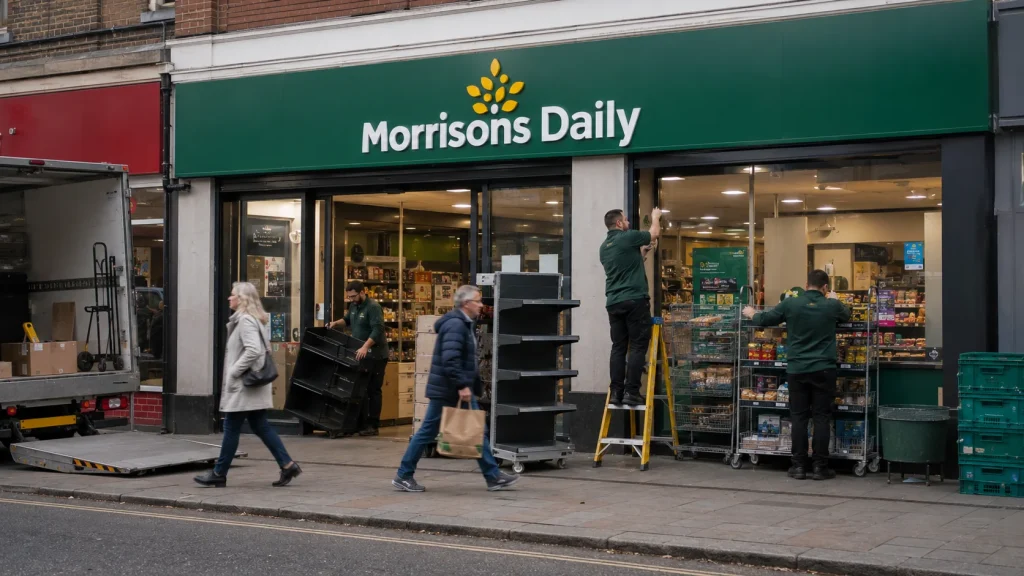
Key takeaways from my findings:
- Around 100 UK Morrisons Daily stores are affected
- Mix of closures, conversions, and relocations
- Strategy driven by profitability, not expansion
- McColl’s acquisition still influencing store structure
- Shift toward franchise-led growth model
What are Morrisons’ convenience store closures and what do they really mean for the UK retail sector?
When I first began looking into the Morrisons convenience store closures, what stood out to me was that this is not a simple case of shutting down shops. Instead, it represents a structured reshaping of around 100 UK convenience locations operating largely under the Morrisons Daily brand.
From my conversations and review of retail data, these changes include closures, conversions, and relocations, depending on store performance. The aim is not contraction for its own sake, but rather optimization in a highly competitive convenience market.
“Morrisons is not retreating from convenience retail; it is recalibrating its exposure to it,” explains David Langford, UK Retail Strategy Consultant. “The closures are performance-led decisions rather than market exit signals.”
| Category of Change | What It Means | Likely Outcome |
| Full closure | Store permanently shuts | Exit from location |
| Conversion | Store changes format/brand | Continued operation under new model |
| Relocation | Store moves nearby | Retained customer base |
| Franchise reset | Partner agreement changes | Operational restructuring |
When I spoke with a UK retail consultant during my research, they highlighted that this restructuring is not about exiting convenience retail altogether, but about refining exposure to underperforming locations.
How Are Morrisons’ Convenience Store Closures Reshaping the UK Convenience Retail Landscape?
When I examined the wider impact of the Morrisons convenience store closures, I noticed something important: this is part of a larger shift happening across UK high streets. Convenience retail is no longer expanding blindly; it is tightening, refining, and focusing on profitability per site.
What makes this significant is how it changes local retail ecosystems. In some areas, Morrisons’ exits create gaps quickly filled by competitors like Tesco Express or Co-op. In others, the absence is more visible, especially in smaller towns.
From a structural standpoint, the UK convenience sector is becoming more concentrated, with fewer but more efficient stores.
| Market Factor | What I Observed | Retail Effect |
| Cost inflation | Higher wages and rent | Lower store viability |
| Consumer shift | More planned shopping | Reduced impulse sales |
| Competition density | Many brands in same area | Margin pressure |
| Location economics | Performance varies widely | Store rationalisation |
“Convenience retail is becoming a game of survival of the most efficient locations,” notes Sarah Mitchell, Retail Economist. “Chains are now pruning portfolios rather than expanding them.”
Why is Morrisons Restructuring Its Convenience Store and Franchise Model?
When I dug deeper into why these Morrisons convenience store closures are happening, the answer consistently came back to one thing: control over performance variability.
From my discussions with franchise specialists, I found that the Morrisons Daily model creates a natural imbalance between expansion speed and operational consistency.
One franchise advisor I interviewed explained it clearly:
“The challenge is that rapid rollout creates uneven performance; some stores thrive, others struggle under cost pressure.”
This explains why Morrisons is now tightening franchise oversight and prioritizing operational alignment rather than pure expansion.
The Morrisons Daily model relies heavily on franchise partners, which allows rapid expansion but also introduces inconsistency. Some stores perform strongly, while others struggle with costs, footfall, or local competition.
| Strategic Area | What I Observed | Expected Outcome |
| Store selection | Focus on profitable sites | Stronger revenue base |
| Franchise model | Tightening agreements | Better consistency |
| Lease structure | Cost renegotiation | Lower overheads |
| Store format | Conversion of weak sites | Improved performance |
What I found particularly interesting is how Morrisons is now tightening its model rather than expanding it aggressively.
How is the Strategy Shifting?
Morrisons is now prioritizing:
- High-performing urban and suburban locations
- Strong franchise alignment
- Lease efficiency and cost control
- Conversion of underperforming stores
“Franchise retail success depends on strict operational alignment,” says Martin Cleary, Retail Franchise Advisor. “Morrisons is now correcting inconsistencies in its convenience portfolio.”
| Strategic Area | What Morrisons Is Doing | Expected Result |
| Store selection | Focusing on profitable sites | Stronger revenue base |
| Franchise model | Reviewing agreements | Better consistency |
| Lease structure | Renegotiating terms | Reduced overheads |
| Store format | Converting weak sites | Improved performance |
What Impact Are Morrisons’ Convenience Store Closures Having on Communities and Employees?

When I spoke to retail analysts and reviewed local reports, the human impact of Morrisons convenience store closures became clear. While this is a corporate restructuring strategy, its effects are felt locally.
When I reviewed local retail impact reports and spoke with workforce analysts, I found that the effects of these closures vary significantly depending on whether stores are closed outright or converted.
A labour market specialist I interviewed noted:
“The biggest difference in outcomes is whether stores are fully closed or repositioned within the same community.”
From my analysis, I found that while some employees are redeployed, others face redundancy depending on local availability of alternative roles.
For employees, outcomes depend heavily on whether a store is closed outright or converted. Some staff are relocated, while others face redundancy depending on regional opportunities.
For communities, especially in smaller towns, these stores often act as daily essentials providers.
“Local convenience stores often function as informal community anchors,” explains Dr. Emily Rhodes, Urban Retail Researcher. “When they change or close, the disruption is felt in everyday routines more than in economic statistics.”
Community and Employment Impact Breakdown
| Area | Positive Impact | Negative Impact |
| Jobs | Transfers possible | Some redundancies |
| Access | New operators may replace stores | Temporary loss of services |
| High streets | Space reuse opportunities | Short-term vacancies |
| Customer habits | More competitive pricing elsewhere | Loss of familiarity |
Are Morrisons’ Convenience Store Closures Part of a Wider UK Supermarket Trend?
From my analysis, it is clear that Morrisons is not acting alone. The entire UK convenience sector is undergoing structural recalibration.
Tesco, Sainsbury’s, and Co-op continue to expand selectively, but even they are becoming more cautious about store profitability. The era of rapid convenience expansion appears to be slowing.
What is emerging instead is a more data-driven approach to store placement and performance management.
| Retailer | Strategy Direction | Market Behaviour |
| Tesco | Selective expansion | Focus on urban density |
| Sainsbury’s | Balanced growth | Strong local positioning |
| Co-op | Community-led model | Wide but fragmented presence |
| Morrisons | Portfolio optimisation | Closure + conversion strategy |
How is Morrisons Restructuring Its Retail Footprint Through These Changes?

As I continued my review, I found that Morrisons is actively reshaping its retail footprint rather than shrinking it outright. The closures are part of a controlled restructuring process that prioritizes performance.
This includes converting stores into more suitable formats, exiting weak lease agreements, and strengthening franchise oversight.
What restructuring looks like in practice
- Converting underperforming stores into alternative formats
- Exiting locations with unsustainable rent structures
- Strengthening supply chain efficiency for remaining stores
- Focusing on urban and high-footfall areas
| Restructuring Tool | Purpose | Outcome |
| Store conversion | Adapt format to demand | Better performance |
| Lease exit | Reduce financial burden | Cost savings |
| Franchise review | Improve consistency | Operational control |
| Location focus | Target high traffic | Higher revenue |
What Happens to Staff and Jobs During Morrisons Convenience Store Closures?
When I looked into workforce implications, the picture was mixed. In some cases, staff are successfully transferred to nearby stores or retained under franchise transitions. In others, closures result in redundancy.
The outcome largely depends on whether a store is closed permanently or restructured.
“Retail restructuring always creates uneven employment outcomes,” explains Paul Greene, Labour Market Analyst. “The key difference lies in whether locations are fully shut or repositioned.”
How Do Competitors Respond to Morrisons’ Convenience Restructuring?
From a competitive standpoint, Morrisons’ retreat from certain locations often creates opportunities for rivals.
Tesco Express and Co-op tend to move quickly into vacated high-street spaces, while Sainsbury’s Local focuses on more premium convenience positioning.
What I found particularly notable is how fast these transitions occur in urban areas, sometimes within months.
What Are the Long-term Implications of Morrisons Convenience Store Closures?
Looking ahead, the Morrisons convenience store closures suggest a long-term shift toward leaner, more efficient retail networks. The focus is moving away from store quantity and toward profitability per location.
This means fewer but stronger stores, more selective expansion, and tighter franchise control.
Conclusion
After reviewing the Morrisons convenience store closures in detail, my overall assessment is that this is a strategic recalibration rather than a contraction. The reshaping of around 100 UK stores reflects a deliberate move toward efficiency, profitability, and tighter franchise control.
While the immediate effects include store conversions, closures, and local disruption, the longer-term goal is a more sustainable convenience network. From a retail perspective, this aligns with wider UK industry trends where performance outweighs presence.
Ultimately, Morrisons is repositioning itself to compete more effectively in a market that is becoming increasingly cost-sensitive and location-driven.
FAQ
What exactly are Morrisons’ convenience store closures?
These refer to the restructuring of around 100 UK convenience stores, where locations are either closed, converted, or repositioned based on performance and profitability.
Are all Morrisons Daily stores affected?
No, only selected stores are impacted. Many Morrisons Daily outlets continue to operate normally, especially in high-performing locations.
Why is Morrisons making these changes now?
The changes are driven by rising costs, competitive pressure, and the need to improve overall profitability across its convenience estate.
Will customers lose access to local stores permanently?
In some cases yes, but often other retailers move into the same locations, maintaining convenience access for customers.
What happens to franchise owners?
Franchise partners may see contract changes, store conversions, or exits depending on how their location performs.
How does this compare to other supermarkets?
Other UK supermarkets are also restructuring convenience portfolios, but Morrisons is currently more focused on consolidation and optimisation.
Could Morrisons expand again in the future?
Yes, but future expansion is expected to be more selective and based heavily on location performance and profitability.