
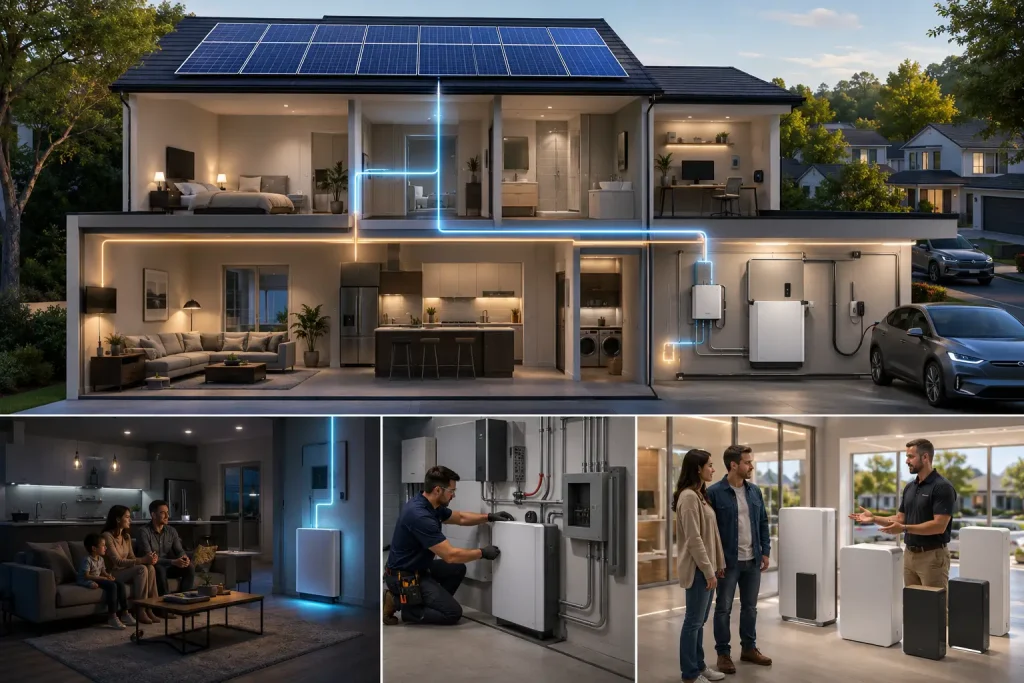
Home energy storage can be worthwhile when you need outage protection, want to use more of your solar electricity or can avoid expensive peak-rate grid power. Its financial value is usually strongest where electricity rates vary by time, solar export payments are low or utilities offer battery incentives.
A home battery may provide less direct financial benefit where electricity prices remain flat, full-retail net metering is available and outages are uncommon.
The right decision therefore depends on your electricity-use pattern, local tariff, backup priorities and installed cost—not simply the battery’s advertised capacity.
Key Takeaways:
- A home energy storage system stores electricity from solar panels or the grid for later use.
- Battery capacity, measured in kilowatt-hours, determines how much energy is available.
- Power output, measured in kilowatts, determines how many appliances can run simultaneously.
- A single battery may cover essential circuits, but whole-home battery backup often requires greater capacity and output.
- Home battery storage can operate with or without solar panels.
- US residential batteries commonly cost well into five figures before state or utility incentives.
- The federal Residential Clean Energy Credit is not available for property placed in service after December 31, 2025, according to current IRS guidance.
- Product certification, permits, system design and professional installation all affect home battery safety.
What Is A Home Energy Storage System?
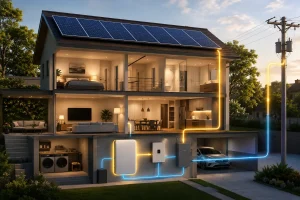
A home energy storage system captures electricity and saves it until the household needs it. Most modern residential energy storage systems use rechargeable lithium-ion batteries, although the complete installation includes considerably more than battery cells.
The US Department of Energy defines energy storage as technology that captures electricity, converts or stores it in another form and releases it when needed.
Storage can be paired with solar panels or installed as a standalone system. Because conversion and retrieval create losses, no storage system is 100% efficient. (energy.gov)
A typical home battery system includes:
- Battery modules that hold the stored energy
- A battery management system that monitors charging, temperature and operating limits
- An inverter that converts electricity into a form the home can use
- Control and communications equipment
- Transfer equipment that disconnects backup circuits from the grid during an outage
- A backup or critical-load panel where selected circuits are used
- Monitoring software that controls charging and discharging
Some products combine several of these components in one enclosure. Others require separate batteries, inverters, gateways and electrical equipment.
How Does Home Energy Storage Work?
A home energy storage system normally follows five steps:
- Electricity is generated by solar panels or purchased from the grid.
- The household uses the electricity it needs immediately.
- Available surplus electricity charges the battery.
- The battery retains that energy until demand increases, electricity becomes more expensive or the grid fails.
- The inverter and control system release stored electricity to the home.
How Does Solar Battery Storage Work During the Day?
Solar panels usually generate the most electricity around the middle of the day. If production exceeds the home’s immediate demand, a solar battery storage system can capture some of that surplus instead of exporting all of it to the grid.
The stored electricity can then be used in the evening, overnight or during an outage. The Department of Energy notes that storage makes solar energy available at times when the sun is not shining and can help manage variations in solar production.
How Does a Home Battery Work at Night?
After solar production falls, the house can draw electricity from its home battery storage before purchasing additional electricity from the grid. The exact operating order depends on the equipment settings, electricity tariff and backup reserve selected by the homeowner.
For example, a homeowner may instruct the battery to:
- Preserve 30% of its capacity for outages
- Discharge during expensive peak-rate hours
- Recharge from surplus solar the following day
- Charge from the grid during an inexpensive off-peak period
What Happens During a Power Outage?
A properly configured battery backup system can isolate selected household circuits from the grid and continue supplying them with electricity.
Solar panels alone generally do not keep a grid-connected home powered during an outage. Standard solar installations are designed to shut down when the grid fails for safety reasons. Outage operation normally requires an appropriately configured inverter, storage and transfer equipment
Can a Home Battery Work Without Solar Panels?
Yes. A home battery without solar can charge from the grid and supply stored electricity later.
A grid-charged home battery may be used to:
- Provide backup power
- Shift electricity use from peak to off-peak periods
- Participate in an eligible utility programme
- Reduce exposure to demand charges where applicable
The economic case depends heavily on the difference between off-peak and peak electricity prices. If the rate difference is small, energy losses and battery degradation can reduce or eliminate the expected savings.
What Can a Home Battery Actually Power?
The answer depends on two separate specifications: energy capacity and power output.
What Is the Difference Between kW and kWh?
A kilowatt-hour, or kWh, measures energy capacity. It indicates how much electricity the battery can store.
A kilowatt, or kW, measures power. It indicates how much electricity the system can deliver at one time.
A battery may hold enough energy to operate essential appliances for many hours but still lack the power output required to start or run several large appliances simultaneously.
For example:
- A refrigerator may consume a relatively modest amount of energy over 24 hours.
- An air conditioner may require high operating power and a brief surge when its compressor starts.
- An electric range, clothes dryer and water heater can create substantial simultaneous demand.
This is why buyers should compare usable kWh capacity, continuous kW output and short-duration peak output.
Essential-Load Backup
An essential-load system is designed to support selected circuits rather than every appliance in the home.
Typical priority loads might include:
- Refrigerator
- Internet equipment
- Lighting
- Phone charging
- Garage-door controls
- Selected outlets
- Medical equipment
- A furnace blower or small cooling load, where compatible
Essential-load backup usually requires less battery capacity and lower inverter output than whole-home backup.
Partial-Home Backup
Partial-home backup supports a broader group of circuits but still excludes some high-demand equipment.
A homeowner might back up the kitchen, lighting, communications equipment and selected heating or cooling equipment while excluding an electric range, pool equipment, clothes dryer or EV charger.
Whole-Home Battery Backup
Whole-home battery backup aims to operate most or all household circuits. It may require multiple batteries, load-management controls, a larger inverter and changes to the electrical panel.
“Whole-home” does not necessarily mean that every appliance can operate without restriction for an unlimited period. Runtime still depends on stored energy, solar production and household demand.
Can A Home Battery Run Air Conditioning?
Some home battery systems can operate air conditioning, but compatibility depends on:
- The air conditioner’s continuous demand
- Its compressor-starting requirements
- Battery and inverter output
- Other loads operating at the same time
- Desired runtime
- Whether a soft-start device or load controller is used
The installer should assess the appliance’s actual electrical specifications rather than relying only on the home’s floor area.
How Much Home Battery Storage Do You Need?
Battery sizing should begin with the purpose of the system.
A battery designed to reduce peak-rate purchases may be sized differently from one intended to keep essential appliances running through an overnight outage.
Sizing For Outage Backup
For backup power, identify:
- Which appliances and circuits must remain available
- Their average and peak power requirements
- How many hours they need to operate
- Whether solar can recharge the battery during the outage
- How much emergency reserve should remain unused
Monthly electricity consumption alone is not enough. Two homes using the same total amount of electricity can have very different evening loads, appliance demands and backup requirements.
Sizing For Solar Self-Consumption
For solar self-consumption, compare:
- Average daytime solar surplus
- Evening and overnight electricity use
- Seasonal variations in production
- Current solar export compensation
- Battery charging and discharging losses
A battery that is larger than the normal daily surplus may frequently remain partly empty. A system that is too small may fill early and continue exporting substantial solar energy.
Sizing For Time-of-Use Savings
For tariff shifting, estimate how much electricity the household normally buys during peak-rate hours.
Then compare:
- Peak electricity price
- Off-peak electricity price
- Battery efficiency
- Usable capacity
- Expected degradation
- Programme or subscription fees
- Installed cost
A large difference between peak and off-peak rates can improve the economics, but the tariff calculation should use actual interval or hourly consumption whenever possible.
Home Battery Sizing Formula
A simplified capacity formula is:
Required nameplate capacity = required load energy ÷ usable discharge fraction ÷ system efficiency
Suppose the priority circuits need 6 kWh during the intended backup period. If the battery provides 90% usable capacity and the assumed system efficiency is 90%, the calculation is:
6 ÷ 0.90 ÷ 0.90 = approximately 7.4 kWh
The result is only an initial energy estimate. The system must also provide enough continuous and surge power for the connected appliances.
Illustrative 24-Hour Backup Example
Consider a fictional household that wants to operate the following loads:
| Essential load | Illustrative usage | Estimated energy |
| Refrigerator | Average 120 watts for 24 hours | 2.88 kWh |
| Internet equipment | 200 watts for 6 hours | 1.20 kWh |
| LED lighting | 60 watts for 5 hours | 0.30 kWh |
| Selected outlets | 500 watts for 3 hours | 1.50 kWh |
| Small electronics | 40 watts for 10 hours | 0.40 kWh |
| Total | 6.28 kWh |
At 90% usable capacity and 90% system efficiency, the illustrative nameplate requirement would be about:
6.28 ÷ 0.90 ÷ 0.90 = 7.75 kWh
Actual refrigerator cycling, appliance power, weather and household behaviour can differ substantially. An installer should verify the load profile, starting currents and electrical design.
Home Energy Storage Options Compared

| System type | Best suited to | Main advantage | Main limitation |
| Standalone home battery | Backup or tariff shifting without solar | Can charge from the grid | Savings depend on local electricity rates |
| Solar-plus-storage | Solar self-consumption and resilience | Stores surplus solar production | Higher combined installation cost |
| Essential-load system | Priority circuits during outages | Requires less battery capacity | Does not support every household circuit |
| Whole-home battery backup | Broad household coverage | More convenience during outages | Higher capacity and power requirements |
| Portable power station | Temporary, limited loads | Portable and relatively simple | Not equivalent to a permanently integrated system |
| Standby generator | Extended outages with available fuel | Can operate while fuel remains available | Noise, emissions, maintenance and fuel storage |
| Hybrid battery-generator system | Short and extended outage protection | Combines automatic battery backup with longer-duration generation | Greater cost and system complexity |
AC-Coupled Versus DC-Coupled Storage
An AC-coupled battery has its own inverter and can often be added to an existing solar installation without replacing the original solar inverter.
A DC-coupled system routes solar electricity through equipment designed to coordinate the panels and battery before supplying the home. This can reduce some conversion steps, but compatibility and retrofit complexity vary.
Neither architecture is automatically best. The right option depends on whether the project is a new installation or retrofit, equipment compatibility, outage functionality, efficiency and cost.
LFP And Other Lithium-Ion Batteries
Lithium iron phosphate, commonly called LFP, is widely used in newer home energy storage products. Other lithium-ion chemistries may offer different combinations of energy density, weight, operating characteristics and cycle life.
Battery chemistry should not be evaluated in isolation. Enclosure design, thermal management, controls, product certification and installation conditions also affect system performance and risk.
Modular Versus Fixed-Capacity Batteries
A modular home battery system allows additional storage units to be added within the manufacturer’s permitted configuration.
Before buying a smaller system with plans to expand later, confirm:
- Whether later expansion is supported
- The maximum number of modules
- Whether old and new modules can be combined
- Whether additional inverter equipment is required
- Whether the warranty changes after expansion
How Much Does Home Energy Storage Cost in 2026?
A current EnergySage marketplace analysis estimates that installing approximately 13.5 kWh of solar battery storage costs about $15,647 before available incentives. The article was updated on July 13, 2026 and is based on marketplace information rather than a fixed national price.
Actual home energy storage cost can vary significantly because the quotation may include:
- One or more batteries
- Integrated or separate inverter equipment
- Gateway and transfer equipment
- Critical-load or backup panel
- Main electrical-panel upgrades
- Load-management controls
- Permitting and inspection
- Utility interconnection work
- Labour and commissioning
- Monitoring subscriptions
- Taxes and financing charges
A lower equipment price does not always produce a lower installed price. Retrofitting a battery into an older home or existing solar system may require additional wiring, panel changes or compatible inverter equipment.
What Affects Home Battery Payback?
Home battery payback depends on:
- Installed price
- Local electricity tariffs
- Peak and off-peak rate differences
- Solar production
- Solar export compensation
- Usable battery capacity
- Round-trip losses
- Battery degradation
- Warranty terms
- State or utility incentives
- Virtual power plant payments
- Financing cost
Where full-retail net metering and flat electricity rates are available, a battery may provide limited additional bill savings. Its value may instead come from resilience and avoided outage losses. EnergySage similarly notes that homeowners with flat rates and full net metering may not see substantial direct financial gains from storage.
A Simple Battery-Savings Calculation
Suppose a homeowner shifts 8 kWh each day from a $0.40-per-kWh peak period to a $0.15-per-kWh off-peak period.
The theoretical daily rate difference is:
8 × ($0.40 − $0.15) = $2.00
The theoretical annual value is:
$2.00 × 365 = $730
That figure is not the homeowner’s guaranteed saving. It must be adjusted for battery losses, days when the full capacity is not used, degradation, programme fees and changing electricity rates.
A responsible home energy storage proposal should therefore show its assumptions rather than presenting a single universal payback period.
Are Home Batteries Eligible For Tax Credits Or Rebates In 2026?

Federal Tax-Credit Position
Current IRS guidance states that the Residential Clean Energy Credit covered qualified clean-energy property installed from 2022 through December 31, 2025. It says the credit is not available for property placed in service after December 31, 2025
Battery storage with at least 3 kWh of capacity was among the qualifying technologies while the credit applied. The IRS also states that eligible expenses could include certain original installation labour and wiring costs
This date matters because older battery guides may still describe the previous federal schedule. Homeowners considering a 2026 installation should rely on current IRS material or qualified tax advice rather than assuming the former 30% credit remains available.
State, Utility and Local Programmes
Home battery incentives may still be available through:
- State rebate programmes
- Local government programmes
- Utility demand-response offers
- Virtual power plants
- Time-of-use battery tariffs
- Installer or manufacturer promotions
Eligibility can depend on location, equipment, battery size, installation date and whether the utility is allowed to dispatch stored electricity.
Before relying on a programme, ask:
- Is approval required before installation?
- Does the battery need to be paired with solar?
- Which products and installers qualify?
- Is payment made upfront or over several years?
- How much battery capacity must remain available to the utility?
- Can the programme change the homeowner’s backup reserve?
- Are there withdrawal penalties or ongoing fees?
Is A Home Battery Better Than a Generator?
A home battery is not universally better than a generator. The right backup source depends on outage length, electrical demand, fuel access, noise tolerance, emissions and budget.
Advantages Of Home Battery Storage
A residential battery system can provide:
- Automatic backup
- Quiet operation
- No direct on-site fuel combustion
- Solar recharging when correctly configured
- Daily tariff or solar-self-consumption use
- Remote monitoring
- Potential utility-programme participation
Advantages of A Standby Generator
A generator can continue operating as long as sufficient fuel is available and the equipment remains functional. It may therefore be better suited to prolonged outages with high household demand.
However, the homeowner must account for fuel availability, storage, exhaust, carbon monoxide precautions, noise, maintenance and testing.
Recent reporting on home backup power highlights the trade-off between battery capacity and fuel-based runtime, particularly as households plan for multiday outages.
When A Hybrid System May Make Sense?
Some homes use a battery for immediate, quiet backup and a generator for extended outages.
A hybrid arrangement may:
- Keep essential loads running while the generator starts
- Reduce generator operating hours
- Use solar to recharge the battery during daylight
- Reserve generator fuel for periods of low solar production
The installation must be engineered so that the battery, generator, solar inverter and transfer equipment operate safely together.
Are Home Energy Storage Systems Safe?
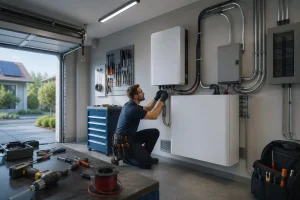
Certified and properly installed home batteries use multiple protective controls, but no electrical or battery system is risk-free.
Safety depends on:
- Battery chemistry
- Cell and enclosure design
- Battery management
- Thermal controls
- Inverter compatibility
- Electrical protection
- Installation location
- Product certification
- Permits and inspection
- Installer competence
What Is UL 9540?
UL 9540 is a safety standard covering energy storage systems and equipment. UL Solutions says its evaluation includes charging, discharging, protection, control, communications and interactions among system components.
This is important because a battery and inverter that are separately certified are not automatically certified to operate together as one residential energy storage system.
What Is UL 9540A?
UL 9540A is a test method used to evaluate thermal-runaway fire propagation in battery energy storage systems. It is different from the UL 9540 system certification.
UL Solutions states that the 2026 edition of NFPA 855 and the 2024 International Fire Code require fire or large-scale fire testing in specified situations, with UL 9540A serving as the referenced test method. The sixth edition of UL 9540A was published on March 13, 2026.
What Is UL 9540B?
UL 9540B addresses large-scale fire testing considerations for residential battery energy storage systems. It does not replace the need to verify the complete product certification, installation instructions and local code requirements.
Where Can a Home Battery Be Installed?
Permitted locations and separation requirements depend on the product, installation instructions and locally adopted codes.
Possible locations may include:
- Garage
- Exterior wall
- Utility room
- Basement
- Detached structure
- Purpose-designed outdoor area
Not every product is approved for every location. Temperature range, flood exposure, vehicle impact, ventilation, access, combustible materials and emergency-service access may affect placement.
Before installation, verify:
- The complete system is listed for the intended use
- The proposed location follows manufacturer requirements
- Required permits have been approved
- The authority having jurisdiction accepts the design
- Emergency shutdown instructions are available
- Monitoring and fault notifications are enabled
- Warranty conditions match the installation environment
How to Choose A Home Energy Storage System?
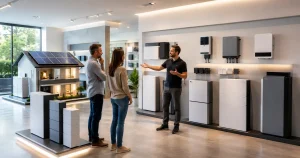
Use four steps:
- Define the objective. Decide whether the system is primarily for backup, solar self-consumption, tariff savings or a combination.
- Measure the loads. Identify essential circuits, large appliances, peak demand and required backup time.
- Compare complete systems. Review usable kWh, continuous and surge kW, certification, efficiency, warranty and expansion limits.
- Compare itemised proposals. Ask qualified installers to separate equipment, electrical work, permits, subscriptions and financing charges.
The best home energy storage system is the one designed around the household’s actual loads and local electricity rules—not necessarily the battery with the largest advertised capacity.
Home Energy Storage Example
Consider a home with rooftop solar, high evening electricity use and several short outages each year.
The homeowner compares three residential energy storage configurations:
| Configuration | Main objective | Likely outcome |
| One smaller battery | Refrigerator, lights, internet and selected outlets | Lower installed cost and longer runtime for a limited group of loads |
| Medium partial-home system | Essential loads plus selected heating or cooling | Greater comfort but faster energy use |
| Multiple-battery whole-home system | Broad household operation | More convenience, higher cost and careful load management |
If the homeowner’s priority is bill savings, the most useful battery size may correspond to the electricity normally purchased during peak-rate hours.
If the priority is outage protection, the design should instead reflect essential loads, expected outage duration and available solar recharge.
The example shows why the best home battery storage configuration cannot be selected from household size or monthly electricity use alone.
Conclusion
Home energy storage can provide backup power, increase solar self-consumption and help households control when they purchase electricity. Its value, however, depends on selecting the right combination of usable capacity, power output, controls and installation design.
Begin with the household’s objective. Identify the appliances that must operate, estimate their energy use and confirm their peak power requirements. Then compare complete home energy storage systems using installed cost, certification, warranty, local tariffs and current incentive rules.
The most effective residential energy storage system is not automatically the largest. It is the one that meets the homeowner’s real priorities without relying on unrealistic runtime or savings assumptions.
Frequently Asked Questions
Can Home Energy Storage Work Without Solar Panels?
Yes. A standalone home battery can charge from the grid and provide backup power or shift electricity use to a different time. Financial value depends on the local tariff and utility rules.
How Long Can a Home Battery Power a House?
Runtime equals usable stored energy divided by the household’s average load. A 10 kWh usable battery supporting an average 1 kW load would theoretically last about 10 hours before accounting for changing demand and conversion losses.
How Many kWh of Battery Storage Does a Home Need?
There is no universal number. Essential-load backup may require considerably less storage than whole-home operation. Calculate the selected loads, required hours, usable capacity and system losses.
Can One Battery Provide Whole-Home Backup?
It may be possible for a low-demand home, but many properties need multiple batteries or active load management. The battery must satisfy both energy and power requirements.
Can a Home Battery Run Central Air Conditioning?
Some systems can, provided their inverter and battery output can handle the operating and starting demand. Running air conditioning can significantly reduce backup duration.
Can a Home Battery Charge During an Outage?
It can recharge from solar during an outage only when the solar, inverter, storage and transfer equipment are configured for islanded operation. Ordinary grid-connected solar panels generally shut down when the grid fails.
How Long Do Residential Batteries Last?
Service life varies by chemistry, operating temperature, charging pattern, throughput and product design. Compare warranty years, warranted energy throughput and retained-capacity terms instead of relying on one general lifespan claim.
Is an LFP Home Battery Safer?
LFP chemistry has characteristics that may make it attractive for stationary storage, but chemistry alone does not establish system safety. Certification, enclosure design, controls and installation remain important.
Does Home Battery Storage Reduce Electricity Bills?
It can reduce bills where stored energy replaces expensive peak-rate electricity or low-value solar exports. Savings may be limited where electricity prices are flat and solar exports receive full retail credit.
Can an Electric Vehicle Provide Home Backup?
Some electric vehicles and charging systems support bidirectional home power, but compatibility depends on the vehicle, charger, electrical equipment, utility rules and manufacturer support.