

If depression or anxiety affects your everyday life, ability to get around or capacity to work, you may be able to claim financial support in the UK.
Depending on your circumstances, benefits for depression and anxiety can include:
- Personal Independence Payment (PIP) If your condition causes long-term difficulties with daily living or mobility
- Universal Credit If you have a low income or your mental health affects your ability to work
- New Style Employment and Support Allowance (ESA) If your health limits your ability to work and you have sufficient National Insurance contributions
- Attendance Allowance If you are State Pension age or older and need care or supervision because of a health condition
- Adult Disability Payment If you live in Scotland and meet the disability-related criteria
- Pension Age Disability Payment If you have reached State Pension age and live in Scotland
- Council Tax Reduction If your income and circumstances meet your local council’s rules
- Housing Support If you need help with eligible rent or housing costs
- Access to Work If you need practical support to stay in or start employment
Having a diagnosis of depression, anxiety or another mental health condition does not automatically mean you will qualify. Each benefit has its own rules, and disability benefits such as PIP focus heavily on how your condition affects your functioning, not simply the name of your diagnosis.
PIP is also different from means-tested benefits. Your earnings and savings do not determine your PIP award, while income and capital can affect Universal Credit and some other financial support.
If you already receive benefits, keeping track of the UK benefits payment schedule can also help you plan around regular payment dates and bank holidays.
Can You Claim Benefits for Depression and Anxiety?
Yes. Depression and anxiety can potentially qualify as health conditions for several UK benefits if their effects meet the relevant eligibility tests.
The important question is usually not simply, “Do you have depression or anxiety?” Instead, the assessment looks at what happens because of your condition.
For example, you may experience difficulty:
- Preparing Food Because poor concentration, low motivation or psychological distress prevents you from doing so reliably
- Eating Regularly Because depression causes loss of appetite and you need encouragement to eat
- Managing Treatment Because you need reminders or support to take medication or follow therapy
- Mixing With People Because severe anxiety causes substantial psychological distress
- Making Journeys Because leaving home or travelling alone causes overwhelming psychological distress
- Managing Money Because your condition significantly affects concentration or decision-making
- Working Reliably Because your symptoms prevent you from sustaining work or work-related activity
Different benefits assess these problems differently. A difficulty that is relevant to PIP does not automatically produce the same result in a Universal Credit Work Capability Assessment.
Can I Claim PIP for Depression and Anxiety?
You may be able to claim PIP for depression and anxiety if your condition causes qualifying difficulties with everyday activities or getting around.
PIP is designed to contribute towards the additional costs associated with long-term disability or health conditions. It is not awarded merely because you have received a medical diagnosis.
For people in England and Wales, the official PIP guidance explains the current claim and eligibility process.
PIP has two components:
- Daily Living For difficulties with specified everyday activities
- Mobility For difficulties planning and following journeys or physically moving around
You can receive one or both components.
PIP Daily Living Activities That Depression or Anxiety May Affect
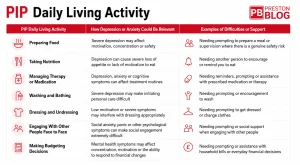
Mental health conditions can affect several PIP daily living activities. The exact points available depend on the descriptor that best reflects the help you need and whether you can complete the activity reliably.
| PIP Daily Living Activity | How Depression or Anxiety Could Be Relevant | Examples of Difficulties or Support |
| Preparing Food | Severe depression may affect motivation, concentration or safety | Needing prompting to prepare a meal or supervision where there is a genuine safety risk |
| Taking Nutrition | Depression can cause severe loss of appetite or lack of motivation to eat | Needing another person to encourage or remind you to eat |
| Managing Therapy or Medication | Depression, anxiety or cognitive symptoms can affect treatment routines | Needing reminders, prompting or assistance with prescribed medication or therapy |
| Washing and Bathing | Severe depression may make initiating personal care difficult | Needing prompting or encouragement to wash |
| Dressing and Undressing | Low motivation or severe symptoms may interfere with dressing appropriately | Needing prompting to get dressed or change clothes |
| Engaging With Other People Face to Face | Social anxiety, panic or other psychological symptoms can make social engagement extremely difficult | Needing prompting or social support when engaging with other people |
| Making Budgeting Decisions | Mental health symptoms may affect concentration, motivation or the ability to respond to financial changes | Needing prompting or assistance with household bills or everyday financial decisions |
The DWP assessment guidance specifically recognises that mental health conditions can be relevant to activities such as managing treatment, engaging with people and making budgeting decisions.
It also notes that depression can affect complex budgeting where the condition prevents someone from responding appropriately to changing financial circumstances.
This does not mean that experiencing one of these symptoms automatically scores PIP points. The difficulty must fit the specific legal descriptor.
Can Anxiety Qualify for the PIP Mobility Component?
Yes. PIP mobility is not limited to physical walking difficulties.
One mobility activity considers your ability to plan and follow journeys. This activity is specifically designed to consider limitations arising from mental health, cognitive and sensory impairments.
Severe anxiety may therefore be relevant if, for example, you cannot undertake a journey because doing so would cause overwhelming psychological distress or you need another person to help you follow a journey.
Simply preferring to travel with someone is not enough. The support must be required because of the effects of your health condition.
The PIP Reliability Rules
When assessing a PIP activity, it is not enough that you can manage it occasionally.
The assessment considers whether you can complete an activity:
- Safely Without an unacceptable risk of harm
- To An Acceptable Standard Well enough for the activity to count as properly completed
- Repeatedly As often as reasonably required
- Within A Reasonable Time Without taking substantially longer than someone without your impairment
These principles are important for depression and anxiety because symptoms can fluctuate. The PIP system considers functional ability across the relevant assessment period rather than judging you only on one particularly good or bad day.
Can You Get PIP If You Work?
Yes. You can work and still receive PIP.
PIP is not an unemployment benefit and is not means-tested. Having a job does not automatically prevent you from qualifying. Your claim is based on how your condition affects the PIP activities.
The Government also introduced regulations in 2026 designed to ensure that simply trying work does not, by itself, trigger a PIP award review. A genuine change in circumstances can still be relevant.
Do Savings Affect PIP?
No. PIP is not affected by your income or savings.
This differs from Universal Credit, where capital and household circumstances can affect entitlement.
The distinction is particularly important when reading about DWP bank account checks and means-tested benefits, as the financial rules applying to Universal Credit should not be confused with PIP eligibility.
PIP Rates in 2026
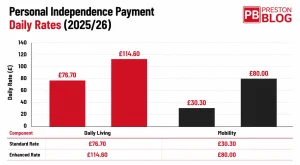
For the 2026 to 2027 financial year, PIP weekly rates are:
| Component | Standard Rate | Enhanced Rate |
| Daily Living | £76.70 | £114.60 |
| Mobility | £30.30 | £80.00 |
PIP is normally paid every four weeks.
Are PIP Rules Changing in 2026?
PIP remains under review, but it is important not to confuse previous proposals with rules that are currently in force.
Earlier government plans included changes to PIP eligibility. Those provisions did not receive sufficient parliamentary support and were removed from the legislation while a wider review of PIP was established.
The Timms Review published its interim report in July 2026 and is considering both daily living and mobility criteria, including activities, descriptors and points. Further recommendations are expected in autumn 2026.
This means claims made in August 2026 should not be assessed as though the previously proposed four-point eligibility restriction has already taken effect.
You can follow the wider background to the DWP PIP reforms in 2026 while checking any future eligibility change against current government guidance before acting on it.
Can I Claim Universal Credit If Depression or Anxiety Stops Me Working?
You may be able to claim Universal Credit if depression, anxiety or another health condition affects your ability to work and you satisfy the normal Universal Credit financial and residency rules.
Universal Credit is means-tested, so your income, savings, partner’s circumstances and household situation can affect what you receive.
Reporting a Mental Health Condition on Universal Credit
If your depression or anxiety limits your ability to work, you should report your health condition through your Universal Credit account.
You may need to provide fit notes and may later be referred for a Work Capability Assessment.
The assessment can result in a finding that you:
- Are Fit For Work
- Have Limited Capability For Work
- Have Limited Capability For Work And Work-Related Activity
What Are LCW and LCWRA?
Limited Capability for Work (LCW) means the assessment has found that your condition limits your ability to work, although you may still be expected to undertake suitable work-related preparation.
Limited Capability for Work and Work-Related Activity (LCWRA) generally means you are not required to look for work or prepare for work because of the level at which your condition affects you.
An LCWRA decision can also result in an additional Universal Credit amount.
Universal Credit Health Element Changes From April 2026
An important change took effect on 6 April 2026.
Universal Credit now has two LCWRA payment rates rather than one.
The higher monthly amount is £429.80, while the lower amount introduced for many new health declarations is £217.26 per month.
You may receive the higher amount if, for example:
- You Reported Your Health Condition Before 6 April 2026
- You Were Already Receiving LCWRA Before 6 April 2026
- You Meet The Severe, Lifelong Condition Criteria
- You Are Nearing The End Of Life
- You Meet Certain Transitional Conditions From ESA
People declaring a condition on or after 6 April 2026 who do not fall into one of the protected categories may receive the lower LCWRA amount if they are subsequently found to have LCWRA.
This is one reason older mental health benefit guides can now give misleading figures.
The wider transition from older income-related benefits is also continuing, so anyone who has received a migration notice should understand the process of moving to Universal Credit rather than assuming an existing legacy claim will continue indefinitely.
Can You Work While Getting Universal Credit for a Mental Health Condition?
Yes, depending on your circumstances.
An LCW or LCWRA decision does not necessarily mean you are prohibited from working. GOV.UK states that someone with LCWRA can work if they feel able to do so.
Your earnings may affect the amount of Universal Credit you receive.
This is different from PIP, where earnings themselves do not reduce the award.
Can I Claim ESA for Depression and Anxiety?
New Style Employment and Support Allowance may be available if depression, anxiety or another health condition limits your ability to work.
Unlike Universal Credit, New Style ESA is primarily contribution-based.
What Is New Style ESA?
New Style ESA is a fortnightly benefit for people whose health condition or disability limits their ability to work.
To qualify, you normally need to have paid or been credited with sufficient National Insurance contributions, usually during the relevant previous tax years.
The same principle can apply to mental health conditions as physical conditions. What matters is whether your health affects your ability to work and whether you meet the other qualifying rules.
National Insurance Contribution Rules
New Style ESA normally requires you to have:
- Worked As An Employee Or Been Self-Employed
- Paid Or Been Credited With Enough National Insurance Contributions
- Met The Health-Related Eligibility Conditions
During the assessment phase in 2026 to 2027, the maximum basic weekly rate is £75.65 if you are under 25 and £95.55 if you are 25 or over. A support component may be added after assessment for people placed in the support group.
Can You Claim ESA and Universal Credit Together?
You can potentially claim New Style ESA and Universal Credit at the same time if you meet the conditions for both.
However, this does not normally mean receiving the full amount of both benefits on top of each other.
GOV.UK states that New Style ESA paid to you is deducted from your Universal Credit by the same amount.
What If You Are Receiving Statutory Sick Pay?
You cannot normally receive New Style ESA while your employer is paying you Statutory Sick Pay.
You can, however, apply for New Style ESA up to three months before your SSP is due to end. If you qualify, ESA can begin after SSP finishes.
What Mental Health Benefits Can You Claim If You Are Over State Pension Age?
If you have reached State Pension age, Attendance Allowance may be relevant if depression, anxiety or another health condition means you need care, help or supervision.
Attendance Allowance is available for physical disabilities, mental disabilities and health conditions.
For 2026 to 2027, it is paid at either £76.70 or £114.60 per week, depending on the level of support you need. It does not include a separate mobility component.
You do not have to have a person formally caring for you to qualify.
Receiving Attendance Allowance can also potentially increase entitlement to other support such as Pension Credit, Housing Benefit or Council Tax Reduction, depending on your circumstances.
Older households should therefore check their overall entitlement rather than looking only at one payment. Research into benefits pensioners may be missing highlights why reviewing multiple forms of support can be worthwhile.
What If You Live in Scotland?
New applications for pension-age disability support in Scotland use Pension Age Disability Payment rather than Attendance Allowance.
If you already receive Adult Disability Payment when you reach State Pension age, different continuation rules can apply.
Benefits for Depression and Anxiety in Scotland
The disability benefit system is different in Scotland.
If you are an eligible working-age adult living in Scotland, Adult Disability Payment (ADP) is the main disability payment instead of making a new PIP claim through the normal DWP route.
You can check the Scottish Government’s Adult Disability Payment guidance for current application rules.
Adult Disability Payment contains:
- A Daily Living Part
- A Mobility Part
Like PIP, Adult Disability Payment is not means-tested. Your employment, income and savings do not determine whether you can receive it.
Mental health difficulties can potentially be relevant to activities including preparing food, managing treatment, engaging socially, making budgeting decisions and planning or following journeys.
For 2026 to 2027, ADP rates are £76.70 or £114.60 for daily living and £30.30 or £80 for mobility, depending on whether you receive the standard or enhanced level.
Pension Age Disability Payment
Pension Age Disability Payment has replaced Attendance Allowance for new claims in Scotland.
It is not means-tested, and your income and savings do not affect an award.
What Benefits Can You Claim for Depression and Anxiety in Northern Ireland?
People in Northern Ireland can also receive disability and incapacity-related benefits for mental health conditions, but claims are administered through Northern Ireland’s own social security system.
PIP is available in Northern Ireland and is administered by the Department for Communities rather than the DWP.
The Northern Ireland PIP service confirms that the 2026 to 2027 weekly PIP rates are the same £76.70 and £114.60 daily living rates and £30.30 and £80 mobility rates.
New Style ESA can also be available in Northern Ireland where a health condition affects how much you can work and the relevant National Insurance requirements are satisfied.
Because administration and application routes differ, Northern Ireland residents should follow Department for Communities and NI Direct instructions rather than using an England or Wales application route.
Start with what your mental health actually affects
Depression or anxiety does not automatically qualify someone for a benefit. The important question is how the condition affects daily living, journeys, work and other parts of everyday life.
Pick the difficulty that best matches
Select one area to see which type of support the article says may be relevant.
Change one circumstance
These situations can point readers towards different forms of support, even when the underlying condition is the same.
Can You Claim More Than One Mental Health Benefit at the Same Time?
Yes. Depending on your circumstances, you may qualify for more than one type of support.
For example, you could potentially receive PIP alongside Universal Credit because the benefits assess different things.
PIP looks primarily at disability-related daily living and mobility difficulties. Universal Credit considers your household finances and, where relevant, your capability for work.
You may also potentially receive PIP alongside New Style ESA.
PIP and Universal Credit
- Receiving PIP does not automatically mean you qualify for LCWRA.
- Likewise, being found to have LCWRA does not automatically qualify you for PIP.
- The assessments use different rules.
PIP and New Style ESA
- PIP can potentially be paid alongside New Style ESA because PIP is designed around additional disability-related needs while ESA focuses on capability for work and contribution conditions.
How One Benefit May Affect Another?
- Although some benefits can be claimed together, receiving one payment can sometimes change another part of your benefit entitlement.
- This is why checking your full household circumstances is important.
- GOV.UK lists free and anonymous benefits calculators that can estimate what benefits you may be entitled to, how much you could receive and how employment or changing circumstances might affect payments.
What Other Financial Help Can You Get for Depression and Anxiety?
The benefits system is not limited to PIP, Universal Credit and ESA.
Depending on your income, housing circumstances, employment and local authority, additional financial help may be available.
Council Tax Reduction
- Council Tax Reduction can reduce your council tax bill if you meet your local authority’s eligibility rules.
- Schemes vary between councils, so you need to apply to the council responsible for your area.
- Help With Rent and Housing Costs
- Universal Credit can include an amount towards eligible housing costs.
- If your benefit does not cover your full eligible rent and you meet the conditions, your council may also offer Discretionary Housing Payments in some circumstances.
Statutory Sick Pay
- If you are employed and unable to work because of depression, anxiety or another health condition, you may qualify for Statutory Sick Pay before moving to other health-related benefits.
Access to Work
- If you can work but need additional help because of your mental health, Access to Work may provide practical employment support.
- Mental health support through employment schemes is different from disability benefit entitlement. Receiving workplace support does not necessarily determine whether you qualify for PIP or Universal Credit.
Local Welfare and Cost-of-Living Support
Local authorities may offer additional assistance such as:
- Council Tax Reduction
- Discretionary Housing Payments
- Local Welfare Assistance
- Household Support
Available programmes and eligibility can change, so current cost-of-living support in 2026 should be checked against your local authority’s rules rather than assuming a widely reported payment applies to everyone.
What Evidence Can Help a Mental Health Benefits Claim?
Good evidence helps explain the functional effect of your depression or anxiety.
A diagnosis can support your claim, but evidence showing what happens in everyday life is particularly important.
Useful evidence may include:
- GP Records Showing your condition, symptoms and treatment history
- Psychiatrist Or Psychologist Reports Where you have received specialist care
- Community Mental Health Team Evidence Explaining ongoing support or difficulties
- Medication Records Showing prescribed treatment and changes
- Therapy Information Showing counselling, CBT or other treatment
- Care Plans Where one is in place
- Supporting Statements From someone familiar with the help you need
- Appointment Records Where they demonstrate the impact of your condition
Your evidence should relate to the difficulties you are actually claiming for.
For example, a letter confirming an anxiety diagnosis may be useful, but evidence explaining why you cannot make unfamiliar journeys alone can be more directly relevant to a PIP mobility claim.
Keeping a Mental Health Diary
A short diary can help show how often your difficulties happen.
You could record:
- Meals You Missed Because you could not motivate yourself to prepare or eat food
- Medication You Needed Reminding To Take
- Journeys You Could Not Complete
- Appointments You Cancelled Because Of Anxiety
- Times You Needed Support To Speak To Other People
- Days You Could Not Manage Personal Care
- Help You Needed With Bills Or Everyday Decisions
Be accurate. Do not exaggerate symptoms and do not minimise genuine problems simply because you occasionally manage an activity.
How to Describe Depression and Anxiety on a Benefits Form?
Focus on what happens when you try to complete an activity rather than repeatedly stating your diagnosis.
- Explain The Difficulty Describe exactly what goes wrong
- Give Real Examples Use recent situations where possible
- State How Often It Happens Explain whether the problem occurs most days or fluctuates
- Describe The Help You Need Include prompting, supervision or assistance
- Explain Reliability Say if you cannot complete the task safely, repeatedly, adequately or within a reasonable time
What Should You Do If Your Mental Health Benefit Claim Is Refused?
A refusal does not necessarily mean you have reached the end of the process.
Read the decision carefully and compare the reasons given with the evidence you provided.
For DWP benefits such as PIP, you can normally ask for the decision to be looked at again through a Mandatory Reconsideration before appealing to a tribunal.
New Style ESA also allows you to request a Mandatory Reconsideration if you disagree with the decision.
The process differs in Scotland, where Social Security Scotland uses re-determinations and appeals.
When challenging a decision:
- Check The Deadline Do not assume you have unlimited time
- Read The Reasons Identify which activities or criteria were disputed
- Provide Relevant Evidence Focus on evidence that addresses the disputed point
- Use Specific Examples Explain what actually happens when you attempt the activity
- Keep Copies Retain forms, letters and supporting documents
- Consider Welfare Rights Advice Particularly if the claim involves complex evidence or an appeal
How to Check Which Benefits You Can Claim?
Start by separating the different types of help you may need.
Identify What Your Mental Health Is Affecting?
Ask whether your main difficulties involve:
- Daily Living
- Leaving Home Or Making Journeys
- Working
- Household Income
- Housing Costs
- Personal Care
- Employment Support
You may need to explore more than one benefit.
Check Which UK Benefits System Applies
- Your location matters.
- England and Wales use DWP-administered PIP.
- Scotland uses Adult Disability Payment for new working-age disability claims.
- Northern Ireland has its own administration through the Department for Communities.
Check Your Financial Circumstances
For means-tested support such as Universal Credit, check:
- Your Earnings
- Your Partner’s Earnings
- Your Savings And Capital
- Your Housing Costs
- Your Household Circumstances
These factors do not determine PIP entitlement.
Gather Evidence Before You Apply
- Collect documents that demonstrate both your condition and its practical effects.
- You do not necessarily need every piece of evidence before starting a claim, but keeping your information organised can make it easier to explain your needs consistently.
Conclusion: What Benefits Can I Claim for Depression and Anxiety in the UK?
If you are asking what benefits can I claim for depression and anxiety in the UK, the answer depends on how your mental health affects your daily life, mobility, ability to work, finances, age and place of residence.
PIP may be available if depression or anxiety causes qualifying daily living or mobility difficulties. It is not means-tested, which means working or having savings does not automatically prevent you from receiving it.
Universal Credit may provide support if you are on a low income or your mental health limits your ability to work. Since 6 April 2026, different LCWRA rates can apply depending on when your health condition was declared and whether you fall within protected categories.
New Style ESA may be another option if your ability to work is limited and you have sufficient National Insurance contributions.
If you have reached State Pension age, Attendance Allowance may be relevant in England and Wales, while Scotland uses Pension Age Disability Payment. Working-age adults in Scotland generally claim Adult Disability Payment rather than PIP.
Do not assume that a mental health diagnosis either guarantees an award or prevents you from claiming. The strongest starting point is to identify exactly how depression or anxiety affects you, check the correct benefit rules for your part of the UK and provide accurate evidence of the support you need.
Frequently Asked Questions
Can I Claim PIP for Depression and Anxiety in the UK?
Yes, you may qualify if depression or anxiety causes long-term difficulties with qualifying daily living or mobility activities. PIP is based on how your condition affects you rather than the diagnosis alone.
How Much PIP Can You Get for Depression and Anxiety?
For 2026 to 2027, the daily living component is £76.70 a week at the standard rate or £114.60 at the enhanced rate. The mobility component is £30.30 at the standard rate or £80 at the enhanced rate.
Do I Need a Diagnosis to Claim PIP for Mental Health Problems?
A diagnosis can provide useful evidence, but PIP focuses on the functional effects of your health condition. Your evidence should explain the difficulties you experience with the relevant activities and the help you need.
Can I Claim Universal Credit If Anxiety or Depression Stops Me Working?
Potentially. If you meet the normal Universal Credit conditions, you can report your mental health condition and may undergo a Work Capability Assessment. An LCWRA decision can provide additional financial support and remove requirements to look for or prepare for work.
Can I Get PIP and Universal Credit at the Same Time?
Yes. It is possible to receive both because they assess different things. PIP is a non-means-tested disability benefit, while Universal Credit is means-tested and can include health-related support.
Can I Work and Still Claim PIP for Depression or Anxiety?
Yes. PIP can be paid whether you are working or not. Your employment may be considered alongside other evidence if it appears relevant to the activities you say you cannot perform, but employment itself does not automatically prevent an award.
What Evidence Do I Need for a Depression or Anxiety Benefits Claim?
Useful evidence can include medical records, treatment information, medication records, mental health team reports, supporting statements and examples showing how your symptoms affect everyday activities or your ability to work.
The most useful evidence usually connects your condition directly to the eligibility criteria of the benefit you are claiming.